Introduction
Research design is one of the most important aspects of scientific research because it provides a structured plan for conducting a study. It acts as a blueprint that guides researchers from the formulation of research questions to the collection, analysis, and interpretation of data. A well-designed research study ensures that the findings are valid, reliable, and capable of answering the research objectives effectively.
In the social sciences, research design is widely used in sociology, psychology, anthropology, political science, education, economics, and public health. It helps researchers organize every stage of the research process systematically while minimizing bias and maximizing the accuracy of results.
The choice of an appropriate research design depends on the research problem, objectives, available resources, and the type of data required. Selecting the right design allows researchers to collect meaningful evidence and draw logical conclusions.

Definition of Research Design
Different scholars have defined research design from different perspectives.
According to John W. Creswell, research design is the specific plan or procedure that connects the philosophical assumptions of a study with methods for collecting, analyzing, and interpreting data.
According to C. R. Kothari, research design is the arrangement of conditions for collecting and analyzing data in a manner that combines relevance to the research purpose with economy in procedure.
According to Earl Babbie, research design is a strategy for answering research questions by integrating various components of the research process logically and systematically.
In simple words, research design is the overall plan that determines how a researcher will conduct a study to answer specific research questions accurately and efficiently.
Characteristics of a Good Research Design
A good research design is systematic because it follows a logical sequence from problem identification to data analysis.
It is objective because it minimizes personal bias and ensures that findings are based on evidence rather than opinions.
A good research design is flexible enough to accommodate necessary adjustments while maintaining scientific rigor.
It ensures validity by accurately measuring what the researcher intends to measure and reliability by producing consistent results when repeated.
Another important characteristic is feasibility. A research design should be practical, considering available time, budget, and resources.
Objectives of Research Design
The primary objective of research design is to provide a clear roadmap for conducting research.
It helps researchers collect accurate and relevant data to answer research questions.
Research design reduces errors and bias during data collection and analysis.
It ensures efficient use of time, financial resources, and human effort.
It also improves the reliability and validity of research findings and facilitates meaningful interpretation of results.
Components of Research Design
Research design consists of several important components that work together throughout the research process.
The research problem defines the issue or phenomenon to be investigated.
Research objectives specify what the researcher intends to achieve through the study.
Research questions and hypotheses provide direction for data collection and analysis.
The target population identifies the individuals or groups from whom data will be collected.
Sampling techniques determine how participants will be selected.
Data collection methods specify whether surveys, interviews, observations, experiments, or other techniques will be used.
Data analysis procedures explain how the collected information will be organized and interpreted.
Ethical considerations ensure that participants’ rights, confidentiality, and well-being are protected throughout the research process.
Types of Research Design
Exploratory Research Design
Exploratory research design is used when little information exists about a research problem.
Its primary purpose is to gain initial understanding, identify new ideas, and develop research questions or hypotheses for future studies.
Researchers often use literature reviews, interviews, focus groups, and observations in exploratory research.
Descriptive Research Design
Descriptive research design aims to describe the characteristics of individuals, groups, situations, or phenomena.
It answers questions such as who, what, when, where, and how.
Surveys, questionnaires, and observational studies are commonly used in descriptive research.
Explanatory Research Design
Explanatory research design seeks to explain why relationships exist between variables.
Researchers investigate causes, effects, and underlying mechanisms that influence social phenomena.
This design is widely used for hypothesis testing.
Experimental Research Design
Experimental research design examines cause-and-effect relationships by manipulating independent variables while controlling other factors.
Participants are usually assigned to experimental and control groups.
Experiments provide strong evidence for establishing causal relationships.
Quasi-Experimental Research Design
Quasi-experimental design resembles experimental research but lacks complete random assignment of participants.
It is commonly used in educational institutions, healthcare settings, and community-based research where true experiments may not be feasible.
Correlational Research Design
Correlational research design investigates the relationship between two or more variables without manipulating them.
Researchers use statistical techniques to determine the strength and direction of relationships.
For example, a study may examine the relationship between education level and employment opportunities.
Cross-Sectional Research Design
Cross-sectional research collects data from participants at a single point in time.
It is useful for studying current opinions, behaviors, or social conditions.
Most opinion polls and social surveys follow a cross-sectional design.
Longitudinal Research Design
Longitudinal research follows the same participants over an extended period.
It helps researchers examine changes and developments over time.
Longitudinal studies are valuable for understanding social change, human development, and long-term trends.
Case Study Research Design
Case study research involves an in-depth examination of a single individual, organization, institution, event, or community.
Researchers gather detailed information using multiple sources such as interviews, observations, and documents.
Case studies provide rich insights into complex social phenomena.
Qualitative, Quantitative, and Mixed-Methods Designs
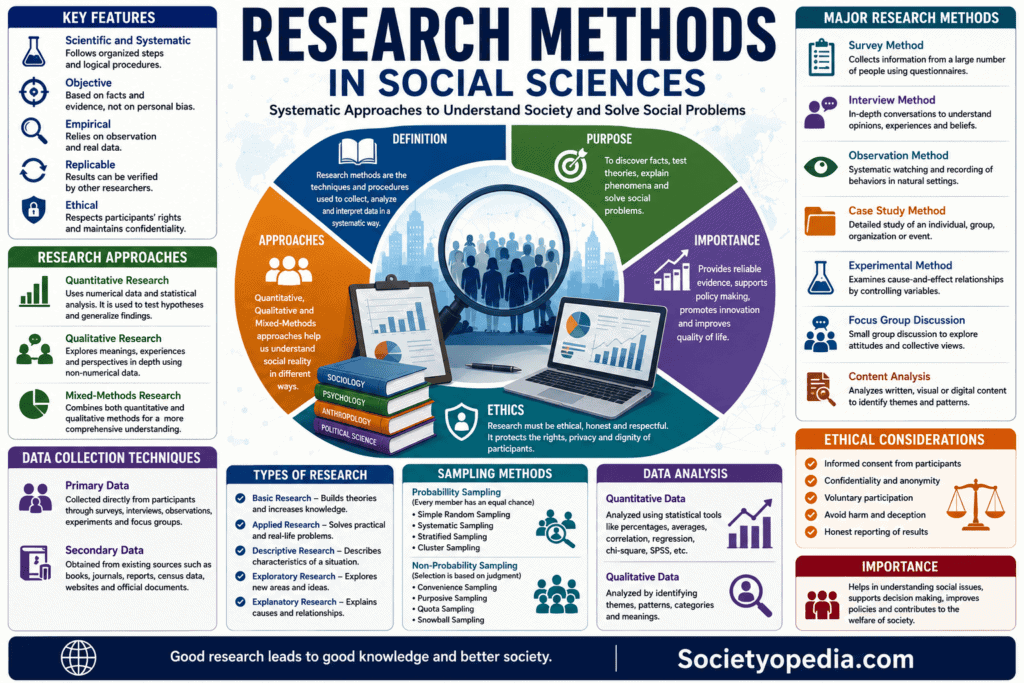
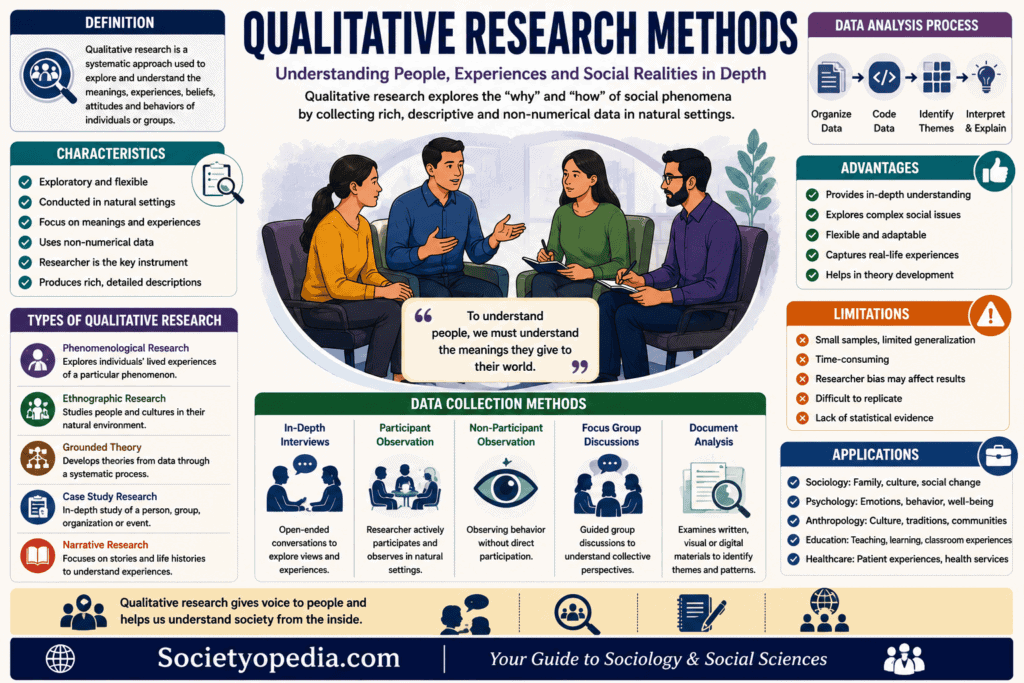
Qualitative research designs focus on understanding meanings, experiences, beliefs, and behaviors using interviews, observations, ethnography, and case studies.
Quantitative research designs focus on numerical measurement, hypothesis testing, and statistical analysis through surveys and experiments.
Mixed-methods research designs combine qualitative and quantitative approaches to provide a more comprehensive understanding of research problems.
Factors Influencing the Choice of Research Design
The research problem is one of the most important factors determining the choice of research design.
Research objectives influence whether descriptive, exploratory, explanatory, or experimental designs are appropriate.
Availability of time, budget, and resources also affects design selection.
The nature of the target population, accessibility of participants, and ethical considerations further influence the choice of research design.
Importance of Research Design
Research design provides a systematic framework for conducting scientific research.
It improves the quality and credibility of research findings.
A well-designed study reduces bias and minimizes errors during data collection and analysis.
Research design helps researchers use resources efficiently and avoid unnecessary duplication of effort.
It facilitates accurate interpretation of findings and strengthens the validity and reliability of conclusions.
Research design also supports evidence-based decision-making in education, healthcare, public administration, business, and policymaking.
Research Methods in Social Sciences: Definition, Types, Approaches, Techniques and Importance
Advantages of a Good Research Design
A good research design improves research efficiency by organizing every stage of the investigation.
It enhances the validity and reliability of findings.
The design reduces research bias and improves objectivity.
It provides clear guidance for data collection, analysis, and interpretation.
Well-designed studies produce findings that are more useful for theory development and practical applications.
Limitations of Research Design
Selecting an inappropriate research design may produce inaccurate or misleading conclusions.
Some research designs require significant financial resources and considerable time to implement.
Complex research designs may demand advanced methodological and statistical expertise.
Ethical restrictions may limit the use of certain experimental or observational designs in social research.
Unforeseen circumstances such as participant dropout or limited access to populations may affect the successful implementation of the chosen design.
Applications of Research Design in Social Sciences
Research design is widely used in sociology to study poverty, education, family, crime, migration, social inequality, and cultural change.
Psychologists use research design to investigate behavior, cognition, and mental health.
Educational researchers use different research designs to evaluate teaching methods, learning outcomes, and educational policies.
Political scientists study elections, governance, public opinion, and policymaking through various research designs.
Healthcare researchers apply research designs to evaluate treatment effectiveness, disease prevention, healthcare delivery, and public health interventions.
Conclusion
Research design is the foundation of every successful research study because it provides a systematic and scientific framework for collecting, analyzing, and interpreting data. It ensures that research objectives are achieved efficiently while maintaining accuracy, reliability, and validity.
Whether conducting exploratory, descriptive, explanatory, experimental, or mixed-methods research, selecting an appropriate research design enables researchers to answer important questions, test theories, and contribute meaningful knowledge to the social sciences. A carefully planned research design not only improves the quality of research but also supports informed decision-making, evidence-based policy development, and academic advancement.