Introduction
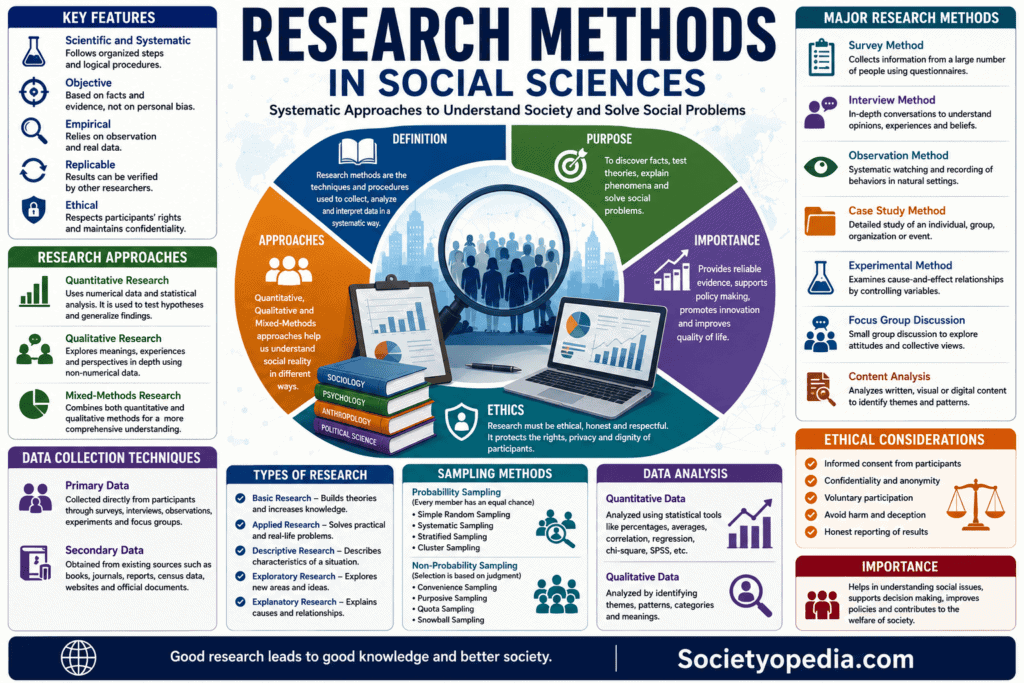
Quantitative research is one of the most widely used research approaches in the social sciences. It focuses on collecting numerical data and analyzing it using statistical techniques to understand relationships between variables, test hypotheses, measure trends, and make generalizations about populations. Unlike qualitative research, which explores meanings and experiences, quantitative research emphasizes objectivity, precision, and measurement.
Researchers in sociology, psychology, economics, political science, education, public health, and other social science disciplines use quantitative research to examine social phenomena scientifically. By using structured research designs, standardized instruments, and statistical analysis, quantitative research produces reliable and replicable findings that can support decision-making, policy formulation, and theory testing.
Definition of Quantitative Research
Different scholars have defined quantitative research from different perspectives.
According to John W. Creswell, quantitative research is an approach for testing objective theories by examining the relationship among variables, which can be measured and analyzed using statistical procedures.
According to Earl Babbie, quantitative research is the systematic investigation of social phenomena through numerical data and statistical analysis.
According to C. R. Kothari, quantitative research involves the measurement of quantities or amounts and is applicable to phenomena that can be expressed numerically.
In simple words, quantitative research is a scientific method that uses numbers, measurements, and statistical techniques to study social problems and answer research questions.
Characteristics of Quantitative Research
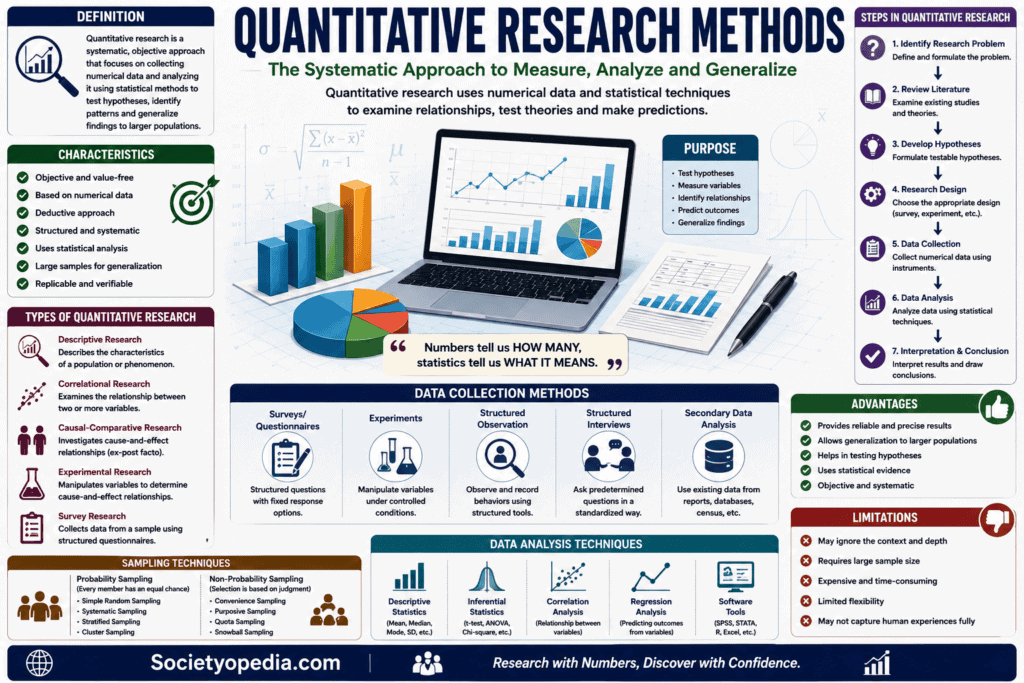
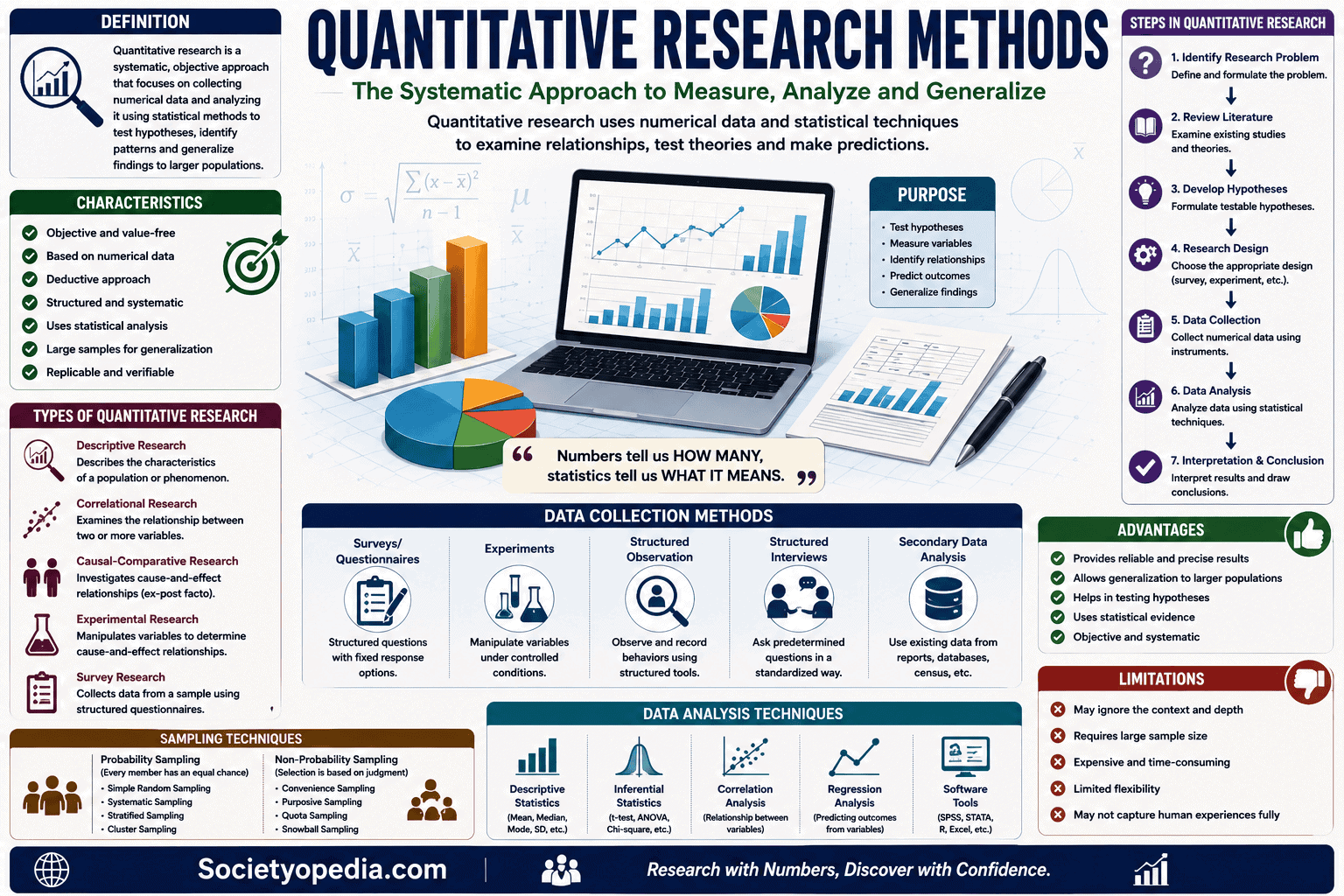
Quantitative research is objective because researchers minimize personal opinions and biases during data collection and analysis. It follows a systematic process where every step, from research design to data interpretation, is carefully planned.
The approach relies on numerical data that can be measured and analyzed statistically. It uses structured research instruments such as questionnaires, surveys, tests, and experiments to ensure consistency.
Quantitative research is deductive in nature because it often begins with an existing theory or hypothesis that is tested using empirical evidence. It also aims to produce findings that can be generalized to larger populations when appropriate sampling techniques are used.
Another important characteristic is reliability. Since standardized procedures are followed, other researchers can replicate the study to verify the results.
Objectives of Quantitative Research
The primary objective of quantitative research is to measure social phenomena accurately and objectively.
It seeks to test hypotheses and determine relationships between variables through statistical analysis.
Quantitative research also aims to identify trends, patterns, and differences within populations.
Researchers use this approach to make predictions, evaluate programs, compare groups, and provide evidence for policy development.
Types of Quantitative Research
Descriptive Research
Descriptive research describes the characteristics of individuals, groups, or situations without determining cause-and-effect relationships.
Researchers use descriptive studies to answer questions such as who, what, when, where, and how much.
Examples include population surveys, census reports, and demographic studies.
Correlational Research
Correlational research examines the relationship between two or more variables without manipulating them.
Researchers use statistical techniques such as correlation coefficients to determine whether variables are positively related, negatively related, or unrelated.
For example, a sociologist may examine the relationship between education level and income.
Experimental Research
Experimental research investigates cause-and-effect relationships by manipulating one variable while controlling others.
Participants are usually divided into experimental and control groups. Researchers then compare outcomes to determine whether the independent variable influences the dependent variable.
Experimental research is common in psychology, education, and health sciences.
Quasi-Experimental Research
Quasi-experimental research is similar to experimental research but lacks complete random assignment of participants.
It is often used in educational and social settings where true experiments are difficult or unethical to conduct.
Causal-Comparative Research
Causal-comparative research examines possible cause-and-effect relationships by comparing existing groups.
Unlike experiments, researchers do not manipulate variables but analyze differences that already exist.
Research Process in Quantitative Research
Quantitative research follows a systematic process.
The researcher first identifies a research problem and reviews relevant literature. Based on previous studies, research objectives and hypotheses are developed.
Next, an appropriate research design is selected, followed by the selection of participants through suitable sampling techniques.
Data are collected using standardized instruments such as questionnaires or experiments.
The collected data are analyzed statistically, interpreted carefully, and finally presented in the form of tables, graphs, and conclusions.
Data Collection Methods
Survey Method
The survey method is the most common technique used in quantitative research. Researchers distribute structured questionnaires containing closed-ended questions to collect information from large populations.
Surveys are widely used to study public opinion, education, employment, health, political attitudes, and social behavior.
Structured Interviews
Structured interviews involve asking every participant the same set of predetermined questions.
This method ensures consistency and makes responses easier to compare statistically.
Observation
Structured observation involves recording specific behaviors using standardized observation schedules.
Researchers quantify observed behaviors and analyze them statistically.
Experiments
Experiments involve manipulating independent variables while controlling other factors to determine their effects on dependent variables.
Experiments provide strong evidence for establishing causal relationships.
Secondary Data Analysis
Researchers also use existing numerical data collected by governments, research organizations, international agencies, and census departments.
Examples include census reports, labor force surveys, health statistics, and educational databases.
Sampling Methods
Sampling is the process of selecting participants from a larger population.
Probability sampling gives every member of the population an equal chance of being selected.
Simple random sampling selects participants entirely by chance.
Systematic sampling selects every nth participant from a population list.
Stratified sampling divides the population into different groups and selects participants from each group proportionally.
Cluster sampling selects entire groups or clusters rather than individual participants.
Non-probability sampling may also be used in some quantitative studies when probability sampling is not feasible. Common methods include convenience sampling, purposive sampling, quota sampling, and snowball sampling.
Variables in Quantitative Research
Variables are measurable characteristics that researchers study.
The independent variable is the factor that influences or predicts changes.
The dependent variable is the outcome that researchers measure.
Control variables are factors that are kept constant to reduce unwanted influences.
For example, in a study examining the effect of education on income, education is the independent variable while income is the dependent variable.
Measurement Scales
Quantitative research uses different measurement scales to classify and analyze data.
Nominal scales categorize data without any specific order, such as gender or religion.
Ordinal scales arrange data in a meaningful order, such as satisfaction levels.
Interval scales measure equal distances between values but have no true zero point, such as temperature measured in Celsius.
Ratio scales have equal intervals and a true zero point, such as age, income, weight, and height.
Data Analysis Techniques
After data collection, researchers organize and analyze the information using statistical methods.
Descriptive statistics summarize data through frequencies, percentages, means, medians, modes, and standard deviations.
Inferential statistics allow researchers to make conclusions about populations based on sample data.
Common inferential techniques include t-tests, chi-square tests, analysis of variance (ANOVA), correlation analysis, regression analysis, and confidence intervals.
Researchers frequently use statistical software such as IBM SPSS Statistics, R, Stata, and Microsoft Excel for quantitative data analysis.
Advantages of Quantitative Research
Quantitative research provides accurate and objective measurements through numerical data.
It allows researchers to analyze large populations and generalize findings when appropriate sampling methods are used.
The approach is highly reliable because standardized procedures can be replicated by other researchers.
Statistical analysis enables researchers to identify relationships, trends, and patterns with greater precision.
Quantitative research also supports evidence-based policymaking and informed decision-making in education, healthcare, economics, and public administration.
Limitations of Quantitative Research
One limitation is that quantitative research focuses mainly on numerical data and may overlook participants’ personal experiences and emotions.
It often requires large sample sizes to achieve reliable statistical results.
Designing surveys, collecting data, and performing statistical analysis can be time-consuming and expensive.
Closed-ended questionnaires may limit participants’ responses and fail to capture complex social realities.
Some important social phenomena cannot be fully understood through numerical measurements alone.
Ethical Considerations in Quantitative Research
Researchers must obtain informed consent from participants before collecting data.
Confidentiality and anonymity should be maintained to protect participants’ personal information.
Researchers must avoid manipulating data or reporting misleading results.
All findings should be presented honestly and accurately while respecting participants’ rights and dignity.
Applications of Quantitative Research in Social Sciences
Quantitative research is widely used in sociology to study poverty, crime, education, family structures, social mobility, migration, and public opinion.
In psychology, researchers use quantitative methods to measure behavior, intelligence, mental health, and personality.
Economists use quantitative research to analyze employment, inflation, economic growth, and consumer behavior.
Political scientists study elections, voting patterns, governance, and public policies using quantitative techniques.
Healthcare researchers use quantitative methods to evaluate disease prevalence, treatment outcomes, healthcare services, and public health interventions.
Difference Between Quantitative and Qualitative Research
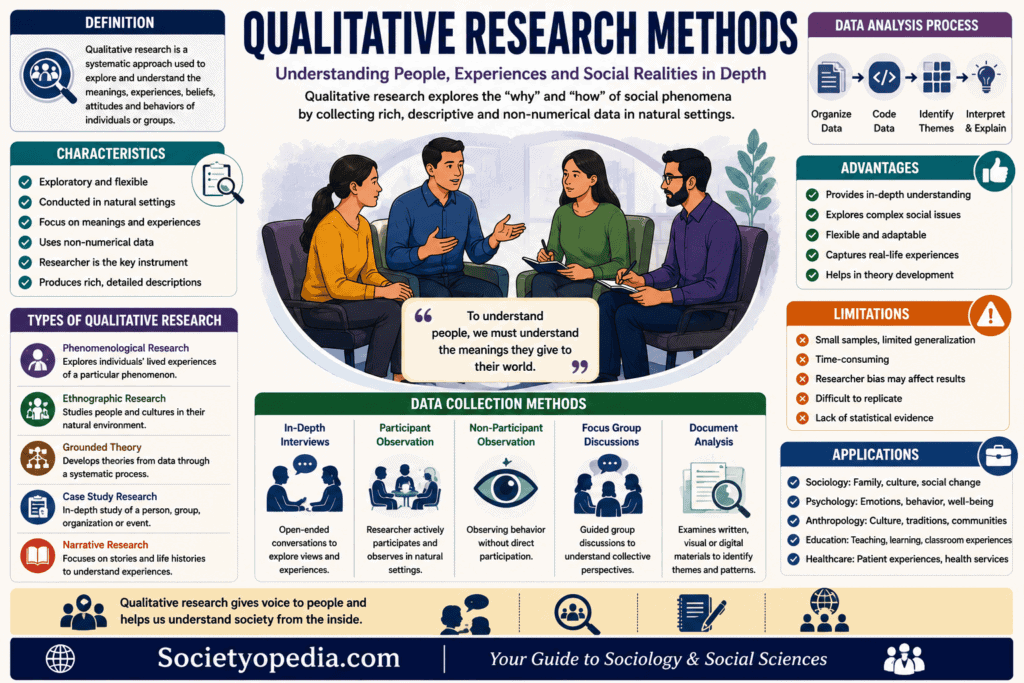
Quantitative research focuses on numerical data, statistical analysis, and hypothesis testing, whereas qualitative research focuses on meanings, experiences, and detailed descriptions.
Quantitative studies generally use large samples, while qualitative studies often involve smaller samples selected for in-depth exploration.
Quantitative research uses structured questionnaires and experiments, whereas qualitative research relies on interviews, observations, and focus group discussions.
Quantitative research aims to measure and generalize findings, while qualitative research aims to understand and interpret human experiences.
Conclusion
Quantitative research methods provide a scientific and systematic approach to studying social phenomena through numerical measurement and statistical analysis. By using structured research designs, standardized instruments, probability sampling, and statistical techniques, researchers can test theories, examine relationships between variables, and generate reliable evidence.
Although quantitative research has limitations in understanding the deeper meanings behind human behavior, its objectivity, precision, reliability, and ability to generalize findings make it one of the most important research approaches in sociology and other social sciences. When combined with qualitative methods, quantitative research contributes to a more comprehensive understanding of society and supports informed decision-making in research, policy, and practice.