Introduction
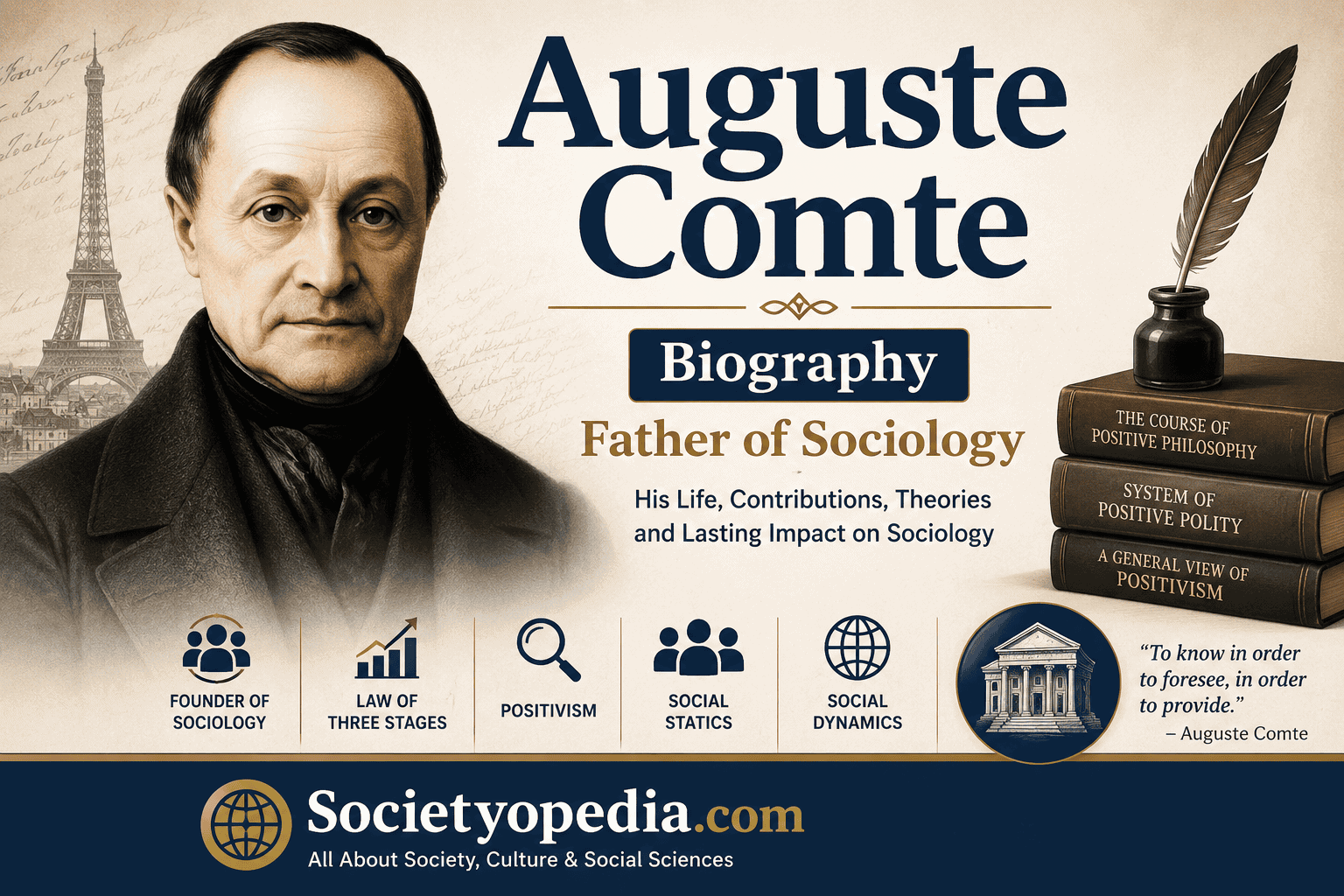
Auguste Comte (1798–1857) was a French philosopher, social thinker, and one of the most influential intellectuals of the nineteenth century. He is widely recognized as the Father of Sociology because he was the first scholar to establish sociology as a distinct scientific discipline. Comte believed that society should be studied using scientific observation and empirical methods rather than speculation or religious beliefs. His ideas laid the foundation for modern sociology and introduced the philosophy of positivism, which continues to influence social science research today.
Through his famous Law of Three Stages, Comte explained how human thought and civilization evolve from religious explanations to philosophical reasoning and finally to scientific understanding. His work transformed the way scholars study society and remains an essential part of sociology, anthropology, political science, and research methodology courses worldwide.
Early Life and Education
Auguste Comte was born on January 19, 1798, in Montpellier, France, into a conservative Catholic family. Although his parents strongly supported monarchy and religion, Comte developed independent intellectual interests at an early age and gradually rejected traditional religious beliefs.
He attended the prestigious École Polytechnique in Paris, one of France’s leading institutions for mathematics and science. Although political events temporarily disrupted his education, the rigorous scientific environment deeply influenced his thinking and convinced him that scientific methods could also be applied to the study of society.
Career and Intellectual Development
After completing his studies, Comte worked as a secretary and collaborator with the French social reformer Henri de Saint-Simon. Saint-Simon’s ideas about social organization greatly influenced Comte’s early thinking. However, disagreements over intellectual ownership eventually led the two thinkers to part ways.
Comte devoted the rest of his life to developing a new science of society. He argued that social phenomena should be examined objectively through observation, classification, and comparison, just as natural scientists study the physical world.
His vision was ambitious: to create a scientific discipline capable of understanding society and solving social problems.
Why Is Auguste Comte Called the Father of Sociology?
Auguste Comte earned the title “Father of Sociology” because he was the first scholar to formally define sociology as an independent academic discipline. He introduced the term “Sociology” by combining the Latin word socius (companion or society) with the Greek word logos (study).
Comte believed that societies operate according to discoverable laws, just as nature does. Therefore, he argued that society could be studied scientifically using observation, experimentation where possible, and systematic analysis.
His approach shifted the study of society away from philosophy and theology toward evidence-based research, establishing the foundations of modern sociological inquiry.
Major Contributions of Auguste Comte
1. Founder of Sociology
Comte established sociology as a separate scientific discipline dedicated to understanding human society, social institutions, and social change.
2. Positivism
One of Comte’s greatest contributions was the development of Positivism. Positivism argues that genuine knowledge should be based on observable facts, scientific evidence, and empirical research rather than intuition, speculation, or supernatural beliefs.
This philosophy became one of the most influential approaches in sociology and social research.
3. Law of Three Stages
Comte’s most famous theory is the Law of Three Stages, which explains that human thinking develops through three intellectual phases:
- Theological Stage
- Metaphysical Stage
- Positive (Scientific) Stage
According to Comte, humanity gradually progresses toward scientific reasoning and evidence-based knowledge.
4. Social Statics and Social Dynamics
Comte divided sociology into two major branches:
Social Statics
Social statics studies the factors that maintain order and stability within society, including institutions such as family, religion, education, and government.
Social Dynamics
Social dynamics examines social change, development, and the forces that drive societies toward progress.
Together, these concepts help sociologists understand both social stability and social transformation.
Major Works of Auguste Comte
Some of Comte’s most influential publications include:
- The Course of Positive Philosophy (1830–1842)
- A General View of Positivism (1848)
- System of Positive Polity (1851–1854)
- The Catechism of Positive Religion (1852)
These works established the philosophical and methodological foundations of sociology and positivism.
Auguste Comte’s View of Society
Comte believed that society functions as an organized system in which different institutions work together to maintain social order. Family, education, religion, politics, and the economy each perform essential roles in ensuring social stability.
He argued that understanding these institutions scientifically would enable societies to solve problems more effectively and achieve continuous progress.
Influence on Sociology
Comte’s ideas influenced many later sociologists, including:
- Émile Durkheim, who further developed scientific sociology.
- Herbert Spencer, who expanded evolutionary approaches to society.
- Harriet Martineau, who translated Comte’s work into English and introduced his ideas to a wider audience.
Although later thinkers disagreed with some of Comte’s conclusions, his scientific approach fundamentally shaped modern sociology.
Criticisms of Auguste Comte
Despite his enormous contributions, Comte’s ideas have faced several criticisms.
- His theory assumes that all societies follow the same path of development.
- Critics argue that human history is more complex than a simple three-stage progression.
- His work focuses heavily on European historical experiences.
- Modern societies often combine religious beliefs, philosophical reasoning, and scientific knowledge rather than progressing through clearly separate stages.
Nevertheless, many scholars acknowledge that Comte’s emphasis on scientific inquiry remains highly influential.
Legacy of Auguste Comte
Auguste Comte’s legacy extends far beyond sociology. His philosophy of positivism influenced psychology, anthropology, political science, economics, and research methodology. Today, social scientists continue to rely on observation, data collection, statistical analysis, and empirical research—principles that Comte strongly advocated.
Universities across the world continue to teach his theories because they provide an essential foundation for understanding the evolution of human thought and the scientific study of society.
Interesting Facts About Auguste Comte
- Born: January 19, 1798
- Birthplace: Montpellier, France
- Died: September 5, 1857
- Nationality: French
- Profession: Philosopher and Sociologist
- Known As: Father of Sociology
- Famous Theory: Law of Three Stages
- Philosophy: Positivism
- Major Field: Sociology
Frequently Asked Questions (FAQs)
Who was Auguste Comte?
Auguste Comte was a French philosopher and sociologist who founded sociology as a scientific discipline and introduced the philosophy of positivism.
Why is Auguste Comte called the Father of Sociology?
He is called the Father of Sociology because he established sociology as an independent scientific field and argued that society should be studied through observation and empirical research.
What is Auguste Comte famous for?
He is best known for the Law of Three Stages, the philosophy of Positivism, and his role in establishing sociology as a science.
What are Auguste Comte’s major contributions?
His major contributions include founding sociology, developing positivism, introducing the Law of Three Stages, and distinguishing between social statics and social dynamics.
What is Positivism?
Positivism is the belief that reliable knowledge comes from scientific observation, evidence, and empirical investigation rather than speculation or supernatural explanations.
Conclusion
Auguste Comte transformed the study of society by introducing scientific methods into the social sciences. His development of sociology, the philosophy of positivism, and the Law of Three Stages laid the intellectual foundation for modern sociological research. Although some aspects of his theories have been criticized, his influence on sociology and the broader social sciences remains profound. More than a century and a half after his death, Comte’s ideas continue to shape how scholars understand society, social order, and social change.