Introduction
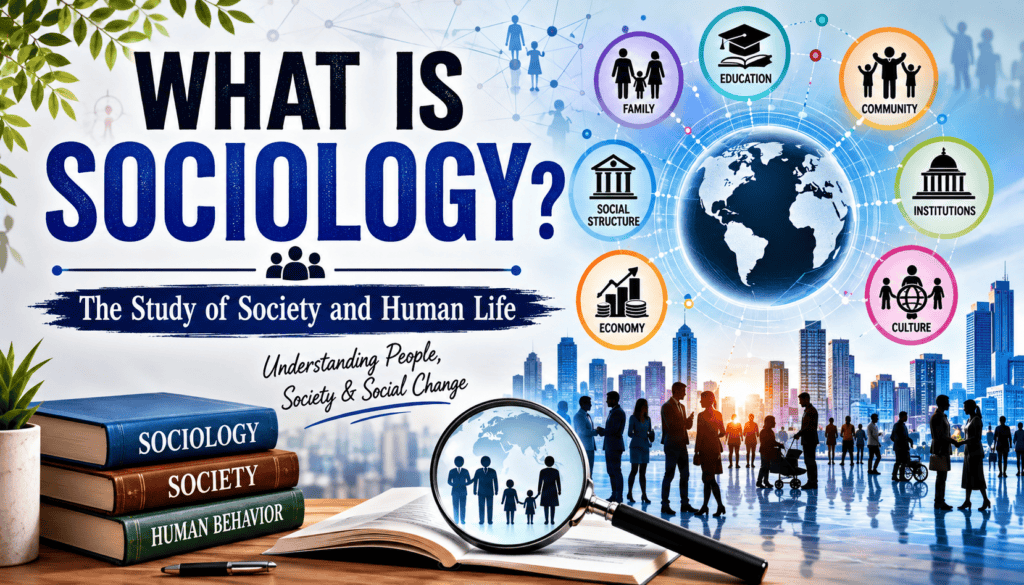
Sociology is one of the most fascinating and expansive fields of academic inquiry in the modern world. It is the systematic, scientific study of human society, social relationships, social institutions, and the forces that shape collective human life. As a discipline, sociology seeks to understand how individuals are shaped by the societies in which they live, how social structures emerge and change over time, and how patterns of behavior, culture, and inequality are produced and reproduced across generations. It occupies a unique intellectual space between the humanities and the natural sciences, drawing on empirical research methods while simultaneously engaging with the deepest philosophical questions about human nature and collective existence.
The word “sociology” itself is a hybrid term derived from the Latin word socius, meaning companion or associate, and the Greek word logos, meaning study or reason. Together, these roots capture the essence of the discipline: the rational, systematic study of human association and companionship — that is, of social life in all its richness and complexity. Sociology emerged as a formal academic discipline in the nineteenth century, born out of the dramatic social transformations brought about by the Industrial Revolution, urbanization, the decline of traditional religious authority, and the rise of modern nation-states. Thinkers of the era were grappling with questions that had no precedent: How do mass industrial societies hold together? What replaces the bonds of traditional community? Why do some people succeed while others fail? These pressing questions gave birth to the sociological imagination.
Definitions of Sociology by Famous Sociologists
Because sociology encompasses such a broad range of human experience, different founding thinkers and later scholars have approached its definition in distinct ways. Each definition reflects the particular concerns, historical moment, and theoretical orientation of its author. Taken together, these definitions reveal the richness and complexity of sociology as a discipline.
Auguste Comte (1798–1857)
Auguste Comte, widely regarded as the founding father of sociology, defined it as the scientific study of social phenomena, governed by natural laws similar to those that govern the physical world. He coined the term “sociology” in 1838 and envisioned the discipline as the “queen of sciences” — the highest and most complex of all scientific endeavors. Comte argued that human societies pass through three stages of intellectual development: the theological stage, the metaphysical stage, and the positive or scientific stage. In the final stage, human understanding of society would be governed not by religious dogma or abstract philosophy but by empirical observation, experimentation, and rational analysis. For Comte, sociology was to be a positive science that would provide the knowledge necessary to reform and stabilize societies undergoing the upheavals of modernity.
Émile Durkheim (1858–1917)
Émile Durkheim, the French sociologist whose work helped establish sociology as a rigorous academic discipline, defined sociology as the science of social facts. By “social facts,” Durkheim meant those ways of thinking, feeling, and acting that are external to individuals and exert a coercive power over them. Social facts include institutions such as law, religion, and morality, as well as broader cultural norms and collective beliefs. Durkheim insisted that social facts must be studied as things in their own right, independent of individual psychology. His famous study of suicide demonstrated how even the most apparently individual act could be explained by social forces such as integration and regulation. For Durkheim, sociology was fundamentally concerned with understanding the social bonds that hold societies together and the consequences of their breakdown — a condition he called anomie.
Max Weber (1864–1920)
Max Weber, the German sociologist and political economist, offered a definition centered on social action and meaningful human behavior. For Weber, sociology is the science which attempts to understand social action interpretively in order to arrive at a causal explanation of its course and effects. By social action, Weber meant any behavior to which an individual attaches subjective meaning and which is oriented toward the behavior of others. This emphasis on interpretation — on understanding the meaning that actors themselves give to their actions — distinguished Weber’s approach from Durkheim’s more structural orientation. Weber developed the method of Verstehen, or empathetic understanding, as a tool for grasping the subjective dimensions of social life. His works on religion, bureaucracy, and the rationalization of modern life remain indispensable contributions to sociological thought.
Karl Marx (1818–1883)
Although Karl Marx did not use the term “sociology” extensively, his work has had a profound and enduring influence on the discipline. Marx understood society through the lens of historical materialism — the idea that the material conditions of production and economic relationships between classes are the fundamental driving forces of social change and historical development. For Marx, the study of society is inseparable from the study of power, exploitation, and conflict. Sociology, in the Marxian tradition, is the critical analysis of how economic structures shape social institutions, ideologies, culture, and consciousness. He argued that the ideas that dominate any historical epoch are the ideas of the dominant class, and that genuine human emancipation requires both the scientific understanding of society and active political struggle to transform it.
George Simmel (1858–1918)
George Simmel defined sociology as the study of the forms of social interaction and association. Unlike Durkheim, who focused on large-scale social structures, or Marx, who emphasized economic forces, Simmel was interested in the micro-level patterns of interaction that constitute social life: how people form groups, how strangers relate to each other, the dynamics of dyads and triads, and the sociology of money and urban life. For Simmel, sociology investigates the forms that human interaction takes, irrespective of the specific content of those interactions. His work laid the groundwork for what would later become symbolic interactionism and micro-sociology.
C. Wright Mills (1916–1962)
Wright Mills, the American sociologist, offered perhaps the most compelling twentieth-century definition of sociology through his concept of the sociological imagination. Mills described the sociological imagination as the quality of mind that allows individuals to understand the relationship between their personal troubles and the broader public issues of social structure. For Mills, the promise of sociology lies in its capacity to connect biography and history — to show how individual lives are shaped by historical forces and social structures that far exceed the individual. In his landmark work The Sociological Imagination (1959), Mills argued that the task of sociology is to help ordinary people become aware of the social forces that constrain and enable their lives, thereby empowering them to act as citizens rather than passive subjects.
Anthony Giddens (1938–Present)
Anthony Giddens, one of the most influential contemporary sociologists, defines sociology as the study of human social life, groups, and societies. For Giddens, sociology has a particularly important role in the modern world because its subject matter — human social behavior — is enormously diverse and endlessly fascinating. He emphasizes that sociology is not merely an academic exercise but has immediate practical relevance: understanding how society works helps us confront social problems ranging from inequality and poverty to crime, environmental degradation, and political conflict. Giddens is particularly noted for his theory of structuration, which seeks to overcome the traditional opposition between individual agency and social structure by arguing that both are mutually constituting: structures are produced and reproduced through human action, while human action is shaped and enabled by structures.
Scope of Sociology
The scope of sociology is extraordinarily broad, encompassing virtually every dimension of human social life. Unlike more specialized social sciences such as economics, which focuses primarily on the production and distribution of goods and services, or political science, which centers on government and political power, sociology takes all of human social existence as its subject matter. This breadth is both a strength and a challenge: it means that sociology can offer uniquely comprehensive insights into social life, but it also means that sociologists must be intellectually versatile and methodologically diverse.
At the macro level, sociology studies large-scale social structures and institutions such as the family, religion, education, the economy, the state, and the media. It examines how these institutions are organized, how they function, how they change over time, and how they interact with one another. Macro-sociologists ask questions such as: How does capitalism shape social inequality? How do religious beliefs influence political behavior? How does the education system reproduce or challenge class structures? These questions require sociologists to think historically and comparatively, examining societies across time and across cultures.
At the micro level, sociology examines the face-to-face interactions, everyday practices, and subjective experiences that make up the texture of daily social life. Micro-sociologists study how people construct meaning in their interactions, how social identities are negotiated and performed, how conversations are organized, and how individuals navigate the norms and expectations of their social worlds. This level of analysis draws on methods such as ethnography, conversation analysis, and in-depth interviewing.
Between the macro and the micro, sociology also occupies a meso level of analysis, concerned with organizations, communities, social networks, and social movements. At this level, sociologists examine how people collaborate and compete within organizations, how communities are formed and sustained, how information and influence flow through social networks, and how collective action transforms social structures. The scope of sociology also extends to the study of social problems such as poverty, crime, racism, sexism, environmental injustice, and health inequality — areas in which sociological knowledge has direct policy relevance.
Importance of Sociology
Sociology holds profound importance for individuals, communities, institutions, and societies as a whole. In an era of rapid social change, deepening inequality, technological disruption, and global interconnection, the insights offered by sociology are more vital than ever. Understanding how society works is not merely an intellectual luxury; it is a practical necessity for anyone who seeks to navigate the social world thoughtfully, contribute to democratic citizenship, or work toward a more just and equitable society.
At the individual level, sociology cultivates critical thinking about the social forces that shape personal experience. By developing the sociological imagination, individuals learn to see that their personal struggles — with employment, health, relationships, identity, or opportunity — are not simply the result of individual failure or success but are deeply influenced by social structures and historical circumstances. This awareness does not remove personal responsibility but enriches it by situating individual lives within a broader social context.
At the policy level, sociological research provides essential knowledge for addressing social problems. Governments, non-governmental organizations, and community groups rely on sociological data and analysis to understand the causes of poverty, to design more effective educational interventions, to combat racial and gender discrimination, to reduce crime, to improve public health, and to manage the social consequences of technological change. Without sociological knowledge, policy makers are flying blind, relying on intuition, ideology, or anecdote rather than systematic evidence.
Sociology also plays a vital role in fostering cultural understanding and tolerance in diverse societies. By examining the social construction of race, ethnicity, gender, sexuality, and religion, sociology reveals how these categories are not natural or fixed but are produced and reproduced through social practices and power relations. This insight challenges prejudice, promotes empathy, and helps build the foundations for multicultural coexistence. In an increasingly globalized world, where people of different backgrounds live and work alongside one another, this contribution of sociology is of incalculable value.
Furthermore, sociology is important for understanding and shaping democratic life. Democracy is not simply a set of formal institutions; it is a living social practice that requires informed, engaged, and critically reflective citizens. Sociology helps create such citizens by providing them with the knowledge and analytical tools to understand how political power operates, how public opinion is formed, how social movements emerge and succeed or fail, and how media and information shape political consciousness.
Research Methods in Sociology
Sociology is an empirical discipline, which means that its claims are grounded in systematic observation and evidence rather than speculation or armchair theorizing. Sociologists employ a wide range of research methods, each suited to different kinds of questions and different aspects of social life. The choice of method is shaped by the research question, the theoretical orientation of the researcher, the availability of data, and ethical considerations. Broadly, sociological research methods can be divided into quantitative methods, qualitative methods, and mixed methods approaches.
Quantitative Research Methods
Quantitative methods involve the collection and analysis of numerical data and are particularly suited to research questions that seek to measure the extent of social phenomena, identify patterns and correlations, and test causal hypotheses. The survey is the most widely used quantitative tool in sociology. Surveys involve administering a structured questionnaire to a sample of respondents in order to gather data on their attitudes, behaviors, and social characteristics. Well-designed surveys, administered to representative samples, can generate data that can be generalized to large populations. Major social surveys such as the General Social Survey in the United States or the British Social Attitudes Survey have produced invaluable longitudinal data on social change over decades.
Statistical analysis of existing data — sometimes called secondary analysis — is another important quantitative method. Sociologists analyze data collected by government agencies, international organizations, and other researchers to address their own research questions. This approach allows sociologists to work with very large datasets covering entire populations and to examine trends over time. Experimental methods, while less common in sociology than in psychology, are also used in some research contexts, particularly in the study of social influence, discrimination, and decision-making. Field experiments and natural experiments — situations in which social conditions change in ways that approximate an experimental design — have become increasingly important tools for causal inference in sociology.
Qualitative Research Methods
Qualitative methods are designed to capture the depth, richness, and complexity of social experience. They are particularly well suited to research questions that seek to understand meaning, process, and context. Ethnography — the practice of immersing oneself in a social setting over an extended period in order to observe and participate in the lives of research subjects — is one of the most powerful and distinctive methods in the sociological toolkit. Classic sociological ethnographies, such as William Foote Whyte’s study of a working-class Italian-American neighborhood in Street Corner Society, or Erving Goffman’s observations of everyday interaction in Asylums, have produced some of the most illuminating accounts of social life ever written.
In-depth interviewing involves conducting extended, open-ended conversations with research participants in order to explore their experiences, perspectives, and understandings of their social world. Unlike survey interviews, which are structured and standardized, in-depth interviews are flexible and exploratory, allowing the researcher to follow unexpected leads and to probe beneath the surface of initial responses. Focus groups, in which a small number of participants are brought together to discuss a topic under the guidance of a researcher, are another widely used qualitative method, particularly in the study of public opinion, consumer behavior, and policy evaluation.
Content analysis — the systematic examination of texts, images, media products, and other cultural artifacts — is used to study how meaning is produced and circulated in society. Sociologists use content analysis to examine everything from news coverage of social issues to representations of race and gender in popular culture to the rhetoric of political movements. Conversation analysis and discourse analysis are more specialized methods for examining the fine-grained structure of language and communication in social interaction.
Mixed Methods and Comparative Research
Many contemporary sociologists employ mixed methods approaches that combine quantitative and qualitative techniques within a single research project. Mixed methods designs allow researchers to exploit the complementary strengths of both approaches: the breadth and generalizability of quantitative data combined with the depth and interpretive richness of qualitative inquiry. Comparative research — the systematic comparison of different societies, institutions, or historical periods — is another important methodological strategy in sociology. Comparative studies allow sociologists to test whether relationships observed in one social context hold across different contexts, and to identify the social conditions that explain variation in social outcomes.
Major Theoretical Perspectives in Sociology
Sociological theory provides the conceptual frameworks through which sociologists interpret and explain social phenomena. Rather than offering a single unified theory of society, sociology encompasses multiple competing theoretical perspectives, each of which highlights different aspects of social life and generates different kinds of questions and explanations.
Functionalism, associated with the work of Durkheim and later developed by Talcott Parsons and Robert Merton, views society as a complex system of interrelated parts that work together to maintain social stability and equilibrium. Each social institution — the family, the economy, religion, education — is seen as performing specific functions that contribute to the overall integration and survival of the social system. Functionalism has been criticized for its conservative tendency to justify existing social arrangements and for its difficulty in accounting for social conflict and change.
Conflict theory, rooted in the work of Marx and later developed by theorists such as C. Wright Mills, Ralf Dahrendorf, and Randall Collins, views society as structured by competing interests and unequal power relations. Social institutions are not seen as neutral mechanisms for meeting social needs but as arenas in which dominant groups exercise power and maintain their privileged positions at the expense of subordinate groups. Conflict theory draws attention to inequality, exploitation, and resistance, and has been particularly influential in the sociology of class, race, and gender.
Symbolic interactionism, associated with George Herbert Mead, Charles Cooley, and Erving Goffman, focuses on the micro-level processes through which individuals construct meaning in their everyday interactions. From this perspective, society is not a thing that exists independently of human actors but is continuously produced and reproduced through the symbolic communication and interpretive practices of individuals. Key concepts include the self, role-taking, the looking-glass self, and the dramaturgical metaphor of social life as performance.
Feminist sociology emerged in the latter half of the twentieth century as a challenge to the male-dominated perspectives that had historically dominated the discipline. Feminist sociologists argue that gender is a fundamental axis of social organization and inequality, and that understanding how patriarchy shapes social institutions, cultural norms, and individual experience is essential to any adequate account of social life. Feminist sociology has generated rich bodies of work on gender and work, the family, sexuality, violence against women, and intersectionality — the idea that gender intersects with race, class, and other dimensions of social difference to produce complex, overlapping forms of inequality and privilege.
Major Branches of Sociology
Sociology has developed an extensive array of specialized sub-fields and branches, each devoted to the systematic study of a particular domain of social life. This diversity reflects the vast scope of the discipline and the richness of the social world it seeks to understand.
The sociology of family examines the structure, functions, and dynamics of family life across different cultures and historical periods. It studies topics such as marriage, divorce, parenting, domestic labor, family violence, and the changing forms of family in contemporary societies. The sociology of religion investigates how religious beliefs, practices, and institutions shape and are shaped by social life, examining topics such as secularization, religious pluralism, fundamentalism, and the relationship between religion and politics.
The sociology of education studies how educational institutions are organized, how they reproduce or challenge social inequality, how socialization occurs in schools, and how educational credentials are distributed across different social groups. Economic sociology examines the social foundations of economic life, studying how markets, organizations, and economic behavior are embedded in social relations, cultural norms, and institutional structures.
Political sociology investigates the relationship between society and political power, studying topics such as the state, social movements, political parties, voting behavior, and the sources of political legitimacy. The sociology of health and medicine examines how social factors — including class, race, gender, and the organization of the healthcare system — shape patterns of illness, health-seeking behavior, and the experience of being a patient or a caregiver.
Urban sociology studies the social life of cities, examining how urbanization shapes patterns of community, inequality, crime, culture, and everyday experience. Rural sociology, by contrast, focuses on agricultural communities and rural social life. Environmental sociology investigates the relationship between society and the natural environment, studying how social factors drive environmental degradation and how environmental change in turn affects social structures and inequalities. The sociology of crime and deviance examines why norms are violated, how societies define and respond to deviance and crime, and how the criminal justice system operates to produce and manage social order.
Relationship of Sociology with Other Disciplines
Sociology does not exist in intellectual isolation; it is embedded in a rich network of relationships with other academic disciplines, from which it borrows insights, methods, and concepts, and to which it contributes its own distinctive perspective. Understanding these relationships helps to clarify both the distinctiveness and the boundaries of sociology as a discipline.
The relationship between sociology and psychology is particularly close and sometimes contested. While psychology focuses on the individual mind and behavior, sociology focuses on social structures, institutions, and relationships. Social psychology occupies the borderland between the two disciplines, studying how social contexts shape individual thought, emotion, and behavior. Sociologists draw on psychological concepts such as identity, motivation, and cognitive schemas, while psychologists increasingly recognize the importance of social and cultural factors in shaping individual psychology. The sociological tradition, however, insists that individual behavior cannot be understood without reference to the social structures and cultural contexts in which it is embedded.
Sociology and economics share a concern with understanding how resources are produced, distributed, and consumed in human societies. However, while mainstream economics tends to model human behavior in terms of rational individual actors pursuing self-interest in markets, sociology emphasizes that economic behavior is always embedded in social relations, cultural values, and institutional frameworks. Economic sociology and behavioral economics have brought the two disciplines into fruitful dialogue, challenging the unrealistic abstractions of the standard economic model.
Sociology and history share a concern with understanding social change over time. While historians tend to focus on specific events and particular contexts, sociologists seek to identify general patterns and causal processes. Historical sociology, a vibrant sub-field, draws on both traditions to examine how social structures emerge, persist, and transform over long periods of time. Sociology also has close relationships with anthropology — particularly cultural anthropology, which studies the diversity of human cultures — with political science, with geography, and with communication studies.
Conclusion
Sociology is an indispensable intellectual enterprise for understanding the world in which we live. It is a discipline that takes seriously the complexity and diversity of human social life, and that brings to bear a rich array of theoretical frameworks and empirical methods in order to illuminate the social forces that shape our individual and collective existence. From the grand questions of historical social change to the intimate details of everyday interaction, sociology offers insight, understanding, and the possibility of transformation.
The great sociologists — from Comte and Durkheim to Weber, Marx, Simmel, Mills, and Giddens — have bequeathed to us not only a body of substantive knowledge about social life but, more importantly, a set of intellectual habits and analytical tools that allow us to see through the surface appearances of social life to the deeper structures and processes that produce them. The sociological imagination — the capacity to connect personal biography with social history, to see the individual life as embedded in a social world that both constrains and enables it — is one of the most valuable intellectual gifts that education can offer.
In an era of unprecedented social change — driven by digitalization, globalization, climate change, demographic transformation, and resurgent social movements — the need for rigorous, empirically grounded, theoretically sophisticated sociological analysis has never been greater. Sociology equips us not only to understand the social world but to imagine and work toward a better one. That, ultimately, is the deepest promise and the enduring purpose of the sociological enterprise.