Introduction
Socialization is one of the most important processes through which human beings learn the values, norms, beliefs, behaviors, and social skills necessary to become active members of society. A person is not born with complete knowledge about society; rather, individuals learn social expectations and ways of living through interaction with other people. Socialization begins from childhood and continues throughout life as individuals experience different social environments.
Through the process of socialization, a child learns language, cultural traditions, social roles, acceptable behaviors, and ways of interacting with others. It connects individuals with society and helps maintain social order by transferring culture from one generation to another.
Definition of Socialization
Different sociologists have explained socialization from different perspectives.
According to Émile Durkheim, socialization is the process through which society influences individuals and develops social beings from biological individuals. He believed that education and social interaction teach individuals the values and rules necessary for living in society.
According to Peter L. Berger and Thomas Luckmann, socialization is the process through which individuals learn and internalize the values, norms, and meanings of their society.
George Herbert Mead explained socialization as the process through which individuals develop their self-concept by interacting with others. According to Mead, people learn to understand themselves by seeing how others respond to them.
According to Charles Horton Cooley, the development of self occurs through social interaction. His concept of the “looking-glass self” explains that individuals develop their identity based on how they imagine others see them.
In simple words, socialization is the lifelong process through which individuals learn the culture and behavior patterns of their society and develop their social identity.
Nature of Socialization
Socialization is a continuous and lifelong process. It starts at birth and continues throughout a person’s life. Although childhood is considered the most important period of socialization, adults also continue learning new roles and behaviors when they enter new social situations such as marriage, employment, or different communities.
Socialization is a social learning process because individuals learn through interaction with family, friends, schools, and other social groups. It is also a cultural process because it transfers cultural values, traditions, and beliefs from one generation to another.
Socialization is different in every society because each culture has its own values, norms, and expectations. The way children are raised, educated, and guided varies according to social and cultural conditions.
Stages of Socialization
Primary Socialization
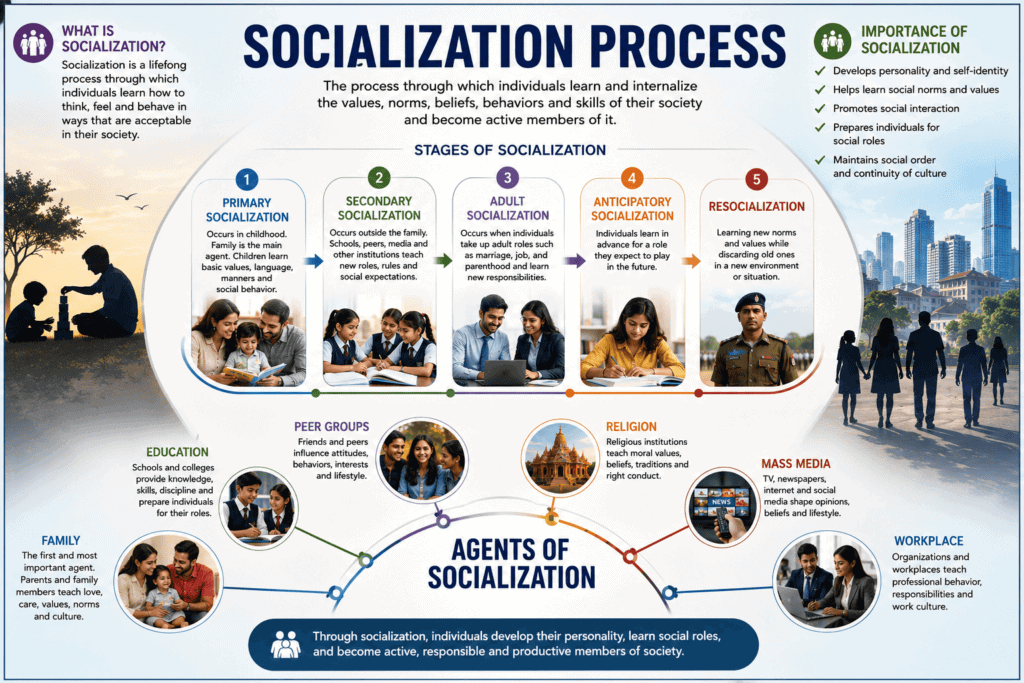
Primary socialization is the first stage of socialization that occurs during childhood. The family is the main agent during this stage. Children learn basic behaviors, language, manners, values, and emotional responses from parents and close family members.
During this stage, children develop their first understanding of society and learn what behaviors are considered acceptable or unacceptable.
Secondary Socialization
Secondary socialization occurs when individuals enter broader social environments outside the family. Schools, peer groups, workplaces, religious institutions, and media play important roles during this stage.
Through secondary socialization, individuals learn new roles, responsibilities, and social expectations required for participation in society.
Adult Socialization
Adult socialization occurs when individuals experience new roles and situations during adulthood. Marriage, employment, parenthood, and social responsibilities require individuals to learn new behaviors and adapt to changing circumstances.
This stage shows that socialization continues throughout life.
Anticipatory Socialization
Anticipatory socialization refers to the process through which individuals learn behaviors and expectations related to a future role they want to achieve. For example, a student preparing for a professional career learns the attitudes and skills associated with that profession.
Resocialization
Resocialization is the process of learning new values, behaviors, and norms while abandoning previous patterns. It often occurs when individuals enter a new environment or experience major life changes.
Examples include joining a new organization, entering military training, or adapting to a completely different culture.
Agents of Socialization
Family
Family is the first and most influential agent of socialization. Parents and family members teach children language, cultural values, traditions, moral beliefs, and social behavior. The personality and identity of individuals are strongly influenced by early family experiences.
Education System
Schools and educational institutions play a major role in socialization. Education teaches knowledge, discipline, cooperation, responsibility, and social values. Schools also prepare individuals for future roles in society.
Peer Groups
Peer groups are groups of people with similar age or interests. Friends influence attitudes, behaviors, language, and lifestyle, especially during adolescence. Peer interaction helps individuals develop independence and social skills.
Religion
Religion is an important agent of socialization in many societies. Religious institutions teach moral values, beliefs, traditions, and rules of behavior. Religion often influences individuals’ understanding of right and wrong.
Mass Media
Media has become a powerful agent of socialization in modern societies. Television, newspapers, films, and social media influence people’s ideas, attitudes, lifestyles, and perceptions about society.
Workplace
The workplace socializes individuals into professional roles. People learn organizational rules, professional behavior, cooperation, and responsibilities through employment experiences.
Importance of Socialization
Socialization is essential because it helps individuals become functioning members of society. Without socialization, people would not learn language, cultural values, social rules, or appropriate behaviors.
It helps in personality development by shaping attitudes, beliefs, and behaviors. The experiences people gain through socialization influence their identity and understanding of the world.
Socialization also maintains social order because it teaches individuals to follow social norms and expectations. By learning society’s rules, people are able to live together peacefully and cooperate with each other.
Another important function of socialization is the transmission of culture. Through socialization, knowledge, traditions, and values are passed from one generation to another.
Socialization also helps individuals adjust to different social roles. People learn how to behave as children, students, workers, parents, and members of communities.
Theories of Socialization
The theory of George Herbert Mead explains that the self develops through interaction with others. He suggested that children pass through stages such as imitation, play, and game stages where they learn social roles.
Sigmund Freud explained socialization through personality development. According to Freud, human personality develops through the interaction of biological instincts, social rules, and moral understanding.
Jean Piaget studied cognitive development and explained how children gradually develop the ability to understand social rules and relationships.
Conclusion
Socialization is a fundamental process that connects individuals with society. Societyopedia is sharing all related concepts with you. Through socialization, people learn culture, develop personality, understand social roles, and become capable members of their communities. Family, education, religion, media, peers, and workplaces all contribute to this lifelong process.
A society cannot exist without socialization because it ensures the continuation of culture, values, and social traditions. Understanding socialization helps us understand how individuals become social beings and how society influences human behavior.