Introduction
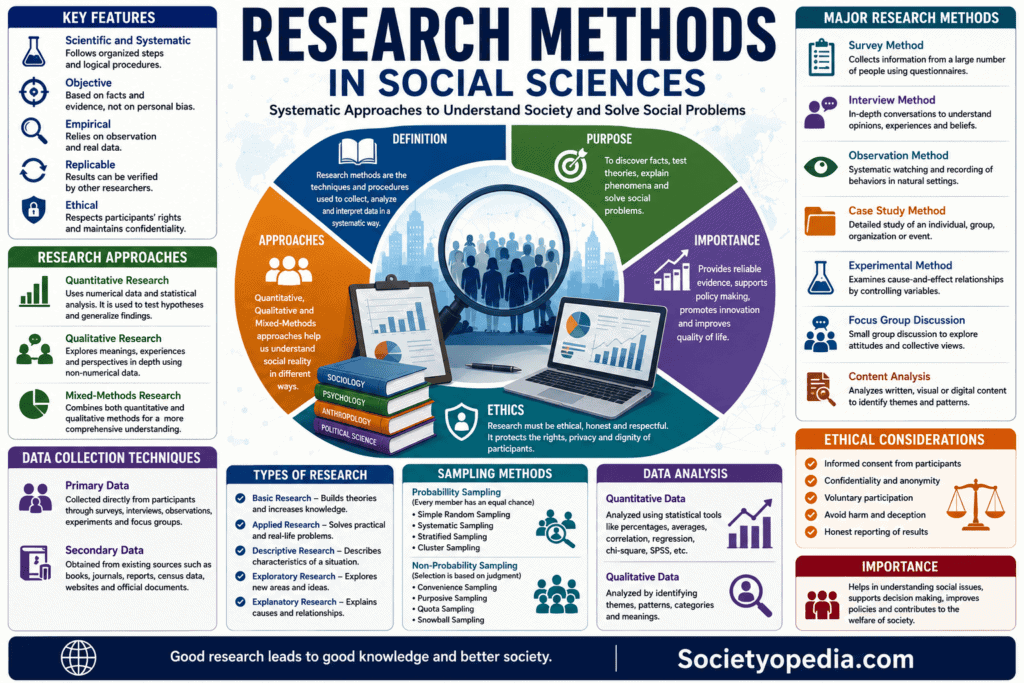
Research methods are the systematic techniques and procedures used to collect, analyze, and interpret information for the purpose of answering research questions or solving problems. In the social sciences, research methods help scholars study human behavior, society, culture, institutions, and social relationships scientifically and objectively. Without proper research methods, it would be difficult to produce reliable knowledge or develop evidence-based solutions to social problems.
Social science research is essential in disciplines such as sociology, psychology, anthropology, political science, economics, education, and gender studies. Researchers use different methods depending on the nature of the research problem, objectives, and the type of data required.
Definition of Research Methods
Different scholars have defined research methods from various perspectives.
According to C. R. Kothari, research is “a scientific and systematic search for pertinent information on a specific topic.” He explained that research methods are the techniques used to conduct this systematic investigation.
According to Earl Babbie, research methods are the procedures used to collect and analyze data in order to understand social phenomena.
John W. Creswell defined research methods as the specific procedures used to gather, analyze, and interpret data within qualitative, quantitative, or mixed-method studies.
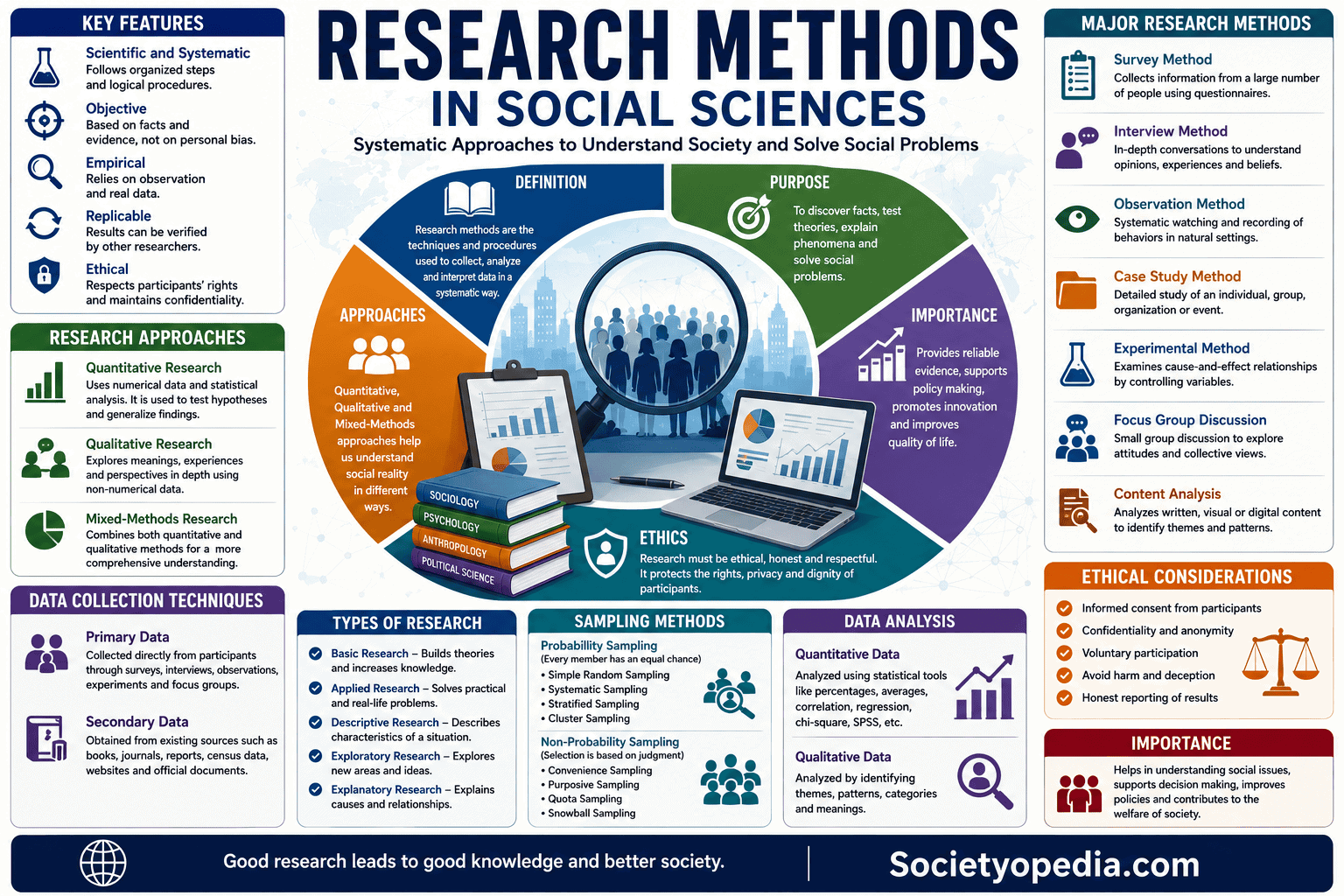
In simple words, research methods are organized procedures that enable researchers to investigate social issues scientifically and produce trustworthy conclusions.
Characteristics of Social Science Research
Research in the social sciences is scientific because it follows systematic procedures and logical reasoning. It is objective because researchers attempt to minimize personal bias while collecting and analyzing data.
Social science research is empirical, meaning that it relies on observation and evidence rather than assumptions or personal opinions. It is also replicable because other researchers can repeat the same study using similar methods to verify the findings.
Another important characteristic is that research is ethical. Researchers must respect participants’ rights, maintain confidentiality, obtain informed consent, and avoid causing harm.
Research Approaches
Quantitative Research
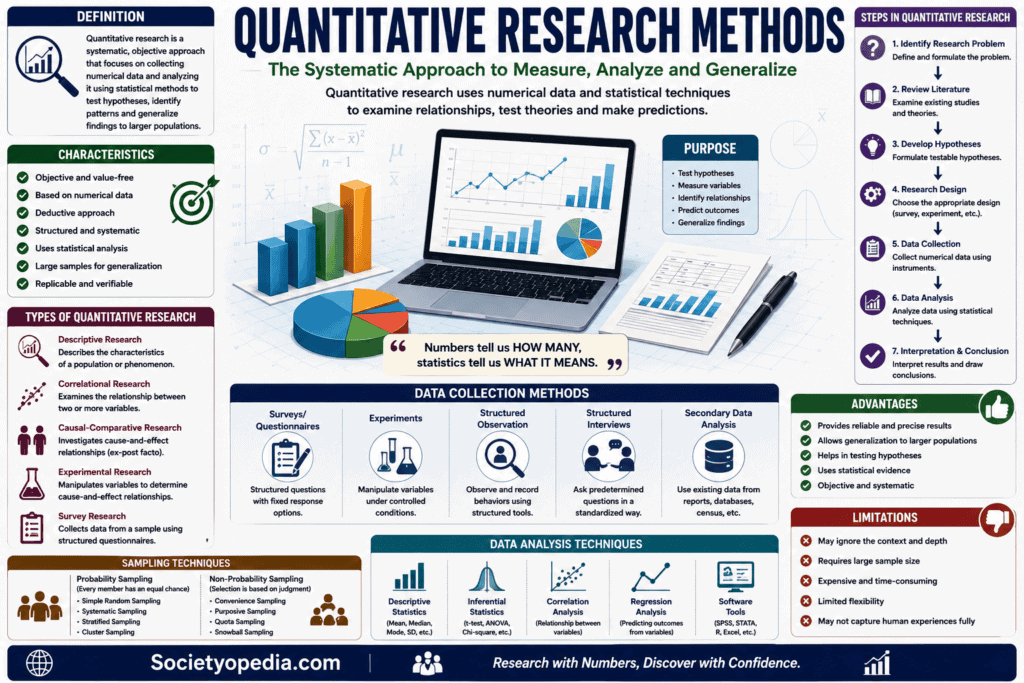
Quantitative research focuses on numerical data and statistical analysis. Researchers collect measurable information using structured questionnaires, surveys, experiments, and official records.
This approach is useful for testing hypotheses, measuring relationships between variables, and making generalizations about larger populations. Quantitative research is widely used in sociology, economics, public health, and political science.
Qualitative Research
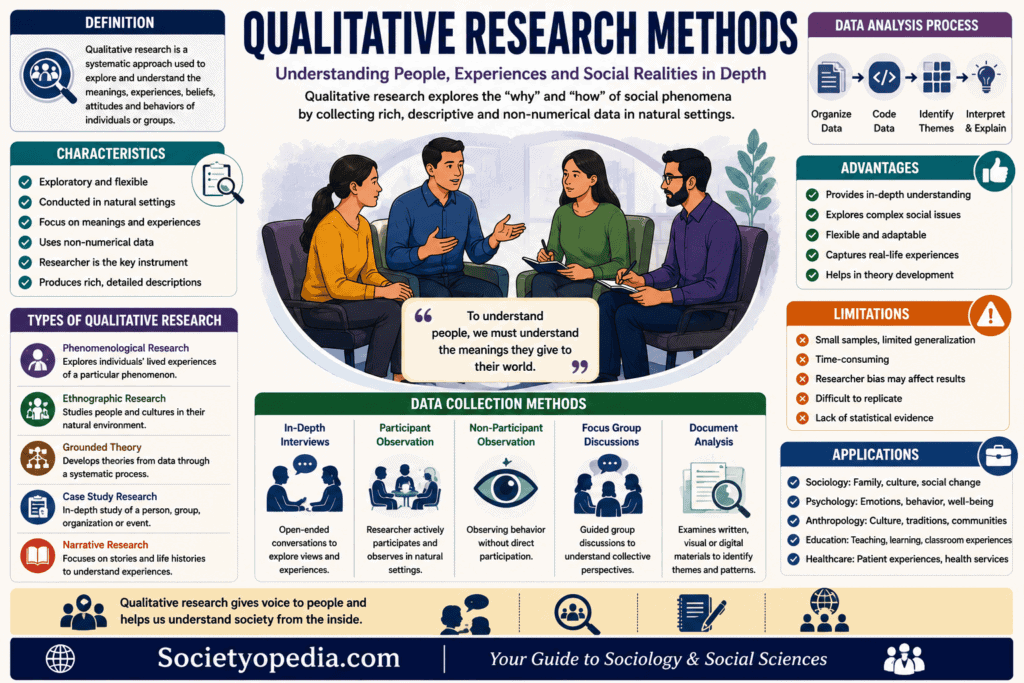
Qualitative research focuses on understanding people’s experiences, opinions, beliefs, and behaviors in depth. It uses non-numerical data collected through interviews, observations, focus groups, and document analysis.
This approach helps researchers explore complex social issues, cultural practices, and individual perspectives that cannot easily be measured statistically.
Mixed-Methods Research
Mixed-methods research combines both quantitative and qualitative approaches in a single study. Researchers collect numerical data as well as descriptive information to gain a more comprehensive understanding of the research problem.
This approach is increasingly popular because it combines the strengths of both research traditions.
Types of Research
Basic Research
Basic research aims to increase knowledge and develop theories without necessarily solving immediate practical problems. It contributes to the advancement of academic understanding.
Applied Research
Applied research is conducted to solve practical problems faced by individuals, organizations, or societies. It provides solutions that can be directly implemented.
Descriptive Research
Descriptive research describes the characteristics of a population, situation, or phenomenon. It answers questions such as what, where, when, and how.
Exploratory Research
Exploratory research is conducted when little information is available about a topic. It helps researchers identify new ideas, patterns, and research questions.
Explanatory Research
Explanatory research seeks to explain why certain social phenomena occur by identifying relationships between variables.
Major Research Methods
Survey Method
The survey method is one of the most commonly used research methods in the social sciences. Researchers collect information from a large number of participants through structured questionnaires or interviews.
Surveys are useful for studying public opinion, attitudes, behaviors, educational levels, employment, health, and social conditions.
Interview Method
Interviews involve direct communication between the researcher and participants. Interviews may be structured, semi-structured, or unstructured depending on the research objectives.
This method provides detailed information about participants’ experiences, beliefs, and perspectives.
Observation Method
Observation involves watching people, events, or situations in their natural settings. Researchers record behaviors and interactions without relying only on participants’ responses.
Observation may be participant observation, where the researcher becomes part of the group, or non-participant observation, where the researcher observes without active involvement.
Case Study Method
The case study method involves an in-depth investigation of an individual, family, organization, community, or event. It provides detailed understanding of specific social situations.
Case studies are especially useful when studying rare or complex phenomena.
Experimental Method
The experimental method is used to examine cause-and-effect relationships by controlling variables. Researchers compare experimental and control groups to measure the effects of specific factors.
Although experiments are more common in psychology, they are also used in some areas of sociology and education.
Focus Group Discussion
A focus group discussion involves a small group of participants who discuss a particular topic under the guidance of a moderator.
This method helps researchers understand opinions, attitudes, and collective experiences.
Content Analysis
Content analysis is the systematic examination of written, visual, or digital materials such as newspapers, books, television programs, websites, and social media posts.
Researchers analyze communication patterns, themes, and messages to understand social trends and public opinion.
Data Collection Techniques
Data collection is an important stage of research because the quality of findings depends on accurate information.
Primary data are collected directly from participants through surveys, interviews, observations, experiments, and focus groups.
Secondary data are obtained from existing sources such as books, research articles, government reports, census records, organizational documents, and online databases.
Sampling Methods
Sampling is the process of selecting a portion of the population for study.
Probability sampling gives every member of the population an equal chance of selection. Common probability sampling methods include simple random sampling, systematic sampling, stratified sampling, and cluster sampling.
Non-probability sampling does not provide equal selection chances. Common methods include convenience sampling, purposive sampling, quota sampling, and snowball sampling.
Data Analysis
After data collection, researchers organize and analyze the information.
Quantitative data are analyzed using statistical techniques such as percentages, averages, correlations, regression analysis, chi-square tests, and statistical software.
Qualitative data are analyzed by identifying themes, patterns, meanings, and categories from interviews, observations, and documents.
Ethical Considerations in Social Science Research
Ethics play a vital role in research because researchers work with human participants.
Researchers must obtain informed consent before collecting information. Participants should voluntarily agree to participate after understanding the purpose of the study.
Confidentiality must be maintained to protect participants’ identities and personal information.
Researchers should avoid causing physical, psychological, or social harm and should report findings honestly without manipulating data.
Importance of Research Methods in Social Sciences
Research methods provide a scientific foundation for studying society and human behavior. They help researchers collect reliable evidence rather than relying on assumptions.
Research methods contribute to policy development by providing information for governments, educational institutions, healthcare organizations, and development agencies.
They help identify social problems such as poverty, unemployment, crime, inequality, discrimination, and public health issues, making it possible to design effective interventions.
Research methods also promote innovation by generating new knowledge, testing theories, and improving existing social practices.
Limitations of Social Science Research
Despite their importance, social science research has certain limitations. Human behavior is complex and may change over time, making prediction difficult.
Researchers may encounter challenges such as biased responses, limited resources, ethical constraints, and difficulties in controlling all variables.
Cultural differences and changing social conditions may also affect the generalizability of research findings.
Conclusion
Research methods are the backbone of the social sciences because they provide systematic and scientific ways of studying society, culture, and human behavior. Through quantitative, qualitative, and mixed-method approaches, researchers are able to collect reliable data, test theories, explain social phenomena, and develop evidence-based solutions to social problems.
Whether using surveys, interviews, observations, experiments, case studies, or content analysis, research methods ensure that knowledge is based on careful investigation rather than personal opinion. As societies continue to evolve, sound research methods remain essential for understanding social change, improving public policies, and advancing academic knowledge.