Introduction
Symbolic Interactionism is one of the major sociological perspectives that focuses on how individuals create meaning through social interactions. Unlike functionalism, which studies society as a large system, and conflict theory, which focuses on inequality and power struggles, symbolic interactionism examines everyday interactions between individuals and explains how people develop their understanding of the social world.
According to this perspective, society is created and maintained through continuous social interactions. People communicate with each other through symbols such as language, gestures, signs, and objects, and these symbols help them understand and interpret social reality.
Symbolic interactionism focuses on small-scale social processes, including face-to-face interactions, relationships, identity formation, and the development of self.

Definition of Symbolic Interactionism
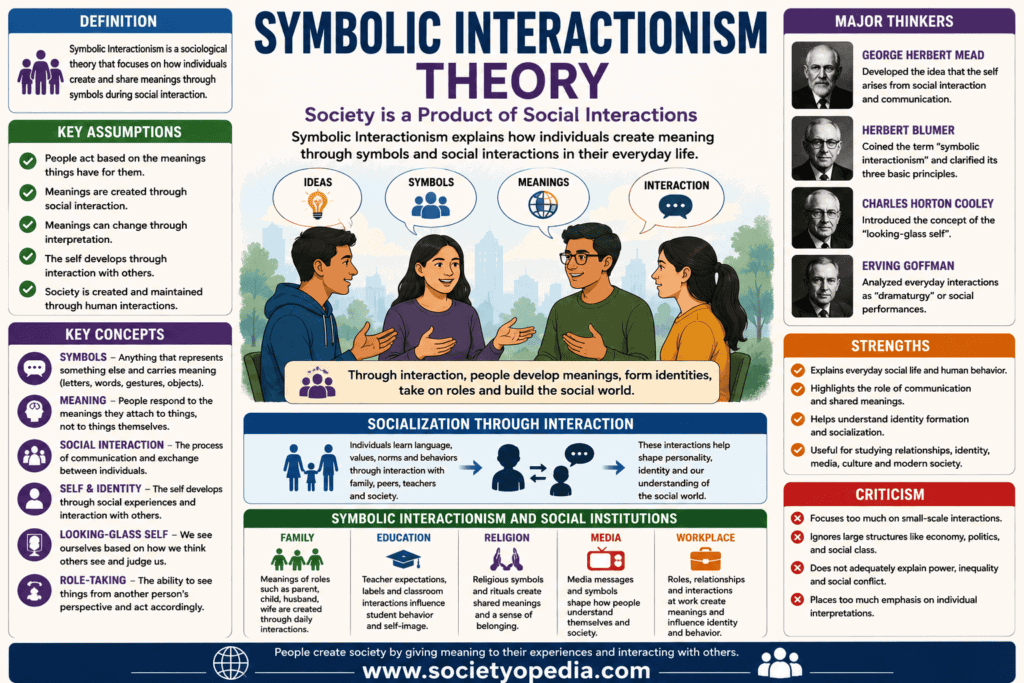
Symbolic Interactionism is a sociological theory that explains society as a product of social interactions in which individuals create and share meanings through symbols.
According to George Herbert Mead, human beings develop their sense of self through interaction with others. He argued that people learn social meanings by communicating and participating in social life.
According to Herbert Blumer, who introduced the term “Symbolic Interactionism,” people act toward things based on the meanings those things have for them. These meanings develop through social interaction and can change through interpretation.
According to Erving Goffman, social life can be understood like a performance where individuals present themselves in different ways depending on the social situation.
In simple words, symbolic interactionism explains how people create meanings, develop identities, and build society through everyday interactions.
Historical Background of Symbolic Interactionism
The roots of symbolic interactionism are connected with the ideas of George Herbert Mead and the philosophical tradition of pragmatism. Mead argued that human behavior cannot be understood without considering the meanings people attach to their actions.
Later, Herbert Blumer developed Mead’s ideas and formally introduced symbolic interactionism as a sociological approach.
The theory became associated with the Chicago School of Sociology, where researchers studied urban life, social interactions, and human experiences.
Conflict Theory in Sociology: Definition, Concepts, Assumptions, Features and Criticism
Main Assumptions of Symbolic Interactionism
Symbolic interactionism is based on the idea that human beings act according to the meanings they attach to objects, people, and situations.
Meanings are created through social interaction. People learn what things mean through communication with others.
Meanings can change over time because individuals interpret and reinterpret situations based on their experiences.
The self and identity develop through interaction with other people. Individuals understand themselves by observing how others respond to them.
Society is not something separate from individuals; rather, society is continuously created through human actions and interactions.
Major Concepts of Symbolic Interactionism
Symbols
Symbols are objects, words, gestures, or actions that represent particular meanings shared by members of society.
Language is one of the most important symbols because it allows people to communicate ideas and emotions.
For example, a national flag is not just a piece of cloth; it represents identity, unity, and national values.
Meaning
Meaning is the understanding people attach to objects, actions, and situations.
Symbolic interactionists argue that people do not respond directly to reality; they respond to the meanings they create about reality.
Social Interaction
Social interaction refers to communication and relationships between individuals. Symbolic interactionism explains that society develops through repeated interactions among people.
Self and Identity
The theory explains that individuals develop their identity through social experiences. People learn who they are through their relationships and interactions with others.
Looking-Glass Self
The concept of the “looking-glass self” was developed by Charles Horton Cooley. It explains that individuals develop their self-image based on how they think others view them.
People imagine how others see them, interpret those reactions, and develop feelings about themselves.
Role-Taking
Role-taking is the ability to understand another person’s perspective and predict their behavior. Mead argued that children develop social understanding by learning to take the roles of others.
Functionalism Theory in Sociology: Definition, Concepts, Assumptions, Features and Criticism
Symbolic Interactionism and Socialization
Symbolic interactionism explains that socialization occurs through interaction with others. Individuals learn language, values, and social expectations by communicating with family, friends, teachers, and society.
Children develop their personalities and identities through everyday experiences and feedback from others.
Symbolic Interactionism and Social Institutions
Family
Symbolic interactionists study how family members create meanings through relationships and communication. They examine how roles such as parent, child, husband, and wife are developed through interaction.
Education
In education, symbolic interactionism focuses on classroom interactions between teachers and students. It studies how labels and expectations influence student behavior and performance.
For example, a teacher’s positive or negative expectations can influence how students see themselves.
Religion
Symbolic interactionism examines how religious symbols, rituals, and beliefs create shared meanings among followers.
Religious practices help individuals develop identity and connection with their communities.
Media
Symbolic interactionists study how media creates meanings and influences how people understand themselves and society.
Media images, language, and representations can shape identity and social attitudes.
Importance of Symbolic Interactionism
Symbolic interactionism helps explain everyday social life and human relationships. It focuses on how people communicate and create meanings in their daily interactions.
The theory helps us understand identity formation and explains how individuals develop their sense of self.
It provides insight into socialization by showing how people learn culture, values, and behaviors through interaction.
Symbolic interactionism is useful for studying topics such as identity, relationships, communication, social media, and human behavior.
Strengths of Symbolic Interactionism
Symbolic interactionism provides a detailed understanding of individual experiences and everyday social interactions.
It recognizes that people are active participants in creating social reality.
The theory explains how meanings, identities, and relationships develop through communication.
It is useful for understanding modern issues related to identity, digital communication, and social relationships.
Criticism of Symbolic Interactionism
One major criticism of symbolic interactionism is that it focuses too much on small-scale interactions and does not adequately explain large social structures such as governments, economies, and social classes.
Critics argue that the theory ignores issues of power, inequality, and social conflict.
Some critics believe symbolic interactionism places too much importance on individual interpretations and does not consider wider social forces.
The theory may explain how people create meanings but does not always explain why certain social conditions exist.
Conclusion
Symbolic Interactionism is an important sociological theory that explains how society is created through human interactions and shared meanings. It focuses on symbols, communication, identity, and everyday experiences.
Developed through the ideas of thinkers such as George Herbert Mead and Herbert Blumer, this theory provides valuable insight into how individuals understand themselves and the world around them. Although it has been criticized for focusing mainly on small-scale interactions, symbolic interactionism remains an important approach for understanding human behavior and social relationships.