Introduction
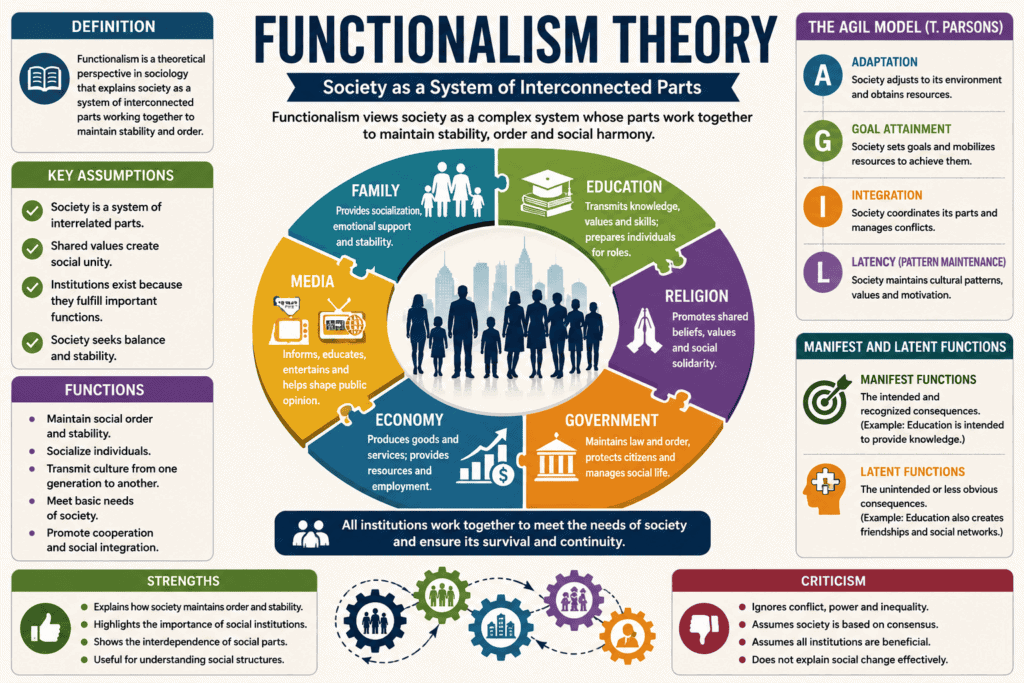
Functionalism is one of the most important theoretical perspectives in sociology that explains how society works and maintains stability. According to functionalist theory, society is a system of interconnected parts, and each part performs certain functions that contribute to the survival and continuity of the whole society. Just like different organs of the human body work together to maintain the body, different social institutions such as family, education, religion, economy, and government, work together to maintain social order.
Functionalism focuses on cooperation, stability, shared values, and social harmony. It explains that social institutions exist because they fulfill important needs of society. If one institution changes, it can affect other parts of society because all social elements are connected.
Definition of Functionalism
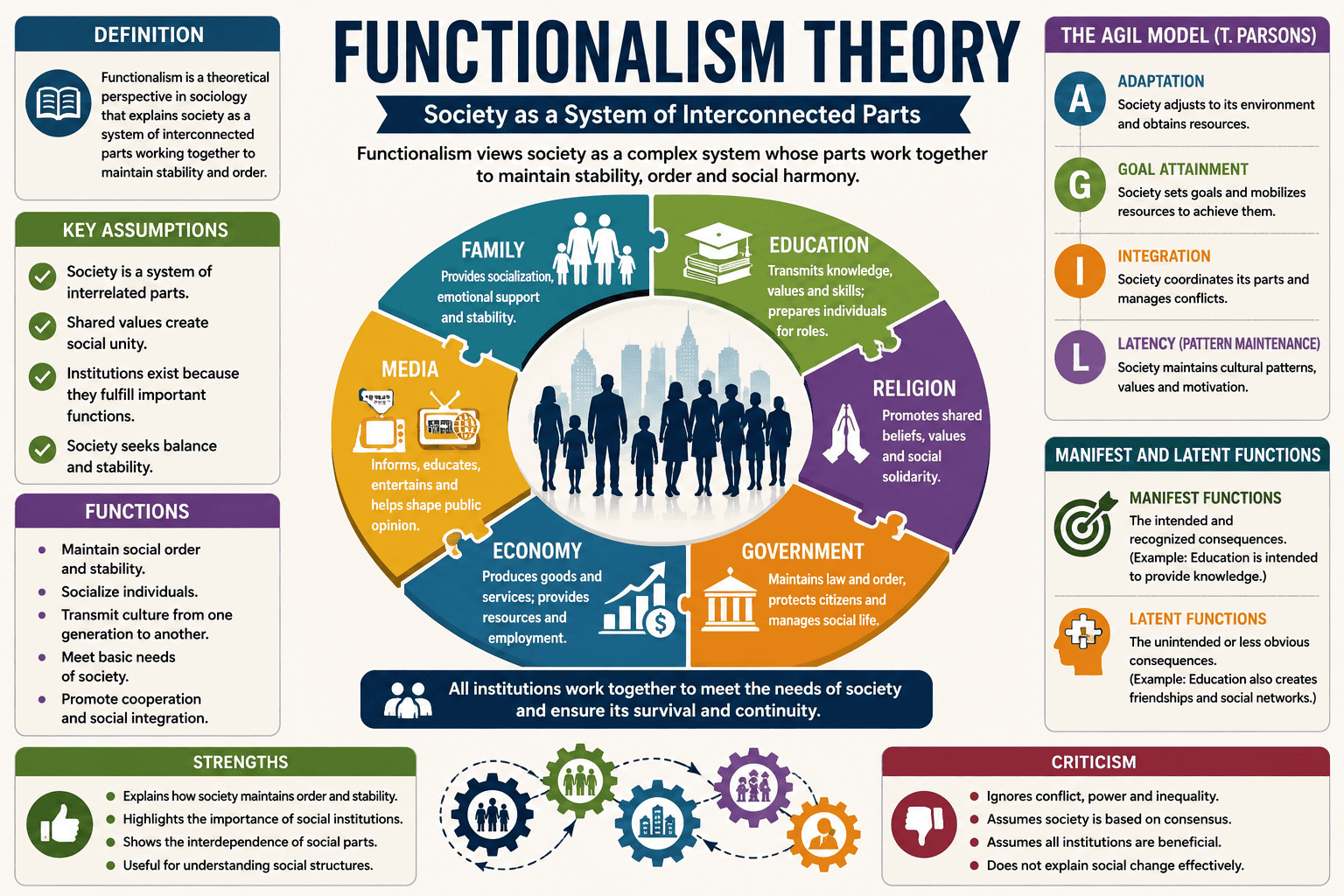
Functionalism is a sociological theory that views society as a complex system whose different parts work together to maintain balance, order, and stability.
According to Émile Durkheim, society is a system of interconnected parts that function together to create social solidarity and stability. Durkheim believed that shared values, beliefs, and moral rules help maintain social order.
According to Talcott Parsons, society is a social system made up of different institutions that perform essential functions necessary for its survival. He argued that every social system must fulfill certain basic needs to continue existing.
According to Robert K. Merton, social structures have different functions that can be either intended or unintended. He introduced the concepts of manifest functions and latent functions to explain how social institutions operate.
In simple words, functionalism explains society as a connected system where every part contributes to maintaining social balance.
Historical Background of Functionalism
The roots of functionalist theory can be traced back to early sociological thinkers who were interested in understanding social order and stability. Auguste Comte compared society to a living organism and suggested that different parts of society work together like parts of a body.
Later, Émile Durkheim developed these ideas and emphasized the importance of social institutions, collective values, and social integration.
During the twentieth century, functionalism became one of the dominant perspectives in sociology through the work of Talcott Parsons and Robert K. Merton.
Conflict Theory in Sociology: Definition, Concepts, Assumptions, Features and Criticism
Main Assumptions of Functionalism
Functionalism is based on the idea that society is a system of interconnected parts. Each institution or social structure has a role to play in maintaining society.
Functionalists believe that society is based on shared values and agreement among members. These common beliefs create social unity and cooperation.
Functionalism argues that social institutions exist because they fulfill important functions. For example, family provides socialization, education provides knowledge and skills, and government maintains law and order.
Functionalists believe that society naturally seeks balance and stability. Changes in one part of society create adjustments in other parts to restore balance.
Major Concepts of Functionalism
Social Structure
Social structure refers to the organized patterns of relationships and institutions within society. Functionalists study how these structures contribute to social stability.
Examples of social structures include family, education, religion, and political systems.
Social Functions
Social functions are the contributions that social institutions make to the operation of society. Functionalists analyze what role different institutions play.
For example, education functions to transmit knowledge and prepare individuals for social roles.
Manifest Functions
Manifest functions are the intended and recognized consequences of social actions or institutions.
For example, the main purpose of education is to provide knowledge and skills to students.
Latent Functions
Latent functions are unintended or less obvious consequences of social activities.
For example, schools not only provide education but also create friendships, social networks, and social discipline.
Social Order
Functionalism emphasizes that societies maintain order through shared values, norms, and institutions. Social rules guide behavior and reduce conflict.
Functionalist View of Social Institutions
Family
Functionalists view family as an essential institution that performs important functions. Family provides emotional support, reproduction, socialization of children, and stability.
According to functionalists, family prepares individuals to participate in society by teaching cultural values and social roles.
Education
Education is considered an important institution for maintaining society. It transfers knowledge, skills, and cultural values from one generation to another.
Education also helps individuals achieve social positions based on their abilities and qualifications.
Religion
Functionalists argue that religion promotes social unity by creating shared beliefs and values. It strengthens social bonds and provides moral guidance.
Durkheim believed that religious practices create collective consciousness, which connects individuals with society.
Economy
The economic institution provides resources, employment, and production systems necessary for society. Functionalists study how economic activities contribute to social stability.
Government
Government maintains social order by creating laws, protecting citizens, and managing social relationships. It performs functions necessary for the organization of society.
AGIL Model of Talcott Parsons
Talcott Parsons developed the AGIL model to explain the basic functions required for any social system to survive.
Adaptation refers to the ability of society to adjust to environmental changes and obtain resources. The economy performs this function.
Goal attainment refers to setting and achieving collective goals. Political institutions perform this function.
Integration refers to maintaining coordination and controlling conflicts among different parts of society. Legal systems and social norms help achieve integration.
Latency refers to maintaining cultural patterns, values, and motivation. Family and education contribute to this function.
Strengths of Functionalism
Functionalism provides a useful explanation of how society maintains order and stability. It highlights the importance of social institutions and explains why they continue to exist.
It helps us understand the relationship between different parts of society and shows how institutions contribute to social organization.
Functionalist theory is useful for studying social structures and explaining how societies continue over time.
Criticism of Functionalism
One major criticism of functionalism is that it focuses too much on stability and ignores social conflict and inequality. Critics argue that society is not always based on agreement because groups often compete for power and resources.
Conflict theorists argue that functionalism fails to explain issues such as social class inequality, discrimination, and struggles between powerful and less powerful groups.
Functionalism is also criticized for assuming that all social institutions are beneficial. Some institutions may create disadvantages for certain groups in society.
Another criticism is that functionalism does not explain social change effectively because it mainly focuses on order and stability.
Conclusion
Functionalism is an important sociological theory that explains society as a system of interconnected parts working together to maintain stability and order. It highlights the role of social institutions such as family, education, religion, economy, and government in fulfilling social needs.
The contributions of thinkers such as Émile Durkheim, Talcott Parsons, and Robert K. Merton made functionalism one of the most influential perspectives in sociology. Although the theory has been criticized for ignoring conflict and inequality, it remains valuable for understanding social structures and the ways societies maintain organization and continuity.