Introduction
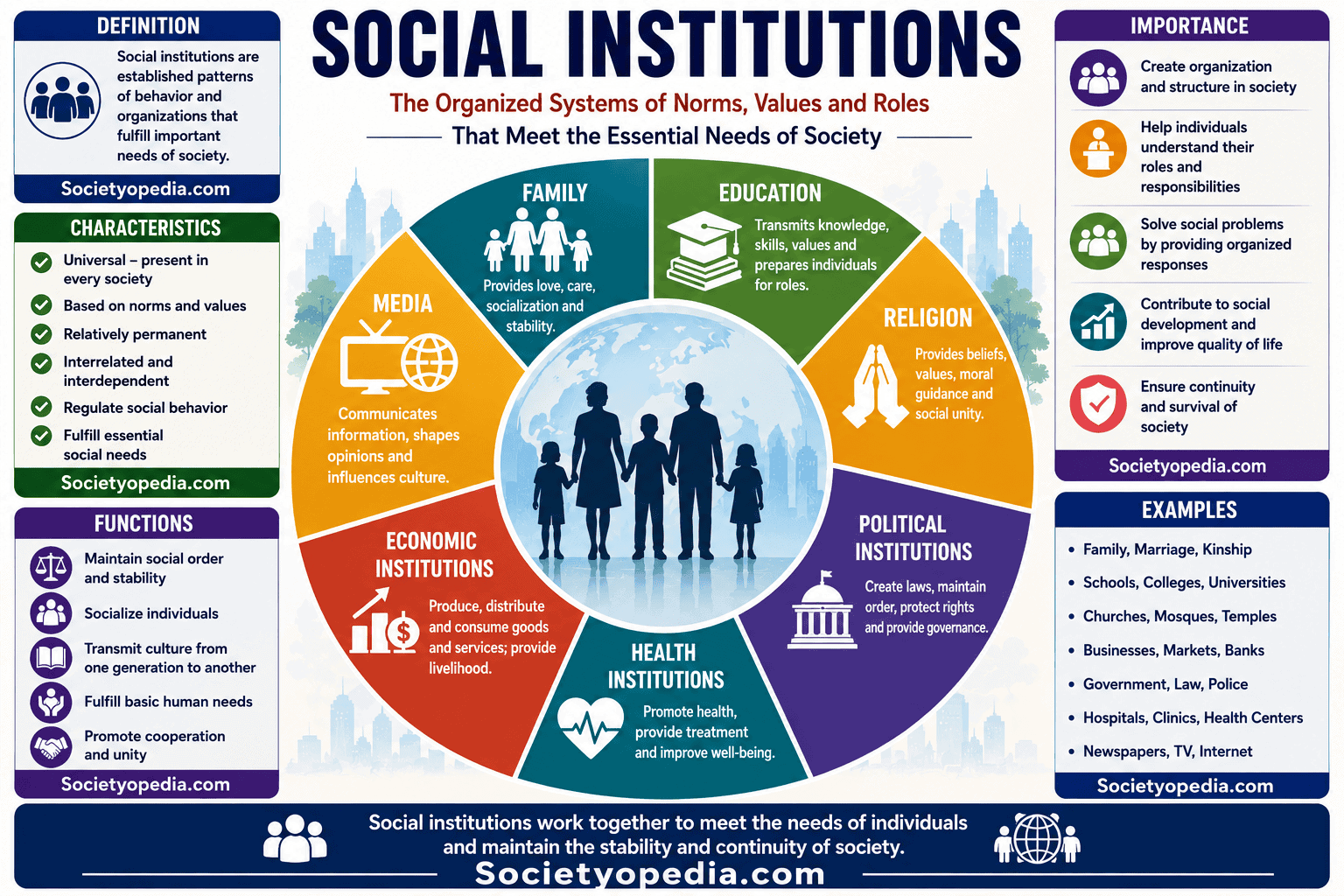
Social institutions are one of the most important concepts in sociology because they provide the basic structure through which society organizes human behavior, relationships, and social activities. Every society has certain established systems that fulfill essential needs and guide individuals about how they should behave. These systems are called social institutions.
Institutions such as family, education, religion, economy, government, and healthcare influence almost every aspect of human life. They provide stability, maintain social order, transfer culture from one generation to another, and help individuals perform their social roles.
Social institutions are not buildings or physical places; rather, they are organized patterns of beliefs, values, norms, and behaviors that develop over time to meet the needs of society.
Definition of Social Institutions
Different sociologists have defined social institutions from different perspectives.
According to Émile Durkheim, social institutions are established systems of social relationships that regulate human behavior and maintain social order. Durkheim emphasized that institutions exist outside individuals and influence their actions.
According to Talcott Parsons, social institutions are organized patterns of beliefs and behaviors that fulfill important functions necessary for the survival and stability of society.
William Graham Sumner defined institutions as established ways of thinking and acting that are built around important social needs. He explained that institutions develop because societies create solutions for common problems.
According to Kingsley Davis, social institutions are established patterns of behavior that are organized around basic social needs.
In simple words, social institutions are organized systems of social rules and relationships that help society function effectively.
Characteristics of Social Institutions
Social institutions have several important characteristics that distinguish them from ordinary social activities.
Social institutions are universal because every society has institutions, although their forms may differ from one culture to another. For example, all societies have family systems, but family structures and traditions vary.
Social institutions are based on social values and norms. They guide individuals about acceptable and unacceptable behaviors. These rules help maintain cooperation and stability within society.
Social institutions are relatively permanent because they continue across generations. Although institutions may change with time, they do not disappear easily because they fulfill important social needs.
Social institutions are interconnected. Changes in one institution often influence other institutions. For example, changes in the economy can affect family patterns, education, and employment systems.
Social institutions control and regulate human behavior by creating expectations and social roles. They influence how people act as family members, students, workers, citizens, and members of communities.
Major Types of Social Institutions
Family Institution
Family is considered the primary and oldest social institution. It is the first institution where individuals learn social values, cultural traditions, language, and basic behaviors.
The family performs important functions such as reproduction, socialization, emotional support, protection, and providing identity to individuals. It also teaches children social norms and prepares them for participation in society.
Different societies have different family structures, including nuclear families, joint families, and extended families.
Educational Institution
Education is an important social institution responsible for transferring knowledge, skills, values, and culture from one generation to another.
Schools, colleges, and universities not only provide academic knowledge but also teach discipline, cooperation, social responsibility, and professional skills. Education plays a major role in social mobility and personal development.
The education system also prepares individuals for future social and occupational roles.
Religious Institution
Religion is a significant social institution that provides beliefs, moral values, and systems of meaning. Religious institutions influence people’s attitudes, behaviors, and relationships.
Religion often promotes social unity by creating shared beliefs and traditions. It also provides moral guidance and helps individuals understand their place within society.
Economic Institution
The economic institution deals with the production, distribution, and consumption of goods and services. It organizes economic activities and determines how resources are managed in society.
Workplaces, markets, businesses, and financial systems are parts of the economic institution. It influences employment opportunities, social class, and living standards.
Political Institution
Political institutions organize power, authority, governance, and decision-making within society. Governments, political parties, and legal systems are examples of political institutions.
The political institution creates laws, maintains security, protects rights, and manages relationships between citizens and the state.
Healthcare Institution
Healthcare is an important social institution that focuses on maintaining and improving human health. Hospitals, clinics, healthcare organizations, and medical systems are part of this institution.
Healthcare institutions address illness, provide treatment, and contribute to the overall well-being of society.
Media Institution
Media has become an important modern social institution. Newspapers, television, internet platforms, and social media influence public opinion, communication, culture, and social behavior.
Media institutions play a major role in spreading information and shaping people’s understanding of social issues.
Functions of Social Institutions
Social institutions perform several important functions that help society operate smoothly.
One major function is maintaining social order. Institutions provide rules and expectations that guide human behavior and reduce conflict.
Social institutions also perform the function of socialization. Through institutions like family and education, individuals learn cultural values, norms, and social roles.
Another important function is cultural transmission. Institutions preserve and transfer traditions, beliefs, knowledge, and values from one generation to another.
Social institutions provide stability and continuity. They create organized systems that help societies survive despite changes and challenges.
Institutions also fulfill basic human needs. Family provides emotional support, education provides knowledge, economy provides resources, and government provides protection and regulation.
Importance of Social Institutions
Social institutions are important because they create organization and structure in society. Without institutions, human behavior would lack direction and social life would become unstable.
They help individuals understand their responsibilities and roles within society. For example, family teaches responsibilities toward relatives, while education prepares individuals for professional roles.
Social institutions also help solve social problems by providing organized responses. Governments create policies, educational institutions promote awareness, and healthcare systems address health challenges.
They contribute to social development by improving knowledge, economic conditions, and quality of life.
Social Institutions and Social Change
Social institutions are not fixed; they change according to the needs of society. Changes in technology, economy, culture, and politics influence how institutions operate.
For example, the rise of digital technology has transformed education and media institutions. Changes in economic conditions have also influenced family structures and employment patterns.
Sociologists study these changes to understand how societies develop and adapt.
Relationship Between Social Institutions
Social institutions are closely connected with each other. No institution works completely independently.
For example, education affects the economy by preparing skilled workers. Family influences education through children’s learning and support. Politics influences economic policies and healthcare systems.
The functioning of society depends on cooperation and interaction among different institutions.
Conclusion
Social institutions are fundamental parts of society that organize human relationships, regulate behavior, and fulfill essential social needs. Family, education, religion, economy, politics, healthcare, and media are major institutions that shape individual lives and social development.
By studying social institutions, sociology helps us understand how societies maintain stability, transfer culture, solve problems, and adapt to change. These institutions form the foundation of social life and play a vital role in creating an organized and functioning society.