Introduction
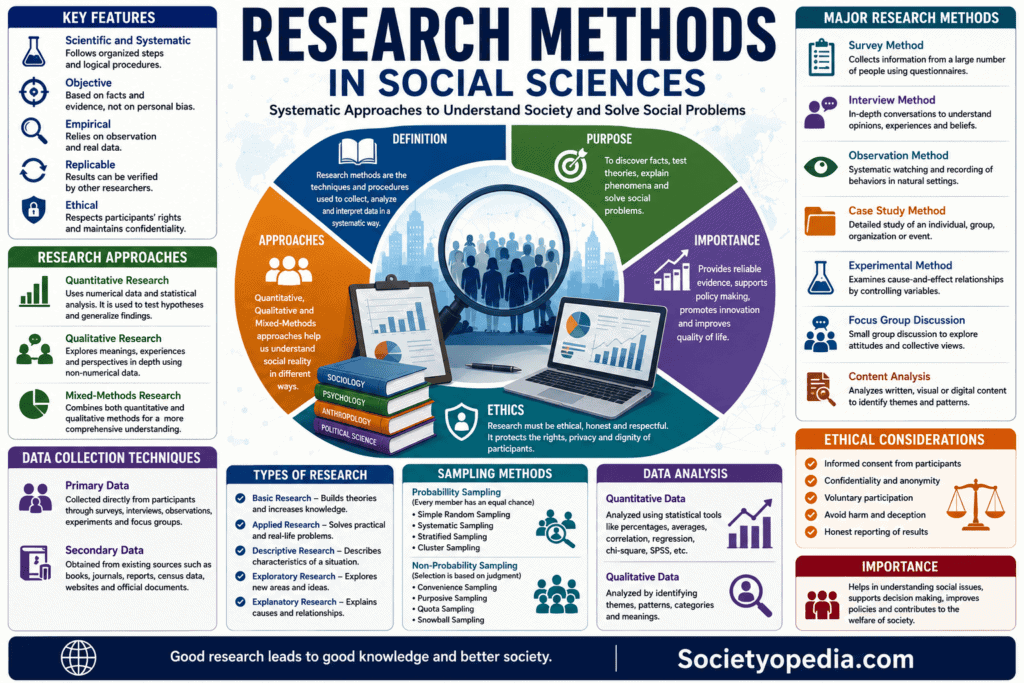
Qualitative research is one of the most important research approaches used in the social sciences. It focuses on understanding human experiences, beliefs, attitudes, emotions, behaviors, and social interactions through detailed and descriptive data rather than numerical measurements. Unlike quantitative research, which relies on statistics and numerical analysis, qualitative research aims to explore the meanings people attach to their experiences and social realities.
Qualitative research is widely used in sociology, anthropology, psychology, education, political science, gender studies, and other social science disciplines because it provides a deep understanding of complex social issues. Researchers use qualitative methods to explore people’s perspectives, cultural practices, social relationships, and lived experiences in their natural settings.
Definition of Qualitative Research
Different scholars have defined qualitative research from various perspectives.
According to John W. Creswell, qualitative research is an approach for exploring and understanding the meaning individuals or groups assign to social or human problems.
According to Norman K. Denzin and Yvonna S. Lincoln, qualitative research studies phenomena in their natural settings by attempting to interpret meanings people bring to them.
According to Earl Babbie, qualitative research emphasizes detailed observations, interviews, and descriptions to understand social behavior and human experiences.
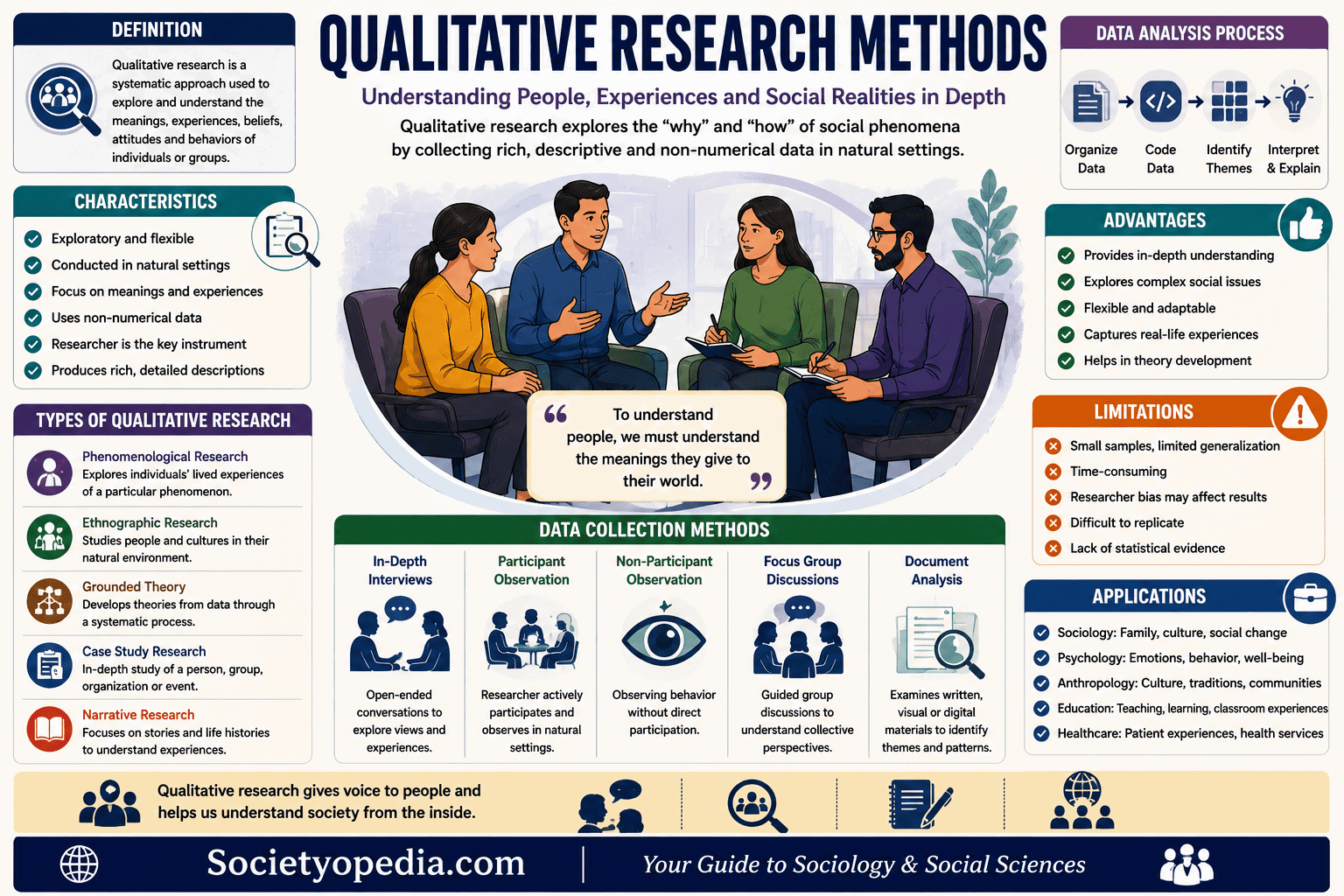
In simple words, qualitative research is a systematic method of studying people, cultures, and social phenomena by collecting descriptive information rather than numerical data.
Characteristics of Qualitative Research
Qualitative research is exploratory in nature because it seeks to discover new insights and understand complex social situations. It is conducted in natural settings where researchers observe or interact with participants in their everyday environments.
This approach focuses on meanings, experiences, and interpretations rather than numbers. Researchers collect detailed information that helps explain why people think or behave in certain ways.
Qualitative research is flexible because research questions and methods may evolve as the study progresses. It also emphasizes the researcher’s close interaction with participants to gain a deeper understanding of the subject.
Another important characteristic is that qualitative research produces rich, detailed descriptions that provide a comprehensive understanding of social reality.
Objectives of Qualitative Research
The primary objective of qualitative research is to understand people’s experiences, beliefs, values, attitudes, and behaviors.
It seeks to explore social phenomena in depth rather than measuring them statistically.
Qualitative research also aims to identify patterns, themes, relationships, and meanings that may not be visible through numerical analysis.
Researchers use qualitative methods to generate theories, explain social processes, and understand cultural practices.
Types of Qualitative Research
Phenomenological Research
Phenomenological research focuses on understanding people’s lived experiences regarding a particular phenomenon.
Researchers explore how individuals perceive and interpret specific events or situations in their lives.
Ethnographic Research
Ethnography is widely used in sociology and anthropology. It involves studying people and cultures in their natural environments over an extended period.
Researchers often use participant observation to understand customs, traditions, behaviors, and social interactions.
Grounded Theory
Grounded theory aims to develop new theories directly from collected data rather than testing existing theories.
Researchers continuously collect and analyze data until meaningful concepts and theoretical explanations emerge.
Case Study Research
A case study involves an in-depth investigation of a single individual, family, organization, community, institution, or event.
Case studies provide detailed information about complex social situations and are especially useful for understanding unique or rare cases.
Narrative Research
Narrative research focuses on collecting and analyzing people’s stories, life histories, and personal experiences.
Researchers examine how individuals describe important events and how these experiences shape their identities.
Data Collection Methods in Qualitative Research
In-Depth Interviews
Interviews are among the most common methods in qualitative research. Researchers ask open-ended questions that encourage participants to share detailed experiences and opinions.
Interviews may be structured, semi-structured, or unstructured depending on the research objectives.
Participant Observation
Participant observation involves the researcher becoming actively involved in the community or group being studied while observing behaviors and interactions.
This method allows researchers to understand social life from the participants’ perspective.
Non-Participant Observation
In non-participant observation, researchers observe people without directly participating in their activities.
This method helps minimize interference while recording natural behaviors.
Focus Group Discussions
Focus groups involve guided discussions among a small group of participants.
Researchers use focus groups to understand collective opinions, attitudes, beliefs, and experiences related to a specific topic.
Document Analysis
Document analysis involves examining written materials such as books, diaries, newspapers, reports, official records, websites, and social media content.
Researchers analyze these materials to identify themes, meanings, and patterns.
Sampling in Qualitative Research
Qualitative research generally uses non-probability sampling because the goal is not statistical generalization but detailed understanding.
Purposive sampling involves selecting participants who have specific knowledge or experience related to the research topic.
Snowball sampling is useful when researchers need participants from difficult-to-reach populations. Existing participants help identify additional participants.
Convenience sampling selects participants who are easily available.
Quota sampling selects participants based on specific characteristics required for the study.
Data Analysis in Qualitative Research
Qualitative data analysis involves organizing, interpreting, and identifying patterns within descriptive information.
Researchers read interview transcripts, observation notes, and documents carefully to identify common themes and categories.
Coding is an important step where researchers assign labels to meaningful pieces of information.
After coding, researchers organize similar ideas into broader themes and develop interpretations based on participants’ experiences.
Advantages of Qualitative Research
Qualitative research provides detailed and comprehensive information about human behavior and social life.
It helps researchers understand participants’ feelings, motivations, beliefs, and perspectives.
The approach is flexible and allows researchers to modify questions and explore unexpected findings during the research process.
Qualitative research is particularly useful for studying new or complex social issues that cannot easily be measured numerically.
It contributes to theory development by generating new ideas and explanations based on real-life experiences.
Limitations of Qualitative Research
One limitation of qualitative research is that findings are usually based on small samples and may not represent the entire population.
The research process can be time-consuming because collecting and analyzing detailed information requires considerable effort.
Researcher bias may influence interpretation if objectivity is not maintained.
Qualitative findings are often difficult to replicate because different researchers may interpret data differently.
The approach generally does not provide statistical evidence for making broad generalizations.
Ethical Considerations in Qualitative Research
Researchers must obtain informed consent before collecting information from participants.
Confidentiality should be maintained by protecting participants’ identities and personal information.
Researchers must respect participants’ privacy and avoid causing emotional, psychological, or social harm.
Honesty, transparency, and accurate reporting of findings are essential ethical principles in qualitative research.
Applications of Qualitative Research in Social Sciences
Qualitative research is widely used in sociology to study family relationships, culture, socialization, gender roles, poverty, crime, and social movements.
In psychology, it helps researchers understand emotions, mental health, and human behavior.
In anthropology, qualitative methods are used to study cultures, traditions, and communities.
Education researchers use qualitative research to examine classroom experiences, teaching methods, and student learning.
Healthcare researchers use qualitative methods to understand patients’ experiences, healthcare delivery, and public health issues.
Difference Between Qualitative and Quantitative Research
Qualitative research focuses on meanings, experiences, and descriptive information, while quantitative research focuses on numerical measurements and statistical analysis.
Qualitative research uses smaller samples and open-ended data collection methods such as interviews and observations. Quantitative research generally uses larger samples and structured surveys or experiments.
Qualitative research aims to understand why and how social phenomena occur, whereas quantitative research measures the extent or relationship between variables.
Conclusion
Qualitative research methods play a vital role in the social sciences by providing deep insights into human behavior, culture, relationships, and social experiences. Through interviews, observations, case studies, ethnography, focus groups, and document analysis, researchers gain a detailed understanding of social realities that cannot be captured through numbers alone.
Although qualitative research has limitations such as smaller sample sizes and challenges in generalization, its ability to explore meanings, generate theories, and understand complex human experiences makes it an indispensable research approach in sociology and other social sciences.