Introduction
Sampling is one of the most important components of social science research. In most research studies, it is impossible to collect data from every member of a population because of limitations such as time, cost, and accessibility. Therefore, researchers select a smaller group of individuals that represents the larger population. This process is known as sampling, and the selected group is called a sample.
Sampling techniques help researchers obtain reliable and valid data while reducing the time and resources required for research. The choice of a sampling technique depends on the research objectives, the nature of the population, the research design, and the availability of resources. Proper sampling improves the accuracy of findings and allows researchers to make meaningful conclusions about the entire population.

Definition of Sampling
Different scholars have defined sampling from different perspectives.
According to C. R. Kothari, sampling is the process of selecting a sufficient number of elements from a population so that by studying the sample, researchers can understand the characteristics of the entire population.
According to Earl Babbie, sampling is the process of selecting observations from a population to represent the characteristics of the whole population.
According to John W. Creswell, sampling involves selecting participants who can provide useful information to answer the research questions effectively.
In simple words, sampling is the process of selecting a representative portion of a population for research purposes.
Population and Sample
A population refers to the complete group of individuals, objects, or events that share common characteristics and are the focus of a research study. For example, if a researcher wants to study all university students in Pakistan, then all university students constitute the population.
A sample is a smaller group selected from the population. Researchers collect data from the sample and use the findings to conclude the entire population.
The quality of research largely depends on how accurately the sample represents the population.
Characteristics of a Good Sample
A good sample should accurately represent the characteristics of the target population. It should be selected using appropriate scientific methods to reduce bias.
The sample should be large enough to provide reliable findings while remaining manageable in terms of time and cost.
Another important characteristic is that every selected participant should provide relevant information related to the research objectives.
Types of Sampling Techniques
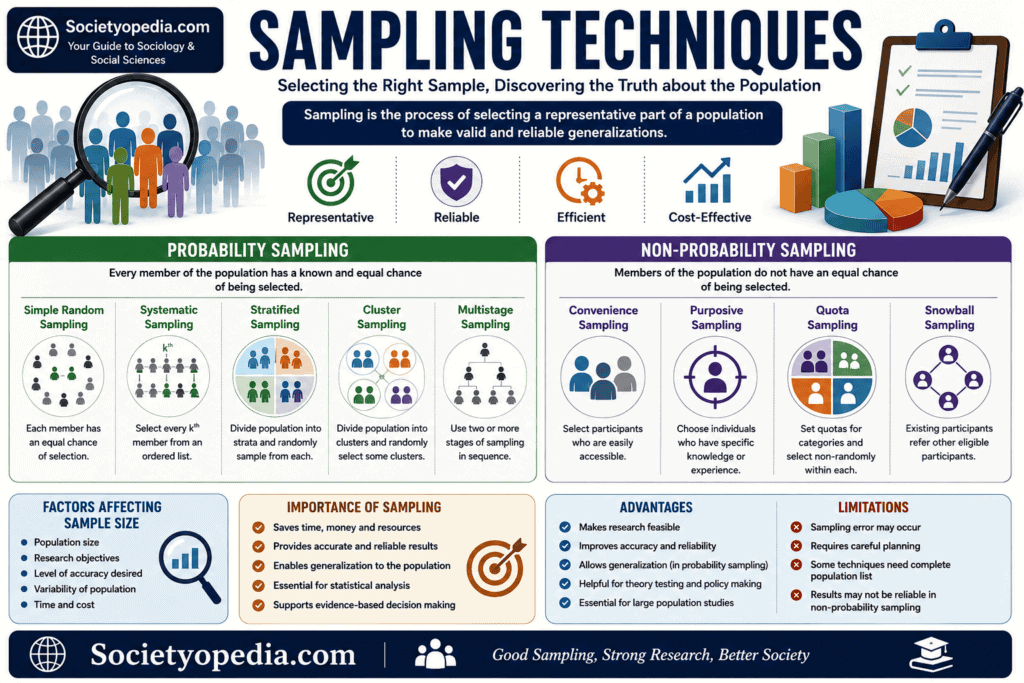
Sampling techniques are broadly divided into two major categories: probability sampling and non-probability sampling.
Probability Sampling
Probability sampling is a scientific sampling method in which every member of the population has a known and equal chance of being selected. Because selection is based on chance rather than personal judgment, probability sampling reduces bias and improves the generalizability of research findings.
Probability sampling is commonly used in quantitative research.
Simple Random Sampling
Simple random sampling is the most basic probability sampling technique. Every individual in the population has an equal chance of being selected.
Researchers often use random number tables, lottery methods, or computer-generated random numbers to select participants.
This method minimizes selection bias and provides highly representative samples when the population is homogeneous.
Systematic Sampling
Systematic sampling involves selecting every nth member from a population list after choosing a random starting point.
For example, if a researcher wants to select 100 participants from a population of 1,000, every 10th individual may be selected.
This method is simple, efficient, and easy to implement.
Stratified Sampling
Stratified sampling divides the population into different groups, known as strata, based on characteristics such as age, gender, occupation, education, or region.
Researchers then select participants randomly from each stratum according to their proportion in the population.
This method ensures that all important groups are adequately represented.
Cluster Sampling
Cluster sampling divides the population into naturally occurring groups or clusters, such as schools, villages, hospitals, or districts.
Researchers randomly select several clusters and then study all or selected individuals within those clusters.
Cluster sampling is especially useful when the population is geographically dispersed.
Multistage Sampling
Multistage sampling combines two or more probability sampling methods in different stages.
For example, researchers may first select provinces, then districts, then schools, and finally students within those schools.
This technique is commonly used in large-scale national surveys.
Non-Probability Sampling
Non-probability sampling does not give every member of the population an equal chance of being selected. Selection is based on the researcher’s judgment, convenience, or specific research needs.
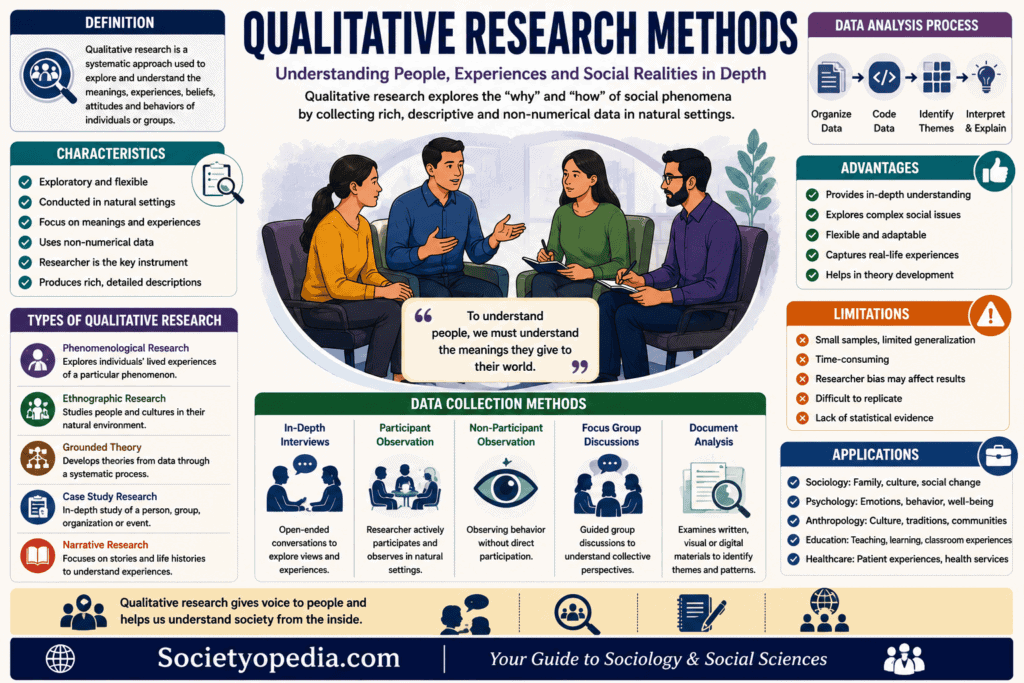
Non-probability sampling is frequently used in qualitative research and exploratory studies.
Convenience Sampling
Convenience sampling involves selecting participants who are easiest to access.
Researchers choose individuals who are readily available and willing to participate.
Although this method saves time and resources, it may not accurately represent the entire population.
Purposive Sampling
Purposive sampling involves selecting participants based on their knowledge, expertise, or experience related to the research topic.
Researchers deliberately choose individuals who can provide rich and relevant information.
This technique is widely used in qualitative research.
Quota Sampling
Quota sampling divides the population into categories and selects participants until a predetermined quota for each category is reached.
Unlike stratified sampling, participant selection within each category is not random.
Quota sampling ensures representation of important population groups.
Snowball Sampling
Snowball sampling is useful for studying hidden or difficult-to-reach populations.
Researchers begin with a small number of participants who then recommend other individuals with similar characteristics.
This method is commonly used in studies involving migrants, marginalized communities, or specialized professional groups.
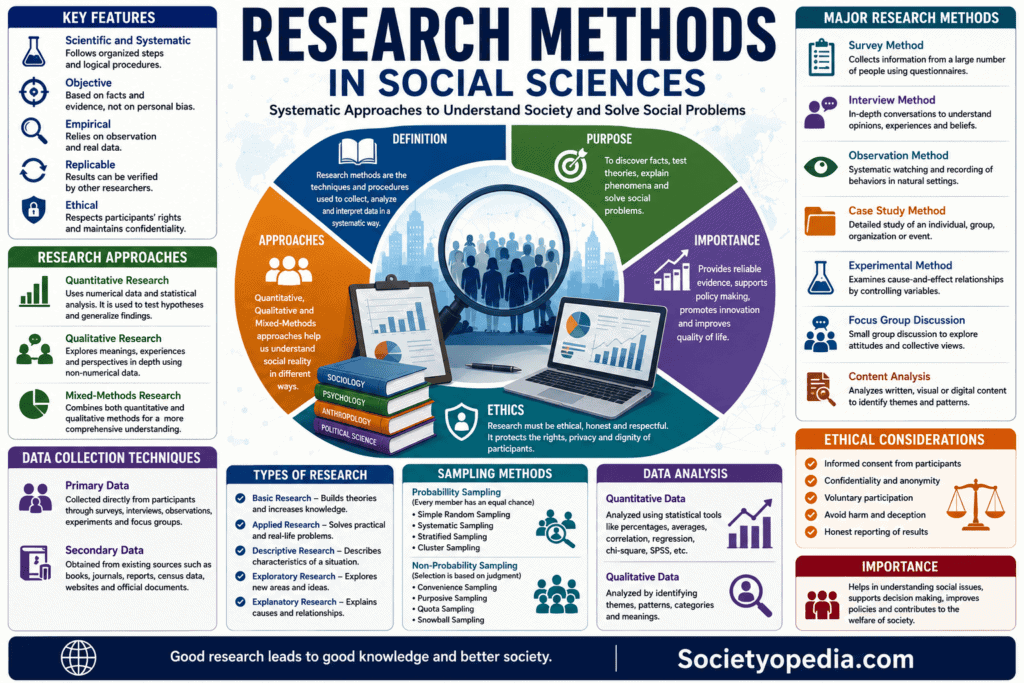
Research Methods in Social Sciences: Definition, Types, Approaches, Techniques and Importance
Factors Affecting Sample Size
The size of the sample depends on several factors, including the size of the population, the objectives of the study, available resources, desired level of accuracy, and variability within the population.
Larger samples generally produce more accurate and reliable results, although they also require more time and resources.
Advantages of Probability Sampling
Probability sampling minimizes researcher bias because participant selection is based on chance.
It allows researchers to generalize findings from the sample to the larger population with greater confidence.
The method supports statistical analysis and hypothesis testing.
Probability sampling is considered more reliable and scientifically rigorous.
Limitations of Probability Sampling
Probability sampling often requires complete population lists, which may not always be available.
It can be expensive and time-consuming, particularly for large populations.
Some probability sampling techniques require advanced statistical knowledge and careful planning.
Advantages of Non-Probability Sampling
Non-probability sampling is easier, faster, and less expensive than probability sampling.
It is particularly useful for exploratory research and qualitative studies.
Researchers can select participants who have specialized knowledge or unique experiences relevant to the study.
It is suitable for studying rare or hard-to-reach populations.
Limitations of Non-Probability Sampling
Non-probability sampling is more vulnerable to researcher bias because selection is not random.
Research findings cannot always be generalized to the entire population.
The sample may not accurately represent the diversity of the population.
Statistical inference is more limited compared to probability sampling.
Difference Between Probability and Non-Probability Sampling
Probability sampling uses random selection and provides equal opportunities for all members of the population to be selected. It is mainly associated with quantitative research and supports statistical generalization.
Non-probability sampling uses non-random selection methods based on convenience, judgment, or referrals. It is commonly used in qualitative research where the objective is to gain detailed understanding rather than statistical representation.
Importance of Sampling Techniques
Sampling techniques play a vital role in improving research quality and efficiency. They enable researchers to study large populations without collecting data from every individual.
Proper sampling reduces research costs, saves time, and ensures that collected data accurately represent the population.
Sampling also supports valid statistical analysis and helps researchers make reliable conclusions about social phenomena.
In policy research, education, healthcare, sociology, and public administration, appropriate sampling techniques contribute to evidence-based decision-making.
Applications of Sampling in Social Sciences
Sampling techniques are widely used in sociology to study family structures, poverty, crime, migration, education, public opinion, and social mobility.
Psychologists use sampling to study behavior, personality, and mental health.
Political scientists use sampling during election surveys and opinion polls.
Healthcare researchers use sampling to evaluate disease prevalence, healthcare quality, and treatment outcomes.
Educational researchers use sampling to assess student performance, teaching methods, and educational policies.
Conclusion
Sampling techniques are an essential part of social science research because they allow researchers to obtain meaningful information from a representative portion of a population. By selecting appropriate probability or non-probability sampling methods, researchers can collect reliable data, reduce research costs, and improve the accuracy of their findings.
Understanding the strengths and limitations of each sampling technique helps researchers choose the most suitable method for their study. Whether conducting quantitative surveys or qualitative interviews, effective sampling ensures that research findings are valid, reliable, and useful for advancing knowledge and solving social problems.