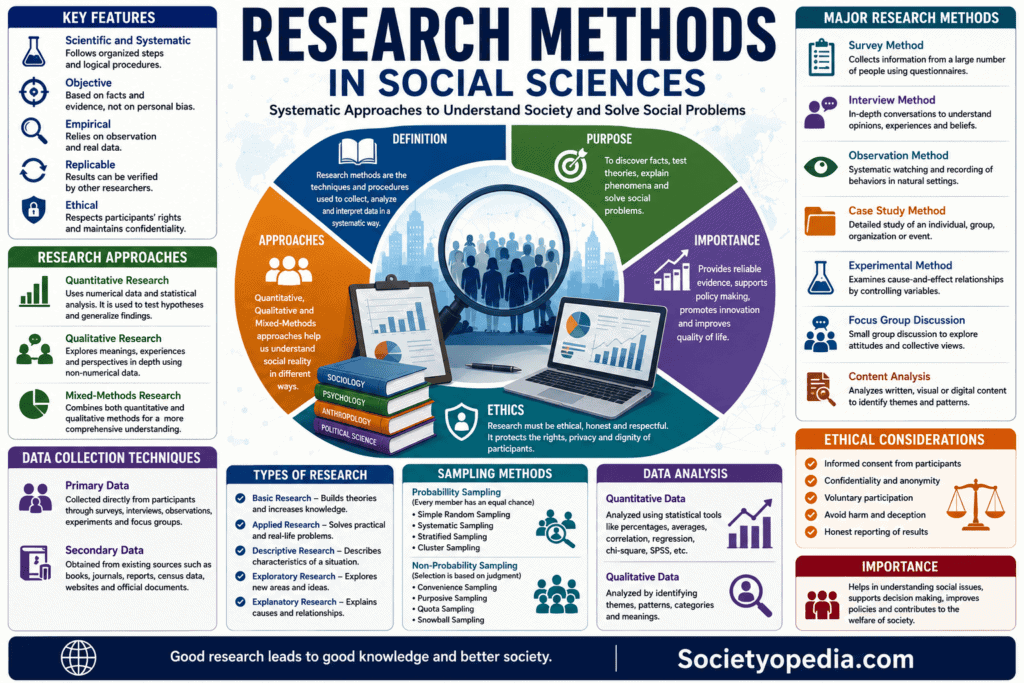
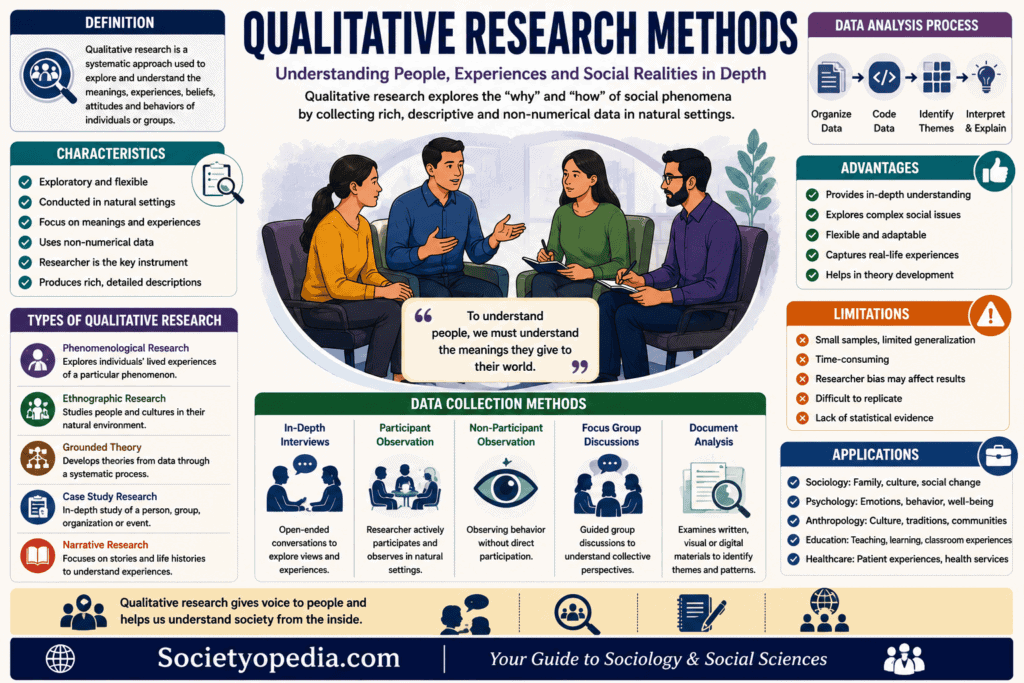
Non-probability sampling is one of the two major categories of sampling techniques used in research, the other being probability sampling. Unlike probability sampling, where every member of the population has a known chance of being selected, non-probability sampling does not rely on random selection. Instead, participants are selected based on the researcher’s judgment, convenience, availability, or specific characteristics relevant to the research objectives.
Non-probability sampling is widely used in qualitative research, exploratory studies, case studies, ethnographic research, phenomenological studies, grounded theory, and action research. It is particularly useful when researchers are studying specialized populations, hidden groups, or situations where obtaining a complete sampling frame is impossible or impractical.
In many real-world research settings, researchers cannot randomly select participants due to time constraints, financial limitations, ethical concerns, or the nature of the population. For example, a sociologist studying victims of domestic violence, drug users, refugees, or homeless individuals may find probability sampling impossible because these populations are difficult to identify and access. In such cases, non-probability sampling becomes the most practical and effective approach.
Although non-probability sampling limits the ability to generalize findings to the entire population, it provides rich, detailed, and context-specific information that is invaluable for understanding complex social phenomena. Researchers often use it during the early stages of research to explore new topics, generate hypotheses, and gain deeper insights into human experiences.
This article explains the concept, definitions, characteristics, types, process, advantages, disadvantages, applications, and practical examples of non-probability sampling.

What Is Non-Probability Sampling?
Non probability sampling is a sampling technique in which participants are selected using non-random methods. The probability of each member of the population being selected is unknown, and not every individual has an equal opportunity to participate.
Instead of relying on randomization, researchers select participants based on specific criteria such as accessibility, expertise, experience, willingness to participate, or the purpose of the study.
For example, a researcher investigating the experiences of female entrepreneurs may deliberately select successful women entrepreneurs who possess relevant knowledge rather than randomly selecting women from the general population.
Non-probability sampling is especially suitable when the research aims to gain in-depth understanding rather than make statistical generalizations.
Definitions of Non-Probability Sampling
Several scholars have defined non probability sampling from different perspectives.
Earl Babbie defines non-probability sampling as a sampling method in which participants are selected without randomization, making it impossible to determine each individual’s probability of selection.
William Lawrence Neuman explains that non-probability sampling relies on the researcher’s judgment, convenience, or other non-random criteria for selecting participants.
John W. Creswell describes non-probability sampling as a technique commonly used in qualitative research where participants are intentionally selected because they can provide valuable information about the phenomenon being studied.
Ranjit Kumar defines non-probability sampling as a method in which participants are selected according to the purpose of the study rather than through random procedures.
These definitions highlight three important characteristics:
- Selection is non-random.
- Probability of selection is unknown.
- Participants are chosen based on research needs.
Characteristics of Non Probability Sampling
Non-probability sampling has several distinctive characteristics.
Non-Random Selection
Participants are selected using methods other than randomization.
Unknown Probability of Selection
Researchers cannot calculate the probability that a particular individual will be included in the sample.
Researcher Judgment
The researcher’s experience and knowledge often influence participant selection.
Suitable for Qualitative Research
Non-probability sampling is widely used in qualitative and exploratory studies.
Flexible Sampling Process
Researchers can modify participant selection as the study progresses.
Limited Generalizability
Findings cannot usually be generalized to the entire population with statistical confidence.
Objectives of Non Probability Sampling
The primary objective of non-probability sampling is to obtain information-rich participants who can provide meaningful insights into the research problem.
Other objectives include:
- Exploring new or poorly understood issues.
- Studying rare or hidden populations.
- Collecting in-depth qualitative data.
- Conducting research with limited resources.
- Generating hypotheses for future studies.
- Understanding experiences, perceptions, and behaviors.
Types of Non-Probability Sampling
Non-probability sampling includes several commonly used techniques.
Convenience Sampling
Convenience sampling involves selecting participants who are easiest to access and willing to participate.
Researchers choose individuals based on availability rather than random selection.
Example
A researcher studying students’ study habits surveys students who are present in the university library during data collection.
Advantages
- Very easy to implement.
- Fast and inexpensive.
- Suitable for pilot studies.
Limitations
- High risk of selection bias.
- Limited representativeness.
Purposive Sampling
Purposive sampling, also called judgmental sampling, involves selecting participants who possess specific knowledge, experience, or characteristics relevant to the study.
Example
A sociologist studying women in leadership interviews only female CEOs and senior managers.
Advantages
- Produces rich and detailed information.
- Suitable for specialized populations.
- Highly effective in qualitative research.
Limitations
- Depends heavily on researcher judgment.
- Limited ability to generalize findings.
Quota Sampling
Quota sampling divides the population into categories and selects participants until a predetermined quota for each category is reached.
Unlike stratified sampling, selection within each category is not random.
Example
A researcher wants a sample of 200 people consisting of 100 males and 100 females. Participants are selected at convenience until each quota is met.
Advantages
- Ensures representation of important subgroups.
- Faster than probability sampling.
- Easy to organize.
Limitations
- Selection within groups may be biased.
- Does not eliminate researcher bias.
Snowball Sampling
Snowball sampling is used when members of the target population are difficult to locate.
Researchers begin with a few participants who then refer other eligible individuals.
The sample gradually grows like a rolling snowball.
Example
A researcher studying undocumented migrants interviews a few participants who then introduce additional respondents.
Advantages
- Effective for hidden populations.
- Builds trust among participants.
- Useful for sensitive research topics.
Limitations
- Sample may become homogeneous.
- Difficult to ensure representativeness.
Steps in Conducting Non Probability Sampling
Step 1: Define the Research Problem
Clearly identify the purpose and objectives of the study.
Step 2: Identify the Target Population
Determine the individuals or groups relevant to the research.
Step 3: Select an Appropriate Sampling Technique
Choose convenience, purposive, quota, or snowball sampling based on research needs.
Step 4: Establish Selection Criteria
Develop clear criteria for participant inclusion.
Step 5: Recruit Participants
Identify and invite participants using the selected sampling method.
Step 6: Collect Data
Gather information through interviews, questionnaires, observations, or focus groups.
Step 7: Analyze and Interpret Findings
Interpret the data while acknowledging the limitations associated with non-probability sampling.
Advantages of Non-Probability Sampling
Non-probability sampling offers several practical advantages.
Easy to Implement
Researchers can quickly recruit participants without complex sampling procedures.
Cost Effective
The method requires fewer financial and logistical resources than probability sampling.
Time Efficient
Data collection can begin immediately without preparing a complete sampling frame.
Suitable for Qualitative Research
It enables researchers to collect detailed and meaningful information.
Useful for Hidden Populations
Researchers can study populations that are difficult to identify or access.
Flexible
Participant selection can be adjusted during the research process.
Disadvantages of Non Probability Sampling
Despite its usefulness, non-probability sampling has several limitations.
Selection Bias
Participants are not selected randomly, increasing the possibility of bias.
Limited Generalizability
Findings cannot be confidently generalized to the broader population.
Unknown Sampling Error
Researchers cannot calculate sampling error because selection probabilities are unknown.
Researcher Subjectivity
Participant selection may be influenced by personal judgment.
Reduced External Validity
Results may not accurately represent the target population.
Non-Probability Sampling vs Probability Sampling
| Feature | Non-Probability Sampling | Probability Sampling |
|---|---|---|
| Selection Method | Non-random | Random |
| Chance of Selection | Unknown | Known |
| Sampling Bias | Higher | Lower |
| Generalization | Limited | Strong |
| Sampling Frame | Usually not required | Required |
| Statistical Analysis | Limited | Extensive |
| Cost | Lower | Higher |
| Common Use | Qualitative Research | Quantitative Research |
Applications of Non-Probability Sampling
Non-probability sampling is widely used across many research disciplines.
In sociology, researchers use it to study marginalized communities, social movements, gender issues, migration, and community development.
In psychology, it helps investigate rare psychological conditions, counseling experiences, and behavioral patterns.
In education, researchers use non-probability sampling to explore teachers’ experiences, classroom practices, and educational innovations.
In public health, it is commonly used to study patients with rare diseases, healthcare professionals, and vulnerable populations.
Businesses apply non-probability sampling in market research, consumer interviews, product testing, and customer feedback studies.
Challenges in Using Non-Probability Sampling
Researchers often face challenges such as participant bias, difficulty in ensuring diversity, and limitations in generalizing findings. Since participants are selected intentionally rather than randomly, the sample may not accurately represent the broader population. Maintaining objectivity during participant selection also requires careful planning and transparent reporting.
Best Practices for Using Non-Probability Sampling
Researchers should clearly explain why a non-probability sampling technique was selected and describe the participant selection criteria in detail. Using well-defined inclusion and exclusion criteria helps reduce bias. Combining multiple data sources and maintaining transparency throughout the sampling process can further strengthen the credibility of the research.
Conclusion
Non-probability sampling is a valuable sampling technique that plays a central role in qualitative, exploratory, and applied research. Allowing researchers to select participants based on accessibility, expertise, or specific characteristics provides flexibility and enables the study of complex, specialised, or hard-to-reach populations.
Although the method does not support statistical generalization and is more susceptible to selection bias, it remains indispensable for gaining rich, contextual, and in-depth insights into human experiences and social phenomena. Researchers who understand the strengths and limitations of non-probability sampling can choose the most appropriate approach for their research objectives.
For students and researchers, mastering non-probability sampling is essential for designing effective qualitative studies and understanding when non-random participant selection is the most appropriate methodological choice. At Societyopedia, learning about non-probability sampling helps build a comprehensive understanding of research methodology and equips scholars with the skills needed to conduct meaningful and impactful research.
Frequently Asked Questions (FAQs)
What is non-probability sampling?
Non-probability sampling is a sampling technique in which participants are selected using non-random methods, and the probability of selection for each population member is unknown.
What are the main types of non-probability sampling?
The four major types are convenience sampling, purposive sampling, quota sampling, and snowball sampling.
When is non-probability sampling used?
It is commonly used in qualitative research, exploratory studies, case studies, and research involving hidden or specialized populations.
What is the biggest limitation of non-probability sampling?
Its main limitation is that findings cannot usually be generalized to the entire population because participants are not selected randomly.
What is the difference between probability and non-probability sampling?
Probability sampling uses random selection and supports statistical generalization, whereas non-probability sampling uses non-random selection methods and is primarily intended for in-depth exploration rather than population-level inference.