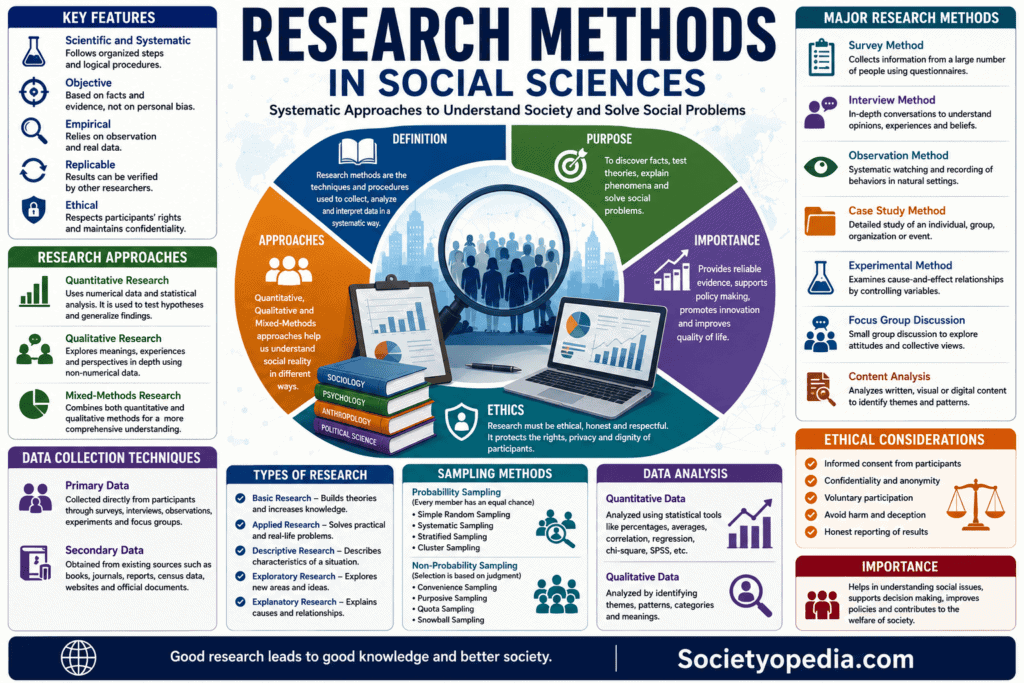
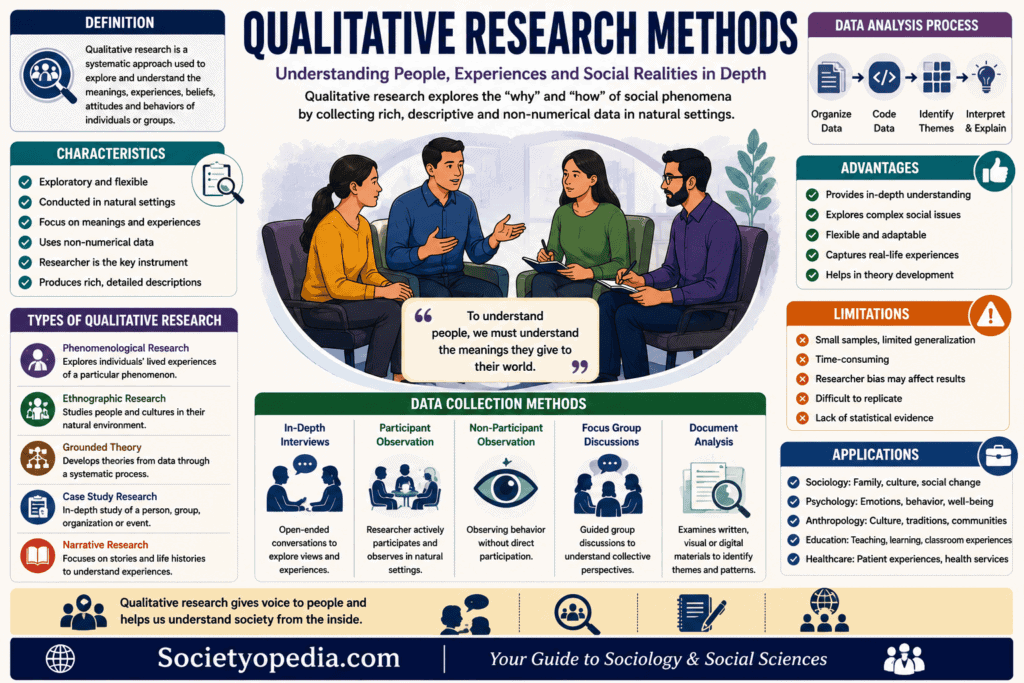
Convenience sampling is one of the simplest and most widely used non-probability sampling techniques in research. As its name suggests, this method involves selecting participants who are easiest to access, readily available, and willing to participate in the study. Unlike probability sampling, convenience sampling does not use random selection, meaning that not every member of the population has an equal chance of being included in the sample.
Researchers frequently use convenience sampling when there are limitations of time, budget, manpower, or accessibility. It is particularly common in pilot studies, exploratory research, classroom projects, market research, and qualitative studies where the primary objective is to gain initial insights rather than make statistical generalizations.
For example, a sociology student conducting research on social media usage among university students may distribute questionnaires to classmates or students present in the university cafeteria because they are easily accessible. Although this sample may not perfectly represent all university students, it provides useful information that can guide future research.
Convenience sampling is often criticized for its high risk of sampling bias and limited representativeness. However, when used appropriately and with an understanding of its limitations, it remains a valuable research technique, especially in the early stages of investigation or when studying easily accessible populations.
This article explains the concept, definitions, characteristics, process, advantages, disadvantages, applications, examples, and best practices of convenience sampling.

What Is Convenience Sampling?
Convenience sampling is a non-probability sampling technique in which participants are selected based on their availability, accessibility, and willingness to participate rather than through random selection.
In this method, researchers include individuals who are easiest to reach at the time of data collection. Since participants are chosen because they are convenient rather than randomly selected, the probability of selection for each member of the population is unknown.
For instance, a researcher investigating customer satisfaction may interview shoppers leaving a supermarket because they are readily available, instead of randomly selecting customers from the entire city.
Convenience sampling is particularly useful when researchers need quick access to participants or when a complete list of the population is unavailable.
Definitions of Convenience Sampling
Several research scholars have defined convenience sampling.
Earl Babbie defines convenience sampling as a non-probability sampling method in which participants are selected simply because they are available and accessible to the researcher.
William Lawrence Neuman explains that convenience sampling involves selecting participants based on ease of access rather than random selection.
John W. Creswell describes convenience sampling as a method in which researchers choose participants because they are willing and available to participate in the study.
Ranjit Kumar defines convenience sampling as selecting the most conveniently available individuals who satisfy the research requirements.
These definitions emphasize three key principles:
- Participants are selected because they are easily accessible.
- Selection is non-random.
- The method prioritizes practicality over representativeness.
Characteristics of Convenience Sampling
Convenience sampling has several distinctive characteristics.
Non-Random Selection
Participants are chosen based on convenience rather than chance.
Easy Accessibility
Researchers recruit participants who are readily available.
Time Efficient
The sampling process can be completed quickly without complex planning.
Low Cost
Convenience sampling requires fewer financial and logistical resources than probability sampling methods.
Flexible
Researchers can begin data collection immediately without preparing a sampling frame.
Limited Representativeness
The sample may not accurately represent the characteristics of the entire population.
Objectives of Convenience Sampling
Convenience sampling is used to achieve several research objectives.
The primary objective is to collect data quickly and efficiently when time, budget, or resources are limited.
It is also used to conduct pilot studies, explore new research topics, test questionnaires, and generate preliminary findings before conducting larger studies.
Another objective is to provide researchers with practical access to participants when probability sampling is not feasible.
Steps in Conducting Convenience Sampling
Convenience sampling follows a straightforward process.
Step 1: Define the Research Objectives
Clearly identify the purpose of the study and the information needed.
Step 2: Identify the Target Population
Determine the group relevant to the research question.
Step 3: Locate Accessible Participants
Identify individuals who are easy to reach and willing to participate.
Step 4: Recruit Participants
Invite accessible individuals to take part in the study.
Step 5: Collect Data
Gather information using questionnaires, interviews, observations, or other research instruments.
Step 6: Analyze the Data
Interpret the findings while acknowledging the limitations of convenience sampling.
Types of Convenience Sampling
Although convenience sampling follows a single basic principle, researchers commonly use it in several ways.
Volunteer Sampling
Volunteer sampling involves selecting individuals who willingly volunteer to participate in the research.
Example
A researcher posts an online survey, and anyone interested can complete it voluntarily.
Advantages
- Easy to organize.
- Participants are usually motivated.
- Suitable for online research.
Limitations
- Volunteers may differ significantly from the general population.
- Results may be affected by self-selection bias.
Opportunity Sampling
Opportunity sampling involves selecting participants who are available at a particular place and time.
Example
A researcher studying consumer behavior interviews customers entering a shopping mall during the afternoon.
Advantages
- Very quick.
- Cost-effective.
- Suitable for field research.
Limitations
- May not represent the wider population.
- Results depend on who happens to be available.
Advantages of Convenience Sampling
Convenience sampling offers several practical benefits.
Easy to Conduct
Researchers can recruit participants without complicated sampling procedures.
Saves Time
Data collection can begin immediately without preparing a sampling frame.
Cost Effective
Minimal financial resources are required.
Suitable for Pilot Studies
Researchers often use convenience sampling to test research instruments before conducting larger studies.
Useful for Exploratory Research
The method helps researchers gain preliminary insights into new or poorly understood topics.
High Participant Availability
Participants are usually easy to locate and recruit.
Disadvantages of Convenience Sampling
Despite its advantages, convenience sampling has several important limitations.
High Selection Bias
Participants are selected based on convenience rather than randomization, increasing the likelihood of bias.
Limited Generalizability
The findings cannot usually be generalized to the entire population.
Poor Representativeness
The sample may not reflect the diversity of the target population.
Researcher Subjectivity
Researchers may unintentionally select participants who support their expectations.
Unknown Sampling Error
Since the probability of selection is unknown, sampling error cannot be calculated accurately.
Convenience Sampling vs Probability Sampling
| Feature | Convenience Sampling | Probability Sampling |
|---|---|---|
| Selection Method | Based on accessibility | Random selection |
| Chance of Selection | Unknown | Known |
| Sampling Bias | High | Low |
| Representativeness | Limited | High |
| Generalization | Limited | Strong |
| Cost | Low | Higher |
| Time Required | Short | Longer |
| Common Use | Qualitative & Pilot Research | Quantitative Research |
Convenience Sampling vs Purposive Sampling
| Feature | Convenience Sampling | Purposive Sampling |
|---|---|---|
| Selection Basis | Ease of access | Researcher’s judgment |
| Participant Expertise | Not necessary | Required |
| Purpose | Quick data collection | Information-rich participants |
| Research Type | Exploratory and Pilot Studies | Qualitative Research |
Applications of Convenience Sampling
Convenience sampling is widely used in various fields of research.
In sociology, it is used to study student behavior, community perceptions, social media use, and public attitudes during exploratory investigations.
In education, researchers use convenience sampling to evaluate classroom teaching methods, student satisfaction, and curriculum effectiveness.
In psychology, it is commonly used for laboratory experiments involving university students because they are easily accessible.
In public health, researchers may survey patients visiting a clinic during a specific period to obtain preliminary health-related information.
Businesses frequently use convenience sampling in market research to collect customer feedback, test new products, and evaluate consumer preferences.
It is also widely employed in academic dissertations, undergraduate research projects, and pilot studies before conducting large-scale surveys.
Challenges in Using Convenience Sampling
Researchers using convenience sampling often face challenges related to selection bias and limited representativeness. Since participants are chosen based on availability, the sample may not accurately reflect the characteristics of the target population. Researchers must also be cautious about overgeneralizing their findings because the results are usually specific to the sampled participants rather than the broader population.
Best Practices for Using Convenience Sampling
Researchers should clearly explain why convenience sampling was selected and acknowledge its limitations in the research report. Whenever possible, efforts should be made to recruit participants from diverse backgrounds to improve the variety of perspectives represented in the sample. Convenience sampling is most effective when used for exploratory research, pilot studies, or situations where probability sampling is impractical. Researchers should avoid making broad statistical generalizations based solely on convenience samples.
Conclusion
Convenience sampling is one of the easiest and most practical non-probability sampling techniques used in research. By selecting participants who are readily available and willing to participate, it enables researchers to collect data quickly and economically. Although the method is highly efficient and widely used in exploratory research, pilot studies, and qualitative investigations, it has important limitations, including selection bias and limited generalizability.
Researchers should use convenience sampling only when it aligns with the objectives of the study and should interpret the findings with appropriate caution. Understanding both the strengths and weaknesses of this technique allows researchers to choose the most suitable sampling method for their research design.
For students and researchers, mastering convenience sampling is essential for understanding the practical realities of data collection and recognizing when non-random sampling methods are appropriate. At Societyopedia, learning about convenience sampling strengthens methodological knowledge and helps researchers make informed decisions when designing effective research studies.
Frequently Asked Questions (FAQs)
What is convenience sampling?
Convenience sampling is a non-probability sampling technique in which participants are selected because they are easily accessible, available, and willing to participate.
Why is convenience sampling used?
It is used because it is quick, inexpensive, and practical, especially for exploratory research, pilot studies, and situations where probability sampling is not feasible.
Is convenience sampling a probability sampling method?
No. Convenience sampling is a non-probability sampling technique because participants are not selected through random methods.
What is the biggest limitation of convenience sampling?
The greatest limitation is selection bias, which reduces the representativeness of the sample and limits the ability to generalize findings.
Where is convenience sampling commonly used?
Convenience sampling is widely used in sociology, psychology, education, public health, business research, market surveys, and academic pilot studies where quick and economical data collection is required.