Employment is one of the most important areas of social and economic life. It provides income, professional identity, social status, independence, and opportunities for personal development. However, employment opportunities and experiences are not always distributed equally between women and men.
Gender inequality in employment occurs when people experience unequal access to jobs, wages, promotions, working conditions, leadership positions, or career opportunities because of gender.
Gender inequality in employment is not limited to whether someone has a job. It can occur throughout the entire employment process, from recruitment and hiring to promotion, wages, working conditions, leadership, and retirement.
The International Labour Organization (ILO) identifies equality of opportunity and treatment in employment and occupation as a fundamental principle, covering areas such as recruitment, promotion, training, remuneration, and termination.
Understanding gender inequality in employment is therefore essential for understanding gender discrimination, the gender pay gap, occupational segregation, workplace bias, and broader patterns of social inequality.
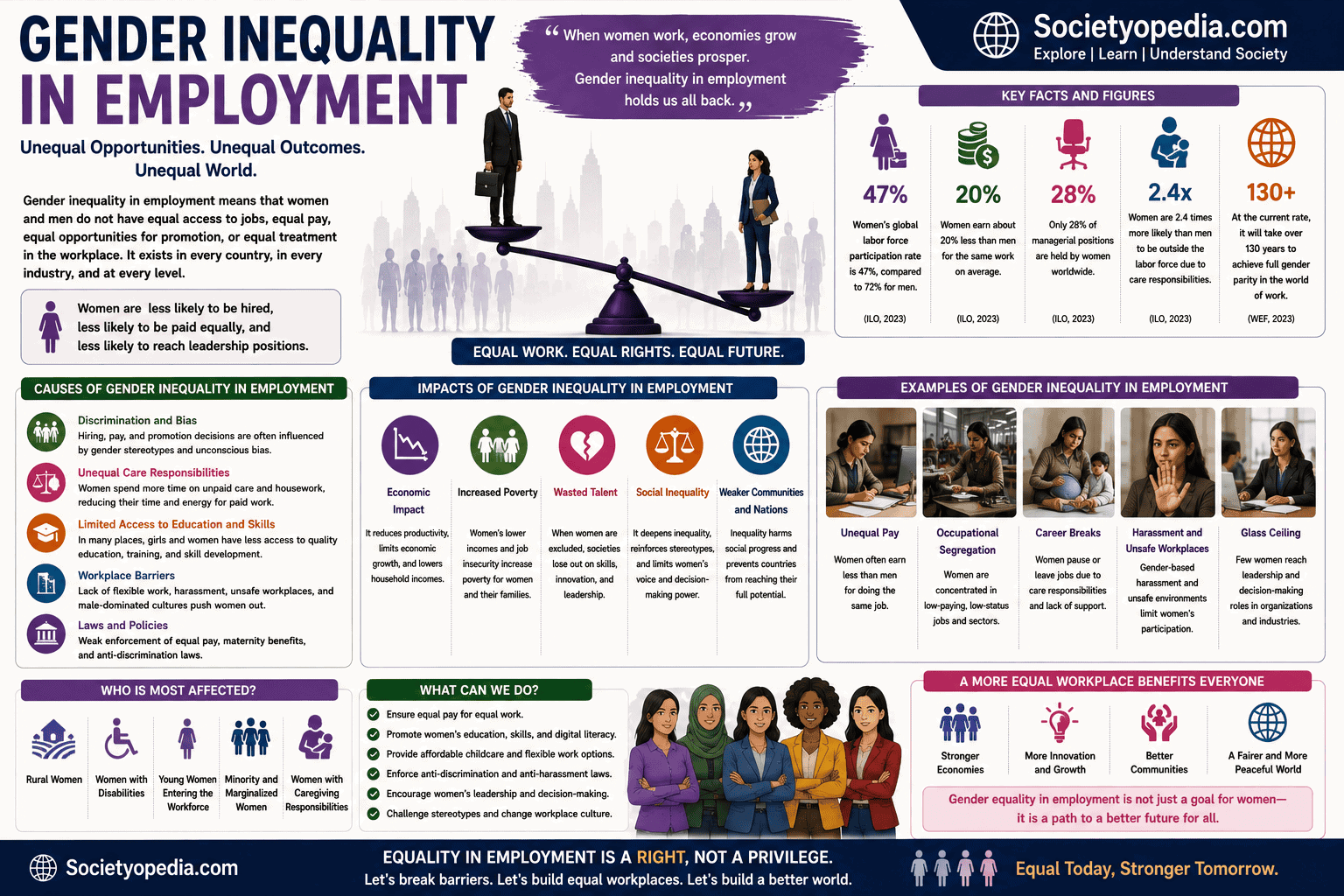
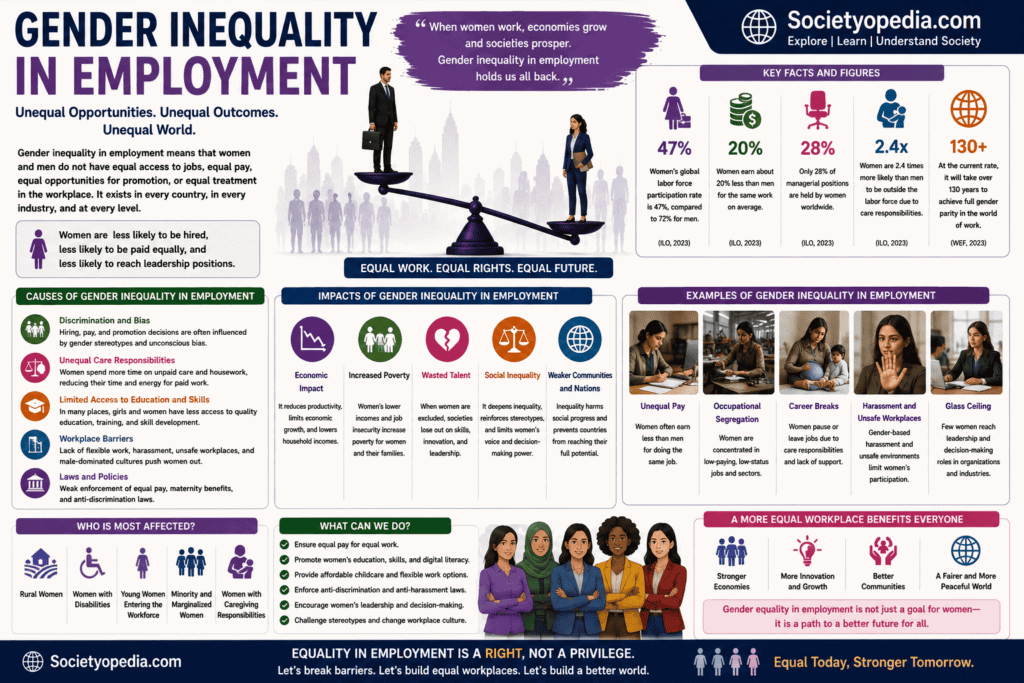
What Is Gender Inequality in Employment?
Gender inequality in employment refers to unequal opportunities, treatment, resources, rewards, or outcomes in the workplace based on gender.
It can occur when women or men have unequal access to:
- employment;
- wages and salaries;
- promotions;
- professional training;
- leadership positions;
- job security;
- workplace benefits;
- decision-making;
- flexible working arrangements;
- professional networks.
Gender inequality can be obvious, such as refusing to hire someone because of gender.
It can also be subtle, such as assigning women more administrative responsibilities or assuming that mothers are less committed to their careers.
Gender Inequality in Employment in Sociology
From a sociological perspective, employment is not simply an economic activity.
Workplaces are social institutions in which power, status, culture, norms, and relationships operate.
Gender expectations can influence how employers evaluate workers and how employees understand their own roles.
For example, societies that associate women primarily with caregiving may influence employers to assume that female employees will prioritize family responsibilities over careers.
Similarly, societies that associate men with financial provision may place pressure on men to work long hours and achieve occupational success.
Gender inequality in employment is therefore connected with wider cultural expectations about femininity and masculinity.
Gender Inequality in Employment vs Gender Discrimination
The two concepts are closely related but should not be treated as identical.
Gender discrimination refers to unfair treatment or exclusion based on gender.
Gender inequality in employment refers to broader unequal opportunities or outcomes within employment.
Discrimination can contribute to employment inequality, but inequality can also result from occupational segregation, unequal caregiving responsibilities, historical patterns, workplace structures, and social norms.
For example, if women are concentrated in lower-paid occupations because of social expectations, inequality may exist even without an employer explicitly stating that women should earn less.
Gender Inequality in Hiring
Hiring is one of the first points at which workplace inequality can occur.
Employers may consciously or unconsciously make assumptions about candidates based on gender.
For example, an employer might assume that a woman will eventually leave work because of marriage or children.
Another employer may assume that a man is more suitable for a physically demanding or leadership-oriented position.
Such assumptions can influence recruitment decisions even when candidates have similar qualifications.
The ILO emphasizes that discrimination can occur at the recruitment stage and throughout the employment relationship.
Gender Inequality in Employment Opportunities
Women and men may have different levels of access to employment opportunities because of social expectations, education, mobility restrictions, family responsibilities, and labor-market structures.
In some societies, women face restrictions on where and when they can work.
Transportation and workplace safety can also influence women’s ability to accept employment, particularly when jobs require long-distance travel or late working hours.
Family expectations can further limit employment choices when women are expected to remain primarily responsible for domestic work.
These factors demonstrate that employment inequality can originate outside the workplace itself.
Gender Inequality in Career Advancement
Obtaining a job does not guarantee equal career progression.
Women may encounter barriers to promotion, professional networking, training, or leadership opportunities.
A qualified employee may be overlooked because of assumptions about leadership ability or future family responsibilities.
Over time, small disadvantages can accumulate.
An employee who receives fewer training opportunities may have less experience.
Less experience can reduce promotion opportunities.
Fewer promotions can produce lower income and less access to senior decision-making positions.
This accumulation of disadvantages is one reason gender inequality can persist even when explicit discrimination is formally prohibited.
The Glass Ceiling
The glass ceiling refers to invisible barriers that make it difficult for women to reach the highest levels of organizational leadership.
The barrier is described as “glass” because it may not be a formal rule preventing promotion. Instead, social expectations, organizational cultures, stereotypes, informal networks, and biased evaluations may limit advancement.
For example, women may be highly represented among employees but become increasingly underrepresented at senior management levels.
The glass ceiling therefore demonstrates how inequality can persist through subtle institutional processes.
Occupational Segregation
Occupational segregation occurs when women and men are concentrated in different occupations or sectors.
For example, women may be disproportionately represented in teaching, nursing, administrative work, social care, and other service-oriented occupations.
Men may be more strongly represented in construction, engineering, transportation, certain technical fields, and some senior leadership positions.
Occupational segregation is not necessarily the result of one discriminatory decision.
It can develop through education, socialization, cultural expectations, career preferences, family responsibilities, hiring practices, and historical patterns.
However, occupational segregation can contribute to differences in pay, status, and career opportunities.
Horizontal and Vertical Occupational Segregation
Occupational segregation can be divided into two broad forms.
Horizontal Segregation
Horizontal segregation occurs when women and men are concentrated in different types of occupations.
For example, women may be concentrated in education and healthcare while men are concentrated in engineering and construction.
Vertical Segregation
Vertical segregation occurs when women and men occupy different levels of authority within the same occupation or sector.
For example, women may constitute a large proportion of employees in an organization but hold fewer senior management positions.
Both forms can contribute to gender inequality in employment.
Gender Pay Gap
The gender pay gap refers to the difference between the average earnings of women and men.
It is one of the most widely discussed indicators of gender inequality in employment.
The gender pay gap can result from several factors, including:
- occupational segregation;
- differences in working hours;
- career interruptions;
- unequal access to leadership;
- unpaid care responsibilities;
- differences in employment sectors;
- discrimination;
- workplace structures.
Therefore, the gender pay gap should not automatically be interpreted as meaning that every woman is paid less than every man for exactly the same job.
At the same time, discriminatory pay practices can be one contributor to unequal earnings.
The ILO’s principle of equal remuneration addresses the importance of equality in pay for work of equal value.
Gender Inequality and Unpaid Care Work
One of the strongest connections between family life and employment is unpaid care work.
Cooking, cleaning, childcare, and caring for older or dependent family members require significant time.
In many societies, women continue to perform a disproportionate share of unpaid domestic work.
This can reduce the time available for paid employment.
Women may therefore be more likely to:
- work part-time;
- take career breaks;
- accept flexible but lower-paid jobs;
- decline promotions requiring long hours;
- leave employment temporarily;
- work closer to home.
These choices are not necessarily individual preferences in isolation. They are influenced by family expectations, childcare availability, workplace policies, and social norms.
The Motherhood Penalty
The motherhood penalty refers to employment and economic disadvantages that mothers may experience because of assumptions and institutional conditions surrounding parenthood.
Employers may assume that mothers are less available or less committed to their careers.
Mothers may also experience career interruptions because of pregnancy, childbirth, and childcare.
This can affect earnings and promotion opportunities over time.
The problem becomes particularly significant when workplaces lack maternity protection, childcare support, flexible working arrangements, or reintegration opportunities.
The Fatherhood Premium
In some employment contexts, fathers can experience what researchers describe as a fatherhood premium, where parenthood may be associated with perceptions of greater responsibility or stability.
This contrasts with the motherhood penalty.
The difference demonstrates how the same family status can be interpreted differently depending on gender.
A father may be perceived as a committed provider, while a mother may be perceived as someone whose work commitment could be reduced by caregiving responsibilities.
These perceptions can influence workplace evaluations and career opportunities.
Gender Inequality in Leadership
Leadership remains an important area of employment inequality.
Women may be underrepresented in senior management, corporate boards, executive positions, and other decision-making roles.
Several factors can contribute to this pattern.
Gender stereotypes may associate authority and leadership with masculinity.
Women may have less access to informal professional networks.
Caregiving responsibilities may make extremely long or inflexible working arrangements more difficult.
Women may also face greater scrutiny of leadership style.
Increasing women’s participation in leadership can help challenge stereotypes and broaden representation in organizational decision-making.
Gender Bias in Performance Evaluation
Performance evaluations can also be affected by gender bias.
The same behavior may be interpreted differently depending on whether the employee is a woman or a man.
For example, assertiveness may be interpreted positively in a male employee but negatively in a female employee.
Similarly, a woman who is highly collaborative may be perceived as lacking authority, while a man displaying the same behavior may be described as a team-oriented leader.
Such differences can influence promotions, bonuses, professional reputation, and leadership opportunities.
Gender Inequality in Professional Networks
Career advancement often depends not only on formal qualifications but also on professional networks.
Networking can provide access to information, mentoring, job opportunities, recommendations, and leadership positions.
If women have less access to influential professional networks, they may have fewer opportunities for advancement.
Informal workplace cultures can unintentionally reproduce inequality when employees receive opportunities primarily through social relationships.
This is one reason transparent organizational systems and inclusive mentoring programs can be important.
Gender Inequality in Workplace Training
Training and professional development can influence career advancement.
If one gender receives fewer opportunities to attend training programs, conferences, leadership courses, or professional development activities, inequality can accumulate over time.
For example, an employee repeatedly excluded from advanced training may later be considered less qualified for promotion.
Equal access to professional development is therefore an important part of workplace equality.
Gender Inequality in Job Security
Job security can also vary by gender.
Workers in temporary, informal, part-time, or precarious employment may have fewer benefits and less protection.
Women are often disproportionately represented in certain forms of insecure or informal employment in many labor markets.
Family responsibilities can also push workers toward jobs offering flexibility but less security.
This creates an important sociological relationship between gender, labor-market structure, and economic security.
Gender Inequality in Informal Employment
Informal employment refers broadly to economic activities that may operate outside formal employment arrangements and protections.
Informal work can include various forms of self-employment, casual labor, domestic work, family-based economic activity, and other arrangements.
Women in informal employment may face limited social protection, unstable income, and restricted access to benefits.
However, the nature and scale of informal employment vary considerably between countries and sectors.
Understanding informal work is particularly important in developing economies where a significant proportion of economic activity may occur outside formal employment structures.
Gender Inequality and Entrepreneurship
Entrepreneurship can provide an important pathway toward economic independence.
However, women entrepreneurs may face barriers related to access to finance, property, business networks, training, technology, markets, and social expectations.
In some communities, women may have limited control over financial resources or mobility, making business development more difficult.
Gender stereotypes may also influence perceptions of women’s business leadership.
Improving women’s access to entrepreneurship can therefore contribute to employment equality and economic empowerment.
Gender Inequality in Employment in Pakistan
Gender inequality in employment is an important issue in Pakistan.
Women’s participation in paid employment is influenced by education, family responsibilities, cultural expectations, transportation, workplace safety, childcare, mobility, and the availability of suitable employment.
Rural and urban contexts can differ substantially.
Women may also face occupational segregation, with many working in education, healthcare, agriculture, home-based work, domestic work, and other sectors.
At the same time, increasing numbers of Pakistani women are participating in professional occupations, entrepreneurship, higher education, public service, healthcare, technology, and other fields.
The situation is therefore changing, but significant structural and cultural barriers remain.
For sociology students, Pakistan provides a useful case for examining how gender, culture, family, institutions, class, education, and labor markets interact.
Gender Inequality and Workplace Safety
Safety can influence employment opportunities.
Women may be less willing or able to accept jobs that require traveling long distances, working late hours, or entering environments perceived as unsafe.
Workplace harassment can also discourage women from entering or remaining in certain occupations.
Safe transportation, secure workplaces, effective reporting mechanisms, and supportive organizational cultures are therefore important components of employment equality.
Gender Harassment in Employment
Sexual harassment and other forms of gender-based harassment can affect workplace participation.
Harassment can create hostile environments and influence job satisfaction, mental well-being, retention, and career progression.
Employees may avoid reporting harassment because they fear retaliation, social stigma, damage to professional reputation, or loss of employment.
Effective workplace policies need not only to prohibit harassment but also to provide credible and accessible mechanisms for reporting and addressing complaints.
Causes of Gender Inequality: Major Social, Cultural, Economic and Institutional Factors
Effects of Gender Inequality in Employment
Gender inequality in employment can produce consequences at several levels.
Economic Effects
Unequal employment opportunities can reduce income and economic independence.
Social Effects
Employment inequality can reinforce traditional gender roles and social hierarchies.
Family Effects
Unequal income and employment opportunities can influence household decision-making and family wellbeing.
Career Effects
Limited promotions and training can create long-term professional disadvantages.
Psychological Effects
Repeated workplace bias and discrimination can contribute to stress, frustration, reduced confidence, and dissatisfaction.
Societal Effects
When qualified people cannot fully participate in employment, societies may fail to utilize available skills and human resources.
Why Gender Equality in Employment Matters
Employment provides more than income.
It can provide social identity, independence, professional networks, skills, confidence, and participation in public life.
Equal employment opportunities therefore contribute to broader social equality.
When women can participate equally in the labor market, households and economies can benefit from additional income and skills.
At the same time, gender equality in employment can benefit men by allowing them greater flexibility to participate in caregiving and pursue occupations without restrictive gender stereotypes.
Gender Inequality Examples: Real-Life Examples in Society, Education, Work and Family
How Can Gender Inequality in Employment Be Reduced?
Reducing employment inequality requires changes at multiple levels.
Fair Recruitment
Employers should use transparent, job-related criteria when recruiting workers.
Equal Pay
Organizations should regularly evaluate compensation systems and address unjustified pay differences.
Equal Promotion Opportunities
Promotion should be based on qualifications, performance, experience, and clearly defined criteria.
Family-Friendly Policies
Maternity protection, parental leave, childcare, and flexible working arrangements can help workers combine employment and family responsibilities.
Safe Workplaces
Organizations should provide effective mechanisms for preventing and addressing harassment and workplace violence.
Mentoring and Professional Development
Equal access to training and mentoring can support career advancement.
Flexible Working
Flexible arrangements can benefit both women and men while reducing the assumption that caregiving is exclusively a women’s responsibility.
Challenge Gender Stereotypes
Schools, families, media, and workplaces should challenge assumptions about which occupations are appropriate for women or men.
Effects of Gender Inequality: Social, Economic, Educational and Psychological Consequences
Gender Equality Benefits Both Women and Men
Gender equality in employment should not be understood only as a women’s issue.
Men can also benefit when gender expectations become more flexible.
For example, men who want to take parental leave or work flexible hours should not be treated as less committed employees.
Similarly, women should not be expected to sacrifice career opportunities because of family responsibilities.
A more equal employment system allows people to combine work and family responsibilities without assigning these roles strictly according to gender.
Conclusion
Gender inequality in employment refers to unequal opportunities, treatment, rewards, or outcomes in the labor market because of gender.
It can occur in hiring, wages, promotion, training, job security, leadership, professional networking, workplace safety, and career advancement.
The problem is connected to wider social structures. Gender stereotypes, unpaid care responsibilities, occupational segregation, family expectations, workplace cultures, and institutional practices can all contribute to employment inequality.
The consequences can be significant. Gender inequality in employment can reduce economic independence, limit career development, contribute to income inequality, reinforce traditional gender roles, and restrict the effective use of human skills and talent.
Reducing these inequalities requires more than simply prohibiting discrimination. Societies and organizations need fair recruitment and promotion systems, equal pay, family-friendly policies, safe workplaces, professional development opportunities, childcare support, and cultural changes that challenge restrictive gender expectations.
Ultimately, gender equality in employment means creating conditions in which people can pursue work, careers, leadership, and economic opportunities according to their abilities and choices rather than assumptions about their gender.