Education is one of the most important institutions in society. It provides knowledge, develops skills, improves employment opportunities, and can increase social mobility. However, access to and experiences of education are not always equal for everyone. Gender inequality in education occurs when people face unequal access, opportunities, treatment, resources, participation, or outcomes in education because of gender.
Gender inequality in education has changed significantly over time. In many countries, girls and women have made major progress in school enrollment and educational attainment. However, gender-based barriers still exist in different forms and vary considerably between countries, communities, social classes, and educational levels.
The problem is therefore not simply whether girls or boys attend school. It also involves what they are encouraged to study, whether they can complete their education, the quality of education they receive, their safety, access to technology, classroom experiences, and the opportunities available after graduation.
UNESCO describes gender equality in education as involving equal opportunities, rights, and outcomes throughout education, while recognizing that inequalities can exist in access, participation, learning, and educational achievement.
What Is Gender Inequality in Education?
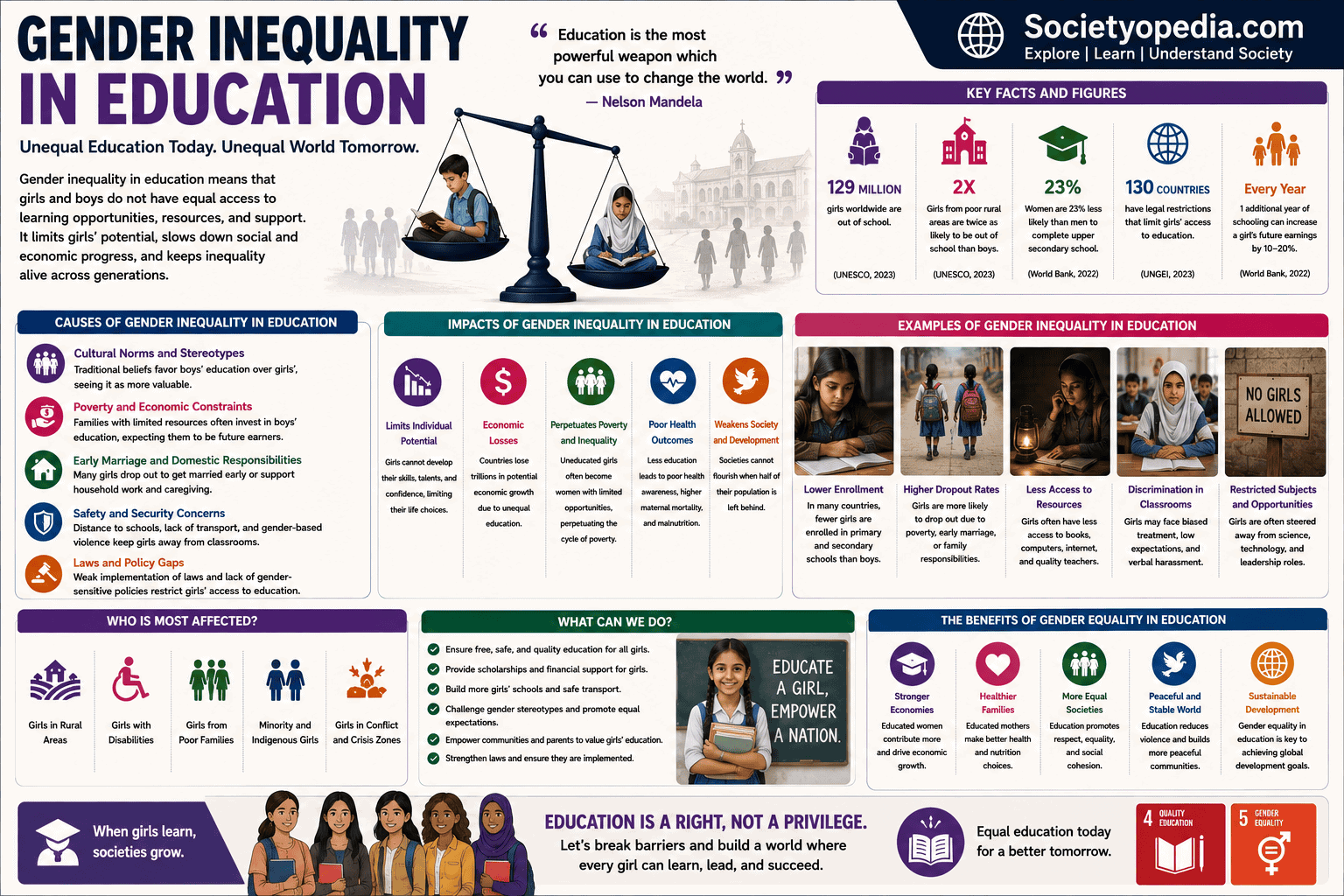
Gender inequality in education refers to unequal access to educational opportunities, resources, participation, treatment, learning conditions, or outcomes based on gender.
It can occur at different stages of education, including:
- early childhood education;
- primary education;
- secondary education;
- higher education;
- vocational education;
- professional training;
- adult education.
Gender inequality may be visible when one gender has lower school enrollment. It can also be less obvious, such as when students technically have equal access to school but receive different encouragement, expectations, resources, or treatment.
For example, a girl may be allowed to attend school but discouraged from studying science or mathematics. Similarly, a boy may be discouraged from pursuing subjects associated with caregiving or the humanities.
Thus, educational equality involves more than simply opening school doors.
Gender Inequality in Education in Sociology
Sociologists view education as a major social institution that can both reproduce and challenge gender inequality.
Schools transmit knowledge, but they also transmit social norms and values.
Students learn ideas about appropriate gender behavior through teachers, textbooks, classroom interactions, peer relationships, school activities, and institutional practices.
Education can therefore reinforce existing gender roles.
At the same time, education can challenge those roles by providing students with knowledge, critical thinking skills, professional qualifications, and exposure to alternative ways of understanding gender.
This dual role makes education particularly important in the study of gender and society.
Gender Inequality in Employment: Meaning, Causes, Examples and Effects
Gender Inequality in Access to Education
One of the most basic forms of educational inequality is unequal access.
In some communities, girls may face barriers that make school attendance difficult or impossible.
These barriers can include:
- poverty;
- household responsibilities;
- early marriage;
- concerns about safety;
- long distances to school;
- lack of transportation;
- inadequate sanitation facilities;
- cultural expectations;
- lack of female teachers;
- family preferences for boys’ education.
UNICEF identifies poverty, gender discrimination, child marriage, disability, location, and social norms among the factors that can prevent children—particularly girls in some contexts—from accessing and completing education.
However, educational access is not only a problem affecting girls. Boys can also face gender-specific educational disadvantages in some settings, particularly where economic pressures encourage them to enter paid work at an early age.
Gender Inequality in School Enrollment
School enrollment provides one way of measuring educational access.
When enrollment rates differ significantly between genders, researchers may investigate the social and economic reasons behind the difference.
Historically, many societies provided boys with greater educational opportunities than girls.
In many countries, this gap has narrowed substantially.
However, progress in enrollment does not automatically eliminate gender inequality. Students may still experience unequal retention, completion, subject selection, classroom treatment, and educational outcomes.
Therefore, enrollment should be considered one indicator rather than a complete measure of educational equality.
Gender Inequality in School Completion
Attending school and completing school are not the same thing.
A child may enroll in school but leave before completing primary or secondary education.
Girls may face pressure to leave school because of domestic responsibilities, marriage, caregiving, or concerns about safety.
Boys may leave school because of pressure to earn income or contribute financially to their families.
UNICEF notes that gender interacts with other disadvantages, including poverty and social norms, influencing whether children remain in and complete school.
Educational completion is important because leaving school early can have long-term consequences for employment, income, and social mobility.
Gender Inequality Examples: Real-Life Examples in Society, Education, Work and Family
Gender Inequality in Higher Education
Higher education has become increasingly accessible to women in many countries.
In numerous societies, women now represent a substantial share of university students and graduates.
However, gender inequality can remain within higher education through differences in academic fields, leadership positions, research opportunities, and career advancement.
Women may be strongly represented in some fields but less represented in areas such as engineering, computer science, physics, and certain technical disciplines.
This pattern is known as gender segregation by field of study.
Thus, equal university enrollment does not necessarily mean complete gender equality in higher education.
Gender Inequality in Subject Choice
Subject choice is one of the most important hidden dimensions of educational inequality.
Students may choose subjects based partly on their interests, but those interests are influenced by social expectations.
Girls may receive messages suggesting that mathematics, engineering, computing, or physical sciences are more appropriate for boys.
Boys may receive messages suggesting that nursing, early childhood education, literature, or caregiving are more suitable for girls.
These expectations can influence academic confidence and career aspirations.
Over time, gendered subject choices can contribute to occupational segregation and differences in income.
Gender Stereotypes in Education
Gender stereotypes are strongly connected with educational inequality.
A stereotype is a generalized belief about the characteristics or abilities of members of a social group.
Examples include the belief that:
- boys are naturally better at mathematics;
- girls are naturally better at languages;
- boys are more suitable for leadership;
- girls are more suitable for caregiving;
- boys are more interested in technology;
- girls are more emotionally intelligent.
Such beliefs can influence parents, teachers, students, and educational institutions.
When students repeatedly receive messages about what they are supposedly capable of doing, they may internalize these expectations.
This can influence confidence, subject selection, and career planning.
Teacher Expectations and Gender Bias
Teachers play an important role in shaping students’ educational experiences.
Gender bias can influence how teachers interact with students.
For example, teachers may unintentionally give boys more encouragement in science-related activities or expect girls to behave more quietly and cooperatively.
Teachers may also interpret similar behaviors differently.
A boy who speaks confidently may be considered assertive, while a girl displaying the same behavior may be considered disruptive.
These differences can influence classroom participation and students’ perceptions of their own abilities.
Teacher training and awareness can therefore be important components of educational equality.
Gender Inequality in Textbooks
Textbooks are another important source of gender representation.
Educational materials can reinforce stereotypes when women are primarily represented as mothers, caregivers, or household workers while men are shown as professionals, leaders, scientists, or decision-makers.
Repeated representations can influence children’s understanding of gender roles.
More balanced educational materials can challenge these assumptions by presenting women and men in diverse occupations and social roles.
For example, textbooks can represent women as scientists, engineers, political leaders, entrepreneurs, and researchers while also showing men as caregivers, teachers, nurses, and active parents.
Gender Inequality in Classroom Participation
Classroom participation can also be influenced by gender.
Students may differ in how frequently they ask questions, speak publicly, lead group activities, or volunteer for tasks.
These differences may reflect socialization rather than natural ability.
Girls may be socialized to be less assertive, while boys may receive stronger encouragement to speak publicly.
Teachers can reduce these inequalities by creating classroom environments in which all students have meaningful opportunities to participate.
Causes of Gender Inequality: Major Social, Cultural, Economic and Institutional Factors
Gender Inequality in School Leadership
Gender inequality can also exist among educational staff.
Women may represent a large proportion of teachers while being less represented in senior administrative positions in some educational systems.
This creates an interesting form of occupational inequality in which women may be concentrated in teaching but underrepresented in leadership.
Leadership representation matters because administrators influence school policies, hiring, curriculum, resource allocation, and institutional culture.
Increasing women’s participation in educational leadership can therefore provide greater diversity in institutional decision-making.
Gender Inequality and Digital Education
Technology has become increasingly important in education.
Students now use computers, smartphones, internet services, online learning platforms, and digital resources for academic purposes.
However, unequal access to technology can create new forms of educational inequality.
Girls may have less access to digital devices or internet services in households where resources are limited or where technology use is more strongly controlled for girls.
The problem can be particularly serious in rural and economically disadvantaged communities.
Digital inequality can therefore reinforce existing educational and economic inequalities.
Gender Inequality in Rural and Urban Areas
Educational gender inequality often varies by geographical location.
Urban areas may provide greater access to schools, colleges, universities, transportation, internet services, and specialized educational institutions.
Rural communities may face greater difficulties because of distance, limited educational infrastructure, transportation problems, teacher shortages, or social expectations.
However, rural communities should not be treated as uniformly unequal. Educational experiences vary according to economic conditions, family attitudes, local institutions, and government services.
The interaction between gender and geography is therefore an important area of sociological research.
Poverty and Gender Inequality in Education
Poverty is one of the strongest factors influencing educational opportunity.
When families have limited resources, they may face difficult decisions about school fees, uniforms, transportation, books, technology, and other educational costs.
In some contexts, families may prioritize boys’ education because they expect sons to become future economic providers.
Girls may instead be expected to contribute to household work.
This can create a cycle:
Poverty → unequal educational investment → unequal qualifications → unequal employment opportunities → continued poverty
Breaking this cycle requires educational support as well as broader economic and social policies.
Gender Inequality and Child Marriage
Early marriage can interrupt or end girls’ education.
When girls marry at a young age, household responsibilities, pregnancy, childcare, and social expectations may make continuing education difficult.
Child marriage is therefore closely connected to educational inequality.
UNICEF identifies child marriage as one of the barriers that can interfere with girls’ education and broader opportunities.
The consequences may extend into adulthood because limited education can reduce access to formal employment and economic independence.
Gender Inequality and Household Responsibilities
Household responsibilities can significantly affect education.
Girls may be expected to help with cooking, cleaning, childcare, or caring for elderly relatives.
These responsibilities can reduce the time available for studying, attending school, completing homework, or participating in extracurricular activities.
Boys can also face household and economic responsibilities, particularly in poor households where they may be expected to work outside the home.
Thus, gender inequality in education can be connected with broader patterns of unpaid and paid labor.
Gender Inequality in Pakistan
Gender inequality in education is particularly important in Pakistan because educational opportunities vary substantially across regions, socioeconomic groups, and communities.
Factors such as poverty, rural location, school availability, transportation, safety concerns, cultural expectations, household responsibilities, and gender norms can influence girls’ and boys’ educational experiences.
The situation should not be understood as uniform across the country. Educational opportunities differ considerably between provinces, districts, urban and rural areas, and socioeconomic groups.
Pakistan has also made progress in expanding educational access, but significant challenges remain in ensuring that all children can attend, remain in, and successfully complete quality education.
For a sociology-focused website such as Societyopedia, this provides an important example of how gender interacts with class, geography, culture, institutions, and economic conditions.
Effects of Gender Inequality in Education
Educational gender inequality has consequences that extend beyond the classroom.
Reduced Employment Opportunities
Limited education can reduce access to formal employment and professional careers.
Lower Income
Lower educational attainment can restrict access to higher-paying occupations.
Reduced Social Mobility
Education is an important pathway to social mobility. Unequal access can therefore reproduce socioeconomic inequality.
Increased Economic Dependence
Limited education can increase dependence on family members or informal economic activities.
Reduced Political Participation
Education can increase political awareness, confidence, and participation.
Reinforcement of Gender Roles
Educational inequality can reproduce traditional gender expectations across generations.
Intergenerational Effects
Parents’ educational experiences can influence their children’s opportunities and expectations.
Education as a Tool for Gender Equality
Education is not only an area where gender inequality occurs. It can also be one of the most powerful tools for reducing it.
Quality education can provide individuals with knowledge, skills, qualifications, confidence, and access to broader social networks.
Schools can challenge stereotypes by teaching students about equality and diversity.
Teachers can encourage students to pursue subjects based on interests and abilities rather than gender.
Educational institutions can also promote equality by ensuring safe learning environments and equal participation.
How Can Gender Inequality in Education Be Reduced?
Reducing gender inequality in education requires action at several levels.
Improve Access
Schools should be accessible to children regardless of gender, location, or socioeconomic background.
Address Poverty
Financial assistance, scholarships, school meals, transportation support, and other programs can reduce economic barriers.
Improve Safety
Safe transportation, secure school environments, and appropriate infrastructure can help students attend regularly.
Challenge Gender Stereotypes
Teachers, parents, textbooks, and media should avoid presenting particular subjects or occupations as naturally belonging to one gender.
Support Girls in STEM
Girls should receive encouragement and opportunities to participate in science, technology, engineering, and mathematics.
Support Boys in Traditionally Female Fields
Educational equality also means allowing boys to pursue subjects such as nursing, teaching, literature, and caregiving without stigma.
Increase Female Leadership
Women should have equal opportunities to become teachers, administrators, researchers, professors, and educational policymakers.
Expand Digital Access
Equal access to devices, internet services, and digital literacy can reduce technology-related educational inequality.
Gender Equality in Education Does Not Mean Identical Outcomes
It is important to distinguish equality of opportunity from identical outcomes.
Gender equality in education means that students should have fair opportunities to access education, develop their abilities, choose subjects, and pursue careers.
It does not mean that exactly equal numbers of boys and girls must choose every subject.
Differences in individual interests are expected.
The concern arises when social pressure, discrimination, stereotypes, or institutional barriers prevent students from freely pursuing their interests.
Conclusion
Gender inequality in education refers to unequal access, opportunities, resources, treatment, participation, or outcomes in education because of gender.
Although many societies have made significant progress in expanding educational access for girls and women, gender inequality can continue through poverty, cultural expectations, gender stereotypes, household responsibilities, school safety, unequal access to technology, teacher expectations, subject selection, and institutional practices.
Educational inequality can have long-term consequences. Limited education can reduce employment opportunities, income, social mobility, political participation, and economic independence. It can also reproduce gender norms across generations.
At the same time, education can be a powerful force for social change. Equal educational opportunities can challenge stereotypes, improve economic prospects, increase social participation, and help individuals develop their abilities without unnecessary gender-based restrictions.
Understanding gender inequality in education therefore requires looking beyond school enrollment. It requires examining access, participation, quality, subject choice, learning experiences, resources, completion, and the social conditions that shape educational opportunities.
For sociology and gender studies, education remains one of the most important institutions through which gender inequality can either be reproduced or challenged.