Gender inequality exists in many societies, but it does not emerge from a single cause. It develops through a combination of social, cultural, economic, political, institutional, and historical factors. These factors influence how people are raised, educated, employed, treated, and expected to behave according to gender.
To understand gender inequality properly, it is important to distinguish between what gender inequality is and why it occurs. Gender inequality refers to unequal opportunities, resources, power, rights, or responsibilities associated with gender. The causes of gender inequality explain the social processes that create and reproduce these unequal conditions.
For example, if women perform more unpaid household work than men, that is an example of gender inequality. To understand its causes, however, we need to examine gender socialization, cultural expectations, family structures, economic arrangements, and ideas about masculinity and femininity.
This article focuses specifically on why gender inequality develops and continues over time.
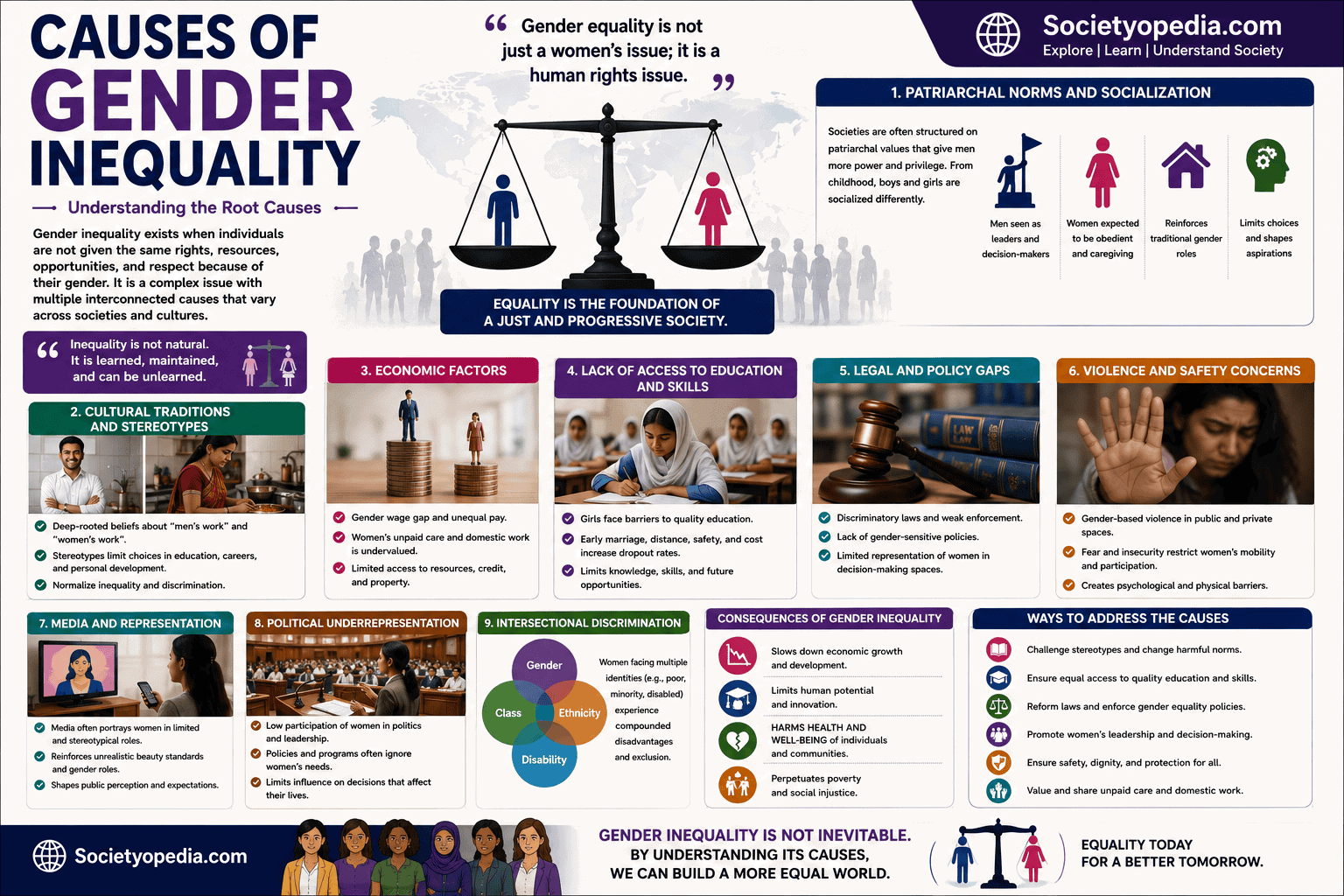
Table of Contents
ToggleWhat Causes Gender Inequality?
The major causes of gender inequality include:
- Patriarchal social structures
- Gender socialization
- Traditional gender roles
- Cultural norms and expectations
- Family structure
- Unequal distribution of unpaid work
- Gender stereotypes
- Unequal access to education
- Economic dependence
- Occupational segregation
- Workplace discrimination
- Political inequality
- Institutional discrimination
- Gender-based violence
- Historical inequalities
- Media representations
- Limited access to technology
- Legal and policy gaps
- Social class and poverty
- Intersection of multiple inequalities
These causes do not operate separately. They often reinforce one another.
1. Patriarchy
One of the most important sociological explanations of gender inequality is patriarchy.
Patriarchy refers broadly to social arrangements in which men have historically held greater authority and control over important resources, institutions, and decision-making.
Patriarchal patterns may be found in family structures, workplaces, political organizations, economic institutions, and other areas of social life.
For example, if men are traditionally expected to make major family decisions while women are expected to follow those decisions, authority is distributed unequally.
Patriarchy therefore provides a structural explanation for gender inequality rather than treating inequality simply as the result of individual prejudice.
2. Gender Socialization
Gender socialization is the process through which people learn the behaviors, values, attitudes, and expectations associated with gender.
Children learn gender expectations from parents, schools, peers, media, religious institutions, and communities.
For example, girls may be encouraged to be caring and cooperative, while boys may be encouraged to be independent and assertive.
When these expectations are repeatedly taught, they can influence educational choices, careers, relationships, and family responsibilities.
Gender socialization can therefore reproduce inequality from one generation to another.
3. Traditional Gender Roles
Traditional gender roles divide social responsibilities according to gender.
A common traditional pattern is:
Men → providers, leaders, decision-makers
Women → caregivers, homemakers, supporters
When these roles are treated as natural rather than socially constructed, they can restrict people’s choices.
A woman may be discouraged from pursuing a demanding career because she is expected to prioritize family responsibilities.
A man may be discouraged from becoming a full-time caregiver because caregiving is considered a feminine responsibility.
Rigid gender roles therefore contribute to inequality for both women and men.
4. Cultural Norms
Culture influences beliefs about appropriate behavior.
Cultural norms can shape expectations concerning:
- marriage;
- family;
- education;
- employment;
- clothing;
- mobility;
- leadership;
- caregiving;
- authority.
When cultural norms give one gender greater freedom or authority, they can contribute to unequal social relations.
However, culture should not be treated as fixed. Cultural norms change over time through education, social movements, economic transformation, migration, technology, and generational change.
5. Family Structure
The family is one of the earliest institutions through which gender expectations are learned.
Parents may unknowingly assign different responsibilities to sons and daughters.
For example, daughters may be expected to help with cooking, cleaning, and childcare, while sons receive more freedom to study or socialize.
When these patterns become normalized, children learn that domestic responsibilities are associated primarily with women.
These expectations can later influence their adult relationships and employment decisions.
6. Unequal Unpaid Care Work
Another major cause of gender inequality is the unequal distribution of unpaid domestic and care work.
Unpaid work includes:
- cooking;
- cleaning;
- childcare;
- caring for elderly family members;
- household management;
- supporting family members.
When women perform most of this work, they have less time available for paid employment, education, political participation, and personal development.
This creates a connection between household inequality and economic inequality.
The unequal distribution of unpaid care work is recognized internationally as an important barrier to women’s economic participation.
7. Gender Stereotypes
Gender stereotypes are generalized beliefs about the characteristics and abilities of women and men.
Examples include beliefs that:
- men are naturally better leaders;
- women are naturally better caregivers;
- men are better at mathematics;
- women are more emotional;
- men should earn more;
- women should prioritize family.
Such beliefs can influence decisions made by families, teachers, employers, and individuals.
For example, if girls repeatedly receive the message that science is a male field, fewer girls may choose science-related careers.
Stereotypes can therefore become a mechanism through which inequality reproduces itself.
8. Unequal Educational Opportunities
Education is an important source of social mobility.
When girls have less access to education, they may have fewer opportunities to obtain professional qualifications and well-paid employment.
Barriers may include:
- poverty;
- family expectations;
- household responsibilities;
- early marriage;
- distance from schools;
- safety concerns;
- limited educational facilities;
- cultural restrictions.
Educational inequality can consequently lead to employment and economic inequality later in life.
9. Economic Dependence
Economic dependence can reinforce gender inequality.
When a person lacks independent income or control over economic resources, their ability to make decisions may be reduced.
For example, a woman who depends entirely on another family member financially may have less bargaining power concerning education, employment, healthcare, mobility, or household decisions.
Economic dependence does not automatically produce inequality, but persistent differences in access to economic resources can strengthen unequal power relationships.
10. Occupational Segregation
Occupational segregation occurs when women and men are concentrated in different occupations or different levels within occupations.
Women may be concentrated in care, education, administrative, or service occupations, while men may be concentrated in technical, engineering, construction, or other sectors.
Occupational segregation can develop partly because of gender socialization and stereotypes.
It can then contribute to differences in earnings, prestige, career advancement, and leadership opportunities.
11. Workplace Discrimination
Gender discrimination in employment is another important cause.
Discrimination can occur during:
- recruitment;
- hiring;
- salary determination;
- promotion;
- training;
- performance evaluation;
- leadership selection.
For example, an employer may assume that women with young children will be less committed to their jobs.
Such assumptions can influence hiring and promotion decisions even when they do not accurately reflect an individual’s abilities or commitment.
12. Gender Pay Differences
Economic systems can reproduce gender inequality through differences in earnings.
The gender pay gap is influenced by several factors, including occupational segregation, working hours, career interruptions, caregiving responsibilities, leadership representation, and discrimination.
The important point is that pay inequality is often connected to earlier inequalities.
For example:
Gender socialization → different career choices → occupational segregation → different earnings
Thus, economic inequality can be the result of multiple social processes operating together.
13. Political Structures
Political institutions determine laws, budgets, policies, and public priorities.
When women have limited access to political power, their perspectives may be less represented in decision-making.
Barriers to women’s political participation can include:
- gender stereotypes;
- limited political networks;
- financial barriers;
- family responsibilities;
- discriminatory party structures;
- cultural expectations.
Political inequality can therefore contribute to the continuation of gender inequality in other institutions.
14. Institutional Discrimination
Gender inequality does not always result from intentional individual discrimination.
Institutions can produce unequal outcomes through rules, procedures, and organizational cultures.
For example, an organization may have a promotion system that rewards employees who can work extremely long hours.
If women disproportionately carry childcare responsibilities, such a system may indirectly disadvantage them.
This is why sociologists distinguish between individual discrimination and institutional or structural inequality.
15. Gender-Based Violence
Gender-based violence can reinforce unequal power relationships.
Violence and the fear of violence can restrict people’s:
- mobility;
- education;
- employment;
- social participation;
- independence;
- decision-making.
For example, concerns about harassment or violence may influence whether women travel alone or accept employment outside their local area.
Gender-based violence therefore has consequences beyond individual victims. It can affect participation in society as a whole.
16. Restrictions on Mobility
Mobility is essential for accessing education, employment, healthcare, and public life.
In some communities, women may face greater restrictions on traveling independently.
For example, a woman may have professional qualifications but be unable to accept a job because transportation is unavailable or family members do not permit her to travel independently.
Such restrictions can transform a social norm into an economic disadvantage.
17. Historical Inequalities
Gender inequality also has historical roots.
In many societies, women historically had limited access to:
- education;
- property;
- voting;
- professions;
- political office;
- financial resources.
Even after formal restrictions are removed, historical patterns can continue to influence institutions and social expectations.
For example, if an occupation was historically dominated by men, existing professional networks and organizational cultures may continue to favor men.
History therefore matters when explaining contemporary gender inequality.
18. Media Representation
Media can reproduce gender inequality by repeatedly presenting particular images of women and men.
Women may be represented primarily as caregivers, wives, mothers, or objects of appearance.
Men may be portrayed more frequently as leaders, professionals, providers, and decision-makers.
Repeated representations can normalize particular gender roles.
However, media can also challenge inequality by presenting women and men in diverse roles.
Thus, media is both a potential source of inequality and a potential instrument of social change.
19. Limited Access to Technology
Digital access has become increasingly important for education, employment, entrepreneurship, and communication.
If women and girls have less access to:
- smartphones;
- computers;
- internet services;
- digital education;
- technology training,
they may face a digital disadvantage.
This can create a new layer of gender inequality because digital skills increasingly influence educational and employment opportunities.
20. Legal and Policy Gaps
Laws and policies can influence gender relations.
When legal protections against discrimination are weak, poorly implemented, or difficult to access, unequal practices may continue.
Important areas include:
- employment;
- education;
- property;
- inheritance;
- political participation;
- workplace safety;
- violence;
- family rights.
However, legal reform alone is insufficient.
Effective implementation and changes in social attitudes are also necessary.
21. Poverty and Social Class
Gender inequality interacts strongly with poverty and social class.
A woman from a wealthy household may have access to education, transportation, technology, childcare, and professional networks.
A woman from a poor household may lack many of these resources.
Similarly, men from disadvantaged socioeconomic backgrounds may experience different pressures concerning employment and masculinity.
Gender therefore cannot always be understood separately from economic class.
22. Intersection of Multiple Inequalities
Gender interacts with other social characteristics and forms of inequality.
These can include:
- social class;
- age;
- disability;
- ethnicity;
- geographical location;
- education;
- occupation.
This perspective is commonly associated with intersectionality.
For example, the experiences of a highly educated urban professional woman may be very different from those of a low-income rural woman.
Therefore, there is no single universal experience of gender inequality.
How These Causes Reinforce Each Other
The causes of gender inequality are interconnected.
Consider this example:
Traditional gender norms
↓
Girls are expected to prioritize family responsibilities
↓
Less educational and career investment
↓
Lower participation in certain professions
↓
Lower economic independence
↓
Greater dependence on family
↓
Less bargaining power
↓
Continuation of traditional gender roles
This illustrates why gender inequality can become self-reinforcing.
Another example can be seen in employment:
Gender stereotype
↓
Employer assumes women are less committed because of family responsibilities
↓
Woman receives fewer opportunities
↓
Fewer promotions
↓
Lower income
↓
Family prioritizes husband’s career
↓
Woman performs more unpaid care work
↓
Career progression slows further
The problem is therefore not one isolated discriminatory decision. It is the interaction of multiple social mechanisms.
Individual Causes and Structural Causes
A useful sociological distinction is between individual-level causes and structural causes.
An individual-level cause may be a person’s discriminatory attitude.
For example, an employer may believe that women are less suitable for leadership.
A structural cause occurs when institutions, rules, or social arrangements consistently produce unequal outcomes.
For example, an organization may reward employees for working extremely long hours without considering unequal caregiving responsibilities.
Individual attitudes and structural conditions can reinforce each other.
This is why gender inequality should not be explained simply by saying that “some people are biased.”
The broader social environment also matters.
Causes of Gender Inequality in Pakistan
In Pakistan, gender inequality is influenced by a combination of social, cultural, economic, family, and institutional factors.
The importance of individual factors varies significantly by province, region, socioeconomic class, rural or urban location, education, and occupation.
Common factors that researchers may examine include:
Family expectations: Women may be expected to prioritize marriage, childcare, and household responsibilities.
Mobility constraints: Restrictions or concerns about transportation and safety can affect women’s education and employment.
Unequal household work: Women may continue performing substantial domestic responsibilities even when they participate in paid employment.
Educational differences: Some girls may experience barriers to continuing education, particularly where poverty, distance, safety, or family expectations are significant.
Workplace conditions: Lack of childcare, maternity support, safe transportation, and flexible working arrangements can make employment more difficult.
Cultural expectations: Traditional ideas about femininity and masculinity can influence education, occupation, marriage, and family decisions.
These factors should not be treated as universal characteristics of Pakistani society. They vary considerably between communities and individuals.
How Can the Causes of Gender Inequality Be Addressed?
Because gender inequality has multiple causes, addressing it requires changes at multiple levels.
Education can challenge stereotypes and expand opportunities.
Economic empowerment can increase access to income and resources.
Childcare and family support can reduce the unequal burden of unpaid care.
Workplace reforms can address recruitment, promotion, pay, harassment, and working conditions.
Political participation can increase women’s representation in decision-making.
Media literacy and responsible representation can challenge harmful stereotypes.
Legal protections can address discrimination and violence.
Changes in family practices can encourage more equal distribution of domestic responsibilities.
Most importantly, gender equality requires changes not only in individual attitudes but also in the institutions and structures that reproduce unequal opportunities.
Conclusion
The causes of gender inequality are complex and interconnected. Patriarchy, gender socialization, traditional gender roles, cultural norms, family structures, unequal unpaid work, stereotypes, educational inequality, economic dependence, occupational segregation, discrimination, political structures, institutional practices, historical inequalities, media representation, technology gaps, and social class can all contribute to unequal gender relations.
The key sociological insight is that gender inequality is not simply created by individual prejudice. It can be reproduced through everyday practices and social institutions.
A child who learns that housework belongs to women may carry that expectation into adulthood. An employer who assumes women are less committed may contribute to occupational inequality. A workplace without childcare may unintentionally make career advancement more difficult for employees with caregiving responsibilities. These processes can reinforce one another.
Gender inequality therefore operates as a social system of interconnected causes and consequences.
Understanding these causes is the first step toward understanding how gender inequality can be reduced. Changes in education, family life, employment, law, politics, culture, technology, and social attitudes can gradually transform the structures that reproduce inequality.