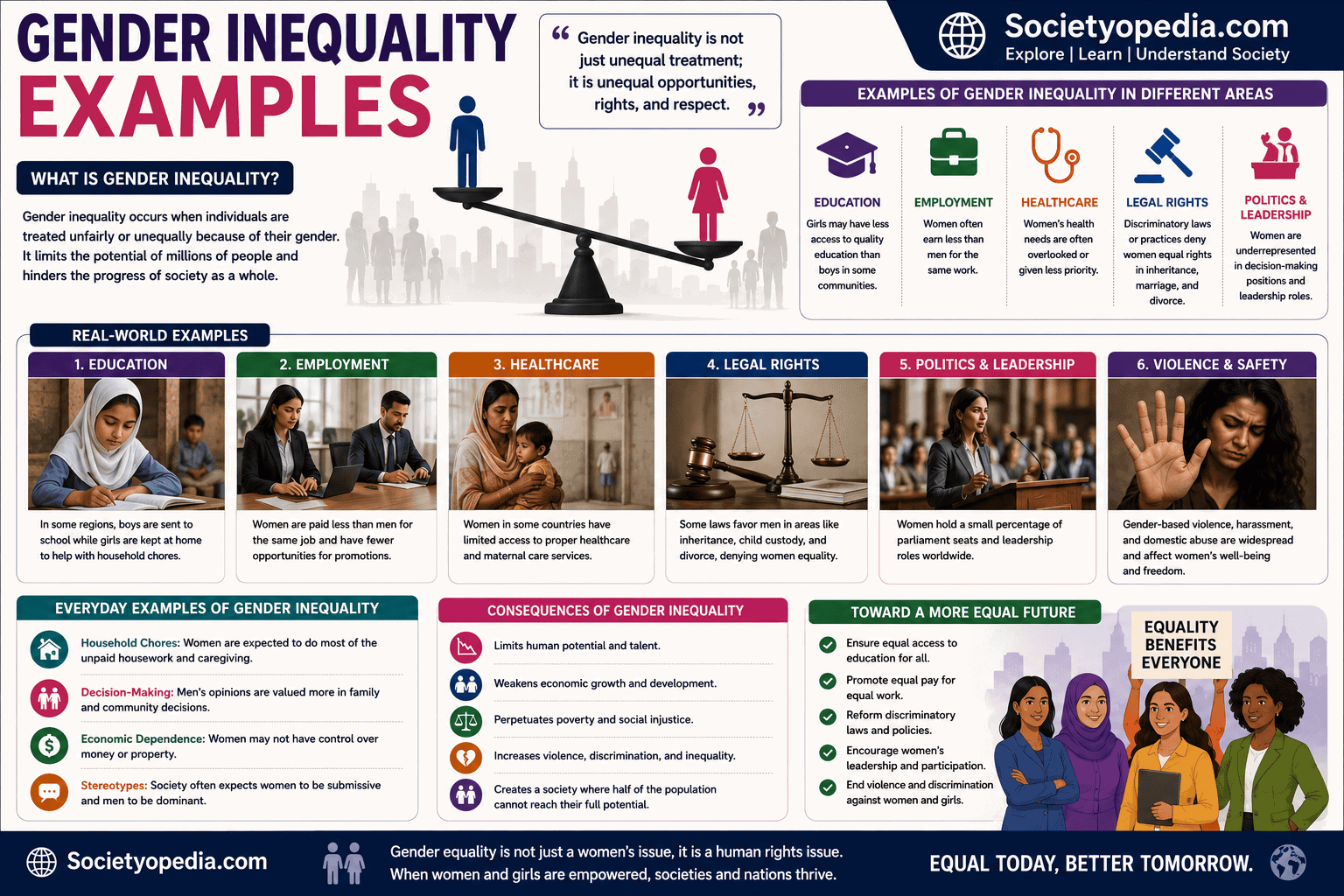
Gender inequality can sometimes seem like an abstract sociological concept. However, it becomes much easier to understand when examined through examples from everyday life. Gender inequality occurs when people experience unequal opportunities, rights, resources, responsibilities, treatment, or social power because of gender.
These inequalities can appear in almost every major social institution, including the family, education, employment, politics, healthcare, religion, media, and the economy.
Some examples are obvious, such as paying employees differently because of gender. Others are less visible, such as expecting women to perform most unpaid household work or assuming that men are naturally better suited to leadership.
Gender inequality should also not be understood as affecting every person in exactly the same way. Experiences vary according to social class, education, age, location, disability, culture, and other social factors.
This article presents practical examples of gender inequality and explains what each example tells us from a sociological perspective.
What Is Gender Inequality?
Gender inequality is the unequal distribution of opportunities, resources, responsibilities, rights, or power between people because of gender.
It can involve differences in:
- education;
- employment;
- income;
- political participation;
- family responsibilities;
- healthcare;
- leadership;
- social status;
- decision-making;
- freedom and mobility.
Gender inequality can be produced by discrimination, gender stereotypes, social norms, institutional practices, economic structures, and historical patterns.
Why Are Examples of Gender Inequality Important?
Examples make it easier to recognize how gender inequality operates in everyday life.
A person may understand that “gender inequality exists” but still struggle to identify how it affects ordinary social relationships.
Consider a family where a daughter is expected to cook and clean while her brother is allowed to study or spend his free time outside the home.
Nothing about the situation may appear as an official law or policy.
Yet the unequal distribution of responsibilities gives the two children different amounts of time, freedom, and opportunity.
This is why sociologists examine everyday practices as well as formal institutions.
Gender and Social Change: Meaning, Relationship, Examples and Importance
Examples of Gender Inequality in Education
1. Girls Being Given Less Educational Opportunity
One example occurs when families prioritize boys’ education over girls’ education.
A family with limited financial resources may decide that a son should continue to university while a daughter should leave school to help with household responsibilities.
The decision gives the two children unequal educational opportunities because of gender.
This can affect their future employment, income, social mobility, and independence.
2. Boys Being Encouraged Toward STEM
Gender inequality can also occur when boys receive stronger encouragement to study science, technology, engineering, and mathematics while girls are directed toward traditionally feminine subjects.
For example, teachers or parents may tell a girl that engineering is “more suitable for boys.”
Even when girls have equal academic ability, repeated messages can influence their confidence and subject choices.
3. Girls Leaving School Because of Domestic Responsibilities
In some communities, girls may be expected to help with cooking, cleaning, childcare, or elder care.
If these responsibilities interfere with school attendance or homework, girls can experience an educational disadvantage.
The inequality is particularly important because household labor may be treated as a normal gender responsibility rather than recognized as a factor affecting educational opportunity.
4. Unequal Access to Digital Education
Another example is unequal access to computers, smartphones, or internet services.
In households with limited digital resources, boys may receive greater access to technology for education.
Girls may have their technology use more strongly restricted because of concerns about safety or social norms.
Digital inequality can consequently become educational inequality.
Examples of Gender Inequality in Employment
5. Hiring a Man Instead of an Equally Qualified Woman
Suppose two candidates have similar qualifications and experience, but an employer chooses the man because the employer assumes that women will eventually prioritize family responsibilities.
This is an example of gender-based discrimination that can contribute to employment inequality.
The decision is based on a gender assumption rather than the candidates’ actual qualifications.
6. Women Being Concentrated in Lower-Paid Occupations
Women may be disproportionately represented in occupations such as care work, teaching, administrative work, or certain service occupations.
Men may be more strongly represented in some technical, engineering, construction, or managerial occupations.
When occupations associated with women receive lower economic rewards, occupational segregation can contribute to broader gender inequality.
7. Fewer Women in Senior Leadership
A company may employ many women but have very few women in senior management.
For example, women might constitute 60% of employees but only 20% of senior executives.
This is an example of vertical occupational segregation.
The pattern can reflect differences in promotion opportunities, networking, workplace culture, caregiving responsibilities, and leadership stereotypes.
8. Women Being Passed Over for Promotion
Imagine a woman has strong performance records but receives fewer promotions than male colleagues with similar qualifications.
If gender stereotypes or assumptions about women’s leadership abilities influence these decisions, gender inequality is occurring.
Repeated promotion disadvantages can create long-term differences in income and professional status.
Causes of Gender Inequality: Major Social, Cultural, Economic and Institutional Factors
Examples of Gender Inequality in Pay
9. Unequal Pay for Comparable Work
A direct example of gender inequality is when employees performing the same or substantially similar work are paid differently because of gender.
For example, if two employees have similar responsibilities, qualifications, experience, and performance but one receives lower compensation specifically because she is a woman, this represents discriminatory unequal pay.
The ILO’s principle of equal remuneration addresses the importance of equal pay for work of equal value.
10. The Overall Gender Pay Gap
A broader example is the gender pay gap—the difference between the average earnings of women and men.
The overall gap can be influenced by occupation, working hours, experience, leadership representation, career interruptions, unpaid care work, and discrimination.
Therefore, the existence of a gender pay gap does not automatically prove that every employer pays women less than men for identical work.
Instead, it is an indicator that requires further sociological and economic analysis.
Examples of Gender Inequality in the Family
11. Girls Doing More Housework
Consider a household in which a daughter is expected to wash dishes, clean rooms, cook, and care for younger siblings while her brother is not given similar responsibilities.
The children have unequal amounts of free time because of gender.
The girl may have less time for homework, leisure, social activities, or personal development.
12. Sons Receiving Greater Freedom
In some families, sons may be allowed to travel independently, meet friends, or stay outside the home later than daughters.
The difference may be justified through concerns about safety or cultural expectations.
Although safety concerns can be genuine, if they systematically restrict girls’ mobility while giving boys greater freedom, the result can be gender inequality.
13. Sons Receiving Greater Educational Investment
Families may sometimes invest more heavily in sons’ education because sons are expected to become financial providers.
Daughters may be expected to marry and prioritize family responsibilities.
This can create unequal opportunities that continue into adulthood.
14. Women Performing Most Unpaid Care Work
Women often perform substantial amounts of unpaid care work, including childcare, household management, cooking, cleaning, and caring for older relatives.
When these responsibilities are distributed unequally, women may have less time for paid employment, education, recreation, or political participation.
UN Women identifies unequal unpaid care responsibilities as an important dimension of gender inequality and economic disadvantage.
Sex and Gender Difference: Definition, Key Differences and Examples
Examples of Gender Inequality in Politics
15. Fewer Women in Political Leadership
One example is the underrepresentation of women in parliaments, cabinets, local governments, and senior political positions.
If women represent a large proportion of the population but occupy substantially fewer political positions, researchers may investigate the cultural, institutional, economic, and political barriers contributing to this difference.
Political representation does not automatically eliminate gender inequality, but unequal representation can limit the diversity of perspectives in decision-making.
16. Women Candidates Being Judged Differently
A woman politician may be evaluated heavily on appearance, family responsibilities, or personality.
A male politician displaying similar behavior may be judged primarily on leadership, policy, or experience.
This illustrates how gender stereotypes can influence political evaluation.
Examples of Gender Inequality in Healthcare
17. Unequal Access to Healthcare
Gender inequality can affect access to healthcare when women face restrictions on mobility, finances, decision-making, or access to health services.
For example, a woman may need permission or financial support from another family member before traveling to obtain medical treatment.
Such restrictions can delay access to healthcare.
18. Gender Bias in Medical Treatment
Gender bias can also occur when healthcare professionals interpret similar symptoms differently depending on the patient’s gender.
Researchers have examined how assumptions about gender can influence medical research, diagnosis, communication, and treatment.
This demonstrates that healthcare institutions are also influenced by broader social ideas about gender.
Examples of Gender Inequality in the Workplace
19. Women Being Expected to Take Notes
Imagine a workplace meeting where the administrative tasks are routinely assigned to women even when these responsibilities are not part of their jobs.
This may appear insignificant, but repeated assignment of such tasks can reinforce gender roles and reduce women’s opportunities to participate in higher-status activities.
20. Men Being Discouraged from Taking Parental Leave
Gender inequality can also affect men.
Suppose a father wants to take parental leave but colleagues criticize him for being insufficiently committed to his career.
This reflects the expectation that caregiving is primarily a woman’s responsibility.
Such expectations can restrict men’s participation in family life.
21. Women Being Expected to Handle Emotional Labor
In many workplaces, women may be expected to organize celebrations, support colleagues emotionally, mediate conflicts, or perform other forms of emotional labor.
These activities can be valuable but may receive little formal recognition.
When such responsibilities are consistently assigned according to gender, they can contribute to unequal workloads.
Examples of Gender Inequality in Leadership
22. Men Being Considered More “Natural” Leaders
A common gender stereotype is that men are naturally more authoritative and decisive.
If organizations use this assumption when evaluating leadership potential, women may have to demonstrate greater evidence of competence to receive the same opportunities.
This can contribute to the glass ceiling.
23. Women Facing a Double Standard in Leadership
A female manager may be expected to be both highly authoritative and highly supportive.
If she is too assertive, she may be considered aggressive.
If she is highly accommodating, she may be considered weak.
Men may not always face the same contradiction.
This is an example of how gender expectations can influence evaluations of leadership.
Examples of Gender Inequality in Media
24. Women Being Represented Mainly as Caregivers
Media can reinforce gender inequality when women are repeatedly portrayed primarily as mothers, wives, caregivers, or romantic partners.
Such representations can suggest that women’s primary social value lies in family relationships.
25. Men Being Represented as Providers and Leaders
Men may be disproportionately portrayed as successful professionals, leaders, decision-makers, or economic providers.
Repeated representations can normalize the idea that authority and economic success are masculine characteristics.
26. Unequal Representation of Female Experts
Another example occurs when news programs or public discussions rely heavily on male experts while women are less frequently represented as authorities.
This can influence perceptions of whose knowledge and opinions deserve public attention.
Examples of Gender Inequality in Social Expectations
27. Women Being Expected to Be Caregivers
Women may be expected to prioritize children, elderly relatives, and household responsibilities.
A woman who prioritizes her career may be criticized for being selfish or neglecting family responsibilities.
These expectations can restrict women’s choices.
28. Men Being Expected to Be Providers
Men may be expected to earn more, support the household financially, and demonstrate economic success.
A man who earns less than his wife may experience social pressure because of traditional expectations of masculinity.
This demonstrates that gender norms can create expectations for both women and men.
Examples of Gender Inequality in Mobility
29. Women Having More Restrictions on Movement
In some communities, women may face greater restrictions on traveling alone, using public transportation, or accepting jobs far from home.
Such restrictions can affect access to education and employment.
Mobility therefore becomes an important link between gender, culture, geography, and economic participation.
30. Different Rules for Sons and Daughters
A family may allow a teenage son to travel independently while requiring a daughter of the same age to be accompanied.
Even if parents have safety concerns, applying substantially different expectations based solely on gender creates unequal freedom of movement.
Examples of Gender Inequality in Technology
31. Unequal Access to Digital Devices
When families have limited access to computers or smartphones, boys may receive priority for educational use.
This can affect girls’ digital skills and educational opportunities.
32. Gender Stereotypes in Technology Careers
Girls may be told that programming, engineering, or technology are “male fields.”
Such stereotypes can discourage women from entering technology-related education and employment.
The result can be a cycle in which low representation reinforces the stereotype that women are less interested or capable in technology.
Examples of Gender Inequality in Sports
33. Unequal Funding for Women’s Sports
Women’s sports may receive less funding, media coverage, sponsorship, or institutional support than men’s sports.
Lower visibility can reduce opportunities for athletes and reinforce the perception that men’s sports are more valuable.
34. Different Expectations of Male and Female Athletes
Female athletes may face greater pressure concerning appearance, while male athletes may receive more attention for physical performance.
This demonstrates how gender expectations can influence sports beyond the question of athletic ability.
Examples of Gender Inequality in Science
35. Women Receiving Less Recognition
Women scientists may experience gender bias in recognition, leadership opportunities, research funding, or professional networks.
Historically, women’s scientific contributions have sometimes received less recognition than those of male colleagues.
Contemporary institutions increasingly recognize the importance of gender equality in scientific participation and leadership.
36. Girls Being Discouraged from Scientific Careers
When girls are repeatedly told that science and mathematics are primarily male fields, they may develop lower confidence in their abilities.
This is an example of how gender socialization can influence educational and occupational choices.
Examples of Gender Inequality in Religion and Culture
37. Gendered Expectations About Social Roles
Cultural traditions may assign different responsibilities to women and men.
Women may be expected to focus on family and caregiving, while men may be expected to provide income and exercise authority.
Such expectations vary considerably across societies and religious traditions and should not be treated as universal.
38. Different Social Standards for Men and Women
In some communities, similar behavior may be judged differently depending on whether it is performed by a man or a woman.
For example, social independence may be praised in men but criticized in women.
This represents a gendered double standard.
Examples of Gender Inequality Affecting Men
Gender inequality is not exclusively about disadvantages experienced by women.
39. Men Being Discouraged from Caregiving
A man who wants to become a stay-at-home parent may face social criticism because caregiving is considered feminine.
This can restrict men’s freedom to choose family roles.
40. Men Being Discouraged from Showing Emotion
Boys may be taught that crying or openly expressing vulnerability is a sign of weakness.
Such expectations can influence emotional development and social relationships.
41. Men Being Pressured to Become Financial Providers
Men may experience strong pressure to earn a high income and financially support their families.
This demonstrates that gender systems can impose restrictive expectations on men as well as women.
Gender Inequality Examples in Pakistan
Gender inequality in Pakistan can be observed in different forms depending on region, socioeconomic class, urban or rural location, education, and family structure.
Examples may include differences in educational opportunities, women’s labor-force participation, unpaid household work, mobility, access to transportation, workplace safety, political representation, and decision-making.
For example, a woman may have the educational qualifications required for employment but face family restrictions on working outside the home.
Another woman may be permitted to work but be expected to perform most household responsibilities after returning from work.
A girl may have strong academic ability but leave school because of household responsibilities or early marriage.
These examples demonstrate that gender inequality often results from the interaction of culture, family, economy, institutions, and social norms rather than from one factor alone.
Gender Roles: Definition, Examples, Types and Importance in Society
Why Do These Examples Matter?
Individual examples may appear small, but repeated patterns can produce significant social consequences.
Consider a simple chain:
Girl receives less educational support → lower educational attainment → fewer employment opportunities → lower income → greater economic dependence
Or:
Woman performs more unpaid care work → fewer paid working hours → slower career progression → lower lifetime earnings
These examples show why sociologists study gender inequality as a social structure rather than simply a collection of individual incidents.
Gender Inequality Is Not the Same Everywhere
Gender inequality varies across societies.
A practice that is common in one community may be uncommon in another.
Similarly, gender inequality can differ according to:
- social class;
- age;
- geographical location;
- education;
- disability;
- occupation;
- family structure;
- economic conditions.
This is why sociologists use an intersectional perspective when studying gender.
Intersectionality helps explain how gender interacts with other forms of social difference and inequality.
How Can Gender Inequality Be Reduced?
The examples above demonstrate that reducing gender inequality requires changes in several areas.
Education should provide equal opportunities and challenge stereotypes.
Workplaces should use fair recruitment, promotion, and compensation practices.
Families can distribute household responsibilities more equally.
Governments can strengthen legal protections and social services.
Schools and media can challenge restrictive gender stereotypes.
Men and women should both have opportunities to participate in caregiving, employment, education, leadership, and public life.
Gender equality is therefore not achieved by focusing on one institution alone. It requires changes across the social system.
Conclusion
Gender inequality becomes easier to understand when we examine how it appears in everyday life.
Examples include girls receiving fewer educational opportunities, women being concentrated in lower-paid occupations, unequal pay, limited access to leadership, unequal household responsibilities, restrictions on women’s mobility, gender stereotypes in textbooks, unequal political representation, and different expectations for men and women.
Some forms of inequality are direct and obvious. Others are subtle and embedded in social norms, institutional practices, and everyday interactions.
The examples also demonstrate that gender inequality is interconnected. Educational inequality can lead to employment inequality. Employment inequality can contribute to income inequality. Income inequality can influence household power and economic independence.
At the same time, gender inequality can affect men through restrictive expectations concerning masculinity, caregiving, emotional expression, and financial responsibility.
Understanding these examples allows us to move from the abstract idea of gender inequality to its real social consequences.
For students of sociology and gender studies, examining everyday examples is particularly useful because it reveals how gender is connected with power, culture, socialization, institutions, family, education, employment, and social change.