Sex and gender are closely related concepts, but they are not identical. The distinction between them is one of the foundational ideas in sociology, anthropology, psychology, and Gender Studies. Understanding this difference helps explain how biological characteristics interact with social expectations, cultural practices, identities, and institutions.
In everyday conversation, people often use the words sex and gender interchangeably. In academic research, however, they are commonly used to describe different dimensions of human life. Sex generally refers to biological characteristics, while gender refers to social and cultural meanings, expectations, roles, and identities.
Understanding the difference between sex and gender is particularly important when studying topics such as gender roles, gender socialization, gender inequality, gender stereotypes, and gender identity.
What Is Sex?
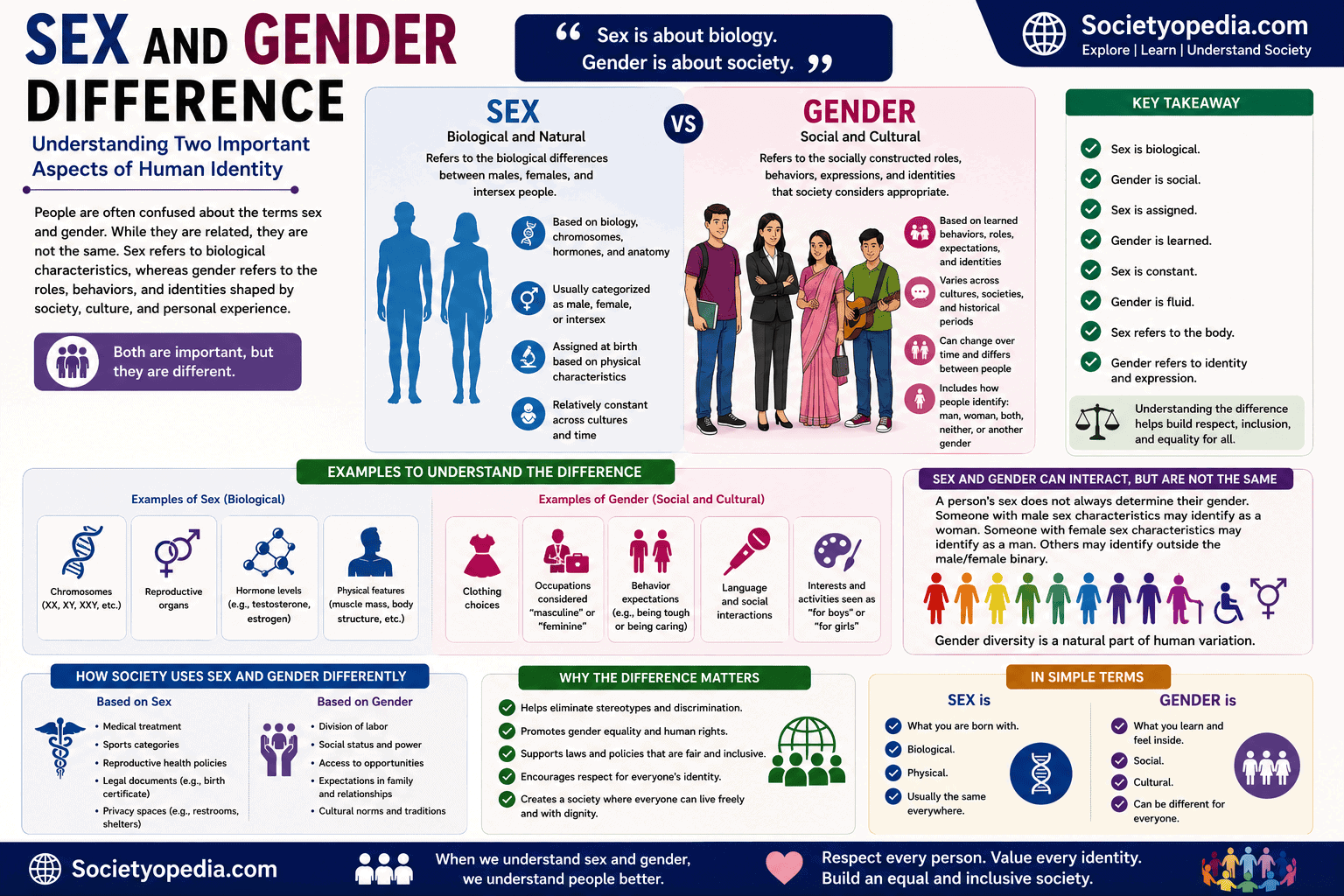
Sex generally refers to biological characteristics associated with reproductive anatomy and physiology. These characteristics can include chromosomes, reproductive organs, hormones, and other physical traits.
In many contexts, people are classified as male or female based on biological characteristics observed at birth. However, biological sex is more complex than a simple two-category model. Some people are born with variations in sex characteristics, commonly described by the term intersex.
Therefore, sex primarily concerns biological and physiological characteristics rather than the social expectations attached to them.
What Is Gender?
Gender refers to the social and cultural meanings, expectations, roles, behaviors, and identities associated with gender.
Societies develop ideas about how people should behave, dress, communicate, work, form families, and participate in social life. These expectations are examples of gender.
For example, a society may associate caregiving with women and leadership with men. Such expectations are not simply biological facts. They are influenced by cultural traditions, social institutions, historical circumstances, and socialization.
Gender can therefore vary between societies and change over time.
Key Difference Between Sex and Gender
The simplest distinction is:
Sex primarily concerns biological characteristics, while gender primarily concerns social and cultural meanings and expectations.
However, the relationship is more complex than this simple distinction suggests.
| Sex | Gender |
|---|---|
| Primarily refers to biological characteristics | Refers to social and cultural meanings |
| Includes reproductive anatomy and physiology | Includes roles, norms, expectations, and identities |
| Has biological dimensions | Has social and cultural dimensions |
| Can include variations in sex characteristics | Can vary across cultures and historical periods |
| Is studied in biological and health sciences as well as social sciences | Is particularly important in sociology, anthropology, and Gender Studies |
This distinction allows researchers to examine how societies create meanings and expectations around biological differences.
Examples of Sex and Gender
Consider reproductive anatomy. Biological reproductive characteristics are related to sex.
Now consider the expectation that women should be responsible for household cooking while men should be responsible for earning income. These are examples of gender roles because they represent socially created expectations about behavior.
Similarly, ideas that men should not show vulnerability or that women should be naturally nurturing are gender expectations. Different societies may hold different views about these behaviors.
This demonstrates why gender cannot be understood solely through biology.
Gender Roles and Sex
One common misunderstanding is that biological sex automatically determines social roles.
For example, the ability to become pregnant is a biological characteristic. However, the expectation that women should perform most household work is a social expectation.
Likewise, physical differences do not automatically determine who should become a teacher, doctor, engineer, political leader, parent, or household provider.
Societies develop rules and expectations around these activities, and those expectations can change.
This is why sociologists study gender roles separately from biological sex.
Gender Socialization
The distinction between sex and gender becomes clearer when we examine gender socialization.
Gender socialization is the process through which individuals learn the expectations, norms, and behaviors associated with gender in their society.
Children may receive different messages about behavior, clothing, toys, occupations, emotions, and responsibilities. Family members, schools, peers, religious organizations, media, and other institutions can all contribute to this process.
For example, if children repeatedly hear that certain occupations are suitable only for men or women, they may internalize these expectations.
Gender socialization therefore helps explain how biological differences can become connected to wider social roles and expectations.
Gender Roles Can Change
Gender roles are not identical across all societies or historical periods.
In some societies, particular forms of employment, education, or political participation may have traditionally been associated with men. Over time, social movements, economic changes, education, legislation, and changing cultural attitudes can transform these expectations.
For example, women’s participation in universities, professional occupations, politics, and public life has increased significantly in many parts of the world.
Similarly, expectations concerning men’s involvement in childcare and domestic responsibilities have changed in many societies.
These changes demonstrate that gender roles are influenced by social conditions and are not simply fixed biological outcomes.
Sex, Gender, and Culture
Culture plays a major role in shaping ideas about gender.
Different cultures may have different expectations concerning:
- Clothing
- Marriage
- Parenting
- Occupations
- Household responsibilities
- Leadership
- Emotional expression
- Social behavior
For example, a behavior considered masculine in one culture may not have the same meaning in another.
This cultural variation is one reason why social scientists study gender as a social and cultural phenomenon.
Sex, Gender, and Social Institutions
Gender expectations are reproduced and sometimes challenged through social institutions.
Family
Families are important agents of gender socialization. Children may learn gender expectations through family roles and everyday interactions.
Education
Schools can influence ideas about gender through classroom practices, textbooks, subject choices, and expectations about students.
Workplace
Workplaces can reflect gender patterns through occupational segregation, leadership opportunities, working conditions, and pay.
Media
Media can reinforce gender stereotypes by repeatedly presenting particular images of masculinity and femininity. At the same time, media can also challenge traditional stereotypes.
Politics
Political institutions influence gender through laws, policies, representation, and participation in decision-making.
Why Is the Sex-Gender Distinction Important?
The distinction between sex and gender is important because it allows researchers to separate biological characteristics from social expectations.
Without this distinction, social inequalities may be incorrectly presented as natural or inevitable.
For example, if women are underrepresented in a particular profession, researchers can ask whether biological differences actually explain the pattern or whether social expectations, education, discrimination, workplace practices, family responsibilities, or cultural norms contribute to it.
Gender analysis therefore helps researchers investigate the social processes behind differences in opportunities and experiences.
Sex and Gender in Contemporary Gender Studies
Contemporary Gender Studies recognizes that sex and gender are complex concepts. Scholars examine biological characteristics alongside social structures, identities, institutions, culture, and power.
Gender is also studied in relation to other dimensions of social life, including class, race, ethnicity, age, disability, religion, and social status. These overlapping dimensions can influence people’s experiences in different ways.
Consequently, understanding sex and gender requires more than simply identifying biological differences. It requires examining the social environment in which individuals live.
Conclusion
Sex and gender are related but distinct concepts. Sex generally refers to biological and physiological characteristics, while gender refers to the social and cultural meanings, roles, expectations, behaviors, and identities associated with gender.
The distinction is important because societies attach different meanings and expectations to biological differences. Through gender socialization, individuals learn these expectations from family, education, media, religion, peers, and other social institutions.
Understanding the difference between sex and gender provides a foundation for studying broader topics such as gender roles, gender norms, gender stereotypes, gender inequality, gender identity, feminism, and gender socialization.
For students of sociology and Gender Studies, this distinction is therefore one of the essential starting points for understanding how biological characteristics and social structures interact.