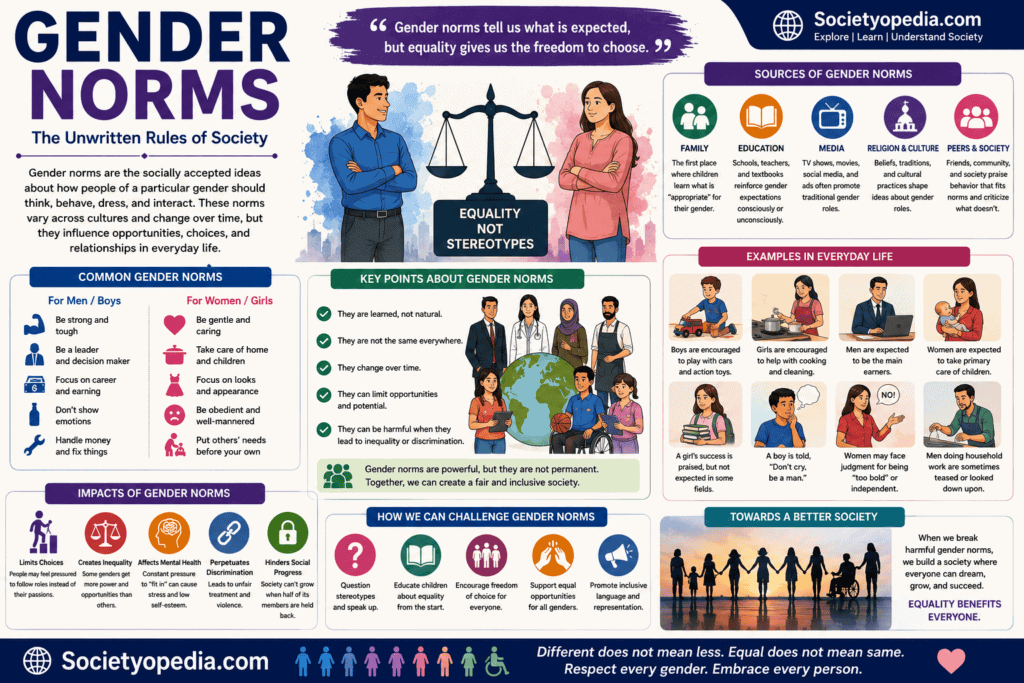
Gender norms are an important concept in sociology and Gender Studies. They refer to the social expectations that influence how people are expected to behave, dress, communicate, work, and interact based on their perceived gender.
From childhood, individuals encounter messages about what is considered appropriate behavior for men, women, boys, and girls. These expectations can influence everyday decisions, relationships, education, employment, family responsibilities, and personal identity.
Gender norms are not identical everywhere. They vary between cultures, communities, generations, and historical periods. They can also change as societies experience social, economic, and cultural transformations.

What Are Gender Norms?
Gender norms are socially shared expectations about appropriate behavior, characteristics, responsibilities, and roles associated with gender.
In simple terms, gender norms tell people what society considers appropriate or inappropriate behavior based on gender.
For example, a society may expect men to be strong and independent while expecting women to be caring and emotionally supportive. These are examples of gender norms because they represent shared expectations about how people should behave.
Gender norms are learned through social interaction rather than being automatically determined by biology.
Examples of Gender Norms
Gender norms can influence many areas of social life.
Common examples include expectations that:
- Men should be financially responsible for the family.
- Women should take greater responsibility for childcare.
- Men should appear strong and confident.
- Women should be caring and emotionally expressive.
- Certain occupations are more suitable for men.
- Certain occupations are more suitable for women.
- Men should take leadership roles.
- Women should prioritize family responsibilities.
These expectations differ across societies and can change over time.
Gender Norms and Gender Roles
Gender norms and gender roles are closely connected.
Gender norms are expectations about appropriate behavior, while gender roles refer more specifically to the behaviors and responsibilities that society assigns to people based on gender.
For example, the belief that women should be responsible for childcare is a gender norm. The actual expectation that a mother should stay home to care for children represents a gender role.
In practice, the two concepts often overlap.
How Are Gender Norms Learned?
Gender norms are learned through gender socialization, which begins early in life.
Family
Family is often the first major source of gender norms. Children observe how adults divide household work, communicate, dress, and behave.
Parents may also encourage different activities for boys and girls, intentionally or unintentionally.
Education
Schools can influence gender norms through textbooks, teachers, classroom practices, extracurricular activities, and career expectations.
Educational institutions can either reinforce traditional expectations or challenge them by providing equal opportunities.
Peer Groups
Friends and classmates can strongly influence gender behavior. Individuals may experience social pressure to behave according to the expectations of their peer group.
Media
Television, films, advertising, video games, and social media can communicate ideas about masculinity and femininity.
Repeated representations can make particular gender expectations appear normal or natural.
Religion and Culture
Religious traditions and cultural practices can influence expectations concerning family life, marriage, dress, responsibilities, and relationships.
The influence of religion and culture varies significantly between societies and communities.
Types of Gender Norms
Gender norms can appear in different areas of social life.
Family Gender Norms
These concern expectations about marriage, parenting, childcare, household work, and family responsibilities.
Workplace Gender Norms
These concern expectations about occupations, leadership, professional behavior, and career responsibilities.
Appearance Norms
These involve expectations concerning clothing, hairstyles, body appearance, and personal presentation.
Emotional Norms
These influence how people are expected to express emotions. For example, some cultures may discourage men from openly expressing vulnerability.
Social Behavior Norms
These concern communication, relationships, social interaction, and public behavior.
Gender Norms and Culture
Culture plays a major role in shaping gender norms.
What is considered appropriate behavior for men or women in one society may be considered unusual in another. Cultural expectations can also change across generations.
For example, the types of employment considered appropriate for women have changed significantly in many societies. Similarly, expectations concerning men’s involvement in childcare and household work have changed in some communities.
This cultural variation demonstrates that gender norms are socially shaped rather than universal.
Gender Norms and Socialization
Gender norms are passed from one generation to another through socialization.
Children observe and learn from the behavior of parents, teachers, peers, media personalities, and other members of society.
When individuals repeatedly encounter the same expectations, they may internalize them and begin to view them as normal.
This process helps explain why gender norms can remain influential even when individuals do not consciously think about them.
Gender Norms and Social Inequality
Gender norms can contribute to social inequality when they create unequal expectations or restrict opportunities.
For example, if women are expected to prioritize unpaid household work, they may have less time for education or paid employment. Similarly, if men are expected to avoid caregiving responsibilities, they may experience pressure to prioritize paid work.
Rigid gender norms can therefore influence access to education, employment, income, leadership, and social participation.
However, gender norms do not affect everyone in exactly the same way. Their effects can vary according to social class, culture, age, ethnicity, family structure, and other social factors.
Changing Gender Norms
Gender norms can change as societies change.
Several factors can contribute to changing gender expectations, including:
- Education
- Economic development
- Urbanization
- Social movements
- Legal reforms
- Technology
- Globalization
- Changing family structures
- Increased participation of women in employment and politics
Social media has also created new spaces where people can discuss, challenge, and redefine traditional gender expectations.
Despite these changes, traditional gender norms may continue to influence social behavior in many societies.
Why Are Gender Norms Important?
Gender norms are important because they influence how individuals understand themselves and others.
They affect everyday decisions about education, careers, relationships, clothing, family responsibilities, and social behavior.
Studying gender norms allows sociologists to understand how societies create expectations and how these expectations can contribute to social stability, inequality, discrimination, or social change.
Conclusion
Gender norms are socially shared expectations about how people should behave based on their perceived gender. They influence family relationships, education, employment, appearance, emotional expression, and many other aspects of social life.
These norms are learned through gender socialization and reinforced by family, schools, peer groups, media, religion, and cultural institutions. They vary between societies and can change over time.
Understanding gender norms is essential for studying gender roles, gender stereotypes, gender socialization, gender inequality, and gender discrimination. It also helps explain how everyday social expectations can shape opportunities and experiences in society.