Gender socialization is an important concept in sociology and Gender Studies. It refers to the process through which individuals learn the gender-related values, norms, behaviors, roles, and expectations of their society.
From early childhood, people encounter messages about how individuals are expected to behave based on gender. These messages may come from parents, teachers, friends, religious institutions, media, and wider cultural practices. Over time, individuals may internalize these expectations and use them to understand their own behavior and the behavior of others.
Gender socialization helps explain how societies reproduce ideas about masculinity and femininity across generations. It is also important for understanding gender roles, gender norms, stereotypes, and gender inequality.
What Is Gender Socialization?
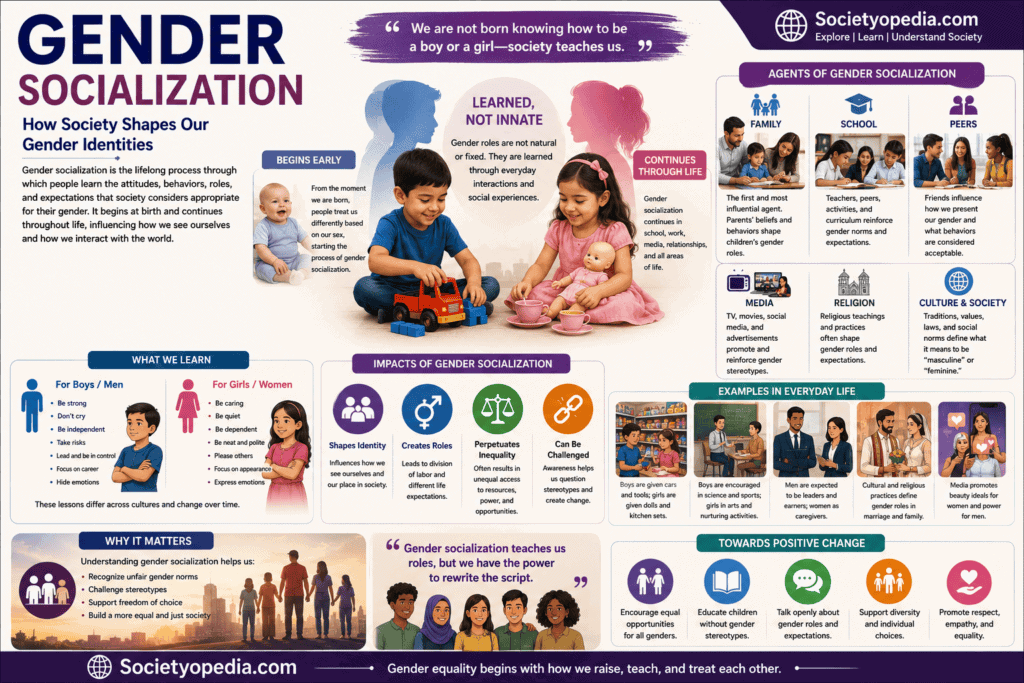
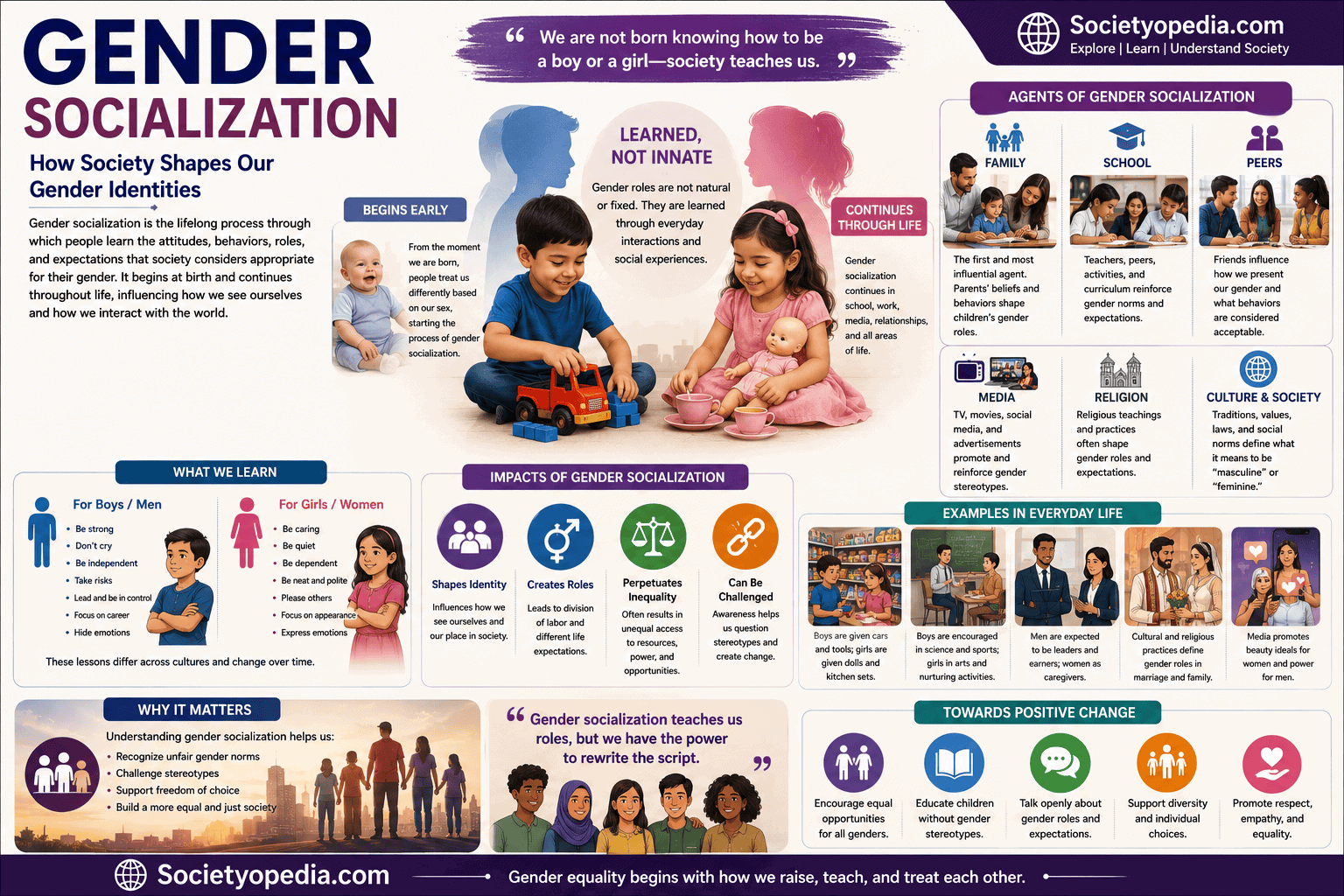
Gender socialization is the process through which individuals learn the gender roles, norms, values, expectations, and behaviors considered appropriate within their society.
The process begins early in childhood and continues throughout life. People do not learn gender expectations from one source alone. Instead, they encounter messages from multiple social environments.
For example, a child may learn ideas about gender from family members, observe gender roles in the household, encounter gender stereotypes in television programs, and later experience gender expectations at school or in the workplace.
Gender socialization therefore connects individual behavior with wider social and cultural structures.
How Does Gender Socialization Work?
Gender socialization occurs through observation, interaction, communication, rewards, sanctions, and social expectations.
Children observe how adults behave and may imitate what they see. They may also receive approval when they behave according to expected gender norms and criticism when they behave differently.
For example, a boy may be praised for being strong or independent, while a girl may be encouraged to be caring and polite. Such repeated interactions can communicate broader cultural expectations.
Gender socialization does not mean that everyone accepts social expectations in exactly the same way. Individuals can interpret, resist, negotiate, or reject gender norms.
Main Agents of Gender Socialization
Several social institutions and groups play important roles in gender socialization.
1. Family
The family is usually one of the earliest and most influential agents of gender socialization.
Children learn gender expectations through everyday family life. Parents and relatives may influence:
- Clothing choices
- Toys and games
- Household responsibilities
- Communication styles
- Educational expectations
- Career aspirations
- Emotional expression
Children also learn by observing how adults divide household work and perform family roles.
For example, if girls are consistently expected to help with cooking and cleaning while boys are encouraged to engage in outdoor activities, children may learn that these responsibilities are associated with different genders.
Families can also challenge traditional gender expectations by encouraging children to participate equally in household responsibilities and activities.
2. Education
Schools are another important agent of gender socialization.
Teachers, classmates, textbooks, school policies, classroom activities, and career guidance can all communicate ideas about gender.
For example, students may encounter assumptions about which subjects or occupations are appropriate for boys and girls.
Schools can reproduce gender norms, but they can also challenge them. Equal participation, inclusive teaching, and exposure to diverse role models can help reduce restrictive expectations.
3. Peer Groups
Peer groups become increasingly important as children grow older.
Friends and classmates influence clothing, behavior, interests, communication, and social relationships. Young people may experience pressure to conform to gender expectations within their peer groups.
For example, a boy who expresses emotions openly may be criticized by peers who believe that emotional expression is inconsistent with traditional masculinity.
Similarly, girls may experience pressure concerning appearance, behavior, or relationships.
Peer groups can therefore reinforce gender norms while also providing opportunities to challenge them.
4. Mass Media
Media is a major source of gender socialization.
Television, films, advertisements, magazines, music, video games, and social media can present ideas about masculinity and femininity.
For example, media may repeatedly portray men as strong, independent, competitive, and successful, while portraying women as caring, attractive, emotional, or family-oriented.
Repeated exposure to such representations can influence how audiences understand gender.
However, media can also challenge stereotypes by presenting diverse identities, careers, family arrangements, and forms of masculinity and femininity.
5. Religion
Religious institutions and beliefs can influence gender expectations in many societies.
Religious teachings, traditions, family practices, and community expectations may shape ideas about marriage, parenting, clothing, family responsibilities, leadership, and relationships.
The influence of religion varies considerably between religious traditions and communities. It can reinforce particular gender roles, but religious communities can also interpret and adapt gender expectations in different ways.
6. Workplace
Gender socialization continues into adulthood.
Workplaces can communicate expectations concerning leadership, communication, appearance, professional behavior, and occupational roles.
For example, some occupations may continue to be associated with particular genders, creating expectations about who is suitable for certain types of work.
Professional environments can also challenge traditional gender expectations by providing equal opportunities and diverse leadership models.
Examples of Gender Socialization
Gender socialization can be observed in everyday life.
Clothing
Children may be encouraged to wear different colors or styles based on gender expectations.
Toys
Certain toys may be marketed toward boys or girls, reinforcing assumptions about interests and future roles.
Household Work
Children may receive different domestic responsibilities according to gender.
Career Expectations
Young people may be encouraged toward particular professions because of assumptions about gender.
Emotional Behavior
Individuals may receive different messages about which emotions are appropriate to express.
These examples demonstrate how gender expectations can become part of everyday social life.
Gender Socialization and Gender Roles
Gender socialization is closely connected to gender roles.
Gender roles refer to expected patterns of behavior and responsibility associated with gender.
Gender socialization is the process through which people learn those expectations.
For example, the belief that women should take primary responsibility for childcare represents a gender role. Learning this expectation through family, culture, education, or media represents gender socialization.
This relationship explains how gender roles can be reproduced across generations.
Gender Socialization and Gender Norms
Gender norms are socially shared expectations about appropriate behavior.
Gender socialization teaches individuals these norms.
For example, if a society expects men to appear emotionally strong, boys may learn this expectation through family interactions, peer pressure, media, and cultural messages.
Over time, individuals may internalize these norms and regulate their own behavior accordingly.
Gender Socialization and Gender Stereotypes
Gender stereotypes can also be transmitted through gender socialization.
A child may repeatedly encounter the idea that girls are naturally caring or that boys are naturally competitive. When such beliefs are reinforced by family, peers, education, and media, they can become part of the individual’s understanding of gender.
This is why gender socialization is important for understanding how stereotypes become socially reproduced.
Gender Socialization Across the Life Course
Gender socialization does not stop during childhood.
Adolescence introduces new expectations concerning relationships, appearance, sexuality, education, and career choices.
During adulthood, gender expectations may become connected with marriage, parenting, employment, leadership, and household responsibilities.
Later in life, people may encounter additional expectations concerning aging, caregiving, retirement, and family relationships.
Therefore, gender socialization is a lifelong process rather than something that happens only during childhood.
Can People Resist Gender Socialization?
Individuals are not passive recipients of social expectations.
People can question, negotiate, reinterpret, or reject gender norms. Social change often occurs when individuals and groups challenge established expectations.
For example, a person may choose an occupation traditionally associated with another gender, share household responsibilities equally, or reject stereotypical expectations about emotional behavior.
Social movements, education, changing laws, and new cultural ideas can also provide individuals with opportunities to challenge traditional gender expectations.
Gender Socialization and Social Inequality
Gender socialization can contribute to inequality when people are taught that different genders deserve different opportunities or responsibilities.
For example, if girls are discouraged from pursuing certain careers or boys are discouraged from participating in caregiving activities, socialization can influence educational and occupational choices.
Similarly, unequal expectations about household responsibilities can affect people’s time, income, career development, and participation in public life.
However, gender socialization does not operate independently. Its effects interact with social class, culture, ethnicity, age, family structure, education, and other social factors.
Importance of Gender Socialization
Studying gender socialization is important because it helps explain how societies maintain and reproduce gender expectations.
It allows sociologists to examine questions such as:
- How do children learn gender roles?
- Why do gender expectations differ between societies?
- How does media influence gender behavior?
- Why do some occupations become gendered?
- How are gender stereotypes reproduced?
- How can gender norms change?
- How does gender socialization contribute to inequality?
Understanding these processes helps researchers examine the relationship between individuals and society.
Conclusion
Gender socialization is the lifelong process through which individuals learn gender-related norms, roles, values, expectations, and behaviors. It begins in early childhood and continues through adolescence and adulthood.
Family, education, peer groups, media, religion, workplaces, and wider culture all contribute to this process. Through repeated interaction, individuals learn what their society considers appropriate or inappropriate gender behavior.
Gender socialization is closely connected to gender roles, gender norms, and gender stereotypes. It can help maintain social expectations across generations, but individuals can also challenge and transform these expectations.
For this reason, gender socialization is a central concept for understanding gender relations, social inequality, identity, and social change.