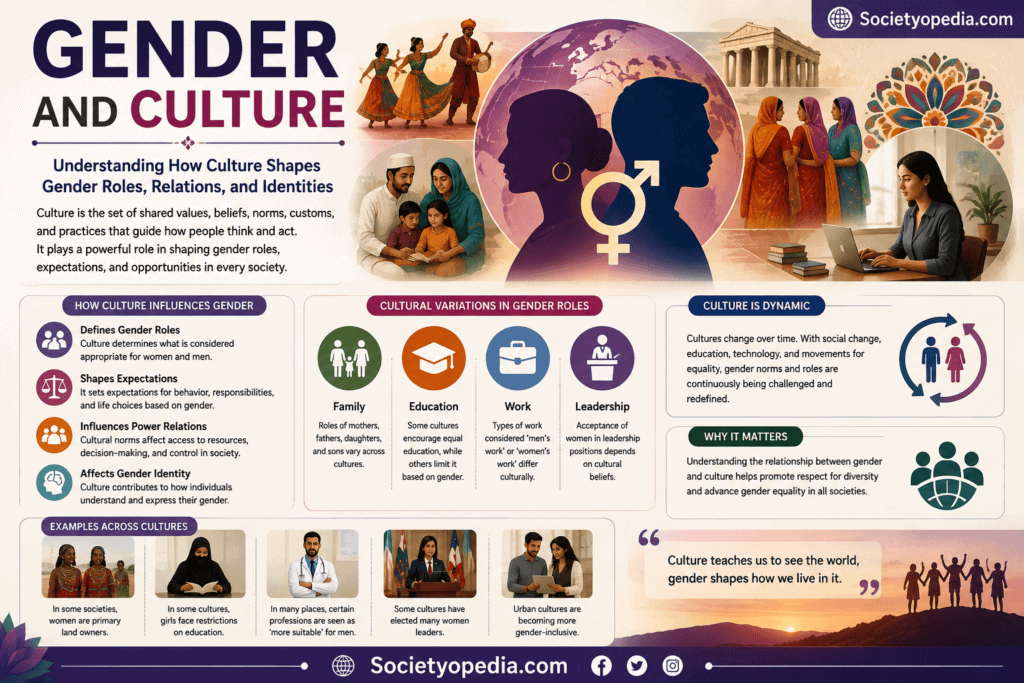
Gender and culture are deeply interconnected concepts in sociology and gender studies. The way people understand masculinity, femininity, gender roles, family responsibilities, work, relationships, appearance, and social behavior is influenced by the culture in which they live.
Culture provides people with values, beliefs, norms, traditions, language, customs, and social practices. Through these cultural elements, individuals learn what their society considers appropriate or inappropriate behavior for women and men. These expectations often begin in childhood and continue throughout life.
However, gender expectations are not identical everywhere. Different societies can have different ideas about how women and men should behave. Gender roles can also change over time as societies experience economic, political, technological, and cultural transformations.
For this reason, studying the relationship between gender and culture helps sociologists understand gender socialization, gender roles, stereotypes, inequality, identity, and social change.
What Is Gender?
Gender refers to the socially and culturally constructed roles, behaviors, expectations, identities, and meanings associated with gender.
Gender is often distinguished from biological sex. Sex generally refers to biological and physiological characteristics, while gender concerns the social meanings and expectations that societies attach to gender.
For example, the belief that women should primarily take care of children while men should provide financial support is a gender expectation. Such expectations are shaped by society and culture rather than being identical across all human communities.
Gender therefore has both personal and social dimensions. Individuals experience gender as part of their identities, while societies create norms and institutions that influence how gender is understood.
What Is Culture?
Culture refers to the shared values, beliefs, norms, customs, traditions, language, knowledge, symbols, and practices of a social group or society.
Culture provides people with guidelines for understanding the world and interacting with others.
For example, cultural traditions can influence how people understand marriage, family, education, clothing, parenting, work, religion, and social relationships.
Because gender is experienced within these social environments, culture plays a major role in shaping gender expectations.
What Is the Relationship Between Gender and Culture?
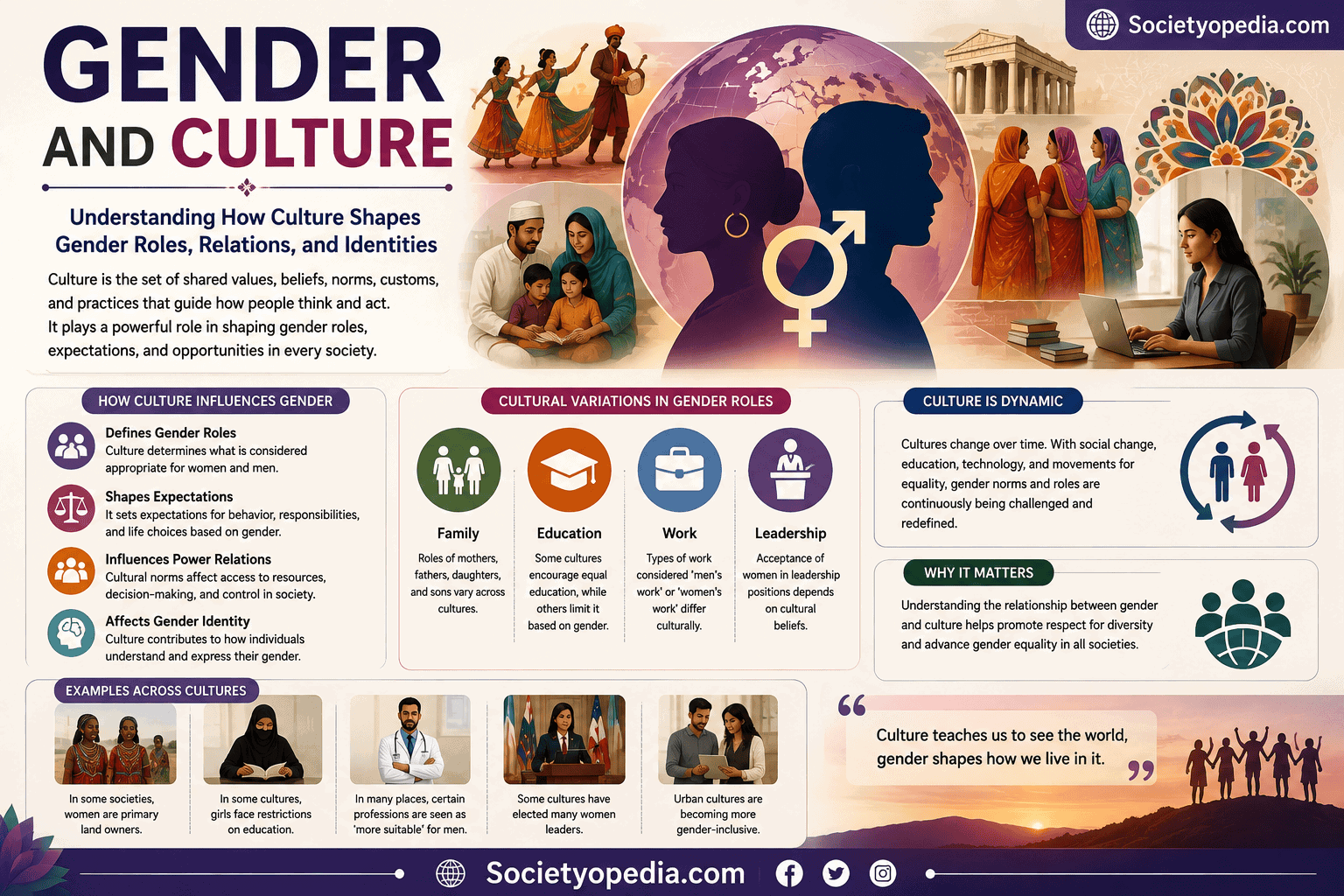
Gender and culture have a close and reciprocal relationship.
Culture influences how gender is defined and expressed, while people’s gender-related behaviors can also contribute to maintaining or changing cultural practices.
From childhood, individuals receive cultural messages about gender. Parents, relatives, teachers, peers, religious communities, media, and other institutions communicate expectations about appropriate behavior.
A child may learn that certain toys, colors, clothing, occupations, or activities are suitable for girls while others are suitable for boys.
When these messages are repeated over many years, they can become deeply embedded in everyday behavior.
However, individuals do not always accept cultural expectations without question. People can challenge traditional gender norms and contribute to cultural change.
How Culture Shapes Gender Roles
Gender roles are socially expected patterns of behavior associated with gender.
Culture plays an important role in defining these roles.
In some societies, women may traditionally be expected to take greater responsibility for childcare and household work, while men may be expected to provide income and make major financial decisions.
In other societies, household responsibilities may be distributed more equally between women and men.
Gender roles can also influence educational and occupational choices. Certain professions may become culturally associated with women, while others become associated with men.
These associations can influence how young people think about their future careers.
Gender roles are therefore not fixed. They can change when cultural values and social conditions change.
Gender Norms and Culture
Gender norms are shared expectations about how people should behave based on gender.
These norms may influence:
- clothing and appearance;
- family responsibilities;
- education;
- employment;
- parenting;
- emotional expression;
- relationships;
- leadership;
- communication;
- social behavior.
Gender norms can be formal or informal.
Some expectations are reinforced by laws and institutional policies, while others are maintained through everyday social interactions.
For example, a society may expect women to behave modestly or men to demonstrate strength and emotional control.
Individuals who conform to dominant norms may receive social approval, while those who challenge them may experience criticism or social pressure.
Gender Socialization and Culture
Gender socialization is one of the main ways culture influences gender.
Gender socialization is the process through which individuals learn the norms, values, expectations, and behaviors associated with gender.
The process begins early in life.
Parents may encourage different activities for boys and girls. Teachers may communicate different expectations. Peer groups can reward conformity to gender norms. Media can reinforce particular ideas about masculinity and femininity.
Through these repeated experiences, children gradually learn how gender is understood within their society.
However, socialization does not mean that people simply accept everything they are taught. Individuals can interpret, negotiate, or reject cultural expectations.
Gender and Family Culture
The family is one of the first and most important environments in which gender expectations are learned.
Children observe how parents and other family members divide household responsibilities, make decisions, communicate, and perform different roles.
For example, if children consistently observe women cooking and cleaning while men earn income, they may learn that domestic work is primarily a woman’s responsibility.
However, families differ considerably.
Some families divide household responsibilities equally between women and men. Fathers may participate extensively in childcare, while mothers may be primary income earners.
These differences demonstrate that family practices can either reproduce traditional gender roles or contribute to changing them.
Gender and Education
Educational institutions are also important cultural environments.
Schools and universities communicate cultural ideas through curriculum, textbooks, classroom practices, teacher expectations, and peer interactions.
For example, if textbooks consistently portray men as scientists, political leaders, and professionals while portraying women mainly as mothers and caregivers, students may develop stereotypical ideas about gender.
On the other hand, education can challenge gender stereotypes by presenting women and men in diverse professional and social roles.
Equal access to education can also provide individuals with greater opportunities for employment, economic independence, leadership, and social participation.
Education can therefore both reproduce and transform cultural expectations about gender.
Gender and Workplace Culture
Workplaces have their own organizational cultures that can influence gender relations.
Some workplaces may have traditional expectations concerning leadership, working hours, appearance, caregiving, and career commitment.
For example, an organization may implicitly view long working hours as a sign of commitment. Such expectations can disproportionately affect workers who have significant family and caregiving responsibilities.
Workplace culture can also influence whether women are encouraged to pursue leadership positions or whether men feel comfortable taking parental responsibilities.
Creating more inclusive workplace cultures can therefore contribute to changing traditional gender expectations.
Gender and Media Culture
Media is one of the most influential cultural forces shaping contemporary gender perceptions.
Television programs, films, advertisements, newspapers, websites, and social media all communicate representations of gender.
Repeated portrayals can reinforce ideas about beauty, masculinity, femininity, relationships, family roles, and professional success.
For example, advertisements may portray women primarily in domestic roles or emphasize physical appearance, while men may be portrayed as powerful, successful, or financially independent.
However, media can also challenge stereotypes.
Women can be represented as scientists, political leaders, entrepreneurs, athletes, and professionals. Men can be represented as caregivers, teachers, fathers, and emotionally expressive individuals.
Media therefore has the potential to reproduce existing gender norms as well as contribute to cultural change.
Gender and Religion
Religion can be an important part of culture and may influence ideas about gender, family, marriage, modesty, parenting, and social responsibilities.
However, religious traditions are interpreted differently across societies and communities.
Even within the same religious tradition, people may have different understandings of appropriate gender roles.
A sociological analysis should therefore distinguish between religious teachings, cultural traditions, institutional interpretations, and individual practices.
The relationship between gender, religion, and culture is complex and should be understood within its particular social and historical context.
Gender and Language
Language is another important component of culture.
The words people use to describe women, men, relationships, appearance, leadership, emotions, and occupations can reflect cultural assumptions about gender.
Language can reinforce stereotypes when certain characteristics are consistently associated with one gender.
At the same time, language changes as societies change.
New terminology and more inclusive ways of communicating can challenge older assumptions about gender.
Language therefore does not merely describe society. It can also influence how people understand social categories.
Gender and Clothing
Clothing provides a visible example of the relationship between gender and culture.
Different societies have different expectations regarding clothing, hairstyles, accessories, colors, and appearance.
What is considered masculine or feminine clothing is not universal.
These meanings can also change over time. Styles that were once strongly associated with one gender may later become common among people of different genders.
This demonstrates that gendered meanings attached to clothing are influenced by cultural norms rather than being biologically determined.
Gender and Masculinity
Culture shapes ideas about what it means to be masculine.
Masculinity refers to socially constructed expectations and meanings associated with being a man.
Some cultures emphasize strength, independence, competitiveness, leadership, emotional control, and economic responsibility as masculine characteristics.
Boys may therefore receive messages encouraging them to be strong, competitive, or emotionally controlled.
However, masculinity varies across societies and social groups.
There is not one universal form of masculinity. Different cultures and communities can produce different expectations concerning men’s behavior.
Gender and Femininity
Culture also influences ideas about femininity.
Femininity refers to socially constructed expectations and meanings associated with being a woman.
Traditional expectations may associate femininity with caring, modesty, emotional sensitivity, beauty, cooperation, and responsibility for family life.
However, these expectations differ across societies and historical periods.
Women may also challenge traditional definitions of femininity through education, employment, political participation, leadership, and other forms of social engagement.
Femininity is therefore better understood as a changing cultural construction rather than a fixed biological characteristic.
Gender Stereotypes and Culture
Gender stereotypes are generalized beliefs about the characteristics, abilities, and behaviors of women and men.
Culture can reproduce stereotypes through family practices, education, media, advertising, entertainment, and everyday interaction.
Examples include beliefs that:
- women are naturally better caregivers;
- men are naturally better leaders;
- women are more emotional;
- men should be strong;
- women should prioritize family;
- men should be financial providers.
These assumptions can influence people’s decisions and opportunities.
When stereotypes become embedded within social institutions, they can contribute to discrimination and gender inequality.
Cultural Differences in Gender Roles
Gender roles vary considerably between societies.
A behavior considered appropriate for women in one culture may be viewed differently in another.
Expectations about women’s employment, men’s involvement in childcare, family decision-making, marriage, education, political participation, and household responsibilities can all vary.
These differences demonstrate the importance of culture in shaping gender.
However, it is important to remember that cultures are not internally uniform. Gender expectations can differ according to social class, age, education, religion, occupation, geographical location, and other social factors.
Therefore, we should avoid treating any society as if every individual follows exactly the same gender norms.
Gender and Cultural Change
Culture changes over time, and gender expectations change with it.
Economic development, urbanization, education, migration, technological development, globalization, political reforms, and social movements can all influence gender relations.
For example, greater participation of women in higher education and paid employment can challenge the belief that women should be restricted to domestic roles.
Similarly, greater involvement of fathers in childcare can challenge traditional expectations about masculinity.
Social movements can also challenge discriminatory practices and promote greater gender equality.
Therefore, gender roles should be understood as dynamic rather than permanent.
Globalization and Gender Culture
Globalization has increased interaction between societies and exposed people to different ideas about gender.
International migration, education, entertainment, social media, international organizations, and digital communication allow people to encounter gender expectations from different cultural settings.
This interaction can encourage cultural exchange and challenge traditional gender norms.
However, globalization does not produce identical gender roles everywhere.
Global ideas are often interpreted and adapted according to local cultures and social conditions.
As a result, globalization can create both opportunities for gender change and tensions between traditional and emerging expectations.
Gender, Culture, and Inequality
Cultural expectations can contribute to gender inequality when they restrict people’s opportunities, rights, resources, or social power.
For example, cultural beliefs about women’s responsibilities may discourage girls from pursuing certain educational fields or careers.
Similarly, expectations that women should perform most unpaid domestic work can limit their participation in paid employment.
Men can also experience restrictive gender expectations. Cultural beliefs that men must always be financially successful or emotionally strong can place significant social pressure on them.
Gender inequality therefore cannot be understood only at the individual level. Cultural norms can become connected with institutions and social structures.
Can Culture Change Gender Roles?
Yes. Gender roles can change when cultural beliefs, social practices, and institutions change.
Several factors can contribute to this process, including education, economic transformation, legal reforms, women’s participation in employment, social movements, technological change, changing family structures, and new media representations.
However, cultural change is often gradual.
Traditional expectations may continue alongside new gender roles, creating differences between generations and social groups.
This means that societies can contain competing ideas about gender at the same time.
Why Is Gender and Culture Important?
Studying gender and culture is important because it helps explain why gender expectations differ across societies and historical periods.
It also helps people recognize that many behaviors considered “natural” may actually be shaped by social learning and cultural expectations.
For sociology and gender studies students, the relationship between gender and culture provides a foundation for understanding:
- gender roles;
- gender norms;
- gender socialization;
- gender stereotypes;
- gender identity;
- gender inequality;
- feminism;
- masculinity;
- gender and family;
- gender and education;
- gender and employment;
- gender and media.
Understanding cultural influences can also help researchers and policymakers identify discriminatory practices and develop more inclusive institutions.
Conclusion
Gender and culture are deeply interconnected. Culture provides the values, norms, beliefs, traditions, and practices through which people learn what their society considers appropriate behavior for different genders.
Family, education, religion, media, language, workplaces, and peer groups all contribute to the construction and reinforcement of gender expectations.
At the same time, gender roles are not fixed. Cultural values and practices can change as societies experience economic, political, technological, and social transformations.
Individuals and social movements can also challenge traditional expectations and contribute to new understandings of gender.
The relationship between gender and culture therefore demonstrates an important sociological principle: gender is shaped within cultural contexts, and cultural contexts themselves can change.
Understanding this relationship provides an essential foundation for studying gender as a social construct, gender identity, gender inequality, feminism, and broader processes of social change.
Related Articles on Societyopedia
Continue exploring the Gender Studies cluster:
- What Is Gender?
- Sex and Gender Difference
- Gender Roles
- Gender Norms
- Gender Stereotypes
- Gender Socialization
- Gender and Society
- Gender as a Social Construct
- Gender Identity Meaning
- Gender Inequality Definition
This article is part of Societyopedia’s Gender Studies content cluster and connects the foundational concepts of gender with the broader study of culture, inequality, identity, and social change.