Introduction
Explanatory Research Design is one of the most important research designs in the social sciences because it seeks to explain why and how social phenomena occur. While exploratory research focuses on discovering new ideas and descriptive research describes existing situations, explanatory research goes a step further by identifying the causes, effects, and relationships between variables. Its primary objective is to answer questions such as “Why does this happen?” and “How are these variables related?”
Researchers use explanatory research to test theories, examine hypotheses, and establish relationships between independent and dependent variables. This design is widely applied in sociology, psychology, anthropology, political science, economics, education, healthcare, public administration, and business. It provides scientific evidence that helps policymakers, organizations, and researchers understand social issues and develop effective solutions.
Explanatory research is often conducted after exploratory and descriptive studies have identified important variables and patterns. It forms the basis for evidence-based decision-making by explaining the mechanisms behind observed social phenomena.
Definition of Explanatory Research Design

Different scholars have defined explanatory research from different perspectives.
According to John W. Creswell, explanatory research is a research design used to investigate relationships among variables and determine how one variable influences another through systematic data collection and analysis.
According to Earl Babbie, explanatory research aims to explain the reasons for observed patterns, events, or relationships by testing hypotheses and examining causal connections.
According to C. R. Kothari, explanatory research attempts to discover cause-and-effect relationships by investigating how changes in one variable influence another.
In simple words, explanatory research design is a systematic research approach used to explain the causes of social phenomena and identify the relationships between different variables.
Characteristics of Explanatory Research Design
Explanatory research is theory-based because it usually begins with existing theories or conceptual frameworks that guide hypothesis development.
It is hypothesis-driven, meaning researchers formulate testable hypotheses before collecting data.
The design focuses on identifying causal relationships between variables rather than simply describing them.
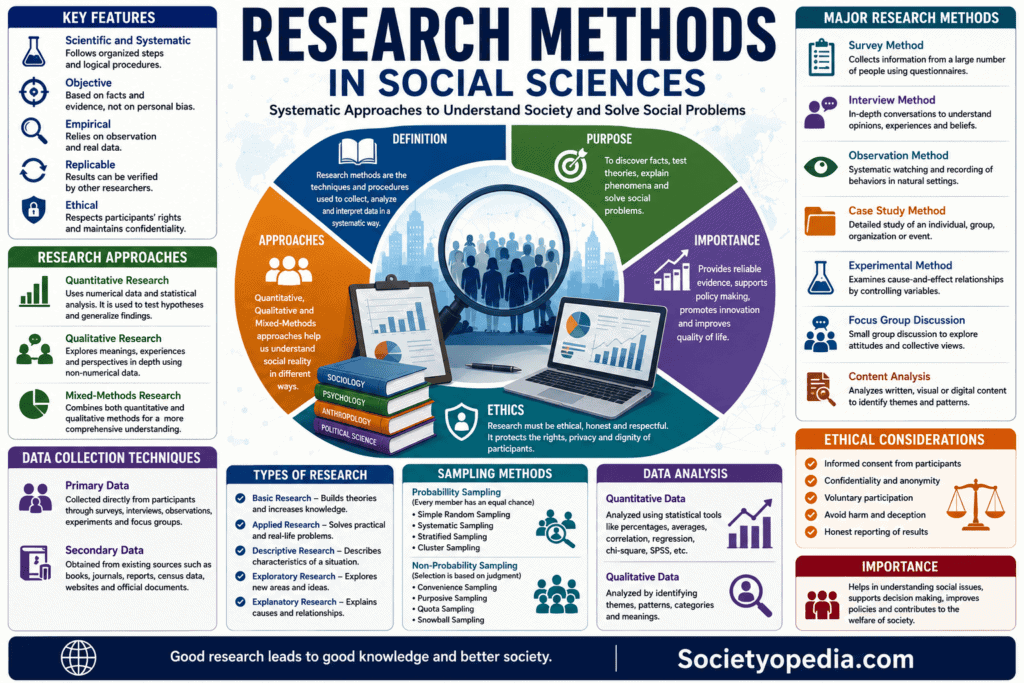
Explanatory research relies heavily on quantitative methods and statistical analysis, although mixed-method approaches may also be used.
The research process is systematic and structured, following clearly defined procedures for sampling, data collection, analysis, and interpretation.
Another important characteristic is objectivity, as researchers seek to minimize personal bias through standardized research methods.
Objectives of Explanatory Research Design
The primary objective of explanatory research is to determine why social phenomena occur.
It seeks to identify causal relationships between independent and dependent variables.
Explanatory research helps researchers test theories and evaluate hypotheses scientifically.
It contributes to predicting future outcomes based on established relationships.
The design supports evidence-based policymaking by identifying the factors responsible for social problems and their possible solutions.
When to Use Explanatory Research Design
Explanatory research is appropriate when sufficient background information already exists and researchers want to understand the causes behind observed patterns.
It is commonly used when testing hypotheses developed from previous exploratory or descriptive studies.
Researchers use explanatory research to investigate social inequalities, educational achievement, healthcare outcomes, political participation, economic behavior, organizational performance, and many other complex social issues.
Types of Explanatory Research Design
Experimental Research Design
Experimental research is one of the strongest forms of explanatory research because researchers manipulate independent variables while controlling other factors.
Participants are assigned to experimental and control groups to determine whether changes in the independent variable produce changes in the dependent variable.
Experimental designs provide strong evidence for causal relationships.
Quasi-Experimental Research Design
Quasi-experimental research resembles experimental research but does not involve complete random assignment of participants.
It is commonly used in educational institutions, healthcare organizations, and community-based studies where true experiments may not be practical.
Correlational Research Design
Correlational research examines the strength and direction of relationships between variables.
Although correlation alone does not prove causation, it provides important evidence that supports explanatory analysis when combined with theory and additional research.
Longitudinal Research Design
Longitudinal studies collect data from the same participants over a long period.
This design enables researchers to examine how changes in one variable influence another over time.
Comparative Research Design
Comparative research compares two or more groups, regions, organizations, or societies to identify similarities, differences, and possible causal factors.
Components of Explanatory Research
A well-designed explanatory study includes clearly defined research questions and objectives.
Researchers identify independent variables, dependent variables, and possible control variables before data collection begins.
A theoretical framework provides the conceptual foundation for explaining relationships among variables.
Hypotheses are formulated based on previous literature and existing theories.
Appropriate sampling methods, reliable data collection instruments, and statistical analysis techniques are selected to ensure valid findings.
Methods Used in Explanatory Research
Survey Research
Surveys are widely used in explanatory research because they allow researchers to collect standardized data from large populations.
Structured questionnaires help measure variables accurately and facilitate statistical analysis.
Experiments
Experiments enable researchers to manipulate independent variables and observe their effects on dependent variables.
This method provides the strongest evidence for establishing causal relationships.
Secondary Data Analysis
Researchers often analyze existing datasets obtained from government agencies, international organizations, universities, and research institutions.
Large-scale datasets are useful for examining long-term social trends and testing complex hypotheses.
Observation
Structured observation can also be used when researchers need to examine behavioral patterns or interactions under controlled conditions.
Case Studies
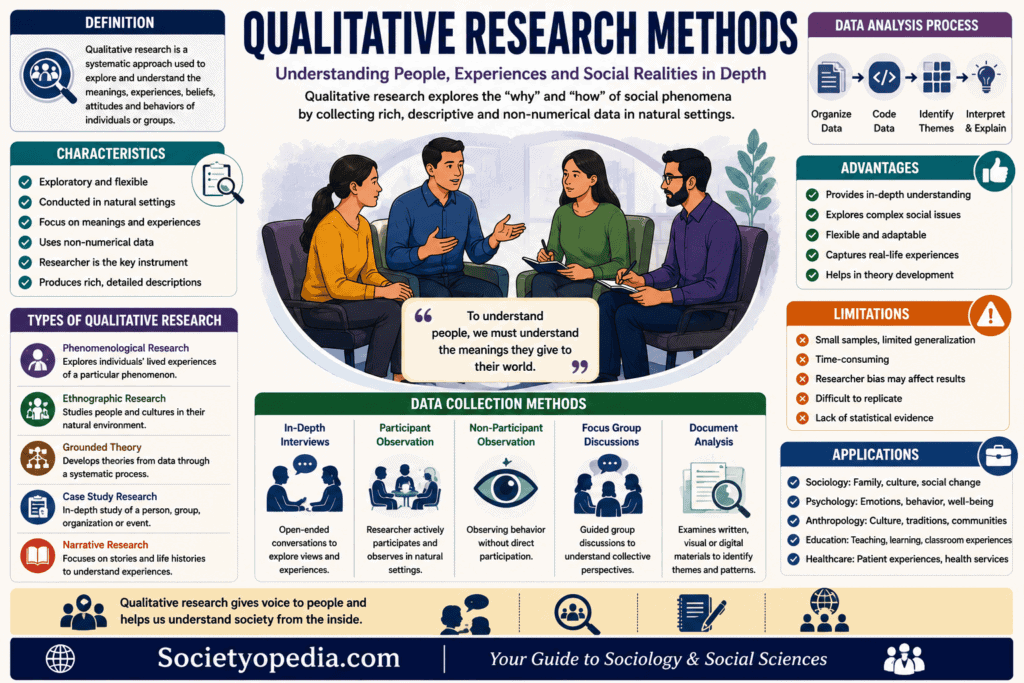
Although case studies are generally associated with qualitative research, explanatory case studies help researchers understand the underlying causes of specific events or organizational outcomes.
Data Collection Techniques
Data collection in explanatory research generally relies on standardized procedures to ensure consistency.
Researchers commonly use structured questionnaires, standardized interviews, experiments, official records, institutional databases, and secondary statistical sources.
The collected data are organized carefully before statistical analysis.
Data Analysis in Explanatory Research
Statistical analysis is central to explanatory research because it allows researchers to examine relationships between variables.
Researchers use descriptive statistics to summarize the data and inferential statistics to test hypotheses.
Common statistical techniques include correlation analysis, regression analysis, chi-square tests, t-tests, analysis of variance (ANOVA), and structural equation modeling.
Software such as IBM SPSS Statistics, R, Stata, and Microsoft Excel is frequently used to analyze explanatory research data.
Advantages of Explanatory Research Design
Explanatory research identifies the causes of social phenomena rather than merely describing them.
It enables researchers to test theories and evaluate hypotheses scientifically.
The design provides evidence for establishing relationships between variables.
Its findings contribute to policy formulation, organizational planning, and evidence-based decision-making.
Explanatory research improves the prediction of future outcomes by identifying influential factors.
The design supports scientific advancement by refining existing theories and developing new knowledge.
Limitations of Explanatory Research Design
Establishing true causation can be difficult because many social phenomena are influenced by multiple interacting variables.
Experimental research may not always be possible due to ethical or practical constraints.
Large-scale explanatory studies often require significant financial resources, advanced statistical skills, and considerable time.
Measurement errors, sampling bias, and uncontrolled variables may affect the accuracy of findings.
Correlation does not always imply causation, requiring careful interpretation of statistical results.
Applications of Explanatory Research in Social Sciences
In sociology, explanatory research is used to investigate the causes of poverty, unemployment, crime, migration, educational inequality, family change, and social mobility.
Psychologists use explanatory research to understand learning processes, personality development, cognitive behavior, and mental health.
Political scientists study voting behavior, public opinion, governance, political participation, and policy outcomes.
Economists examine inflation, employment, economic growth, consumer behavior, and market performance.
Educational researchers investigate factors affecting academic achievement, student motivation, teacher effectiveness, and educational policy.
Healthcare researchers study disease risk factors, treatment effectiveness, healthcare utilization, and public health interventions.
Difference Between Descriptive and Explanatory Research
Descriptive research focuses on describing characteristics and conditions, whereas explanatory research seeks to identify the reasons behind those characteristics and conditions.
Descriptive research answers questions such as who, what, where, when, and how, while explanatory research answers why and how variables are related.
Descriptive studies often provide the foundation for explanatory research by identifying patterns that require further explanation.
Importance of Explanatory Research Design
Explanatory research is essential because it helps researchers move beyond observation to understand the mechanisms responsible for social phenomena.
It provides scientific evidence that supports policy development, organizational improvement, educational reform, healthcare planning, and economic decision-making.
The design strengthens theoretical knowledge by testing existing theories and refining conceptual frameworks.
Explanatory research also contributes to solving real-world social problems through evidence-based interventions.
Conclusion
Explanatory Research Design is a fundamental approach in scientific research because it enables researchers to explain the causes of social phenomena and examine relationships between variables. Through systematic data collection, hypothesis testing, statistical analysis, and theory evaluation, explanatory research provides valuable evidence for understanding complex social issues.
Although establishing causality can be challenging due to ethical, practical, and methodological limitations, explanatory research remains one of the most powerful research designs in sociology and other social sciences. Its ability to identify causal relationships, support evidence-based policymaking, and advance theoretical knowledge makes it indispensable for researchers, educators, policymakers, and development professionals.