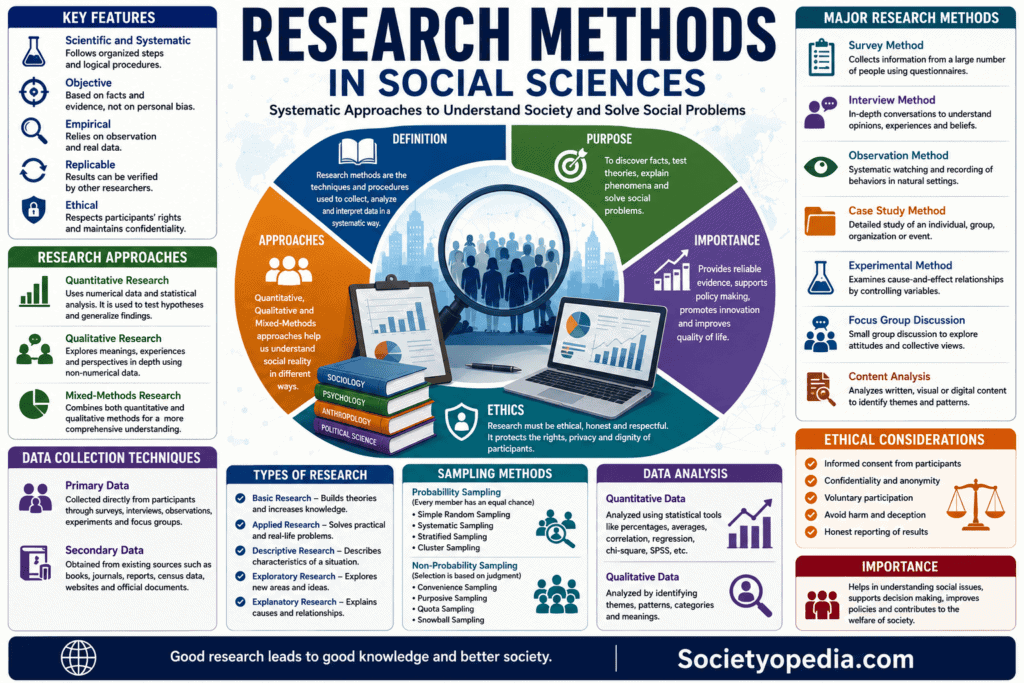
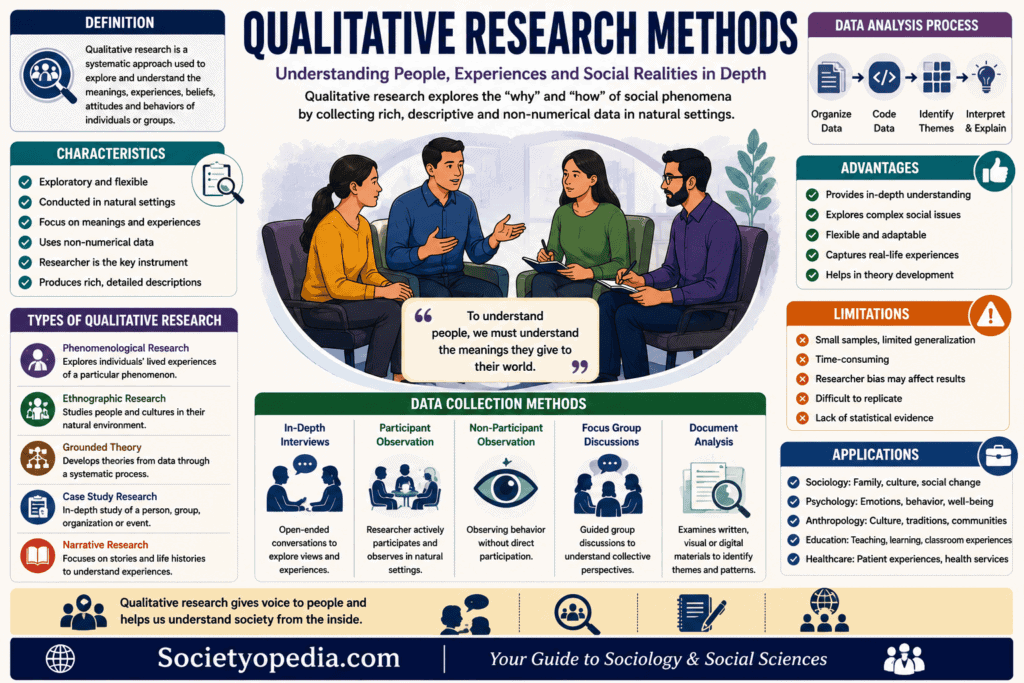
Stratified sampling is one of the most important probability sampling techniques used in quantitative research. It is a method in which researchers divide a population into smaller subgroups, known as strata, based on specific characteristics, and then select samples from each subgroup. The main purpose of stratified sampling is to ensure that important segments of the population are adequately represented in the final sample.
Unlike simple random sampling, where individuals are selected directly from the entire population, stratified sampling recognizes that populations often contain different groups with unique characteristics. By dividing the population into homogeneous subgroups before sampling, researchers can obtain a sample that more accurately reflects the population’s diversity.
For example, a researcher studying job satisfaction among university employees may divide employees into strata such as faculty members, administrative staff, and technical employees. A sample is then selected from each group to ensure that all categories are represented.
Stratified sampling is widely used in sociology, education, public health, economics, political science, and business research. It is particularly valuable when researchers want to compare different subgroups or when certain groups within the population may be underrepresented through simple random sampling.
The method improves the accuracy and precision of research findings by ensuring that important population characteristics are included in the sample. However, stratified sampling requires detailed knowledge of the population and accurate classification of individuals into appropriate groups.
This article explains the concept, definitions, characteristics, types, process, advantages, disadvantages, applications, and practical examples of stratified sampling.

What Is Stratified Sampling?
Stratified sampling is a probability sampling technique in which a population is divided into smaller groups called strata, and participants are randomly selected from each stratum.
The strata are created based on important characteristics such as:
- Age
- Gender
- Income level
- Education
- Occupation
- Geographic location
- Social class
- Ethnicity
- Professional category
The main principle behind stratified sampling is that members within each stratum are similar to one another, while different strata represent different characteristics of the population.
For example, if a researcher wants to study political attitudes among university students, the population may be divided into strata based on academic departments:
- Sociology students
- Psychology students
- Economics students
- Political Science students
Participants are then randomly selected from each department.
Stratified sampling ensures that every important subgroup has representation in the research sample.
Definitions of Stratified Sampling
Several research scholars have defined stratified sampling.
Earl Babbie defines stratified sampling as a probability sampling method in which the population is divided into homogeneous subgroups and samples are selected from each subgroup.
William Lawrence Neuman explains that stratified sampling involves separating a population into meaningful categories and drawing random samples from each category.
John W. Creswell describes stratified sampling as a technique where researchers divide the population into groups and select participants from each group to improve representation.
Ranjit Kumar defines stratified sampling as a sampling procedure in which a population is classified into different strata and samples are independently selected from each stratum.
These definitions highlight four important principles:
- The population is divided into meaningful subgroups.
- Each subgroup receives representation.
- Selection within groups is random.
- The goal is improved accuracy and representation.
Characteristics of Stratified Sampling
Stratified sampling has several important characteristics.
Division into Strata
The population is divided into smaller groups based on relevant characteristics.
Homogeneous Groups
Individuals within each stratum share similar characteristics.
Random Selection Within Strata
Participants are selected randomly from each subgroup.
Improved Representation
Important population groups are included in the final sample.
Probability-Based Method
Every individual has a known probability of selection.
Suitable for Heterogeneous Populations
It is particularly useful when populations contain diverse groups.
Objectives of Stratified Sampling
Stratified sampling is used to achieve several research objectives.
The primary objective is to ensure that all important groups within a population are represented in the sample.
It also aims to improve the accuracy and precision of research findings by reducing variation within each subgroup.
Another objective is to allow researchers to compare different categories within a population.
For example, researchers may compare:
- Male and female respondents
- Rural and urban populations
- Different income groups
- Different educational levels
Types of Stratified Sampling
Stratified sampling is generally divided into two major types.
Proportional Stratified Sampling
In proportional stratified sampling, the number of participants selected from each stratum is proportional to that group’s size in the population.
The sample reflects the actual distribution of the population.
Example
A university has:
- 60% undergraduate students
- 40% postgraduate students
If the researcher requires a sample of 500 students:
- 300 undergraduate students are selected.
- 200 postgraduate students are selected.
The sample maintains the same proportion as the population.
Advantages
- Provides a highly representative sample.
- Reduces sampling bias.
- Reflects actual population characteristics.
Limitations
- Requires accurate population information.
Disproportional Stratified Sampling
In disproportional stratified sampling, researchers select unequal numbers of participants from different strata regardless of their actual population size.
This method is used when researchers want to study smaller groups in greater detail.
Example
A university has:
- 90% male students
- 10% female students
A researcher studying gender differences may select equal numbers:
- 250 male students
- 250 female students
This allows meaningful comparison between groups.
Advantages
- Ensures adequate representation of smaller groups.
- Useful for comparative research.
Limitations
- The sample may not reflect actual population proportions.
Steps in Conducting Stratified Sampling
Stratified sampling follows a systematic process.
Step 1: Define the Target Population
Identify the population to be studied.
Example:
All healthcare professionals working in public hospitals.
Step 2: Identify Stratification Variables
Determine the characteristics that will be used to divide the population.
Example:
Doctors, nurses, and paramedics.
Step 3: Divide the Population into Strata
Create clearly defined and separate groups.
Step 4: Determine Sample Size
Calculate the total number of participants required.
Step 5: Decide the Sampling Approach
Choose proportional or disproportional stratified sampling.
Step 6: Select Participants Randomly
Use random selection methods within each stratum.
Step 7: Collect and Analyze Data
Gather information and apply appropriate statistical techniques.
Advantages of Stratified Sampling
Stratified sampling provides several important benefits.
Ensures Representation
All important population groups are included in the sample.
Improves Accuracy
The sample is often more representative than simple random sampling.
Reduces Sampling Error
Grouping similar individuals reduces variation within strata.
Allows Subgroup Comparisons
Researchers can compare different categories within the population.
Suitable for Diverse Populations
It works effectively when populations contain multiple groups.
Greater Statistical Efficiency
It often produces more precise estimates than simple random sampling.
Disadvantages of Stratified Sampling
Despite its advantages, stratified sampling has several limitations.
Requires Detailed Population Information
Researchers must know the characteristics of the population before sampling.
Complex Planning
Creating appropriate strata requires careful consideration.
Time Consuming
The process requires additional preparation compared with simple random sampling.
Classification Problems
Some individuals may not fit clearly into one category.
More Expensive
Managing multiple groups can increase research costs.
Stratified Sampling vs Cluster Sampling
| Feature | Stratified Sampling | Cluster Sampling |
|---|---|---|
| Group Formation | Based on characteristics | Based on natural groups |
| Purpose | Ensure representation | Reduce cost and complexity |
| Selection | Individuals selected from each stratum | Clusters selected |
| Similarity Within Groups | High | High |
| Common Use | Comparative studies | Large-scale surveys |
Stratified Sampling vs Simple Random Sampling
| Feature | Stratified Sampling | Simple Random Sampling |
|---|---|---|
| Population Division | Required | Not required |
| Representation | Guaranteed | Not guaranteed |
| Selection | Random within groups | Random from entire population |
| Accuracy | Usually higher | Moderate |
| Complexity | Higher | Lower |
Applications of Stratified Sampling
Stratified sampling is widely used across different fields.
In sociology, researchers use stratified sampling to study social inequality, gender differences, social class, migration, and community characteristics.
In education, it is used to ensure representation of students from different academic levels, institutions, regions, and backgrounds.
In public health, researchers apply stratified sampling to compare health outcomes among different age groups, genders, regions, or professional categories.
In political science, election researchers use stratified sampling to ensure representation of different demographic groups.
In business research, companies use stratified sampling to study customer preferences across different market segments.
Government agencies frequently use stratified sampling in population surveys, economic studies, and social research projects.
Challenges in Using Stratified Sampling
Researchers using stratified sampling must carefully determine appropriate stratification variables. Incorrect classification of individuals can reduce the quality of the sample. Another challenge is obtaining accurate information about the population structure before sampling begins. Researchers must also ensure that each stratum is sufficiently represented to produce meaningful results.
Best Practices for Using Stratified Sampling
Researchers should select stratification variables that are directly related to the research objectives. Each stratum should be clearly defined, mutually exclusive, and collectively cover the entire population. Sample sizes should be carefully calculated, and random selection should be applied within each group. Proper documentation of the stratification process improves transparency and reliability.
Conclusion
Stratified sampling is a powerful probability sampling technique that improves the representation and accuracy of research samples by dividing populations into meaningful subgroups. It is particularly useful when researchers need to study diverse populations or compare different categories within a population.
Although stratified sampling requires detailed population information and careful planning, its ability to reduce sampling error and ensure subgroup representation makes it one of the most reliable sampling methods in social science and quantitative research.
For students and researchers, understanding stratified sampling is essential for designing high-quality research studies. At Societyopedia, learning about stratified sampling helps scholars develop strong methodological skills and select appropriate sampling strategies for different research objectives.
Frequently Asked Questions (FAQs)
What is stratified sampling?
Stratified sampling is a probability sampling technique in which a population is divided into subgroups called strata, and participants are randomly selected from each group.
Why is stratified sampling used?
It is used to ensure representation of important population groups and improve the accuracy of research findings.
What are the two main types of stratified sampling?
The two main types are proportional stratified sampling and disproportional stratified sampling.
Is stratified sampling a probability sampling method?
Yes. Stratified sampling is a probability sampling method because participants are randomly selected within each stratum.
What is the biggest advantage of stratified sampling?
Its greatest advantage is that it ensures all important subgroups of the population are represented in the research sample.
What is the main limitation of stratified sampling?
The main limitation is that it requires detailed knowledge of the population and careful classification into appropriate strata.