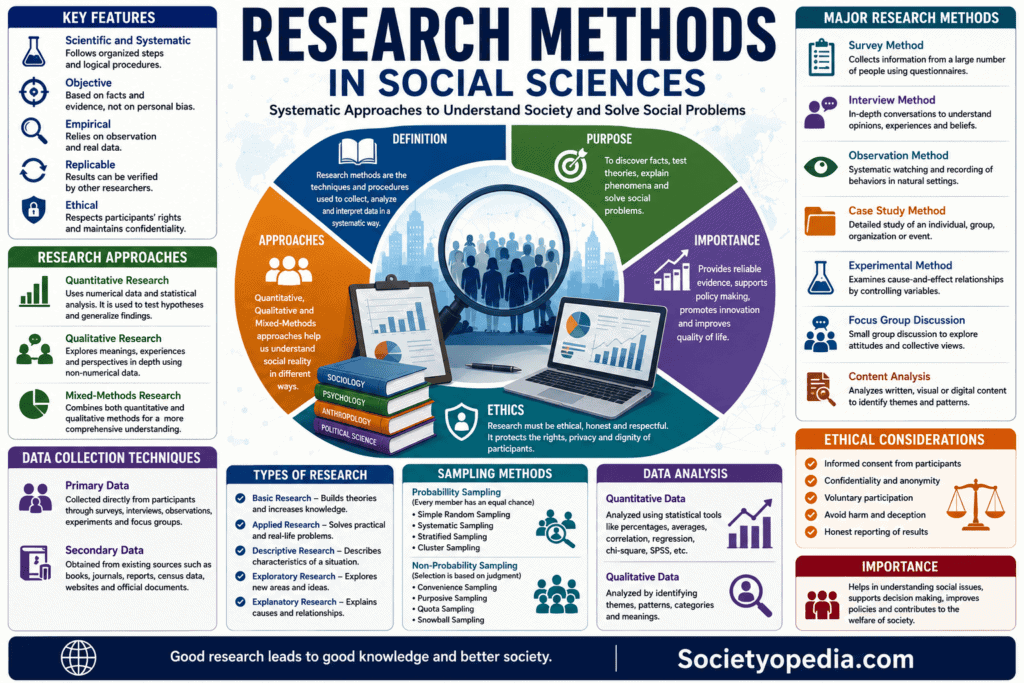
Cluster sampling is a probability sampling technique in which researchers divide the population into naturally occurring groups called clusters and then randomly select entire clusters or individuals from selected clusters for data collection. Instead of selecting individuals directly from the entire population, researchers select groups that represent the larger population.
This sampling method is particularly useful when the population is large, geographically dispersed, or difficult to access individually. By selecting groups rather than individual participants, researchers can significantly reduce the cost, time, and administrative effort required for data collection.
Cluster sampling is widely used in sociology, education, public health, economics, political science, and social research. Many large-scale surveys conducted by governments and international organizations rely on cluster sampling because populations are often organized naturally into groups such as villages, schools, hospitals, households, or administrative regions.
For example, if a researcher wants to study educational quality among secondary school students across a country, it may be impossible to create a list of all students and randomly select individuals. Instead, the researcher can divide the country into school clusters, randomly select schools, and collect data from students within those selected schools.
Cluster sampling differs from simple random sampling because the primary unit of selection is not an individual but a group. It also differs from stratified sampling because clusters are usually naturally existing groups, while strata are created based on specific characteristics to ensure representation.
Although cluster sampling is efficient and practical, it may increase sampling error because individuals within the same cluster often share similar characteristics. Therefore, researchers must carefully design cluster selection procedures to maintain the accuracy and reliability of research findings.
This article explains the concept, definitions, characteristics, types, process, advantages, disadvantages, applications, and practical examples of cluster sampling.

What Is Cluster Sampling?
Cluster sampling is a probability sampling method in which the population is divided into groups or clusters, and a random sample of these clusters is selected for study.
A cluster is a naturally occurring group of individuals that exists within the population. Instead of selecting individual participants from the entire population, researchers select groups and then collect data from individuals within those groups.
Examples of clusters include:
- Schools
- Villages
- Hospitals
- Households
- Universities
- Districts
- Communities
For example, a researcher studying healthcare access among rural residents may divide a region into villages. Instead of selecting individuals from all villages, the researcher randomly selects several villages and surveys residents within those selected villages.
Cluster sampling is especially useful when a complete list of individuals is unavailable but a list of groups or clusters exists.
Convenience Sampling: Definition, Advantages, Disadvantages & Examples
Definitions of Cluster Sampling
Several research scholars have defined cluster sampling.
Earl Babbie defines cluster sampling as a probability sampling method in which researchers select groups or clusters rather than individual elements from the population.
William Lawrence Neuman explains that cluster sampling involves dividing a population into naturally occurring groups and randomly selecting some groups for research.
John W. Creswell describes cluster sampling as a method where researchers identify groups and select participants from those groups instead of sampling individuals directly.
Ranjit Kumar defines cluster sampling as a technique in which population members are organized into clusters and a sample of clusters is selected for investigation.
These definitions emphasize four major principles:
- Population is divided into natural groups.
- Clusters are selected randomly.
- Data are collected from selected clusters.
- The method is suitable for large populations.
Characteristics of Cluster Sampling
Cluster sampling has several important characteristics.
Group-Based Selection
The basic sampling unit is a group rather than an individual.
Probability-Based Technique
Clusters are selected using random procedures.
Natural Grouping
Clusters usually already exist within the population.
Cost Efficient
Researchers can collect data from selected locations instead of traveling to every individual.
Suitable for Large Populations
It is particularly useful for geographically scattered populations.
Increased Sampling Error
Individuals within clusters may have similar characteristics, which can reduce sample diversity.
Objectives of Cluster Sampling
Cluster sampling is used to achieve several research objectives.
The primary objective is to make large-scale research manageable by reducing the complexity of selecting individuals from a large population.
It also aims to reduce research costs, travel requirements, and administrative difficulties.
Another objective is to provide a practical sampling solution when a complete list of individuals is unavailable but groups can be identified.
Types of Cluster Sampling
This sampling can be classified into several types depending on how clusters and participants are selected.
One-Stage Cluster Sampling
In this sampling technique, researchers randomly select clusters and collect data from every member within those selected clusters.
Example
A researcher studying teachers’ working conditions randomly selects 20 schools and surveys every teacher working in those schools.
Advantages
- Simple implementation.
- Easy data collection.
- Reduces administrative burden.
Limitations
- Selected clusters may not fully represent the population.
- Higher risk of sampling error.
Two-Stage Cluster Sampling
In this sampling technique, researchers first select clusters and then randomly select individuals within those clusters.
Example
A researcher studying student performance:
Stage 1:
Randomly selects schools.
Stage 2:
Randomly selects students from those schools.
Advantages
- Provides more control over sample size.
- Reduces excessive data collection.
Limitations
- More complex than one-stage sampling.
- Requires accurate information at both levels.
Multistage Cluster Sampling
This involves selecting samples through multiple levels.
Example
A national education survey may involve:
Country → Province → District → School → Classroom → Student
Each level represents a stage of sampling.
Advantages
- Suitable for national-level research.
- Efficient for very large populations.
Limitations
- Requires complex planning.
- Statistical analysis becomes more difficult.
Steps in Conducting Cluster Sampling
It follows a systematic process.
Step 1: Define the Target Population
Identify the complete population to be studied.
Example: All university students in a country.
Step 2: Identify Natural Clusters
Divide the population into existing groups.
Example:
Universities, colleges, departments, or campuses.
Step 3: Create a Sampling Frame of Clusters
Prepare a complete list of available clusters.
Step 4: Determine Sample Size
Decide how many clusters or individuals are needed.
Step 5: Randomly Select Clusters
Use random methods to select clusters for the study.
Step 6: Select Participants
Depending on the design, collect data from all members or select individuals within clusters.
Step 7: Collect and Analyze Data
Gather information and apply appropriate statistical techniques.
Advantages
Cluster sampling provides several important advantages.
Cost Effective
Researchers save money because data collection is concentrated in selected locations.
Time Efficient
Travel and administrative requirements are reduced.
Practical for Large Populations
It makes research possible when populations are widely distributed.
Requires Less Information
Researchers only need information about clusters rather than every individual.
Suitable for Field Research
It is highly useful for community-based and large-scale surveys.
Easier Organization
Managing selected groups is often easier than managing scattered individuals.
Disadvantages of Cluster Sampling
Despite advantages, there are several limitations.
Higher Sampling Error
People within the same cluster often share similar characteristics, reducing variation.
Lower Precision
Cluster samples may be less statistically efficient compared with simple random samples.
Cluster Bias
Some selected clusters may differ significantly from the overall population.
Complex Analysis
Researchers must use specialized statistical methods to account for cluster effects.
Requires Accurate Cluster Information
Poorly defined clusters can negatively affect research quality.
Cluster Sampling vs Simple Random Sampling
| Feature | Cluster Sampling | Simple Random Sampling |
|---|---|---|
| Selection Unit | Groups or clusters | Individuals |
| Random Selection | Clusters selected randomly | Individuals selected randomly |
| Cost | Lower | Higher |
| Suitable Population | Large and scattered | Smaller populations |
| Sampling Error | Usually higher | Usually lower |
Cluster Sampling vs Stratified Sampling
| Feature | Cluster Sampling | Stratified Sampling |
|---|---|---|
| Group Formation | Natural groups | Researcher-created categories |
| Purpose | Reduce cost and complexity | Ensure subgroup representation |
| Selection | Random clusters | Random individuals within strata |
| Similarity Within Groups | High | Lower |
| Main Use | Large-scale surveys | Comparative studies |
Applications
It is widely used in various research fields.
In sociology, researchers use it to study communities, social inequalities, family structures, and population behaviors.
In education, it is commonly used to select schools, classrooms, and students for educational assessments.
In public health, it is used in disease surveillance, vaccination studies, healthcare evaluations, and community health surveys.
In political science, election surveys often use geographic clusters such as polling areas or districts.
In economics, household income surveys and labor force studies frequently apply this sampling.
Government organizations also use this sampling technique for national surveys, census-related research, and social development studies.
Challenges in Using Cluster Sampling
Researchers using cluster sampling must carefully consider the selection of clusters because poor cluster design can reduce the accuracy of findings. Another challenge is that individuals within the same cluster often have similar characteristics, which can create clustering effects. Researchers must also apply appropriate statistical methods to account for the relationship between participants within the same cluster.
Best Practices for Using Cluster Sampling
Researchers should clearly define clusters before beginning the sampling process. Selected clusters should represent the diversity of the population, and random selection should always be applied when choosing clusters. Researchers should carefully determine the number of clusters needed and use appropriate analytical techniques that consider the cluster structure of the data.
Conclusion
Cluster sampling is an important probability sampling technique that allows researchers to study large and geographically dispersed populations efficiently. By selecting groups rather than individuals, it reduces the cost, time, and complexity associated with large-scale data collection.
Although cluster sampling may produce higher sampling error compared with individual-level random sampling, its practical advantages make it essential for national surveys, educational research, public health studies, and community-based investigations.
When carefully designed and properly implemented, cluster sampling provides researchers with a reliable method for collecting meaningful data from complex populations. Understanding cluster sampling is essential for students and researchers who aim to conduct large-scale social science research.
At Societyopedia, learning about cluster sampling helps researchers develop strong methodological skills and select appropriate sampling strategies for different research situations.
Frequently Asked Questions (FAQs)
What is cluster sampling?
Cluster sampling is a probability sampling technique in which researchers divide a population into groups called clusters and randomly select clusters for research.
What are examples of clusters?
Common examples of clusters include schools, villages, hospitals, households, universities, and geographical areas.
What are the main types of cluster sampling?
The main types are one-stage, two-stage, and multistage cluster sampling.
Is cluster sampling a probability sampling method?
Yes. Cluster sampling is a probability sampling technique because clusters are selected through random procedures.
What is the biggest advantage?
The greatest advantage of cluster sampling is that it reduces the cost and complexity of studying large, geographically dispersed populations.
What is the biggest limitation?
The main limitation is increased sampling error because individuals within the same cluster often share similar characteristics.