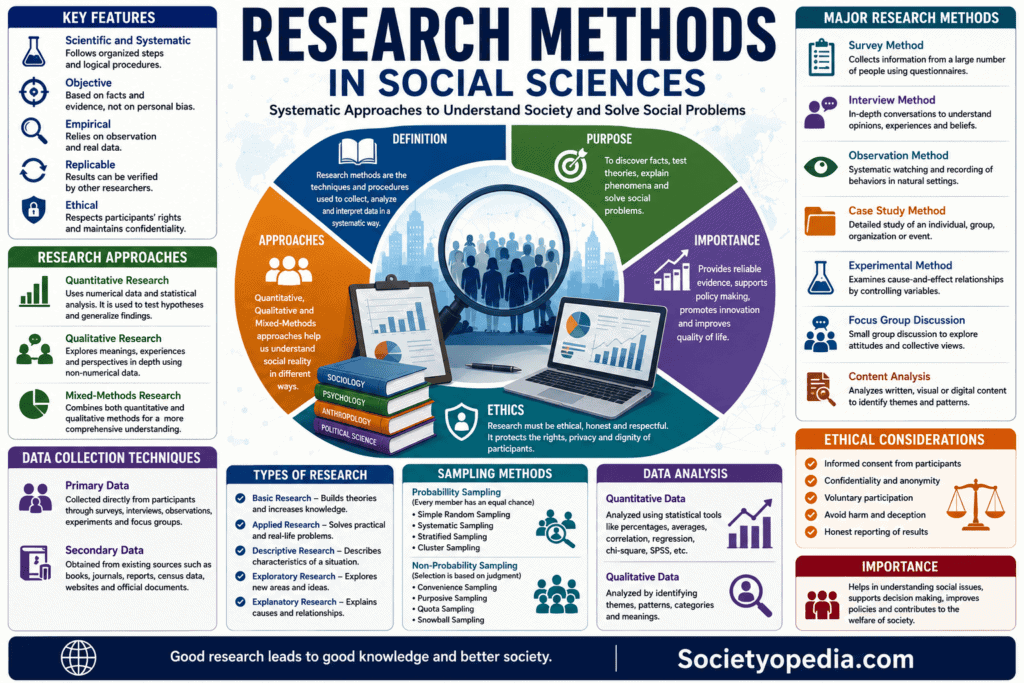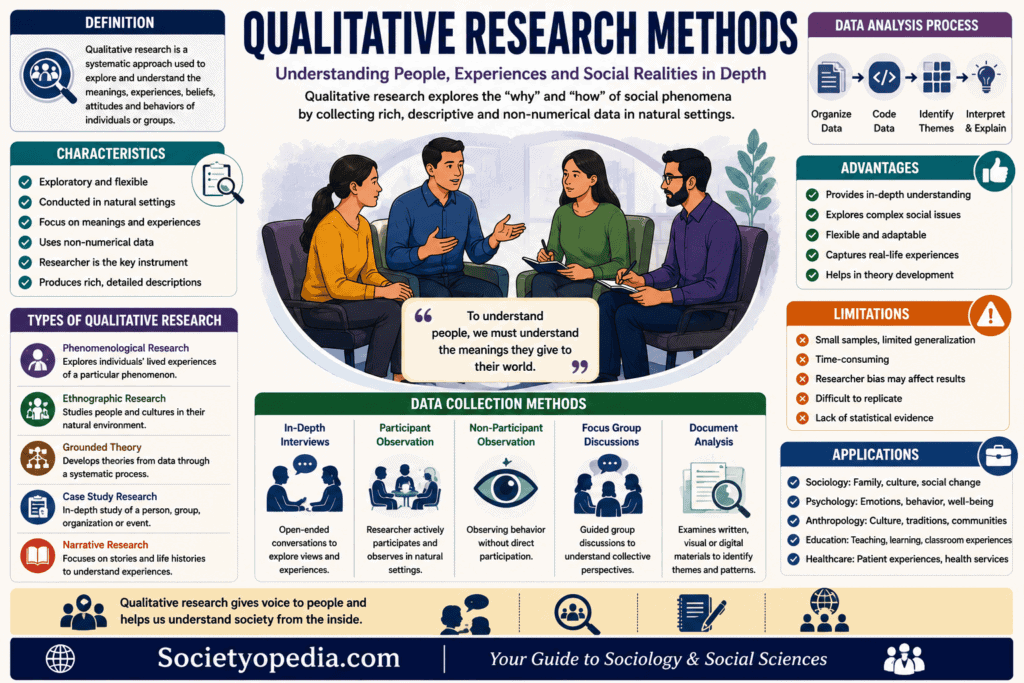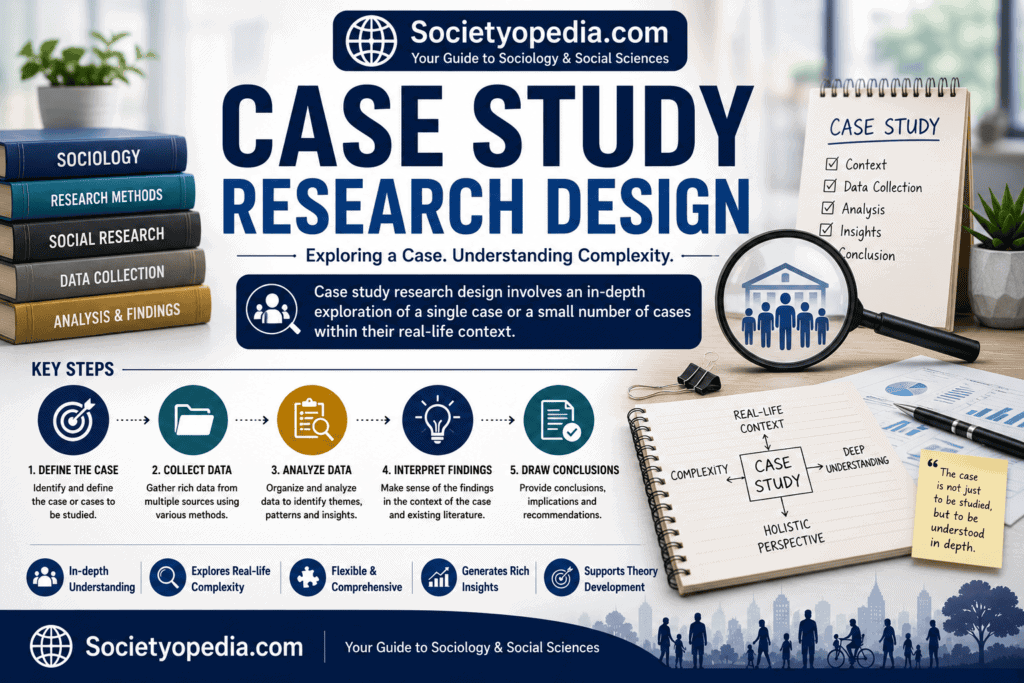
Case Study Research Design is one of the most comprehensive and widely used research designs in qualitative research. It enables researchers to investigate a real-world phenomenon in depth while considering the social, cultural, organizational, political, historical, and environmental contexts in which it occurs. Unlike research designs that primarily focus on identifying statistical relationships or testing hypotheses through controlled experiments, a case study seeks to understand the complexity of a particular case by collecting rich, detailed, and contextual evidence from multiple sources.
The growing popularity of case study research across sociology, education, psychology, business, political science, public administration, anthropology, healthcare, and law demonstrates its versatility. Researchers frequently use this design when they need to answer questions such as how, why, and what happened. These questions require an understanding of processes, interactions, decisions, and contextual influences rather than simple numerical measurements.
Modern societies face increasingly complex social issues, including poverty, educational inequality, gender discrimination, healthcare accessibility, migration, technological transformation, environmental challenges, and organizational change. Such issues cannot always be understood through surveys or experiments alone because they involve numerous interacting variables operating within specific social contexts. Case Study Research Design provides researchers with the flexibility to investigate these complex realities while preserving their natural settings.
One of the greatest strengths of case study research is that it does not separate the phenomenon from its environment. Instead, it studies both simultaneously. This holistic perspective enables researchers to understand not only what happened but also why it happened, how different factors interacted, and what lessons can be learned for future policy, theory, or practice.
Definitions of Case Study Research Design
Many renowned research scholars have defined Case Study Research Design from different methodological perspectives.
According to Robert K. Yin (2018),
“A case study is an empirical inquiry that investigates a contemporary phenomenon within its real-life context, especially when the boundaries between phenomenon and context are not clearly evident.”
Yin’s definition emphasizes that researchers should investigate real-world situations where contextual factors cannot be separated from the phenomenon being studied.
John W. Creswell (2018) defines case study research as:
“A qualitative approach in which the investigator explores a bounded system (a case) or multiple bounded systems over time through detailed, in-depth data collection involving multiple sources of information.”
Creswell highlights two important aspects: the case must be clearly bounded, and data should be collected from various sources.
According to Sharan B. Merriam (1998),
“A qualitative case study is an intensive, holistic description and analysis of a bounded phenomenon.”
Merriam stresses that the purpose of a case study is not simply to describe events but to understand the phenomenon comprehensively.
Robert E. Stake (1995) explains,
“Case study is the study of the particularity and complexity of a single case, coming to understand its activity within important circumstances.”
Stake focuses on understanding the uniqueness and complexity of each case rather than producing broad generalizations.
Thomas (2021) argues that a case study is a detailed examination of an individual instance intended to illuminate a broader class of phenomena, making it particularly valuable for generating insights that can inform theory and practice.
Although these definitions differ slightly, they all emphasize several common features: studying a bounded case, collecting detailed evidence, understanding context, and producing an in-depth interpretation rather than relying solely on statistical analysis.
Meaning of a Case
The word case refers to a specific, bounded unit selected for detailed investigation. A case is not merely a participant or an event; it is a clearly identifiable system with defined boundaries related to time, place, activity, organization, or individuals. The concept of “boundedness” distinguishes case study research from broader qualitative approaches such as ethnography.
A case may represent an individual, a family, a school, a university, a village, a hospital, a business organization, a government department, a community, a policy implementation process, a social movement, or even an entire country. The defining feature is that the researcher studies the selected case intensively rather than superficially.
For example, a researcher examining the implementation of digital learning in one public university is conducting a case study because the university serves as the bounded case. Similarly, studying the experiences of female healthcare professionals in a specific hospital, the management practices of a multinational company, or the rehabilitation process of juvenile offenders within a correctional institution all represent case studies.
A case should possess clear boundaries. These boundaries may include geographical location, duration, organizational structure, population, or specific events. Without clear boundaries, it becomes difficult to determine what should and should not be included in the investigation.
Researchers distinguish between single-case studies and multiple-case studies. A single-case study investigates one carefully selected case in great depth, while a multiple-case study compares several cases to identify similarities and differences. Both approaches are valuable depending on the research objectives.
Selecting an appropriate case is one of the most critical decisions in the research process. The chosen case should be information-rich, relevant to the research questions, accessible to the researcher, and capable of providing meaningful insights into the phenomenon under investigation.
Historical Development of Case Study Research
Case study research has a long intellectual history. Its origins can be traced to early historical documentation and legal investigations, but it gained prominence during the late nineteenth and early twentieth centuries.
The Chicago School of Sociology played a pioneering role in developing case study methodology. Scholars such as Robert Park, Ernest Burgess, and their colleagues used detailed case studies to investigate urbanization, immigration, crime, poverty, family life, and social disorganization. Their work demonstrated that social phenomena could only be fully understood by examining the lived experiences of individuals and communities within their social environments.
Psychologists later adopted case studies to understand personality development and mental disorders. One of the most famous examples is Sigmund Freud’s detailed case analyses, which significantly influenced psychoanalytic theory.
During the latter half of the twentieth century, scholars including Robert Yin, Robert Stake, and Sharan Merriam transformed case study research into a rigorous methodological approach with clearly defined procedures for research design, data collection, validation, and analysis. Today, case study research is recognized as one of the most respected qualitative research designs across numerous disciplines.
Characteristics of Case Study Research Design
Investigation in a Natural Setting
Case study research investigates phenomena where they naturally occur. Researchers do not manipulate variables or create artificial laboratory environments. Instead, they observe real-life situations as they unfold. This naturalistic approach enables researchers to understand authentic behaviors, institutional practices, interpersonal relationships, and social processes without disturbing the environment.
In-depth Investigation
Unlike surveys that gather limited information from many participants, case studies collect extensive information from relatively few cases. Researchers may spend weeks, months, or even years gathering interviews, observations, documents, photographs, and archival materials to understand every important aspect of the case. This depth of investigation often uncovers hidden processes and relationships that would remain invisible in large-scale quantitative studies.
Contextual Understanding
A defining characteristic of case study research is its emphasis on context. Human behavior cannot be separated from cultural norms, economic conditions, political structures, organizational environments, historical developments, and social relationships. Researchers therefore analyze both the phenomenon and its surrounding context to produce meaningful interpretations.
Multiple Sources of Evidence
Case study research rarely depends on a single source of information. Instead, researchers use interviews, observations, official records, policy documents, newspapers, organizational reports, photographs, videos, websites, social media content, diaries, and archival materials. This combination of evidence allows researchers to verify information through triangulation, increasing the credibility of their findings.
Holistic Perspective
Rather than examining isolated variables, case study research views the case as an integrated system. Social, cultural, economic, psychological, political, and institutional dimensions are analyzed together to develop a comprehensive understanding of the phenomenon.
Flexibility
Case study research is highly flexible. As new evidence emerges, researchers may refine interview questions, explore unexpected themes, revisit participants, or consult additional documents. This adaptability allows the investigation to evolve according to the realities of the field.
Rich Description
Case studies provide what qualitative researchers call “thick description.” Instead of merely reporting statistical outcomes, researchers present detailed narratives describing participants, settings, events, interactions, and experiences. Such descriptions allow readers to understand the complexity of the case and judge the transferability of findings to similar contexts.
Objectives of Case Study Research Design
The primary objective of case study research is to develop a comprehensive understanding of a particular phenomenon within its real-life context. Rather than seeking broad statistical generalizations, researchers aim to produce detailed explanations of how and why events occur.
Case studies are frequently conducted to explore new or insufficiently understood issues, explain complex social processes, evaluate policies and programs, examine organizational practices, investigate rare or unique cases, generate theoretical insights, and inform practical decision-making.
Researchers also use case studies to test existing theories in real-world settings or to develop new theoretical propositions grounded in empirical evidence.
Types of Case Study Research Design
Intrinsic Case Study
An intrinsic case study is conducted because the case itself is of special interest. The researcher seeks to understand the unique characteristics of that particular case rather than using it to represent a broader phenomenon.
For example, a sociologist may investigate the remarkable educational achievements of a remote mountain village because of its exceptional success despite limited resources.
Instrumental Case Study
In an instrumental case study, the selected case serves as a tool for understanding a broader issue or theory. The primary interest lies in the phenomenon rather than the individual case itself.
For instance, studying one hospital’s successful implementation of electronic health records may provide broader insights into digital transformation within healthcare organizations.
Collective or Multiple Case Study
A collective case study examines several related cases simultaneously. Comparing multiple cases enables researchers to identify recurring patterns, differences, and contextual influences that strengthen theoretical understanding.
An education researcher comparing teaching strategies across five universities is conducting a collective case study.
Exploratory Case Study
Exploratory case studies investigate relatively unexplored issues. They often serve as preliminary investigations that help researchers formulate research questions, hypotheses, or theoretical frameworks for larger future studies.
Explanatory Case Study
Explanatory case studies attempt to explain why specific events occurred and identify causal relationships among different factors. They are particularly useful in public policy, organizational research, and program evaluation.
Descriptive Case Study
Descriptive case studies provide comprehensive accounts of individuals, organizations, institutions, or communities. Their objective is to document phenomena accurately while preserving contextual details.
Components of Case Study Research Design
A rigorous case study research design includes several interconnected components.
The research begins with a clearly defined problem statement explaining why the study is necessary. Specific research objectives and research questions guide the entire investigation. Because case study research primarily seeks explanation rather than measurement, questions often begin with “how” or “why.”
Researchers then identify an appropriate case and define its boundaries. The unit of analysis may be an individual, organization, community, institution, event, or policy.
A detailed research protocol outlines data collection procedures, ethical considerations, interview schedules, observation guidelines, and document review strategies. Researchers also establish procedures for data organization, coding, analysis, validation, interpretation, and reporting.
Data Collection Methods
Case study research depends on collecting evidence from multiple complementary sources.
Interviews remain one of the most important methods because they allow participants to explain experiences, beliefs, motivations, and perceptions in their own words. Researchers may conduct structured, semi-structured, or unstructured interviews depending on the research objectives.
Observation enables researchers to witness behaviors, interactions, routines, meetings, classroom activities, hospital practices, or organizational processes directly. Observations may be participant or non-participant and structured or unstructured.
Documents provide valuable contextual information. Government reports, organizational policies, annual reports, newspapers, court records, meeting minutes, school records, hospital files, and historical archives often reveal evidence unavailable through interviews alone.
Researchers may also examine photographs, videos, websites, social media content, physical artifacts, diaries, emails, letters, and digital records to gain a richer understanding of the case.
The use of multiple data collection methods strengthens the study through methodological triangulation, reducing the likelihood that findings depend on a single source of evidence.
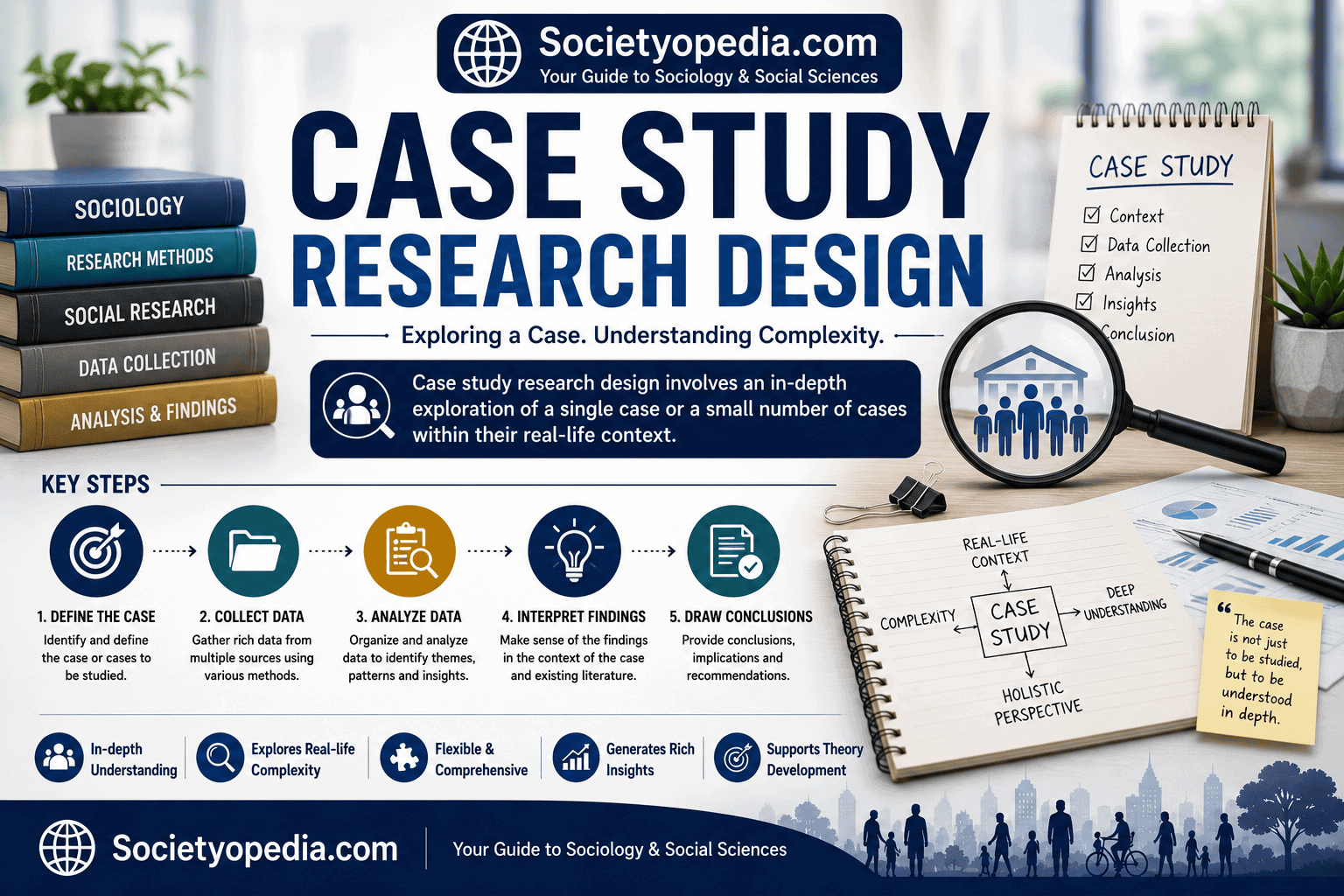
Steps in Conducting Case Study Research
Conducting a case study requires a systematic sequence of activities. Researchers first identify the research problem and review existing literature to understand current knowledge and identify research gaps. They then formulate research questions and select an appropriate case that can provide meaningful evidence.
Once ethical approval and participant consent have been obtained, researchers develop interview guides, observation protocols, and document review strategies. Data collection proceeds through repeated visits, interviews, observations, and examination of documentary evidence.
Following data collection, researchers organize, transcribe, code, categorize, and analyze the evidence. Emerging themes are compared across different data sources to verify consistency. Finally, findings are interpreted within relevant theoretical frameworks before preparing a comprehensive research report containing conclusions, implications, recommendations, and suggestions for future research.
Data Analysis in Case Study Research
Case study analysis begins by organizing all collected materials into manageable categories. Researchers frequently use thematic analysis, content analysis, narrative analysis, explanation building, pattern matching, or cross-case synthesis depending on the nature of the study.
Coding plays a central role in qualitative analysis. Researchers assign labels to meaningful units of information, combine similar codes into categories, and identify broader themes that answer the research questions.
Pattern matching compares observed findings with theoretical expectations, while explanation building develops logical interpretations linking evidence to research questions. Multiple-case studies often employ cross-case analysis to compare similarities and differences among cases.
Qualitative software such as NVivo, ATLAS.ti, and MAXQDA may assist researchers in organizing and analyzing large volumes of textual data, although manual coding remains common in many social science studies.
Advantages of Case Study Research Design
Case study research offers numerous advantages. It provides rich, detailed, and contextual information that cannot be obtained through questionnaires alone. Researchers gain a deeper understanding of complex social phenomena by observing them in their natural environments.
The design is particularly valuable for investigating rare, unique, or emerging issues where little prior knowledge exists. Its flexibility allows researchers to adapt data collection as new themes emerge during fieldwork.
Case studies support theory development by generating explanations grounded in real-life evidence. Policymakers and practitioners often value case study findings because they illustrate how programs, institutions, and policies function under actual conditions rather than idealized experimental settings.
The use of multiple evidence sources enhances credibility through triangulation, while detailed narratives help readers appreciate the complexity of human experiences and organizational processes.
Limitations of Case Study Research Design
Despite its strengths, case study research has limitations. Findings based on one or a few cases may not be statistically generalizable to larger populations. Data collection is often time-consuming, requiring repeated field visits and extensive documentation.
Researchers may unintentionally introduce bias during interviews, observations, coding, or interpretation. Managing large volumes of qualitative data can also be challenging without systematic organization and analysis procedures.
Access to participants, confidential documents, or organizational records may be restricted, limiting the scope of investigation. Replicating case studies is often difficult because each case possesses unique contextual characteristics.
Nevertheless, careful research design, transparent reporting, triangulation, member checking, and maintaining an audit trail substantially improve the credibility and trustworthiness of case study findings.
Ethical Considerations
Ethics play a fundamental role in case study research. Researchers must obtain informed consent from participants before collecting information. Participants should understand the study’s objectives, procedures, risks, and benefits and must be free to withdraw at any time without negative consequences.
Confidentiality and anonymity should be maintained by removing identifying information from transcripts and reports whenever appropriate. Sensitive documents and digital records should be securely stored to prevent unauthorized access.
Researchers must avoid harming participants psychologically, socially, professionally, or legally. Findings should be reported honestly without fabrication, falsification, or selective presentation of evidence. Ethical approval from relevant institutional review boards may be required before beginning data collection.
Applications of Case Study Research Design
Case study research has extensive applications across academic disciplines.
In sociology, researchers investigate poverty, crime, family structures, social movements, migration, gender relations, urbanization, community development, and institutional change.
In education, case studies examine classroom practices, curriculum implementation, teacher development, student learning, educational leadership, and inclusive education.
Within healthcare, researchers analyze hospital management, patient care, disease prevention, public health interventions, nursing practices, and healthcare policy implementation.
Business researchers use case studies to investigate leadership, entrepreneurship, organizational culture, innovation, strategic management, marketing, and corporate governance.
In political science, case studies help explain governance, elections, policy implementation, conflict resolution, democratization, and institutional reforms.
Psychologists employ case studies to understand mental health disorders, therapeutic interventions, personality development, and behavioral change.
Anthropologists, public administration scholars, environmental scientists, criminologists, and legal researchers also rely extensively on case study methodology to examine complex real-world issues.
Difference Between Case Study and Other Research Designs
Case study research differs from survey research because it emphasizes depth rather than breadth. While surveys collect standardized information from large populations, case studies focus intensively on a limited number of cases.
Unlike experimental research, case studies do not manipulate independent variables or establish controlled environments. Instead, they investigate naturally occurring phenomena within authentic contexts.
Ethnographic research generally studies an entire culture or community over an extended period, whereas case study research focuses on a specific bounded system. Phenomenological research explores the shared lived experiences of several individuals, while a case study investigates the complexity of one or more specific cases.
Ensuring Quality in Case Study Research
Researchers employ several strategies to strengthen the quality of case study research. Triangulation compares evidence from multiple data sources and methods to verify consistency. Member checking allows participants to review findings and confirm the accuracy of interpretations.
Maintaining an audit trail documents every major methodological decision, enhancing transparency. Thick description provides sufficient contextual detail for readers to determine whether findings may be transferable to other settings. Reflexivity encourages researchers to acknowledge their own assumptions and minimize potential biases throughout the research process.
Challenges in Conducting Case Study Research
Researchers often encounter practical challenges while conducting case studies. Obtaining access to organizations, confidential documents, or vulnerable populations can be difficult. Participants may withdraw, decline interviews, or provide incomplete information.
Managing extensive qualitative data requires careful organization and substantial analytical skills. Maintaining objectivity while developing close relationships with participants also presents challenges. Time, financial resources, and travel requirements may further complicate fieldwork, especially in geographically dispersed settings.
Despite these difficulties, careful planning, flexibility, and adherence to ethical principles enable researchers to overcome most obstacles successfully.
Future of Case Study Research
Technological advancements are transforming case study research. Digital interviews, virtual observations, online communities, social media analysis, artificial intelligence, cloud-based data management, and qualitative analysis software are expanding researchers’ methodological capabilities.
Interdisciplinary research is also increasing the importance of case studies, as complex global issues require collaboration among sociologists, economists, political scientists, psychologists, public health experts, and environmental researchers. Future case studies are expected to integrate traditional qualitative methods with digital evidence, geospatial information, and computational analysis while preserving the contextual richness that defines the methodology.
Conclusion
Case Study Research Design remains one of the most powerful qualitative research approaches for understanding complex phenomena within their real-life settings. By focusing on bounded cases and employing multiple sources of evidence, researchers can produce rich, contextualized knowledge that explains not only what happens but also how and why it happens. Its flexibility, depth, and emphasis on real-world contexts make it invaluable across disciplines including sociology, education, healthcare, business, psychology, political science, anthropology, and public administration.
Although case study research requires considerable time, careful planning, and rigorous analysis, its ability to generate meaningful insights often outweighs these challenges. When supported by triangulation, ethical practice, systematic data analysis, and transparent reporting, case studies provide trustworthy evidence that contributes to both theory and practice. For students, scholars, and professionals, mastering this research design is an essential step toward conducting high-quality qualitative research.
Educational platforms such as Societyopedia play an important role in supporting this learning process by presenting research methodologies, sociological theories, academic writing guidance, and practical research examples in a structured and accessible manner. Whether a learner is preparing a university assignment, designing an MPhil or PhD proposal, or conducting independent social research, comprehensive resources like those available on Societyopedia can help build stronger methodological knowledge and encourage evidence-based inquiry.
As the demand for high-quality social science research continues to grow, Case Study Research Design will remain an indispensable methodology for exploring the complexity of human societies and organizations. Researchers who understand its principles, strengths, limitations, and applications are better equipped to produce rigorous, insightful, and impactful studies that contribute to academic knowledge and practical problem-solving.
Research Design in Social Science Research: Definition And Types