Cross-sectional research design is one of the most commonly used research approaches in social sciences, health sciences, education, psychology, economics, and public policy. It is a research method in which data are collected from a population or sample at a single point in time to examine existing conditions, relationships among variables, attitudes, behaviors, or characteristics of individuals and groups.
Unlike longitudinal research, which follows the same participants over an extended period, cross-sectional research provides a snapshot of a phenomenon at a particular moment. Researchers use this design when they want to understand the current situation, compare different groups, measure prevalence, or identify associations between variables without tracking changes over time.
Because of its relatively low cost, shorter duration, and practical nature, cross-sectional research has become highly popular among researchers. Many social surveys, opinion polls, demographic studies, and public health investigations use this design to collect information efficiently from large populations.
In sociology, cross-sectional research is particularly important because it helps researchers understand social structures, cultural patterns, inequalities, attitudes, and behaviors existing within society at a specific time. For example, a sociologist may conduct a cross-sectional study to examine the relationship between education level and political participation among adults in a particular region.
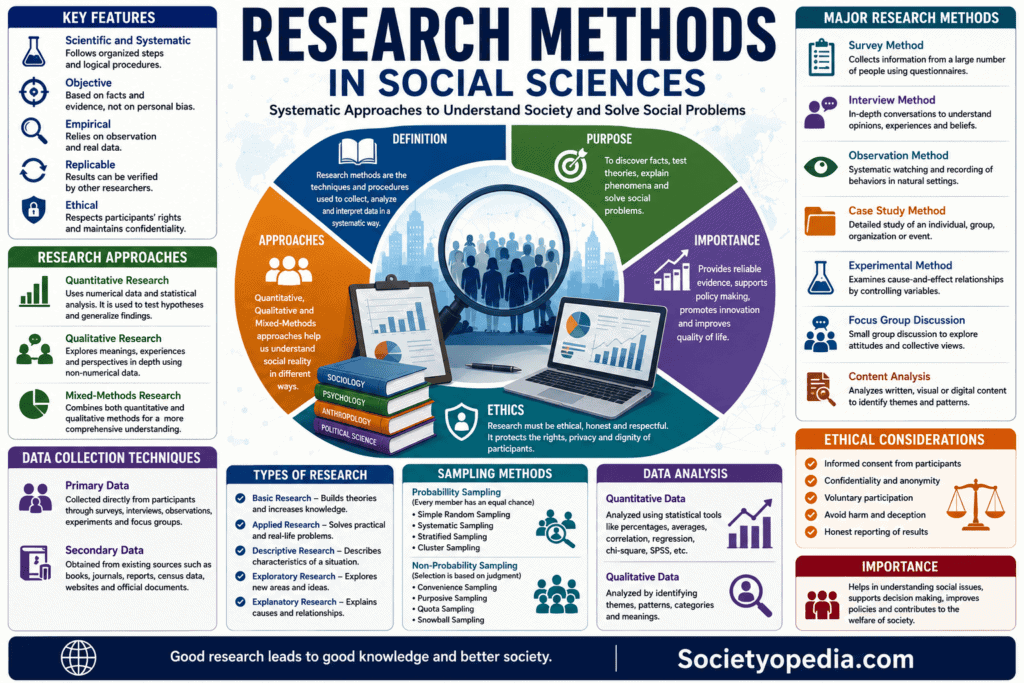
This article explains the concept, definitions, characteristics, types, process, advantages, limitations, applications, and comparison of cross-sectional research design with other research approaches.
What Is Cross-Sectional Research Design?
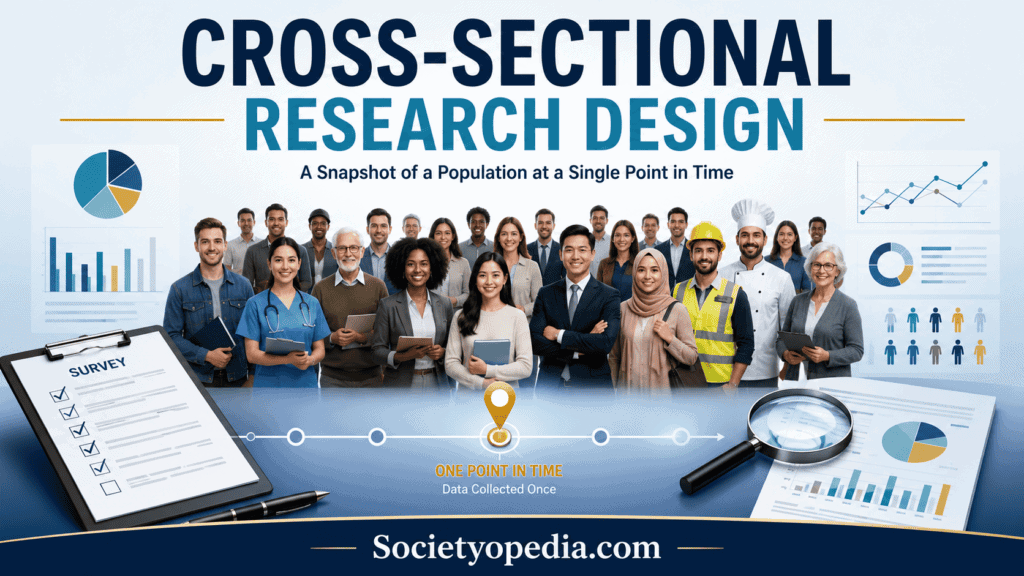
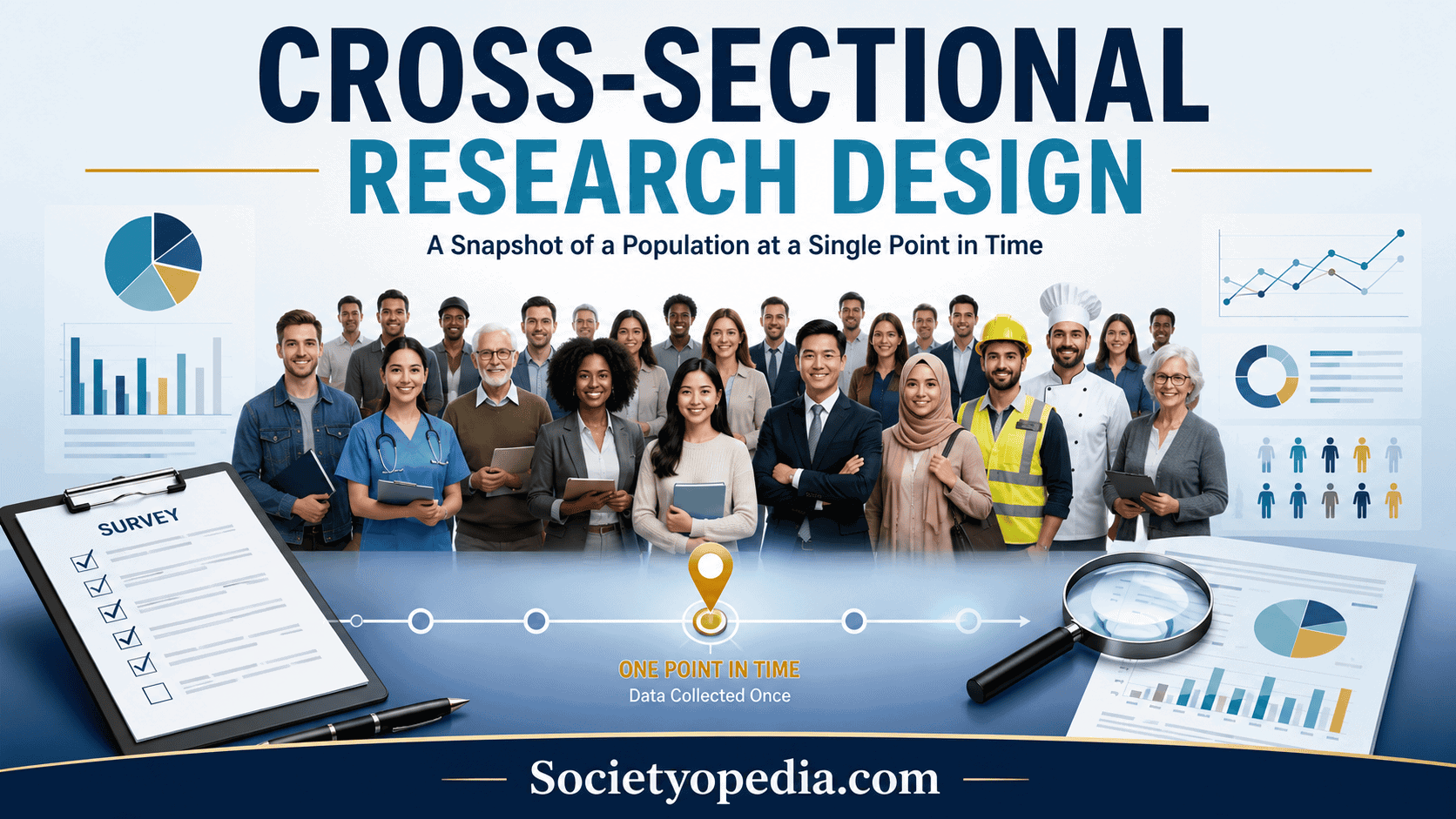
Cross-sectional research design is a research strategy in which data are collected from different individuals, groups, or units at one specific point in time. The purpose is to describe current conditions or analyze relationships among variables without observing changes over a longer period.
In simple words, cross-sectional research provides a picture of a population at a particular moment, similar to taking a photograph of a social phenomenon.
For example, if a researcher surveys university students in 2026 to examine their attitudes toward artificial intelligence in education, the study represents students’ opinions at that specific time. It does not examine how their attitudes change in future years.
Cross-sectional studies may involve thousands of participants and can examine multiple variables simultaneously. Researchers may collect information about age, gender, education, income, occupation, beliefs, health status, or social behaviors and analyze relationships among these characteristics.
Definitions of Cross-Sectional Research Design
Several scholars have defined cross-sectional research from different perspectives.
Earl Babbie defines cross-sectional research as a study based on observations made at one point in time, allowing researchers to describe a population or examine relationships between variables.
William Lawrence Neuman explains that cross-sectional research collects data about different cases at a single time period to identify patterns, differences, and associations.
John W. Creswell describes cross-sectional research as a design where researchers collect data from participants at one point in time to examine current conditions or relationships.
Alan Bryman states that cross-sectional research involves collecting data from multiple cases at a single time to analyze variation among individuals, groups, or social units.
These definitions highlight the major characteristics of cross-sectional research:
- Data collection occurs at one point in time.
- Researchers study differences among individuals or groups.
- The design focuses on current conditions.
- Variables are measured simultaneously.
Characteristics of Cross-Sectional Research Design
Cross-sectional research has several important characteristics that distinguish it from other research designs.
Single Point of Data Collection
The most important feature of cross-sectional research is that data are collected only once. Researchers do not return to participants for future measurements.
This makes cross-sectional studies faster and easier to conduct compared with longitudinal studies.
Large Sample Size
Cross-sectional studies often involve large samples because collecting data only once reduces time and financial requirements. Large samples improve the ability to generalize findings to broader populations.
Comparison Between Groups
A major purpose of cross-sectional research is comparing different groups within a population.
For example, researchers may compare healthcare access among rural and urban populations or compare political attitudes among different age groups.
Measurement of Multiple Variables
Researchers can examine several variables simultaneously. For example, a single survey may measure education, employment status, income, family background, and social attitudes.
Focus on Current Conditions
Cross-sectional research describes what exists at a specific moment rather than how something develops over time.
Quantitative Orientation
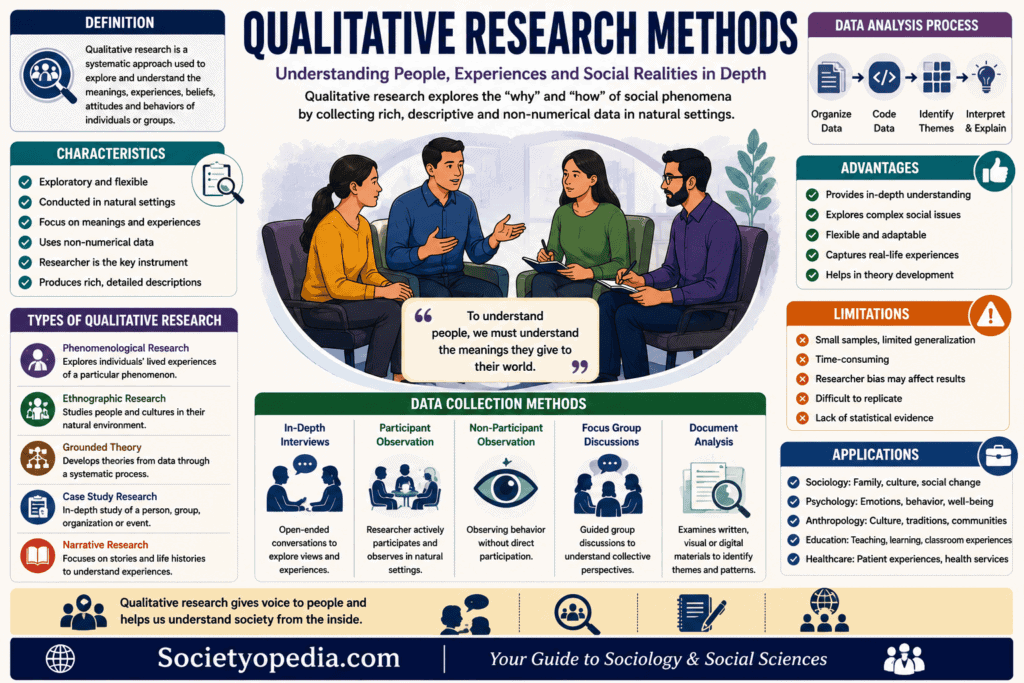
Although qualitative cross-sectional studies exist, this design is commonly associated with quantitative research methods such as surveys and statistical analysis.
Objectives of Cross-Sectional Research Design
Cross-sectional research is conducted for several important purposes.
Measuring Prevalence
One major objective is estimating how common a particular condition or behavior is within a population.
For example, health researchers may conduct a cross-sectional study to measure the prevalence of diabetes, obesity, or mental health problems in a community.
Examining Relationships Between Variables
Researchers use cross-sectional designs to identify whether variables are associated with each other.
For example, a sociologist may study whether educational attainment is related to political participation.
Comparing Different Groups
Cross-sectional studies help identify differences between social groups.
Researchers may compare men and women, different age groups, socioeconomic classes, ethnic communities, or occupational groups.
Developing Research Hypotheses
Findings from cross-sectional studies often help researchers develop hypotheses for future longitudinal or experimental research.
Research Methods in Social Sciences: Definition, Types, Approaches, Techniques and Importance
Types of Cross-Sectional Research Design
Cross-sectional research is generally divided into two major types.
Descriptive Cross-Sectional Research
Descriptive cross-sectional research aims to describe characteristics of a population at a particular point in time.
The researcher does not primarily examine relationships between variables but focuses on describing existing conditions.
Example
A researcher conducts a survey to determine the percentage of university students using online learning platforms in 2026.
The study describes current usage patterns without examining causes or long-term effects.
Descriptive cross-sectional studies are commonly used in:
- Population surveys
- Census research
- Public opinion studies
- Health assessments
- Educational surveys
Analytical Cross-Sectional Research
Analytical cross-sectional research examines relationships between variables collected at the same time.
Researchers attempt to determine whether one factor is associated with another.
Example
A researcher investigates the relationship between unemployment and depression among young adults by collecting information about employment status and mental health during the same survey period.
Analytical cross-sectional studies are useful for identifying possible risk factors and associations.
Steps in Conducting Cross-Sectional Research
A successful cross-sectional study requires systematic planning.
Step 1: Identify the Research Problem
The researcher defines the issue to be studied and develops research questions.
For example, a study may examine factors influencing women’s participation in the workforce.
Step 2: Review Existing Literature
Previous studies are reviewed to understand theoretical perspectives and identify research gaps.
Step 3: Define Population and Sample
Researchers identify the target population and select a representative sample using appropriate sampling techniques.
Common sampling methods include:
- Simple random sampling
- Stratified sampling
- Cluster sampling
- Systematic sampling
- Purposive sampling
Step 4: Develop Research Instruments
Researchers prepare questionnaires, interview schedules, or observation tools.
The instruments should measure variables accurately and consistently.
Step 5: Collect Data
Data are collected from participants during a specific period.
Surveys are the most common method used in cross-sectional studies.
Step 6: Analyze Data
Researchers use statistical techniques such as:
- Frequencies
- Percentages
- Mean and standard deviation
- Correlation analysis
- Chi-square tests
- Regression analysis
Step 7: Interpret Findings
The researcher explains relationships among variables and discusses implications.
Data Collection Methods in Cross-Sectional Research
Cross-sectional studies use various methods depending on research objectives.
Surveys
Surveys are the most common method because they allow researchers to collect standardized information from large samples.
Questionnaires
Self-administered questionnaires are frequently used in educational, social, and health research.
Interviews
Structured and semi-structured interviews provide detailed information about participants’ experiences and opinions.
Observation
Researchers may observe behaviors or social interactions within communities or organizations.
Secondary Data Analysis
Researchers may analyze existing datasets such as census records, government reports, or institutional databases.
Advantages of Cross-Sectional Research Design
Cross-sectional research offers several important benefits.
Cost Effective
Because data are collected only once, cross-sectional studies require fewer resources compared with longitudinal research.
Time Efficient
Researchers can complete studies relatively quickly, making this design suitable for academic research projects and policy studies.
Large Population Coverage
Cross-sectional studies can include large samples, increasing the reliability and generalizability of findings.
Useful for Measuring Prevalence
This design is particularly valuable for estimating the frequency of diseases, behaviors, attitudes, and social conditions.
Allows Comparison
Researchers can compare different groups within the same population.
Multiple Variables Can Be Studied
Researchers can examine several factors simultaneously.
Suitable for Exploratory Research
Cross-sectional studies often provide initial evidence for developing more detailed research.
Limitations of Cross-Sectional Research Design
Despite its advantages, cross-sectional research has several limitations.
Cannot Measure Change Over Time
Because data are collected only once, researchers cannot determine how variables develop or change.
Limited Ability to Establish Causality
Cross-sectional research can identify relationships but usually cannot prove cause and effect.
For example, if education and income are related, the researcher cannot determine whether education directly caused higher income or whether other factors influenced both.
Possibility of Sampling Bias
Poor sampling methods may produce findings that do not represent the larger population.
Lack of Historical Information
Researchers may not know whether participants’ current conditions are recent developments or long-term patterns.
Common Method Bias
When all variables are measured at the same time using the same instrument, relationships between variables may appear stronger than they actually are.
Cross-Sectional Research Design vs Longitudinal Research Design
| Feature | Cross-Sectional Research | Longitudinal Research |
|---|---|---|
| Time Period | Single point in time | Extended period |
| Data Collection | Once | Multiple times |
| Participants | Usually different groups | Same participants or population |
| Main Focus | Current situation | Change over time |
| Cost | Lower | Higher |
| Duration | Short | Long |
| Measures Development | Limited | Strong |
| Causal Understanding | Weak | Stronger |
Research Design in Social Science Research: Definition And Types
Applications of Cross-Sectional Research
Cross-sectional research is widely used across different disciplines.
Sociology
Sociologists use cross-sectional studies to examine social inequality, family structures, cultural values, social attitudes, and community behaviors.
For example, a researcher may study factors affecting women’s employment participation within a particular region.
Public Health
Health researchers use cross-sectional studies to measure disease prevalence and identify health-related risk factors.
Education
Educational researchers examine student achievement, teaching practices, learning attitudes, and educational inequalities.
Economics
Economists study income distribution, employment patterns, consumer behavior, and economic conditions.
Political Science
Political researchers use cross-sectional surveys to analyze voting behavior, political opinions, and public trust.
Ethical Considerations in Cross-Sectional Research
Ethical principles are essential in conducting cross-sectional research.
Researchers must obtain informed consent from participants and clearly explain the purpose of the study.
Confidentiality and privacy should be maintained, especially when collecting sensitive information related to health, income, family life, or personal beliefs.
Participants should have the right to refuse participation without negative consequences.
Researchers must ensure accurate reporting and avoid manipulating findings.
Conclusion
Cross-sectional research design is an important and widely used approach for studying social, behavioral, health, and economic phenomena at a specific point in time. By collecting data from a population or sample once, researchers can efficiently measure conditions, compare groups, identify relationships, and generate valuable insights.
Although cross-sectional studies cannot fully explain changes over time or establish strong causal relationships, their affordability, speed, and ability to study large populations make them essential in modern research. When carefully designed and combined with appropriate sampling and analytical techniques, cross-sectional research provides reliable evidence for understanding contemporary social realities.
For students, researchers, and scholars in sociology and related disciplines, understanding cross-sectional research design is essential for selecting appropriate methodologies and producing meaningful academic research. At Societyopedia, research methodology concepts such as cross-sectional research design help learners develop stronger foundations for conducting scientific studies and interpreting evidence-based knowledge.