Introduction
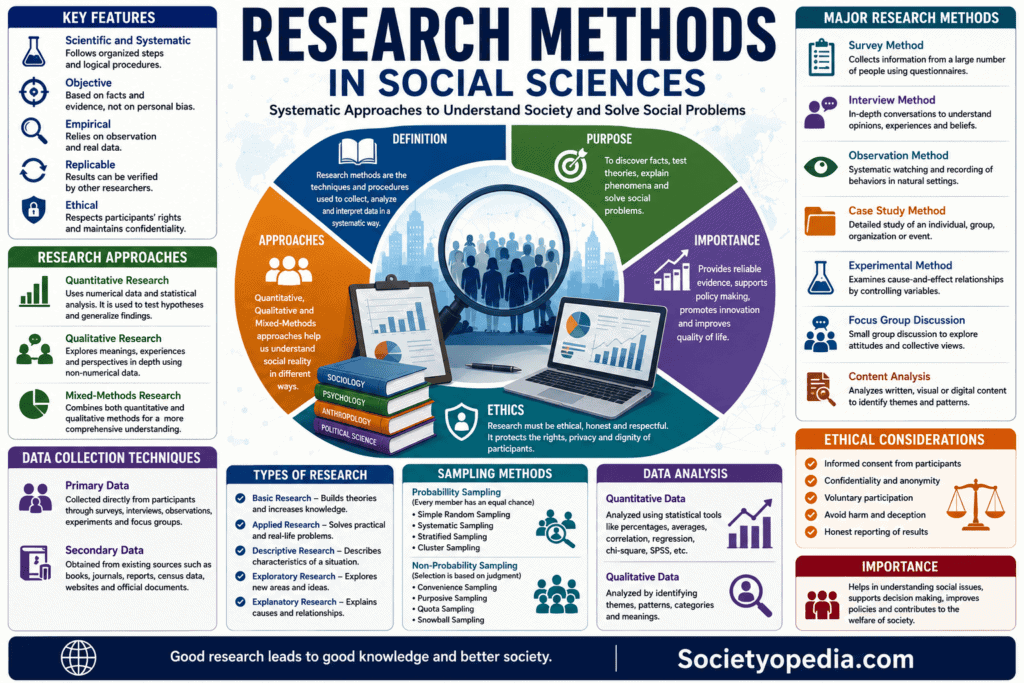
Experimental Research Design is one of the most rigorous and scientific approaches used in social science research. It is designed to examine cause-and-effect relationships by manipulating one or more independent variables while controlling other factors that may influence the outcome. Through careful planning and systematic observation, researchers can determine whether changes in one variable directly cause changes in another.
Experimental research is widely used in sociology, psychology, education, healthcare, economics, political science, and behavioral sciences. Although true experiments are more common in natural sciences, they also play an important role in social sciences for evaluating educational interventions, public policies, social programs, psychological treatments, and organizational practices.
The primary purpose of experimental research is not merely to observe social phenomena but to establish scientific evidence regarding causal relationships. This makes experimental research one of the strongest research designs for testing theories and evaluating interventions.

Definition of Experimental Research Design
Different scholars have defined experimental research from different perspectives.
According to John W. Creswell, experimental research is a quantitative research design in which researchers determine whether a specific treatment influences an outcome by assigning participants to different groups and measuring the effects.
According to Earl Babbie, experimental research is a method of testing hypotheses by observing the effects of controlled changes in one variable upon another.
According to C. R. Kothari, experimental research is a scientific investigation in which the researcher manipulates one variable while controlling all other relevant variables to study causal relationships.
In simple words, experimental research design is a systematic research approach used to determine whether changes in an independent variable produce changes in a dependent variable under controlled conditions.
Characteristics of Experimental Research Design
Experimental research is characterized by the manipulation of independent variables to observe their effects on dependent variables.
The design involves control over external variables to reduce bias and improve the accuracy of findings.
Random assignment of participants to experimental and control groups is another important characteristic because it helps ensure that groups are comparable.
Experimental research follows a highly structured and systematic procedure that enhances reliability and validity.
The findings are objective because data collection and analysis are based on standardized methods and statistical techniques.
Another important characteristic is replicability, allowing other researchers to repeat the study under similar conditions to verify the results.
Objectives of Experimental Research Design
The primary objective of experimental research is to establish cause-and-effect relationships between variables.
It seeks to test hypotheses derived from existing theories.
Experimental research evaluates the effectiveness of interventions, treatments, educational programs, policies, or social initiatives.
It also contributes to the development and refinement of scientific theories by providing empirical evidence.
The design enables researchers to predict future outcomes based on observed causal relationships.
Basic Elements of Experimental Research
Experimental research consists of several essential components.
The independent variable is the factor manipulated by the researcher.
The dependent variable is the outcome that is measured to determine the effect of the independent variable.
The experimental group receives the treatment or intervention being studied.
The control group does not receive the treatment or receives a standard condition for comparison.
Control variables are factors kept constant to prevent them from influencing the results.
Random assignment ensures that participants have an equal chance of being allocated to different groups, reducing selection bias.
Explanatory Research Design: Definition, Characteristics, Types And Methods
Types of Experimental Research Design
Pre-Experimental Design
Pre-experimental designs are the simplest forms of experimental research. They involve limited control over variables and often lack random assignment.
Common examples include one-shot case studies, one-group pretest-posttest designs, and static group comparisons.
Although useful for preliminary investigations, pre-experimental designs provide relatively weak evidence for causal relationships.
True Experimental Design
True experimental design is considered the strongest experimental approach because it includes random assignment, manipulation of the independent variable, and a control group.
Common true experimental designs include the pretest-posttest control group design, posttest-only control group design, and Solomon four-group design.
True experiments provide the highest level of internal validity.
Quasi-Experimental Design
Quasi-experimental design resembles true experimental research but lacks complete random assignment of participants.
Researchers often use existing groups such as classrooms, hospitals, or communities.
Although internal validity is somewhat reduced, quasi-experimental designs are widely used when random assignment is impractical or unethical.
Steps in Conducting Experimental Research
The first step involves identifying the research problem and reviewing relevant literature.
Researchers then formulate research objectives and hypotheses.
Independent and dependent variables are clearly defined.
Participants are selected and randomly assigned to experimental and control groups whenever possible.
Baseline measurements are collected through pretests if required.
The experimental treatment is then introduced to the experimental group while the control group remains unchanged.
After the intervention, posttests are administered to measure changes.
Finally, the collected data are analyzed statistically, interpreted, and conclusions are drawn regarding the effectiveness of the treatment.
Data Collection Methods
Experimental research commonly uses standardized tests, structured questionnaires, observation schedules, psychological scales, educational assessments, physiological measurements, and laboratory instruments.
Researchers ensure that identical procedures are followed for all participants to maintain consistency.
Repeated measurements may also be conducted to evaluate changes over time.
Variables in Experimental Research
Understanding variables is fundamental to experimental research.
The independent variable represents the intervention or treatment controlled by the researcher.
The dependent variable is the measurable outcome affected by the independent variable.
Extraneous variables are factors that may unintentionally influence the results.
Researchers attempt to control these variables through randomization, matching, or statistical techniques.
Control variables remain constant throughout the experiment to minimize confounding effects.
Data Analysis in Experimental Research
Experimental research relies heavily on statistical analysis to evaluate the effectiveness of interventions.
Researchers first use descriptive statistics such as frequencies, percentages, means, and standard deviations to summarize the data.
Inferential statistical techniques are then used to test hypotheses.
Common statistical tests include t-tests, paired t-tests, independent sample t-tests, analysis of variance (ANOVA), analysis of covariance (ANCOVA), chi-square tests, correlation analysis, regression analysis, and effect size calculations.
Researchers frequently use statistical software such as IBM SPSS Statistics, R, Stata, and Microsoft Excel for data analysis.
Advantages of Experimental Research Design
Experimental research provides the strongest evidence for establishing cause-and-effect relationships.
Random assignment reduces selection bias and increases internal validity.
Researchers maintain high levels of control over experimental conditions.
The findings are generally reliable because standardized procedures can be replicated.
Experimental research contributes significantly to theory testing and scientific advancement.
The design is highly valuable for evaluating educational interventions, healthcare treatments, public policies, and organizational programs.
Limitations of Experimental Research Design
Experimental research can be expensive and time-consuming.
Ethical concerns may prevent researchers from manipulating certain social variables.
Artificial experimental settings may reduce external validity because participants may behave differently than they would in natural environments.
Complete control over all external variables is often difficult in social science research.
Participant attrition and non-compliance may also affect research outcomes.
Some complex social phenomena cannot be studied experimentally because they involve numerous interacting factors beyond the researcher’s control.
Applications of Experimental Research in Social Sciences
In sociology, experimental research is used to evaluate social policies, community interventions, educational reforms, and behavioral change programs.
Psychologists use experiments to investigate learning, memory, perception, motivation, personality, and mental health treatments.
Educational researchers examine the effectiveness of teaching methods, instructional technologies, and curriculum innovations.
Healthcare researchers conduct clinical trials to evaluate medicines, therapies, health education programs, and preventive interventions.
Political scientists study voter behavior, campaign strategies, leadership styles, and policy communication through experimental methods.
Business researchers evaluate employee training programs, leadership interventions, consumer behavior, and marketing strategies.
Difference Between Experimental and Observational Research
Experimental research involves manipulating independent variables and controlling research conditions to establish causality.
Observational research simply records behaviors or events as they naturally occur without manipulating variables.
Experimental studies provide stronger evidence for causal relationships, whereas observational studies mainly identify associations and patterns.
Experimental research generally has higher internal validity, while observational research often provides greater external validity because it occurs in natural settings.
Importance of Experimental Research Design
Experimental research plays a critical role in scientific inquiry because it enables researchers to determine whether specific interventions produce measurable outcomes.
The design supports evidence-based policymaking by evaluating the effectiveness of government programs and social initiatives.
Experimental findings help educational institutions improve teaching practices and learning outcomes.
Healthcare professionals use experimental evidence to improve patient care and treatment protocols.
Experimental research also contributes to theoretical development by providing empirical evidence for testing scientific explanations.
Ethical Considerations in Experimental Research
Researchers must obtain informed consent from all participants before beginning the study.
Participants should be informed about the purpose, procedures, risks, and benefits of the research.
Confidentiality and privacy must be protected throughout the study.
Researchers should minimize any potential physical, psychological, or social harm.
Participants should have the right to withdraw from the study at any time without penalty.
Any use of deception should be scientifically justified and followed by appropriate debriefing after the experiment.
Conclusion
Experimental Research Design is one of the most powerful and scientifically rigorous research approaches for establishing cause-and-effect relationships. By manipulating independent variables, controlling external influences, and using standardized procedures, researchers can evaluate interventions, test theories, and generate reliable evidence for solving real-world problems.
Although ethical constraints, practical limitations, and resource requirements may restrict its application in some social science contexts, experimental research remains indispensable for advancing knowledge and supporting evidence-based decision-making. Its systematic nature, high internal validity, and ability to identify causal relationships make it an essential research design in sociology and other social sciences.