Introduction
Descriptive Research Design is one of the most widely used research designs in the social sciences. It aims to describe the characteristics, behaviors, conditions, opinions, or situations of individuals, groups, institutions, or societies as they naturally exist. Unlike exploratory research, which seeks to discover new ideas, or experimental research, which examines cause-and-effect relationships, descriptive research focuses on providing an accurate and systematic picture of a phenomenon without manipulating variables.
Researchers in sociology, psychology, anthropology, education, political science, economics, public health, and business frequently use descriptive research to collect factual information about populations and social conditions. It is especially useful for studying demographic characteristics, social attitudes, educational performance, health conditions, consumer behavior, and public opinion.
Descriptive research provides a solid foundation for policy formulation, decision-making, and future analytical studies by presenting reliable and organized information about the current state of affairs.

Definition of Descriptive Research Design
Different scholars have defined descriptive research from different perspectives.
According to John W. Creswell, descriptive research is a research design used to describe the characteristics of a population or phenomenon by collecting and analyzing data systematically.
According to Earl Babbie, descriptive research aims to provide an accurate picture of a particular individual, group, or social situation by observing and documenting its characteristics.
According to C. R. Kothari, descriptive research includes surveys and fact-finding inquiries of different kinds. Its primary purpose is to describe the current state of affairs as it exists.
In simple words, descriptive research design is a systematic approach used to collect detailed information about people, events, or situations without influencing or changing them.
Characteristics of Descriptive Research Design
Descriptive research is systematic because it follows carefully planned procedures for collecting and analyzing data.
It is objective, aiming to present factual information without researcher bias or personal interpretation.
The design is non-experimental because researchers do not manipulate variables or control experimental conditions.
Descriptive research focuses on answering questions such as who, what, where, when, and how rather than explaining why a phenomenon occurs.
It often involves large sample sizes to improve the accuracy and generalizability of findings.
The research relies on standardized data collection instruments to ensure consistency and reliability.
Objectives of Descriptive Research Design
The primary objective of descriptive research is to provide an accurate description of individuals, groups, events, or social conditions.
It seeks to identify patterns, trends, and distributions within a population.
Descriptive research helps researchers gather baseline information before conducting explanatory or experimental studies.
It supports decision-making by providing reliable information for governments, educational institutions, healthcare organizations, and businesses.
The design also contributes to policy development by identifying social needs and current conditions.
When to Use Descriptive Research Design
Descriptive research is appropriate when researchers need detailed information about a phenomenon without attempting to determine causal relationships.
It is useful for studying demographic characteristics, educational achievement, health conditions, employment patterns, voting behavior, social attitudes, and public opinion.
Researchers also use descriptive research when they want to document existing conditions or monitor changes over time.
Research Design in Social Science Research: Definition And Types
Types of Descriptive Research Design
Survey Research
Survey research is the most common form of descriptive research. Researchers collect information from participants using structured questionnaires or interviews.
Surveys are widely used to study opinions, attitudes, behaviors, education, health, employment, and social issues.
Observational Research
Observational research involves systematically observing individuals, groups, or situations without interfering with their natural behavior.
Researchers record behaviors and events as they occur in real-life settings.
Case Study Research
Case study research provides a detailed examination of a single individual, organization, family, institution, or community.
Although case studies often include exploratory elements, they can also serve descriptive purposes by documenting important characteristics.
Cross-Sectional Research
Cross-sectional research collects data from participants at a single point in time.
It provides a snapshot of current conditions, opinions, or behaviors within a population.
Longitudinal Research
Longitudinal research involves collecting data from the same participants over an extended period.
It allows researchers to observe changes, trends, and developments over time.
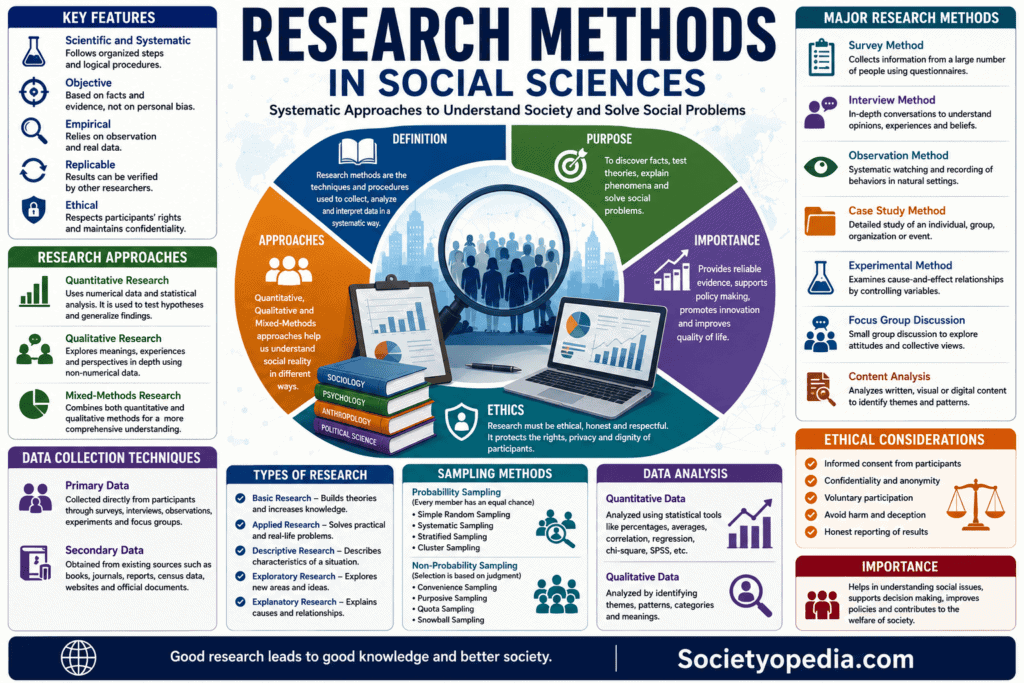
Methods Used in Descriptive Research
Questionnaires
Questionnaires are among the most widely used methods in descriptive research.
Researchers use structured questionnaires containing closed-ended or multiple-choice questions to collect standardized information from large populations.
Structured Interviews
Structured interviews involve asking all participants the same predetermined questions in the same order.
This method improves consistency and facilitates statistical analysis.
Observation
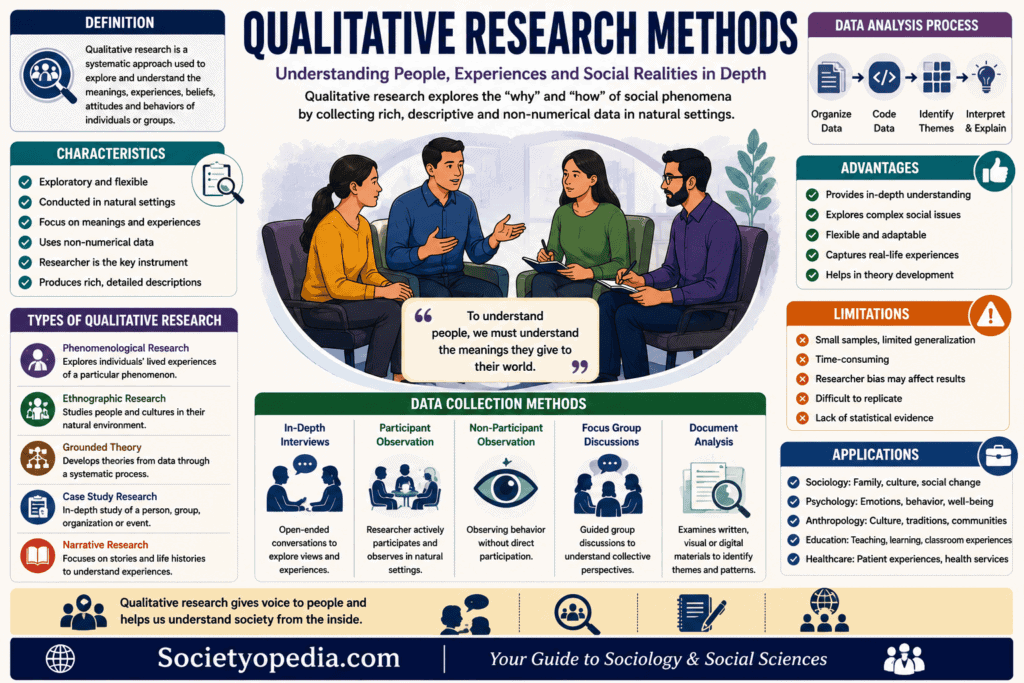
Researchers systematically observe behaviors, interactions, or events in natural settings.
Observation is especially useful when participants cannot accurately describe their own behavior.
Secondary Data Analysis
Researchers often analyze existing information obtained from census reports, government publications, institutional records, organizational databases, and previous research studies.
Secondary data provide valuable insights while reducing research costs and time.
Data Collection Process
The first step involves identifying the research problem and developing clear research objectives.
Researchers then determine the target population and select an appropriate sampling technique.
Data collection instruments such as questionnaires or observation schedules are prepared and tested.
Information is collected systematically from selected participants.
Finally, the collected data are organized, analyzed, interpreted, and presented using tables, graphs, charts, and statistical summaries.
Data Analysis in Descriptive Research
Descriptive research mainly uses descriptive statistical techniques.
Researchers calculate frequencies, percentages, means, medians, modes, and standard deviations to summarize the collected information.
Data are often presented using tables, bar charts, pie charts, histograms, and line graphs to facilitate interpretation.
Statistical software such as IBM SPSS Statistics, Microsoft Excel, R, and Stata are commonly used for descriptive data analysis.
Advantages of Descriptive Research Design
Descriptive research provides detailed and accurate information about existing situations.
It allows researchers to study large populations efficiently.
The design is relatively simple to plan and implement compared to experimental research.
Standardized procedures improve the reliability and consistency of findings.
Descriptive research supports evidence-based policymaking and organizational decision-making.
The findings often provide a foundation for future explanatory and experimental research.
Limitations of Descriptive Research Design
Descriptive research cannot establish cause-and-effect relationships because variables are not manipulated.
The design depends heavily on the quality of collected data.
Participants may provide inaccurate or socially desirable responses in surveys and interviews.
Researcher bias during observation may affect the accuracy of findings.
Although descriptive research identifies patterns and trends, it does not explain why they occur.
Applications of Descriptive Research in Social Sciences
In sociology, descriptive research is used to study family structures, poverty, crime, education, migration, social inequality, urbanization, and demographic changes.
Psychologists use descriptive research to examine personality traits, learning behaviors, emotional development, and mental health conditions.
Educational researchers study student achievement, classroom practices, teacher performance, and institutional effectiveness.
Political scientists use descriptive research to analyze voting behavior, public opinion, electoral participation, and governance.
Healthcare researchers examine disease prevalence, healthcare utilization, nutrition, maternal health, and public health indicators.
Business researchers investigate customer satisfaction, market trends, employee performance, and consumer preferences.
Difference Between Exploratory and Descriptive Research
Exploratory research is conducted when little information exists about a problem and aims to generate ideas and hypotheses.
Descriptive research is conducted when sufficient information already exists and aims to describe characteristics accurately.
Exploratory research is generally flexible and qualitative, whereas descriptive research follows a structured design and frequently uses quantitative methods.
Exploratory research asks questions such as “What is happening?” while descriptive research answers questions such as “Who?”, “What?”, “Where?”, “When?”, and “How?”.
Importance of Descriptive Research Design
Descriptive research provides accurate information about social conditions, making it valuable for governments, educational institutions, healthcare organizations, businesses, and non-governmental organizations.
It helps identify trends, monitor social changes, and evaluate existing programs.
The design contributes to policy formulation by providing factual evidence for decision-makers.
Descriptive research also supports future scientific investigations by establishing baseline information for explanatory and experimental studies.
Conclusion
Descriptive Research Design is a fundamental research approach that enables researchers to describe individuals, groups, institutions, and social phenomena accurately and systematically. Through surveys, observations, structured interviews, case studies, and secondary data analysis, descriptive research provides reliable information about existing conditions without manipulating variables.
Although it cannot establish causal relationships, descriptive research remains one of the most valuable research designs in sociology and other social sciences because it produces factual evidence, identifies patterns and trends, and supports informed decision-making. Its ability to present a clear picture of social reality makes it an indispensable tool for researchers, policymakers, educators, and development practitioners.