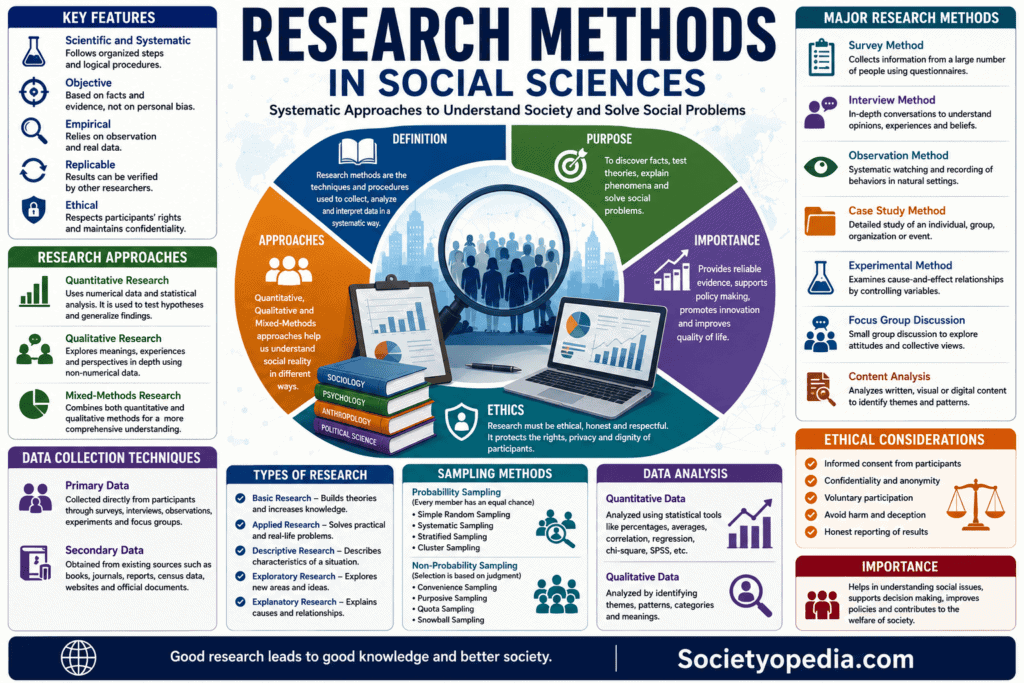
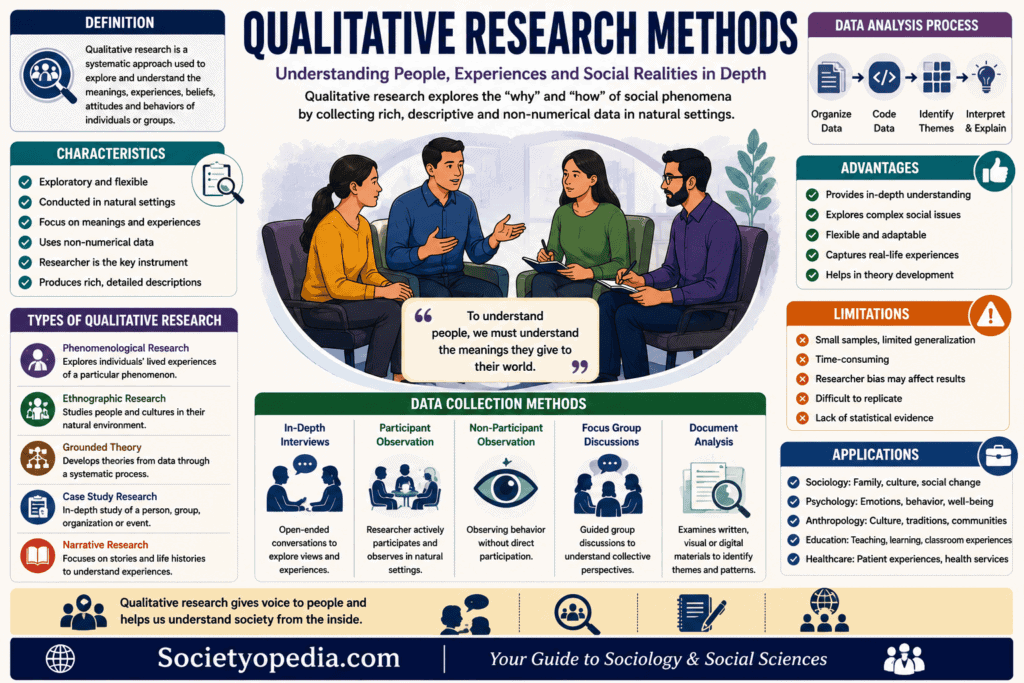
Introduction
Exploratory Research Design is one of the most important research designs in the social sciences. It is used when a researcher has little or no prior knowledge about a research problem and wants to gain a deeper understanding before conducting more detailed investigations. Rather than testing hypotheses, exploratory research seeks to explore ideas, identify patterns, generate insights, and formulate research questions for future studies.
In sociology, psychology, anthropology, political science, education, business, and public health, exploratory research helps researchers investigate new or emerging issues where existing information is limited. It provides flexibility and allows researchers to examine complex social phenomena from multiple perspectives.
Exploratory research serves as the foundation for many descriptive, explanatory, and experimental studies by helping researchers clarify concepts, identify variables, and understand the nature of the research problem.

Definition of Exploratory Research Design
Different scholars have defined exploratory research from different perspectives.
According to John W. Creswell, exploratory research is conducted when the researcher needs to explore a problem because little information is available or existing knowledge is inadequate.
According to Earl Babbie, exploratory research aims to satisfy the researcher’s curiosity, test the feasibility of conducting a more extensive study, and develop methods for future investigations.
According to C. R. Kothari, exploratory research is conducted to gain familiarity with a phenomenon or to obtain new insights into it.
In simple words, exploratory research design is a flexible research approach used to investigate unfamiliar topics, discover new ideas, and develop a better understanding of a research problem.
Characteristics of Exploratory Research Design
Exploratory research is flexible because researchers can modify research questions, methods, and procedures as new information emerges during the study.
It is open-ended in nature and encourages the exploration of different perspectives rather than focusing on predetermined answers.
The design is generally qualitative, although quantitative techniques may also be used in some exploratory studies.
Exploratory research focuses on generating ideas instead of testing hypotheses. It helps identify variables, concepts, and relationships that may later be examined through more structured research.
Another important characteristic is that exploratory research is often conducted at the initial stage of the research process when knowledge about the problem is limited.
Objectives of Exploratory Research Design
The primary objective of exploratory research is to gain a deeper understanding of a research problem.
It helps researchers identify important variables and relationships that may influence the phenomenon being studied.
Exploratory research generates new ideas, concepts, and hypotheses for future investigations.
It assists researchers in determining whether a larger or more detailed study is feasible.
The design also helps refine research questions and improve the overall research plan.
When to Use Exploratory Research Design
Exploratory research is appropriate when little information exists about a topic.
It is useful when researchers want to investigate new social trends, emerging issues, or previously unstudied phenomena.
Researchers also use exploratory research to clarify vague research problems before conducting descriptive or explanatory studies.
It is particularly valuable in situations where existing theories cannot adequately explain the phenomenon.
Methods Used in Exploratory Research
Literature Review
A literature review is often the first step in exploratory research. Researchers examine books, journal articles, reports, government publications, and previous studies to understand existing knowledge and identify research gaps.
Reviewing the literature helps researchers refine their research questions and avoid duplication of previous work.
In-Depth Interviews
Exploratory research frequently uses in-depth interviews to obtain detailed information from individuals with relevant knowledge or experience.
Open-ended questions encourage participants to share their opinions, beliefs, and personal experiences.
Focus Group Discussions
Focus group discussions involve a small group of participants who discuss a particular issue under the guidance of a moderator.
This method helps researchers understand different viewpoints and identify important themes.
Observation
Observation allows researchers to study people, behaviors, and social situations in their natural environments.
Both participant observation and non-participant observation may be used to collect valuable insights.
Case Study
Case studies provide detailed examinations of individuals, organizations, communities, or events.
They help researchers understand complex issues in their real-life contexts.
Pilot Study
A pilot study is a small preliminary investigation conducted before the main research.
It helps researchers evaluate research instruments, identify potential problems, and improve the research design.
Steps in Conducting Exploratory Research
The first step is identifying a broad research problem that requires further understanding.
Researchers then review existing literature to determine what is already known and identify knowledge gaps.
Appropriate research methods such as interviews, observations, or focus groups are selected.
Data are collected from relevant participants or sources using flexible procedures.
Researchers analyze the information by identifying patterns, themes, and emerging concepts.
Finally, conclusions are drawn, and recommendations are made for future research.
Data Collection Techniques
Exploratory research generally relies on qualitative data collection techniques.
Interviews provide detailed personal experiences and opinions.
Observations help researchers understand behaviors and social interactions.
Focus groups generate collective discussions and multiple perspectives.
Document analysis involves examining written materials such as reports, newspapers, policy documents, and organizational records.
In some cases, researchers may also use preliminary surveys to gather initial information.
Advantages of Exploratory Research Design
Exploratory research provides a deeper understanding of complex social problems.
Its flexible nature allows researchers to adapt their methods as new information emerges.
The design helps identify important variables and generate hypotheses for future studies.
Exploratory research encourages innovation by discovering new ideas and perspectives.
It is particularly useful for studying emerging social issues where little previous research exists.
The findings often provide the foundation for descriptive, explanatory, and experimental research.
Limitations of Exploratory Research Design
Exploratory research generally involves small samples, making it difficult to generalize findings to larger populations.
The flexible nature of the design may introduce researcher bias if objectivity is not maintained.
Because exploratory research often relies on qualitative methods, statistical analysis is usually limited.
The findings are considered preliminary and often require further verification through more structured research designs.
Results may differ depending on the researcher’s interpretation of the collected information.
Applications of Exploratory Research in Social Sciences
In sociology, exploratory research is used to investigate emerging social issues such as digital communities, changing family structures, migration, social inequality, and youth culture.
Psychologists use exploratory research to understand new behavioral patterns, mental health issues, and emotional experiences.
Political scientists use exploratory studies to examine emerging political movements, public opinion, and governance challenges.
Educational researchers use exploratory research to investigate new teaching methods, student experiences, and educational reforms.
Healthcare researchers apply exploratory research to understand patients’ experiences, healthcare access, and community health concerns.
Difference Between Exploratory and Descriptive Research
Exploratory research aims to discover new ideas, identify research problems, and generate hypotheses, whereas descriptive research aims to describe characteristics or situations accurately.
Exploratory research is flexible and usually qualitative, while descriptive research follows a more structured design and often uses quantitative methods.
Exploratory studies seek answers to “what might be happening” and “why should this be studied,” whereas descriptive studies answer questions such as who, what, when, where, and how.
Importance of Exploratory Research Design
Exploratory research plays a critical role in scientific inquiry by providing the initial understanding needed before conducting large-scale studies.
It helps researchers clarify research problems, identify key concepts, and improve research designs.
The approach contributes to theory development by discovering new relationships and generating innovative ideas.
Exploratory research also supports evidence-based policymaking by identifying emerging social challenges that require further investigation.
Conclusion
Exploratory Research Design is an essential research approach used to investigate unfamiliar or poorly understood problems. It provides researchers with the flexibility to explore new ideas, understand complex social phenomena, identify important variables, and develop research questions for future studies.
Although exploratory research does not usually provide definitive conclusions or statistical generalizations, it serves as the foundation for more advanced research designs. By using methods such as literature reviews, interviews, observations, focus groups, and case studies, researchers gain valuable insights that contribute to the advancement of knowledge in sociology and other social sciences.