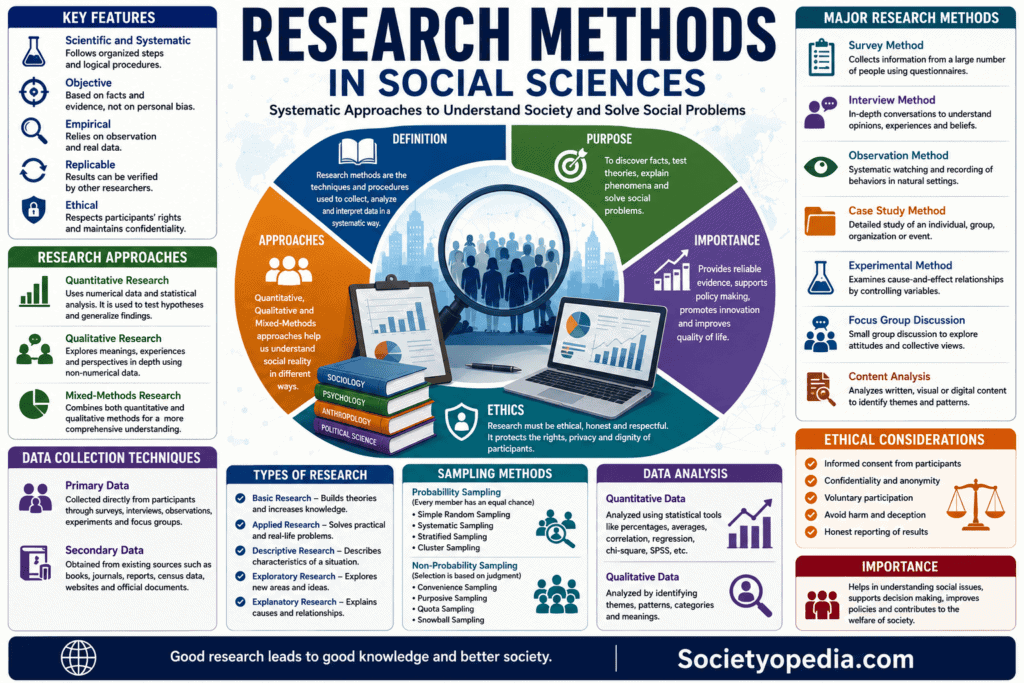
Research design serves as the blueprint of any scientific investigation. It provides researchers with a systematic framework for collecting, analyzing, and interpreting data to answer research questions effectively. Among the most widely used research approaches in social sciences are Qualitative Research Design, Quantitative Research Design, and Mixed-Methods Research Design. Each design has unique philosophical foundations, methodologies, strengths, and limitations, making them suitable for different types of research problems.
The choice of research design depends on the nature of the research question, the objectives of the study, the availability of data, and the theoretical perspective adopted by the researcher. While qualitative research focuses on understanding meanings, experiences, and social realities, quantitative research emphasizes numerical measurement and statistical analysis. Mixed-methods research combines the strengths of both approaches to provide a more comprehensive understanding of complex phenomena.
Researchers in sociology, psychology, anthropology, education, political science, public health, economics, and business frequently employ these research designs to investigate human behavior, social institutions, public policies, and organizational processes. Understanding the differences and applications of these approaches is essential for conducting high-quality research.

What is a Research Design?
Research design is the overall plan that guides researchers from the formulation of research questions to the interpretation of findings. It specifies how data will be collected, what methods will be used, how participants will be selected, and how the results will be analyzed.
A well-designed research study improves the validity, reliability, credibility, and overall quality of research findings. Choosing an appropriate design ensures that the research objectives are achieved efficiently and scientifically.
Qualitative Research Design
Definition
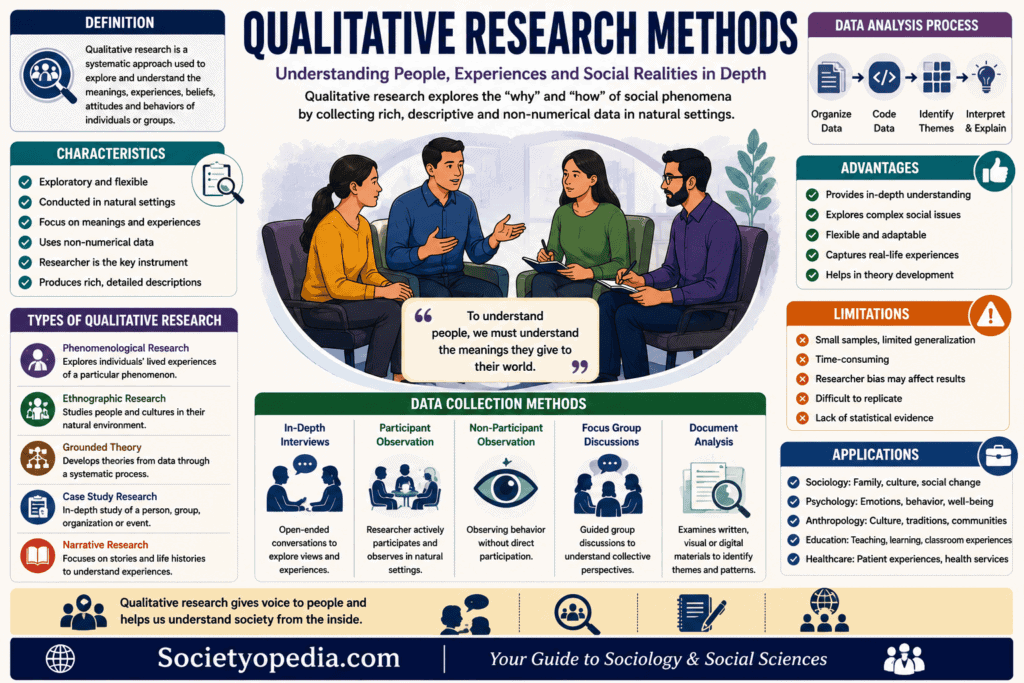
Qualitative Research Design is an approach used to explore and understand human experiences, beliefs, behaviors, values, cultures, and social interactions through non-numerical data. Rather than measuring variables statistically, qualitative research seeks to understand the meanings individuals attach to their experiences.
According to John W. Creswell, qualitative research is an approach for exploring and understanding the meaning individuals or groups ascribe to social or human problems.
According to Norman K. Denzin and Yvonna S. Lincoln, qualitative research studies phenomena in their natural settings and attempts to interpret them in terms of the meanings people bring to them.
Characteristics of Qualitative Research
Qualitative research focuses on understanding social reality from the participants’ perspectives. It generally uses small, purposively selected samples and collects rich, detailed information through interviews, observations, focus groups, case studies, and document analysis. The research process is flexible and evolves as new insights emerge during data collection.
Rather than testing hypotheses, qualitative studies aim to generate theories, explore new ideas, and provide in-depth descriptions of social phenomena.
Common Qualitative Research Methods
The most common qualitative methods include in-depth interviews, participant observation, focus group discussions, ethnography, phenomenology, grounded theory, narrative research, and case study research. Researchers analyze textual data through thematic analysis, content analysis, discourse analysis, or narrative analysis.
Advantages of Qualitative Research
Qualitative research provides deep understanding of human behavior, emotions, motivations, and social interactions. It allows researchers to study complex social issues in their natural settings and offers flexibility throughout the research process. It is particularly useful for exploring new or under-researched topics.
Limitations of Qualitative Research
Qualitative studies often involve smaller samples, limiting generalizability. Data collection and analysis can be time-consuming, and findings may be influenced by researcher interpretation. Replication is also more difficult compared to quantitative research.
Quantitative Research Design
Definition
Quantitative Research Design is a systematic approach that uses numerical data, measurement, and statistical analysis to examine relationships between variables and test hypotheses.
According to John W. Creswell, quantitative research is an approach for testing objective theories by examining relationships among variables that can be measured and analyzed statistically.
According to Earl Babbie, quantitative research emphasizes precise measurement, objective observation, and statistical analysis to understand social phenomena.
Characteristics of Quantitative Research
Quantitative research follows a structured and objective process. Researchers formulate hypotheses before collecting data and use standardized instruments such as questionnaires, surveys, and tests. Large sample sizes are commonly used to improve the generalizability of findings.
The collected data are analyzed using descriptive and inferential statistics to identify patterns, relationships, and causal effects.
Common Quantitative Research Methods
Common quantitative methods include surveys, experiments, quasi-experiments, correlational studies, cross-sectional studies, and longitudinal studies. Statistical techniques such as regression analysis, correlation, chi-square tests, t-tests, and analysis of variance (ANOVA) are frequently employed.
Researchers often use software such as IBM SPSS Statistics, R, Stata, and Microsoft Excel for data analysis.
Advantages of Quantitative Research
Quantitative research provides objective and reliable results through standardized procedures. It allows researchers to study large populations, test hypotheses, establish statistical relationships, and generalize findings to broader populations.
Limitations of Quantitative Research
Quantitative research may overlook the deeper meanings, emotions, and social contexts behind human behavior. Standardized instruments may not fully capture complex social realities, and numerical data alone cannot always explain why certain phenomena occur.
Mixed-Methods Research Design
Definition
Mixed-Methods Research Design combines qualitative and quantitative approaches within a single study to obtain a more comprehensive understanding of the research problem.
According to John W. Creswell and Vicki L. Plano Clark, mixed-methods research integrates quantitative and qualitative data collection and analysis to provide a more complete understanding than either approach alone.
Characteristics of Mixed-Methods Research
Mixed-methods research integrates numerical and textual data. It uses multiple sources of evidence to answer research questions and often involves collecting quantitative and qualitative data either simultaneously or sequentially.
The approach emphasizes triangulation, complementarity, and integration to improve the validity and richness of findings.
Types of Mixed-Methods Designs
One of the most common mixed-methods designs is the Convergent Parallel Design, in which qualitative and quantitative data are collected simultaneously and integrated during interpretation.
The Explanatory Sequential Design begins with quantitative data collection and analysis, followed by qualitative research to explain the statistical findings.
The Exploratory Sequential Design starts with qualitative exploration, after which quantitative methods are used to test or generalize the qualitative findings.
Other mixed-methods designs include embedded, transformative, and multiphase designs depending on the complexity of the research.
Advantages of Mixed-Methods Research
Mixed-methods research provides a more comprehensive understanding of complex social issues by combining numerical evidence with participants’ experiences. It improves the validity of findings through triangulation and allows researchers to answer multiple research questions simultaneously.
The integration of qualitative and quantitative evidence enhances policy recommendations and practical applications.
Limitations of Mixed-Methods Research
Mixed-methods research requires considerable time, financial resources, and methodological expertise. Researchers must be skilled in both qualitative and quantitative methods as well as techniques for integrating different types of data. Managing and interpreting multiple datasets can also be challenging.
Comparison of Qualitative, Quantitative, and Mixed-Methods Research
Qualitative research seeks to understand meanings, experiences, and social processes through non-numerical data. Quantitative research focuses on measuring variables numerically and testing hypotheses using statistical techniques. Mixed-methods research combines both approaches to obtain a more complete understanding of the research problem.
Qualitative studies generally use small purposive samples, whereas quantitative studies often involve larger probability samples. Mixed-methods research may use both sampling approaches depending on the study design.
Data collection in qualitative research includes interviews, observations, and focus groups. Quantitative research relies primarily on surveys, questionnaires, experiments, and standardized instruments. Mixed-methods research combines these techniques to produce richer evidence.
Choosing the Appropriate Research Design
The selection of a research design depends on the research objectives and the nature of the problem. Qualitative research is appropriate when little is known about a phenomenon and detailed understanding is required. Quantitative research is suitable when researchers aim to measure variables, test theories, and establish statistical relationships. Mixed-methods research is most appropriate when neither qualitative nor quantitative methods alone can adequately answer the research questions.
Researchers should also consider available resources, time, sample accessibility, ethical considerations, and methodological expertise before selecting a design.
Applications in Social Sciences
In sociology, qualitative research is commonly used to study family dynamics, culture, identity, migration, and community life. Quantitative research examines poverty, crime, education, employment, health, and social inequality through surveys and statistical analysis. Mixed-methods research is increasingly used to evaluate social policies, development programs, healthcare interventions, educational reforms, and organizational change.
The growing complexity of contemporary social problems has increased the popularity of mixed-methods research because it provides both statistical evidence and contextual understanding.
Importance of Understanding Research Designs
A clear understanding of qualitative, quantitative, and mixed-methods research enables students and researchers to select appropriate methodologies for their studies. Appropriate design selection improves the credibility, validity, and usefulness of research findings while ensuring that research questions are answered effectively.
Knowledge of these research designs is also essential for evaluating published research, conducting academic investigations, and developing evidence-based policies and interventions.
Research Design in Social Science Research: Definition And Types
Conclusion
Qualitative, quantitative, and mixed-methods research designs each play a vital role in scientific inquiry. Qualitative research provides rich insights into human experiences and social processes, quantitative research offers objective measurement and statistical evidence, while mixed-methods research integrates both approaches to produce comprehensive and robust findings.
No single design is universally superior. Instead, the most appropriate research design depends on the research objectives, theoretical framework, and nature of the problem under investigation. By understanding the strengths and limitations of each approach, researchers can produce high-quality studies that contribute meaningfully to knowledge, policy development, and social progress.