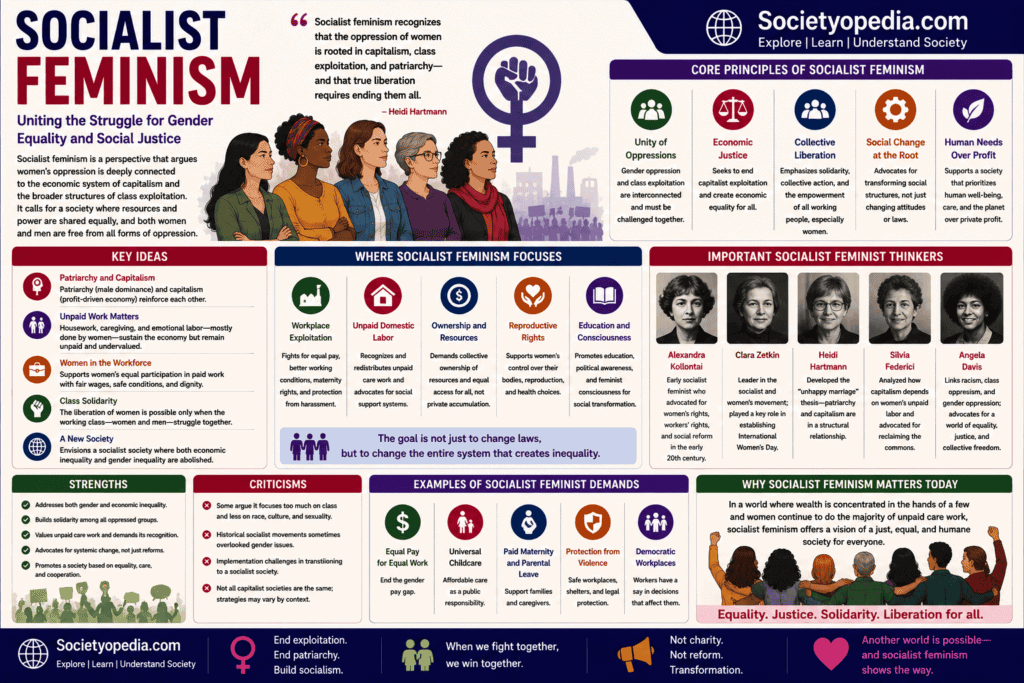
Socialist feminism is a major approach within feminist theory that examines gender inequality through the interaction of patriarchy, capitalism, class, labor, and social institutions. It developed partly from Marxist feminism but argues that gender inequality cannot be explained by economic class alone.
Socialist feminists maintain that women can experience oppression through both patriarchal gender relations and economic structures. Understanding gender inequality therefore requires examining how these systems interact.
For example, women may experience inequality because they are expected to perform unpaid domestic work while also facing disadvantages in paid employment. Socialist feminism examines how family, workplace, economy, and cultural expectations work together to produce these inequalities.
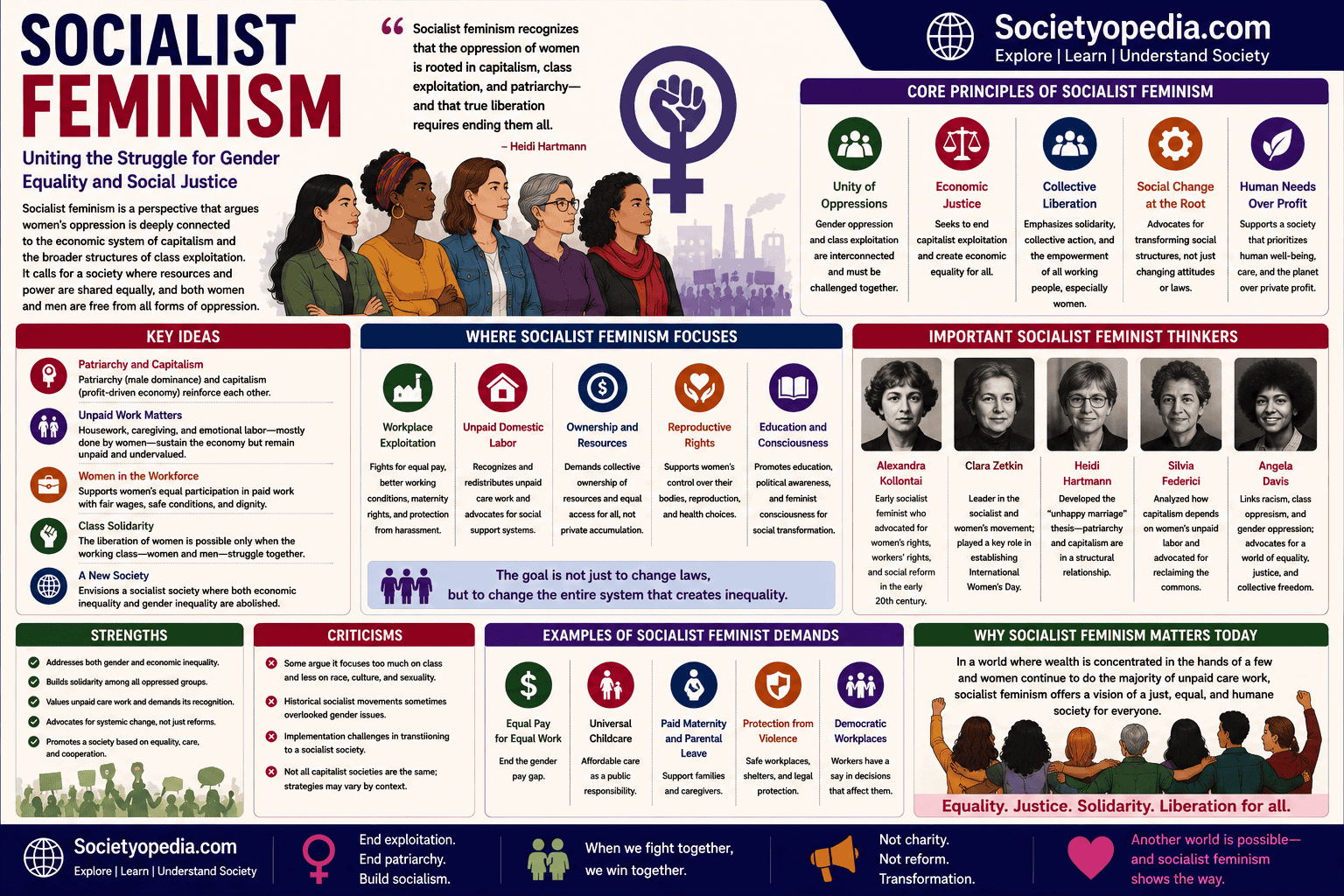
What Is Socialist Feminism?
Socialist feminism is a feminist perspective that explains gender inequality through the interaction of patriarchy and economic structures, particularly capitalism and class relations.
In simple terms:
Socialist feminism argues that gender inequality is influenced by both male-dominated power structures and economic systems.
This makes socialist feminism different from approaches that focus almost exclusively on either patriarchy or capitalism.
The Central Idea of Socialist Feminism
The central argument can be represented as:
Patriarchy + Capitalism + Gender Division of Labor → Gender Inequality
Socialist feminists argue that these structures can reinforce one another.
For example, traditional gender expectations may assign women primary responsibility for childcare and household work. At the same time, economic structures may reward continuous paid employment.
The combination can disadvantage women who have significant caregiving responsibilities.
Origins of Socialist Feminism
Socialist feminism developed through interactions between Marxist thought, socialist movements, and feminist movements.
Marxist feminism provided important concepts concerning:
- capitalism;
- class;
- labor;
- exploitation;
- economic structures.
Feminist analysis added attention to:
- patriarchy;
- gender roles;
- family;
- sexuality;
- reproduction;
- women’s experiences.
Socialist feminism attempted to bring these dimensions together.
Socialist Feminism and Patriarchy
Patriarchy refers broadly to social arrangements in which men have greater authority, power, or control over resources and decision-making.
Socialist feminists argue that patriarchy is an important source of gender inequality.
It can influence:
- family relationships;
- workplaces;
- politics;
- culture;
- education;
- sexuality.
However, socialist feminists generally argue that patriarchy should not be analyzed separately from economic structures.
Socialist Feminism and Capitalism
Capitalism is another major concept in socialist feminist analysis.
Capitalist societies organize much economic activity around:
- private ownership;
- wage labor;
- markets;
- profit;
- production.
Socialist feminists ask how these economic arrangements interact with gender relations.
For example, a labor market may reward workers who can devote long and uninterrupted hours to employment.
If women are expected to perform most childcare and household work, they may have less time for paid employment and career advancement.
Thus, economic structures and gender expectations can reinforce one another.
Socialist Feminism and Class
Social class is central to socialist feminism.
Women from different classes may experience gender inequality differently.
For example, a professional woman may be able to hire childcare or domestic assistance.
A low-income working woman may have fewer resources to do so.
Both may experience gender inequality, but their social and economic circumstances are different.
Socialist feminism therefore combines analysis of gender and class.
Socialist Feminism and the Family
The family is a particularly important institution for socialist feminist analysis.
Families provide:
- childcare;
- food preparation;
- cleaning;
- emotional support;
- care for elderly people;
- reproduction and socialization.
Much of this work is unpaid.
Socialist feminists ask:
Who performs this work?
Who benefits from it?
How is it distributed between women and men?
How does household labor affect women’s economic opportunities?
These questions connect the private household with wider economic structures.
Unpaid Domestic Labor
Unpaid domestic work is one of the most important topics in socialist feminism.
It includes:
- cooking;
- cleaning;
- childcare;
- caring for elderly relatives;
- household organization;
- emotional support.
This work contributes to maintaining families and communities even when it does not generate direct wages.
Socialist feminists argue that understanding gender inequality requires taking this work seriously.
The Double Burden
Women who participate in paid employment may also remain responsible for a large share of unpaid domestic labor.
This creates what is commonly called the double burden:
Paid work + Unpaid domestic work
For example, a woman may work a full day at a hospital or school and then return home to prepare meals, clean the house, and care for children.
Socialist feminist analysis examines how workplace structures and family expectations combine to create this burden.
Social Reproduction
The concept of social reproduction is particularly important.
Social reproduction refers broadly to the activities required to maintain people and society from one generation to another.
It includes:
- childbirth;
- childcare;
- education;
- healthcare;
- household work;
- care for dependents;
- emotional support.
These activities allow societies and economies to continue functioning.
Socialist feminists ask why much of this essential work is unpaid or undervalued and why women often perform a disproportionate share.
Socialist Feminism and Women’s Employment
Socialist feminism does not simply ask whether women are employed.
It asks:
What kind of employment do women have?
What wages do they receive?
Who performs unpaid work at home?
Who has access to leadership?
How does employment interact with family responsibilities?
This broader approach recognizes that women’s participation in the labor market does not automatically produce gender equality.
Occupational Segregation
Women and men may be concentrated in different occupations.
Women are often heavily represented in sectors such as:
- education;
- healthcare;
- social care;
- administrative work;
- domestic work.
Men may be more strongly represented in certain technical, industrial, or high-authority occupations.
Socialist feminist analysis examines how gender expectations and economic structures influence these patterns.
Socialist Feminism and the Gender Pay Gap
The gender pay gap can be examined through both gender and economic structures.
Possible contributing factors include:
- occupational segregation;
- unequal access to leadership;
- career interruptions;
- caregiving responsibilities;
- discrimination;
- part-time employment;
- differences in working conditions.
A socialist feminist approach emphasizes that these factors do not exist independently.
Family responsibilities can influence women’s employment patterns, while employment structures can influence family life.
Types of Feminism: Major Feminist Approaches and Their Differences
Socialist Feminism and Power
Socialist feminism views power as operating through multiple institutions.
Power can exist within:
- households;
- workplaces;
- political institutions;
- economic systems;
- cultural institutions.
For example, a woman may have legal equality but still have limited bargaining power because she lacks independent income.
This demonstrates the connection between economic power and gender power.
Socialist Feminism and Education
Education can also be examined through socialist feminist theory.
Questions may include:
- Do girls have equal access to education?
- What subjects are associated with girls and boys?
- How does family income affect educational opportunities?
- Do women have equal access to professional training?
- How do educational choices influence employment?
Socialist feminism therefore examines both gender expectations and class inequality.
Socialist Feminism and Healthcare
Healthcare provides another example of how gender and economic structures interact.
Researchers can examine:
- access to healthcare;
- maternal healthcare;
- women’s health services;
- working conditions of female healthcare professionals;
- unpaid caregiving;
- economic barriers to healthcare.
Women may simultaneously be caregivers within families and paid caregivers in healthcare occupations.
This creates an important connection between gendered care work and the economy.
Liberal Feminism: Definition, Principles, History, Goals and Importance
Socialist Feminism and Politics
Socialist feminism also examines women’s political participation.
Political participation can be influenced by:
- economic resources;
- education;
- social networks;
- family responsibilities;
- cultural gender norms;
- institutional barriers.
Women who carry substantial unpaid caregiving responsibilities may have less time and resources for political participation.
Therefore, political inequality cannot always be separated from economic and family structures.
Socialist Feminism vs Marxist Feminism
The two approaches overlap considerably.
| Marxist Feminism | Socialist Feminism |
|---|---|
| Strong emphasis on capitalism and class | Combines capitalism, class, and patriarchy |
| Focuses heavily on labor and economic structures | Examines economic and gender power together |
| Emphasizes economic exploitation | Emphasizes multiple interconnected structures |
| Strong focus on social reproduction | Social reproduction plus patriarchal relations |
The distinction is not absolute. There is considerable overlap between the two traditions.
A useful way to remember it is:
Marxist feminism → capitalism and class
Socialist feminism → capitalism + patriarchy
Radical Feminism: Definition, Principles, Ideas, History and Importance
Socialist Feminism vs Liberal Feminism
| Liberal Feminism | Socialist Feminism |
|---|---|
| Equal rights | Structural inequality |
| Equal opportunities | Capitalism and patriarchy |
| Legal reform | Economic and social transformation |
| Individual freedom | Collective and structural analysis |
| Anti-discrimination | Labor, family, class, and gender |
For example, liberal feminism may support equal employment laws.
Socialist feminism may argue that such laws are important but insufficient if women remain responsible for disproportionate unpaid care work.
Socialist Feminism vs Radical Feminism
| Radical Feminism | Socialist Feminism |
|---|---|
| Patriarchy is central | Patriarchy and capitalism are central |
| Focuses on gender power | Focuses on gender and class power |
| Examines sexuality and violence strongly | Examines labor, family, economy, and gender |
| Challenges male dominance | Challenges interconnected social structures |
Both approaches recognize gender-based oppression but emphasize different structural relationships.
Marxist Feminism: Definition, Principles, Capitalism, Class and Gender Inequality
Socialist Feminism and Intersectionality
Contemporary socialist feminist analysis can also incorporate intersectionality.
Gender and class interact with:
- ethnicity;
- race;
- disability;
- age;
- sexuality;
- nationality;
- geography.
For example, women from low-income households may experience different employment and family pressures from women with substantial economic resources.
Intersectional analysis makes socialist feminism more sensitive to differences among women.
Socialist Feminism and Social Change
Socialist feminists generally argue that meaningful gender equality requires changes at multiple levels.
Change may involve:
Family
→ More equal household responsibilities
Workplace
→ Fair employment and family-friendly policies
Economy
→ Greater economic security
Culture
→ Challenging gender stereotypes
Politics
→ Greater participation and representation
Social policy
→ Support for childcare, healthcare, and caregiving
This multidimensional approach reflects the belief that gender inequality is produced by interconnected structures.
Major Goals of Socialist Feminism
Socialist feminist goals may include:
Gender Equality
Reducing unequal power between women and men.
Economic Equality
Reducing class-based and economic disadvantages.
Recognition of Unpaid Labor
Recognizing the social and economic value of household and caregiving work.
Equal Division of Domestic Work
Encouraging more equitable sharing of household responsibilities.
Workplace Equality
Improving wages, working conditions, opportunities, and leadership access.
Social Support
Developing policies that support childcare, healthcare, parental responsibilities, and caregiving.
Transformation of Gender Relations
Challenging patriarchal expectations within families and institutions.
Strengths of Socialist Feminism
It Connects Gender and Class
Socialist feminism recognizes that gender inequality cannot always be separated from economic inequality.
It Examines Both Family and Workplace
It connects unpaid household labor with paid employment.
It Highlights Social Reproduction
It demonstrates why care work is essential to the functioning of society.
It Recognizes Structural Inequality
It moves beyond explanations based solely on individual attitudes.
It Offers a Broad Framework
Socialist feminism can be applied to family, education, employment, politics, economy, and culture.
Criticisms of Socialist Feminism
It Can Be Theoretically Complex
Because it combines multiple structures, it can sometimes be difficult to determine which factor is most influential in a particular situation.
It May Overemphasize Capitalism
Critics argue that gender inequality can exist in societies with different economic systems.
It May Underestimate Other Forms of Inequality
Race, ethnicity, sexuality, disability, religion, and culture may also shape gender relations.
Not All Women Have the Same Economic Experience
Women from different social classes may face very different opportunities and constraints.
These criticisms have encouraged feminist scholars to develop increasingly intersectional approaches.
Examples of Socialist Feminist Analysis
Working Mothers
A socialist feminist may examine how workplace expectations and unequal household responsibilities combine to disadvantage working mothers.
Childcare
Instead of treating childcare as purely a private family responsibility, socialist feminism examines its economic and social significance.
Domestic Work
It asks why unpaid household labor is disproportionately performed by women.
Low-Paid Care Work
It examines why occupations involving care and traditionally feminized work may receive relatively low economic value.
Women’s Political Participation
It considers how economic resources and family responsibilities influence political participation.
Socialist Feminism in Pakistan
Socialist feminist analysis can be applied to several gender issues in Pakistan.
For example, researchers may examine:
- women’s labor-force participation;
- unpaid domestic work;
- informal employment;
- agricultural labor;
- domestic workers;
- female healthcare professionals;
- childcare responsibilities;
- workplace discrimination;
- economic dependence;
- women’s access to property and income.
A particularly useful application is the study of women who participate in paid employment while continuing to carry major household responsibilities.
This allows researchers to examine how family expectations, workplace structures, economic conditions, and gender norms interact.
Why Is Socialist Feminism Important?
Socialist feminism is important because it provides a multidimensional explanation of gender inequality.
It asks us to look at:
Gender
Class
Capitalism
Patriarchy
Family
Labor
Social reproduction
This makes it particularly useful for sociological research because gender inequality rarely exists within a single institution.
Conclusion
Socialist feminism is a major feminist perspective that examines gender inequality through the interaction of patriarchy, capitalism, class, labor, family, and social reproduction.
It developed partly from Marxist feminism but places greater emphasis on the relationship between economic structures and patriarchal power.
One of its most important contributions is its analysis of unpaid domestic and care work. It shows that household labor is not merely a private responsibility but an important social activity connected to the wider economy.
Socialist feminism also explains why women’s experiences differ according to social class and economic position.
Although it has been criticized for sometimes placing too much emphasis on capitalism or structural explanations, it remains an important perspective for understanding the relationship between gender, family, work, class, and economic inequality.
For sociology and gender studies, socialist feminism provides a valuable framework for asking not only whether women experience inequality, but also how economic and patriarchal structures work together to produce and maintain that inequality.