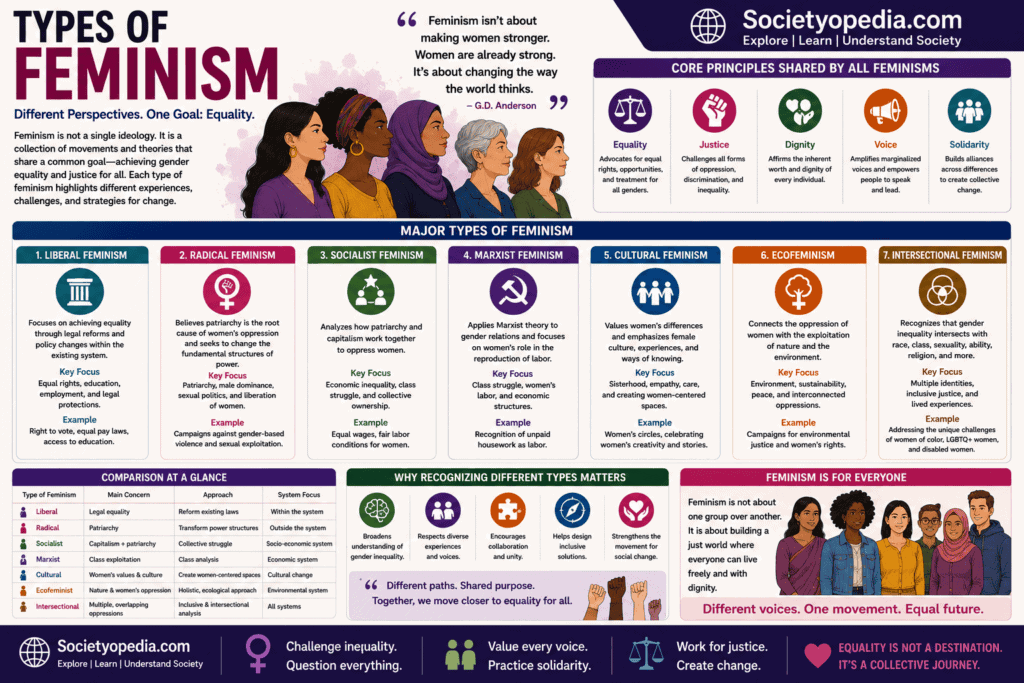
When we talk about types of Feminism it is not a single theory or movement. It includes a wide range of ideas, theories, movements, and approaches that seek to understand and challenge gender inequality. Different feminists have developed different explanations for why inequality exists and different ideas about how society should change.
These different approaches are commonly described as types of feminism or feminist perspectives.
Some types of feminism focus primarily on equal rights and opportunities. Others emphasize patriarchy, capitalism, class inequality, culture, sexuality, or the interaction of gender with other forms of inequality.
Understanding these differences is important because the term feminism represents a diverse intellectual and social tradition rather than one uniform set of beliefs.
What Are the Types of Feminism?
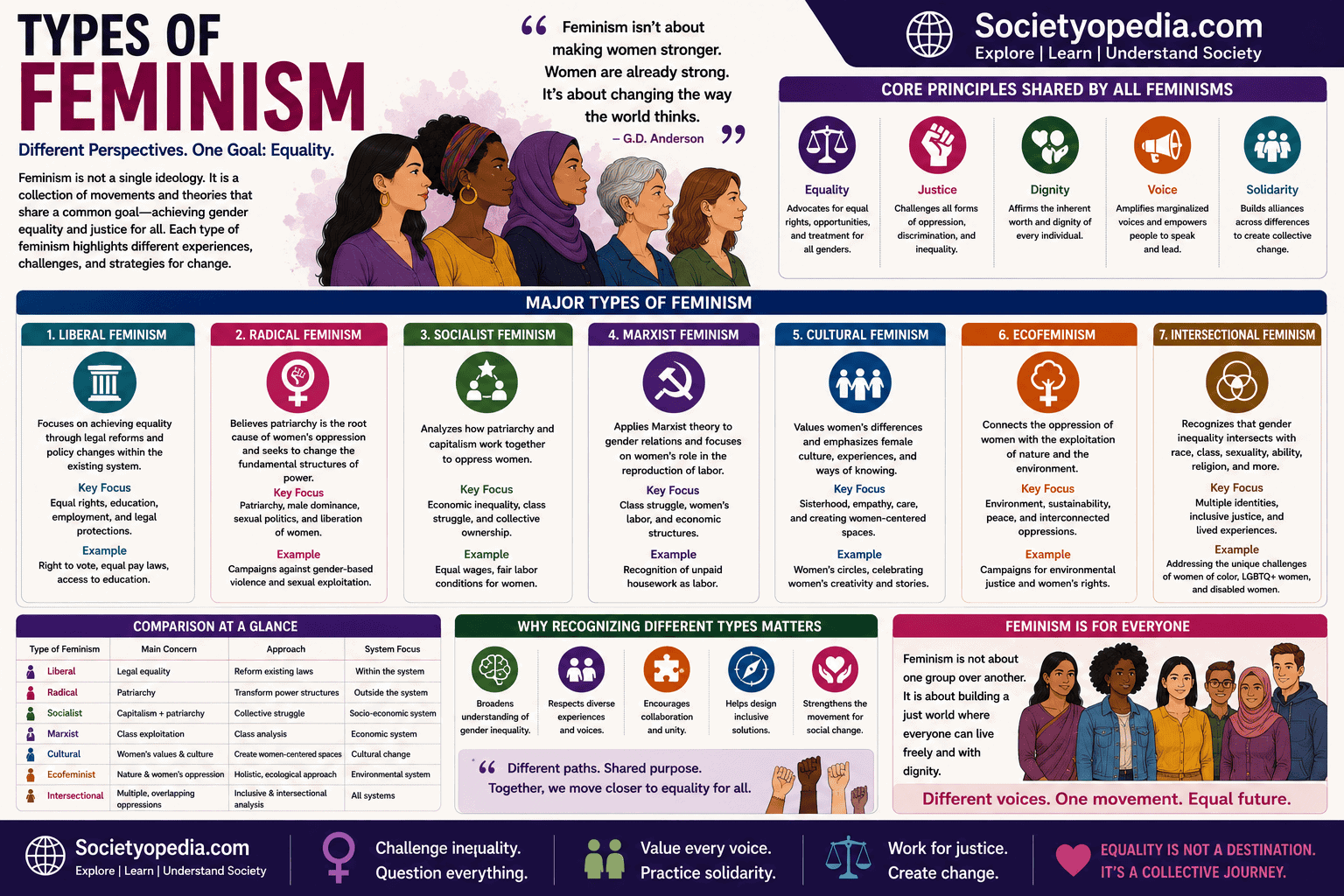
Types of feminism are different theoretical and political approaches that explain the causes of gender inequality and propose different ways of achieving greater equality.
Major types include:
- Liberal feminism
- Radical feminism
- Marxist feminism
- Socialist feminism
- Intersectional feminism
- Cultural feminism
- Black feminism
- Postmodern feminism
- Ecofeminism
- Existential feminism
The first five are particularly important for introductory sociology and gender studies because they provide major frameworks for understanding gender inequality.
Why Are There Different Types of Feminism?
There is no single explanation for gender inequality.
For example, one feminist may argue that women experience inequality because they lack equal access to education and employment.
Another may argue that the deeper problem is patriarchal power.
Another may emphasize capitalism and women’s unpaid labor.
Another may argue that gender inequality cannot be understood without considering class, race, ethnicity, disability, sexuality, and other social positions.
These different explanations have produced different feminist approaches.
1. Liberal Feminism
Liberal feminism focuses primarily on equal rights, opportunities, and individual freedom.
Liberal feminists generally argue that women should have the same legal and social opportunities as men.
They are particularly concerned with barriers that prevent women from participating equally in society.
Major areas of concern include:
- education;
- employment;
- voting;
- political participation;
- equal pay;
- legal rights;
- anti-discrimination laws.
Feminist Theory Definition: Meaning, Concepts, Approaches and Importance
Main Idea of Liberal Feminism
The central idea is:
If discriminatory barriers are removed, women should have equal opportunities to participate in society.
Liberal feminism therefore tends to emphasize reform rather than complete transformation of social institutions.
For example, if women are excluded from a profession, a liberal feminist approach may focus on removing discriminatory recruitment practices.
Strength of Liberal Feminism
Its emphasis on legal rights and equal opportunities has contributed to important discussions about education, employment, political participation, and discrimination.
Limitation
Critics argue that legal equality alone may not eliminate deeper structural inequalities.
For example, women may have the legal right to work but still perform disproportionate amounts of unpaid domestic labor.
2. Radical Feminism
Radical feminism places patriarchy and gender-based power at the center of its analysis.
Radical feminists argue that gender inequality is deeply rooted in social relationships and institutions.
Rather than seeing discrimination as isolated behavior, radical feminism examines broader systems of male power.
Major areas of concern include:
- patriarchy;
- sexual violence;
- domestic violence;
- sexuality;
- reproductive control;
- women’s bodies;
- gender-based oppression.
Main Idea of Radical Feminism
The basic argument is that gender inequality is deeply embedded in patriarchal social structures.
Therefore, simply changing laws may not be sufficient.
Radical feminism calls attention to power relationships in both public and private life.
Strength
It brought significant attention to issues that had often been treated as private matters, particularly domestic violence and sexual violence.
Limitation
Critics have argued that some radical feminist approaches may treat women as a relatively unified group and may not sufficiently account for differences involving class, race, ethnicity, sexuality, or culture.
3. Marxist Feminism
Marxist feminism connects gender inequality with capitalism, class relations, and labor.
Marxist feminists examine women’s position within economic systems and ask how capitalism influences gender relations.
A major concern is the relationship between:
Paid labor + unpaid domestic labor + capitalism
Women may perform unpaid household work such as childcare, cooking, and cleaning while men or women participate in paid employment.
Marxist feminist analysis asks how this unpaid labor contributes to the reproduction of the labor force and the wider economy.
Main Areas of Marxist Feminism
- capitalism;
- class inequality;
- women’s labor;
- unpaid domestic work;
- economic dependence;
- exploitation.
Strength
It connects gender inequality with economic structures rather than explaining it solely through culture or individual attitudes.
Limitation
Critics argue that focusing heavily on class and capitalism may understate the importance of patriarchy, culture, sexuality, and other dimensions of gender inequality.
4. Socialist Feminism
Socialist feminism combines feminist analysis of patriarchy with Marxist analysis of capitalism and class.
Socialist feminists argue that gender inequality cannot be fully explained by patriarchy alone or capitalism alone.
Instead, gender and economic structures interact.
For example, women may experience inequality because:
- they are expected to perform unpaid domestic work;
- the economy depends on their paid and unpaid labor;
- workplaces may discriminate against women;
- cultural norms assign caregiving primarily to women.
Main Idea
Socialist feminism therefore emphasizes the relationship between:
Patriarchy + Capitalism + Gendered Division of Labor
Strength
It provides a broader explanation by connecting family, workplace, economic systems, and gender power.
Limitation
The approach can become theoretically complex because it attempts to explain multiple structures simultaneously.
5. Intersectional Feminism
Intersectional feminism emphasizes that gender inequality cannot always be understood separately from other forms of inequality.
A person’s experience of gender may be influenced by:
- race;
- ethnicity;
- social class;
- disability;
- age;
- sexuality;
- nationality;
- geographical location.
The concept of intersectionality is strongly associated with legal scholar Kimberlé Crenshaw, who developed the term to describe how systems of discrimination can intersect.
Example
Consider two women:
Woman A: wealthy, highly educated, urban professional.
Woman B: low-income, rural, limited access to education.
Both may experience gender inequality, but their experiences are unlikely to be identical.
Intersectional feminism therefore asks how multiple social positions shape people’s experiences.
Strength
It recognizes diversity among women and avoids treating all women as one homogeneous group.
Limitation
Intersectional analysis can become complicated because many forms of inequality may interact simultaneously.
6. Cultural Feminism
Cultural feminism emphasizes qualities and experiences traditionally associated with women.
Some cultural feminist approaches argue that qualities such as cooperation, nurturing, care, and nonviolence have been undervalued in societies that prioritize traditionally masculine characteristics.
The approach developed partly from radical feminist traditions.
Main Concern
Cultural feminism may argue that society should value characteristics associated with femininity rather than treating them as inferior.
Criticism
Critics argue that emphasizing supposedly “feminine” qualities can unintentionally reinforce gender stereotypes.
For example, saying women are naturally more caring may strengthen the expectation that women should perform most caregiving work.
7. Black Feminism
Black feminism developed partly in response to limitations within both mainstream feminist movements and anti-racist movements.
Black feminist thinkers emphasized that Black women’s experiences could not be fully explained through gender alone.
They examined the interaction of:
- gender;
- race;
- class;
- history;
- discrimination;
- power.
Black feminism contributed significantly to the development of intersectional approaches.
Main Idea
Black women’s experiences of inequality can involve multiple interconnected systems of oppression.
Therefore, feminism must consider racial and economic inequalities as well as gender.
8. Postmodern Feminism
Postmodern feminism questions the idea that there is one universal experience of “womanhood.”
It emphasizes that identities and meanings are influenced by:
- language;
- culture;
- discourse;
- history;
- social context.
Postmodern feminist approaches therefore question simple categories and universal claims about women.
Main Idea
There is not necessarily one single definition of what it means to be a woman across all societies and historical periods.
Importance
This approach encourages attention to diversity and differences among women’s experiences.
9. Ecofeminism
Ecofeminism connects gender inequality with environmental issues.
Ecofeminist thinkers examine relationships between:
- women;
- nature;
- economic systems;
- environmental exploitation;
- social inequality.
Some ecofeminist approaches argue that systems that dominate and exploit nature may also contribute to the domination of marginalized groups.
Main Concern
Ecofeminism explores how environmental problems and social inequalities can be connected.
For example, environmental degradation may disproportionately affect communities where women have major responsibilities for obtaining water, food, fuel, or household resources.
10. Existential Feminism
Existential feminism is strongly associated with philosopher and writer Simone de Beauvoir.
It examines how women become socially defined in relation to men and how social expectations influence freedom and identity.
A major idea associated with this tradition is that gender identity and social roles are not simply determined by biology.
Existential feminism emphasizes:
- freedom;
- choice;
- identity;
- social expectations;
- women’s autonomy.
Comparison of Major Types of Feminism
| Type of Feminism | Main Focus | Main Explanation of Inequality |
|---|---|---|
| Liberal Feminism | Equal rights and opportunities | Discrimination and unequal opportunities |
| Radical Feminism | Patriarchy and power | Patriarchal social structures |
| Marxist Feminism | Class and capitalism | Economic structures and exploitation |
| Socialist Feminism | Patriarchy and capitalism | Interaction of gender and economic structures |
| Intersectional Feminism | Multiple inequalities | Intersecting systems of inequality |
| Cultural Feminism | Women’s experiences and values | Devaluation of feminine qualities |
| Black Feminism | Race, gender, and class | Interconnected forms of oppression |
| Postmodern Feminism | Identity and discourse | Social construction of gender and identity |
| Ecofeminism | Gender and environment | Connected systems of domination |
| Existential Feminism | Freedom and identity | Social expectations and restricted autonomy |
How Are These Types of Feminism Different?
The major difference is how each approach explains the source of gender inequality.
Liberal Feminism
Asks:
Are women receiving equal rights and opportunities?
Radical Feminism
Asks:
How does patriarchy create and maintain women’s oppression?
Marxist Feminism
Asks:
How does capitalism and class inequality contribute to women’s oppression?
Socialist Feminism
Asks:
How do capitalism and patriarchy work together?
Intersectional Feminism
Asks:
How does gender interact with race, class, ethnicity, disability, sexuality, and other inequalities?
Ecofeminism
Asks:
How are gender inequality and environmental exploitation connected?
These different questions demonstrate why feminism contains multiple theoretical approaches.
Are All Feminists the Same?
No.
Feminists may agree that gender inequality is a significant social issue while disagreeing about:
- its causes;
- its effects;
- the role of capitalism;
- the importance of patriarchy;
- the role of culture;
- political strategies;
- the meaning of equality.
For example, a liberal feminist may prioritize equal employment opportunities, while a radical feminist may argue that workplace reform alone cannot address deeper patriarchal structures.
Both are feminist approaches, but their theoretical assumptions differ.
What Is Feminism? Meaning, History, Types, Goals and Importance
Why Is It Important to Study Different Types of Feminism?
Studying different feminist approaches helps students understand that social problems can have multiple explanations.
Gender inequality is complex.
It can involve:
Culture
↓
Family
↓
Education
↓
Employment
↓
Economics
↓
Politics
↓
Power
No single theory necessarily explains every aspect of gender inequality.
Comparing feminist perspectives therefore provides a more comprehensive understanding of society.
Types of Feminism in Sociology
Feminist perspectives are particularly important in sociology because they can be applied to the study of major social institutions.
For example:
Family: Who performs unpaid domestic work?
Education: How do gender stereotypes influence educational choices?
Employment: Why are women and men concentrated in different occupations?
Politics: Why are women underrepresented in political leadership?
Media: How are femininity and masculinity represented?
Economy: How does unpaid labor contribute to economic production?
Culture: How are gender norms created and reproduced?
Each feminist approach may provide a different explanation of these patterns.
Types of Feminism and Social Change
Different feminist approaches also propose different pathways toward social change.
Liberal feminism often emphasizes legal and institutional reform.
Radical feminism emphasizes transforming patriarchal power relations.
Marxist feminism emphasizes changing economic and class structures.
Socialist feminism emphasizes transforming both economic and patriarchal structures.
Intersectional feminism emphasizes addressing multiple interconnected inequalities.
Ecofeminism connects gender equality with environmental and social justice.
These differences are important because feminism is both a theoretical tradition and a collection of social movements.
Feminism in Different Social Contexts
It is important not to assume that one type of feminism applies identically to every society.
Gender relations are influenced by:
- history;
- culture;
- economy;
- political institutions;
- religion;
- family structures;
- social class;
- geography.
For example, gender inequality in a rural community may involve different barriers from those experienced by women in a highly urbanized professional environment.
Therefore, feminist analysis should consider the specific social context.
Feminism in Pakistan
Feminist approaches can be used to study many gender-related issues in Pakistan.
Researchers may examine:
- women’s education;
- female labor-force participation;
- political representation;
- family roles;
- unpaid domestic work;
- mobility;
- workplace discrimination;
- gender-based violence;
- access to healthcare;
- media representation.
Different feminist theories can produce different interpretations.
For example, a liberal feminist analysis might focus on equal access to education and employment.
A Marxist feminist analysis might examine women’s economic position and unpaid labor.
An intersectional approach might examine how gender interacts with class, rural location, education, ethnicity, or other social factors.
This demonstrates why using multiple theoretical perspectives can strengthen sociological analysis.
Conclusion
Feminism is a diverse intellectual and social tradition rather than a single theory. The different types of feminism provide different explanations of gender inequality and different ideas about social change.
The major approaches include liberal feminism, radical feminism, Marxist feminism, socialist feminism, intersectional feminism, cultural feminism, Black feminism, postmodern feminism, ecofeminism, and existential feminism.
Each approach highlights particular dimensions of gender inequality.
Liberal feminism emphasizes equal rights. Radical feminism focuses on patriarchy and power. Marxist feminism examines capitalism and class. Socialist feminism connects capitalism with patriarchy. Intersectional feminism examines the interaction of gender with other forms of inequality.
Understanding these differences is essential for students of sociology and gender studies because it demonstrates that gender inequality is a complex social phenomenon with multiple causes and dimensions.
Rather than asking which single feminist theory explains everything, sociology can use these perspectives to examine different aspects of gender relations and social inequality.