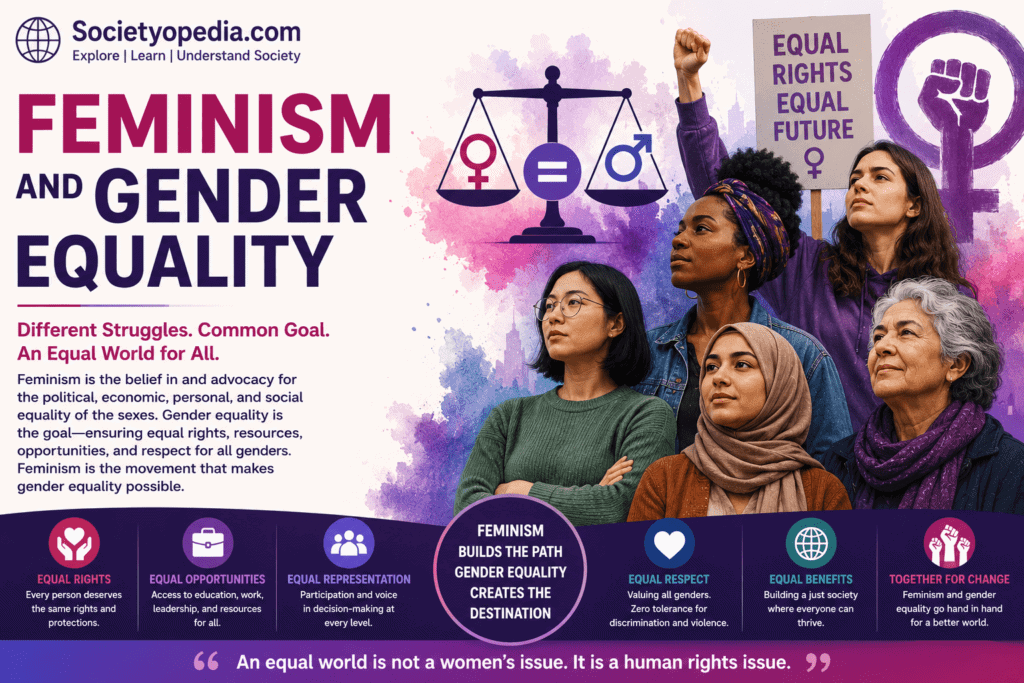
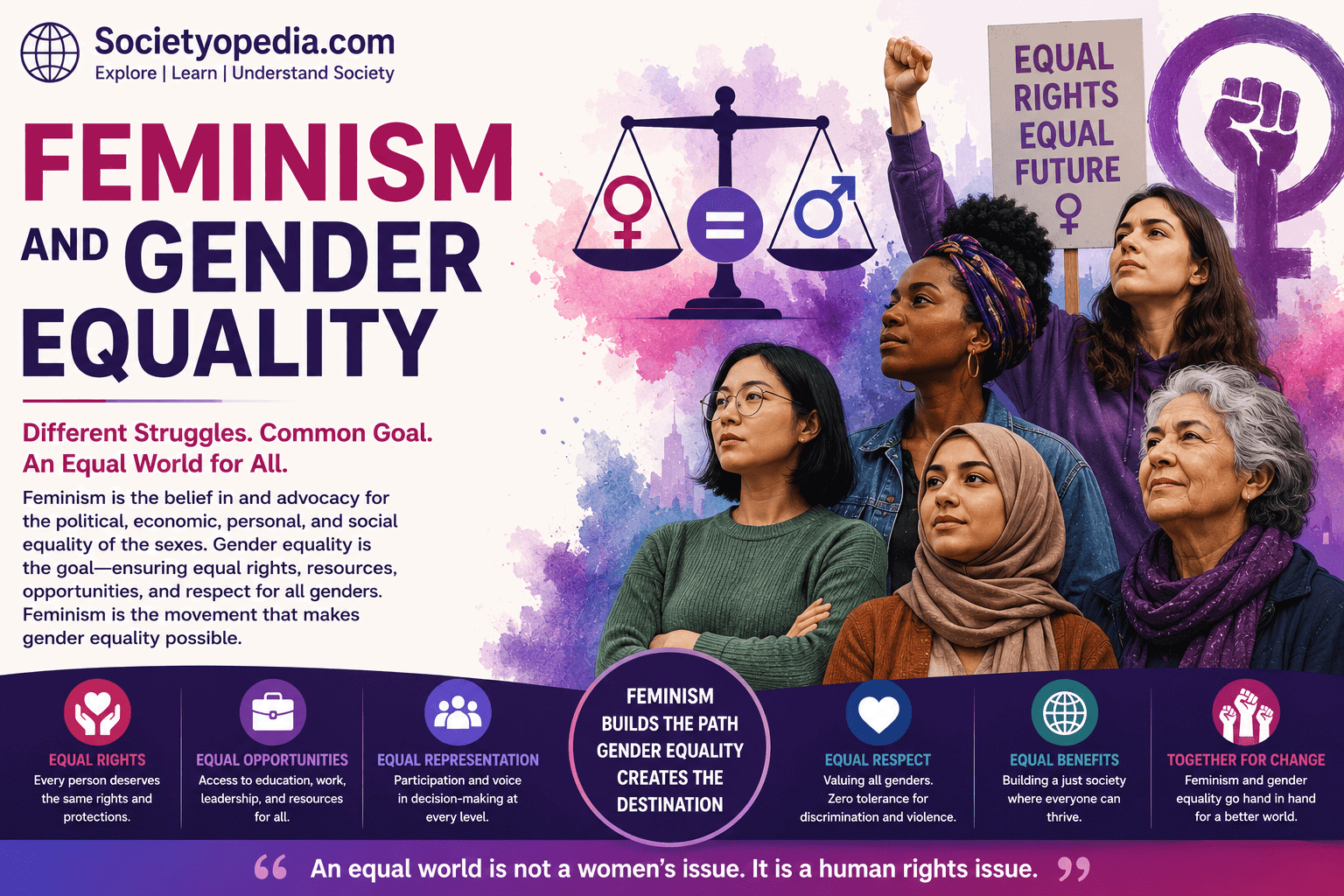
Feminism and gender equality are closely connected concepts in sociology and gender studies. Feminism refers to a broad collection of social movements, ideas, and theories concerned with addressing gender-based inequality and improving women’s rights and opportunities. Gender equality refers to a social condition in which people are not disadvantaged because of their gender and have equal rights, opportunities, responsibilities, and access to resources.
Although feminism includes many different perspectives, most feminist approaches share a concern with understanding and reducing gender inequality.
Feminism has influenced debates about education, employment, political participation, family relationships, legal rights, healthcare, and social expectations. It has also encouraged societies to question traditional assumptions about what women and men should be allowed or expected to do.
What Is Feminism?
Feminism is a collection of social, political, and intellectual movements that seek to challenge gender inequality and promote greater equality and freedom for women and other groups affected by gender-based discrimination.
Feminism is not a single theory.
There are different feminist perspectives, including:
- Liberal feminism
- Radical feminism
- Marxist feminism
- Socialist feminism
- Intersectional feminism
These perspectives may disagree about the causes of inequality and the best methods for achieving change.
However, they share an interest in understanding gender relations and challenging unjust forms of inequality.
What Is Gender Equality?
Gender equality means that people should have equal rights, opportunities, responsibilities, and access to resources regardless of gender.
Gender equality does not necessarily mean that everyone must be identical.
Women and men may have different personal preferences, circumstances, or biological characteristics.
The principle of gender equality is that these differences should not be used to justify unfair treatment or unequal opportunities.
Feminism and Gender Equality: The Connection
The relationship between feminism and gender equality can be summarized as:
Feminism → identifies and challenges gender inequality → promotes gender equality
Feminist movements have historically challenged barriers that prevented women from fully participating in social life.
These barriers have included:
- limited educational opportunities;
- political exclusion;
- employment discrimination;
- unequal legal rights;
- economic dependence;
- gender stereotypes;
- gender-based violence.
Gender equality is therefore one of the major goals associated with feminist thought and activism.
Why Is Feminism Important for Gender Equality?
Feminism is important because it draws attention to inequalities that may otherwise appear normal or natural.
For example, if women are expected to perform most household work simply because they are women, feminism asks:
Why should domestic responsibilities automatically depend on gender?
Similarly, if women receive fewer opportunities for leadership, feminism asks:
What social structures and expectations produce this inequality?
These questions encourage society to examine the causes of unequal outcomes.
Feminism and Equal Rights
Equal rights are a fundamental component of gender equality.
Feminist movements have historically advocated for women’s equal rights in areas such as:
- education;
- voting;
- employment;
- property;
- political participation;
- legal protection.
The principle is that women should be recognized as full and equal members of society.
Types of Feminism: Major Feminist Approaches and Their Differences
Feminism and Education
Education is one of the most important areas of gender equality.
Feminist perspectives challenge barriers that prevent girls and women from obtaining education.
Gender equality in education involves:
- equal access to schools;
- equal access to higher education;
- safe learning environments;
- equal encouragement in academic subjects;
- freedom from gender stereotypes.
Education can improve access to employment and economic independence.
It can also increase women’s ability to participate in public and political life.
Feminism and Employment
Gender equality in employment means that women and men should have fair opportunities to:
- obtain jobs;
- receive appropriate wages;
- receive promotions;
- develop careers;
- participate in leadership;
- access professional training.
Feminist approaches challenge employment practices that disadvantage people because of gender.
However, employment equality involves more than simply allowing women to enter the workforce.
Workplace policies, childcare, transportation, safety, working hours, and family responsibilities can also influence women’s participation.
Liberal Feminism: Definition, Principles, History, Goals and Importance
Feminism and the Gender Pay Gap
The gender pay gap refers to differences in average earnings between women and men.
The causes can be complex and may include:
- occupational segregation;
- differences in working hours;
- career interruptions;
- caregiving responsibilities;
- concentration in lower-paid occupations;
- discrimination;
- differences in access to leadership.
Feminist analysis examines how social expectations and institutional practices contribute to these patterns.
Gender equality therefore requires attention not only to wages but also to the conditions that shape employment and career progression.
Intersectional Feminism: Definition, Principles, Examples and Importance
Feminism and Political Participation
Political participation is another important dimension of gender equality.
Women should have opportunities to:
- vote;
- contest elections;
- hold public office;
- participate in political organizations;
- contribute to policymaking.
Women’s political participation is important because decisions made by governments affect issues such as:
- education;
- healthcare;
- employment;
- family policy;
- social protection;
- gender-based violence.
Feminist movements have therefore emphasized women’s political citizenship and representation.
Feminism and the Family
Feminism also examines gender relations within families.
Traditional expectations may assign:
Women → caregiving and domestic work
Men → economic provision and decision-making
Feminist perspectives question whether these responsibilities should automatically be divided according to gender.
Gender equality within families can involve:
- shared household responsibilities;
- shared childcare;
- joint financial decision-making;
- equal educational opportunities;
- respect for individual choices.
Radical Feminism: Definition, Principles, Ideas, History and Importance
Feminism and Unpaid Domestic Work
Domestic work is often unpaid but socially necessary.
It includes:
- cooking;
- cleaning;
- childcare;
- caring for elderly relatives;
- household management.
Feminist scholars have highlighted the importance of recognizing this work.
If women perform most unpaid domestic labor, they may have less time for:
- education;
- employment;
- political participation;
- recreation;
- professional development.
This creates an important connection between household labor and gender equality.
Feminism and Gender Roles
Gender roles are expectations about how people should behave based on gender.
Examples include assumptions that:
- women should be nurturing;
- men should be strong;
- women should prioritize family;
- men should prioritize careers;
- women should be emotionally expressive;
- men should avoid showing vulnerability.
Feminism challenges rigid gender roles because they can restrict individual choices.
Gender equality allows people greater freedom to develop their abilities without being limited by stereotypes.
Feminism and Gender Stereotypes
Gender stereotypes can influence decisions in education, employment, family life, and politics.
For example:
“Women are naturally better caregivers.”
“Men are better leaders.”
“Women are not suited for technical occupations.”
Such assumptions can influence how individuals are treated.
Feminist analysis challenges stereotypes by emphasizing individual ability rather than predetermined gender expectations.
Feminism and Gender Discrimination
Gender discrimination occurs when individuals are treated unfairly because of gender.
It may occur in:
- education;
- employment;
- politics;
- healthcare;
- family;
- legal institutions.
Examples include refusing to hire someone because of gender or limiting educational opportunities because of gender.
Feminist movements have worked to identify and challenge such practices.
Feminism and Gender-Based Violence
Gender-based violence is another major issue within feminist scholarship and activism.
It can include:
- domestic violence;
- sexual violence;
- sexual harassment;
- forced marriage;
- other forms of gender-related abuse.
Feminist approaches argue that violence against women should not be treated merely as a private matter.
Social attitudes, power relations, legal systems, economic dependence, and institutional responses can all influence the prevalence and consequences of gender-based violence.
Feminism and Women’s Economic Independence
Economic independence is closely connected to gender equality.
Women who have access to:
- education;
- employment;
- income;
- property;
- financial resources
may have greater ability to make independent decisions.
Economic independence can also influence women’s bargaining power within households.
However, economic independence alone does not eliminate all forms of gender inequality.
Cultural expectations, unpaid care responsibilities, discrimination, and institutional barriers may continue to affect women’s lives.
Feminism and Social Change
Feminism has contributed to social change by challenging assumptions about gender.
Social change can occur through:
Awareness
↓
Questioning traditional norms
↓
Collective action
↓
Institutional reform
↓
Changes in social attitudes
For example, changing attitudes toward women’s education can contribute to greater female participation in schools and universities.
Feminism and Legal Reform
Feminist movements have often supported legal reforms addressing:
- discrimination;
- political rights;
- employment;
- education;
- violence;
- harassment;
- property rights.
Legal reform can provide important protections.
However, feminist scholars also emphasize that laws alone may not eliminate inequality if social norms and institutional practices continue to disadvantage women.
Feminism and Intersectionality
Contemporary feminism increasingly recognizes that women’s experiences are diverse.
Gender intersects with:
- social class;
- ethnicity;
- disability;
- age;
- sexuality;
- nationality;
- geography.
This is the central concern of intersectional feminism.
For example, a wealthy urban woman and a low-income rural woman may both experience gender inequality but face very different barriers.
Therefore, gender equality policies should consider differences among women rather than treating women as a completely homogeneous group.
Different Feminist Approaches to Gender Equality
Different feminist theories explain gender equality in different ways.
Liberal Feminism
Focuses on:
Equal rights + Equal opportunities + Legal reform
Radical Feminism
Focuses on:
Patriarchy + Power + Gender oppression
Marxist Feminism
Focuses on:
Capitalism + Class + Labor
Socialist Feminism
Focuses on:
Capitalism + Patriarchy + Gender and class
Intersectional Feminism
Focuses on:
Gender + Class + Ethnicity + Disability + Other intersecting inequalities
Although their explanations differ, all provide important ways of understanding gender inequality.
Gender Equality Does Not Mean Gender Sameness
An important distinction is that gender equality does not mean that everyone must be identical.
People may have different:
- interests;
- abilities;
- responsibilities;
- life choices.
Equality means that gender should not be used as a justification for denying people rights or opportunities.
For example, gender equality does not require every person to choose the same career.
It requires that people have fair opportunities to pursue the career they choose.
Examples of Feminism Promoting Gender Equality
Equal Education
Supporting equal educational opportunities for girls and boys.
Equal Employment
Challenging discriminatory hiring practices.
Women’s Political Participation
Supporting women’s participation in political institutions.
Equal Pay
Addressing unjustified gender-based differences in compensation.
Shared Family Responsibilities
Encouraging more equal participation in childcare and household work.
Anti-Harassment Policies
Creating safer educational and workplace environments.
Leadership Opportunities
Removing barriers that prevent qualified women from reaching leadership positions.
Feminism and Gender Equality in Third World
Feminism and gender equality can be examined in Third World through issues such as:
- women’s education;
- female workforce participation;
- political representation;
- workplace discrimination;
- women’s mobility;
- unpaid domestic work;
- access to healthcare;
- gender-based violence;
- women’s economic independence.
However, gender experiences vary significantly according to social class, location, education, occupation, family structure, and other social conditions.
Therefore, gender equality initiatives need to consider the diversity of women’s experiences.
Challenges to Gender Equality
Despite progress in many societies, gender inequality continues to exist in different forms.
Common challenges include:
- gender stereotypes;
- unequal domestic responsibilities;
- workplace discrimination;
- unequal political representation;
- limited access to resources;
- gender-based violence;
- educational barriers;
- economic inequality.
These challenges demonstrate why gender equality remains an important issue in sociology and gender studies.
How Can Gender Equality Be Promoted?
Gender equality can be promoted through changes at several levels.
Education
Provide equal access to quality education and challenge gender stereotypes in schools.
Employment
Strengthen equal-opportunity policies and address discriminatory workplace practices.
Family
Encourage shared domestic and caregiving responsibilities.
Politics
Increase women’s opportunities for political participation and leadership.
Law
Strengthen legal protections against discrimination and gender-based violence.
Social Attitudes
Challenge stereotypes that restrict women’s and men’s choices.
Economic Opportunities
Expand access to employment, entrepreneurship, property, and financial resources.
Why Is Feminism Important?
Feminism is important because it provides frameworks for understanding and challenging gender inequality.
It asks fundamental sociological questions:
Why are some opportunities distributed differently according to gender?
How do gender norms develop?
How does power influence gender relations?
How do family and economic institutions reproduce inequality?
Why do different groups of women experience inequality differently?
These questions help researchers understand gender as a social issue rather than simply an individual problem.
Conclusion
Feminism and gender equality are closely connected concepts concerned with challenging gender-based inequality and promoting equal rights and opportunities.
Feminist perspectives have contributed to debates about education, employment, political participation, family, economic independence, legal rights, gender stereotypes, and gender-based violence.
However, feminism is not a single theory. Liberal, radical, Marxist, socialist, and intersectional feminists may explain the causes of gender inequality differently.
Understanding these differences is important because gender inequality is complex and can be influenced by multiple social institutions and structures.
Ultimately, gender equality means creating a society where gender does not unfairly limit people’s rights, opportunities, choices, or participation.
Feminist theory remains important because it provides both theoretical tools and practical questions for understanding how such equality can be achieved.