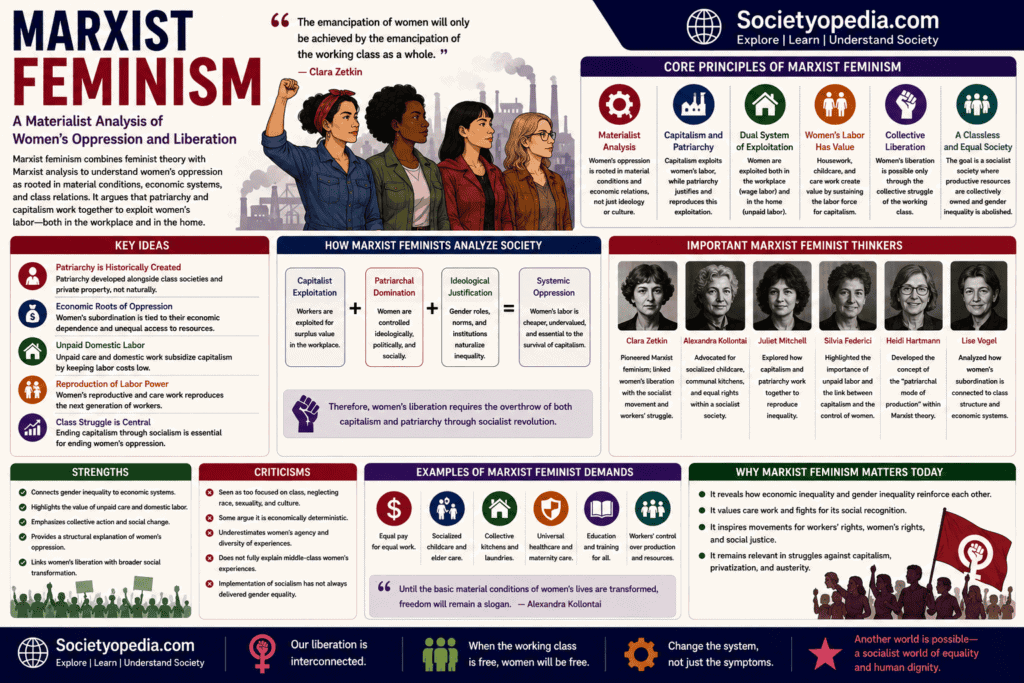
Marxist feminism is a major approach within feminist theory that examines gender inequality through the relationship between capitalism, class, labor, and women’s social position. It draws on ideas associated with Karl Marx and applies them to the study of women’s oppression and inequality.
Unlike approaches that focus mainly on legal discrimination or patriarchy, Marxist feminism emphasizes the importance of economic structures. It asks how capitalism, private property, paid employment, and unpaid domestic labor influence relationships between women and men.
One of its most important contributions is its attention to work that takes place inside the household. Cooking, cleaning, childcare, and caring for family members may not receive wages, but they are essential to the functioning of households and economies.
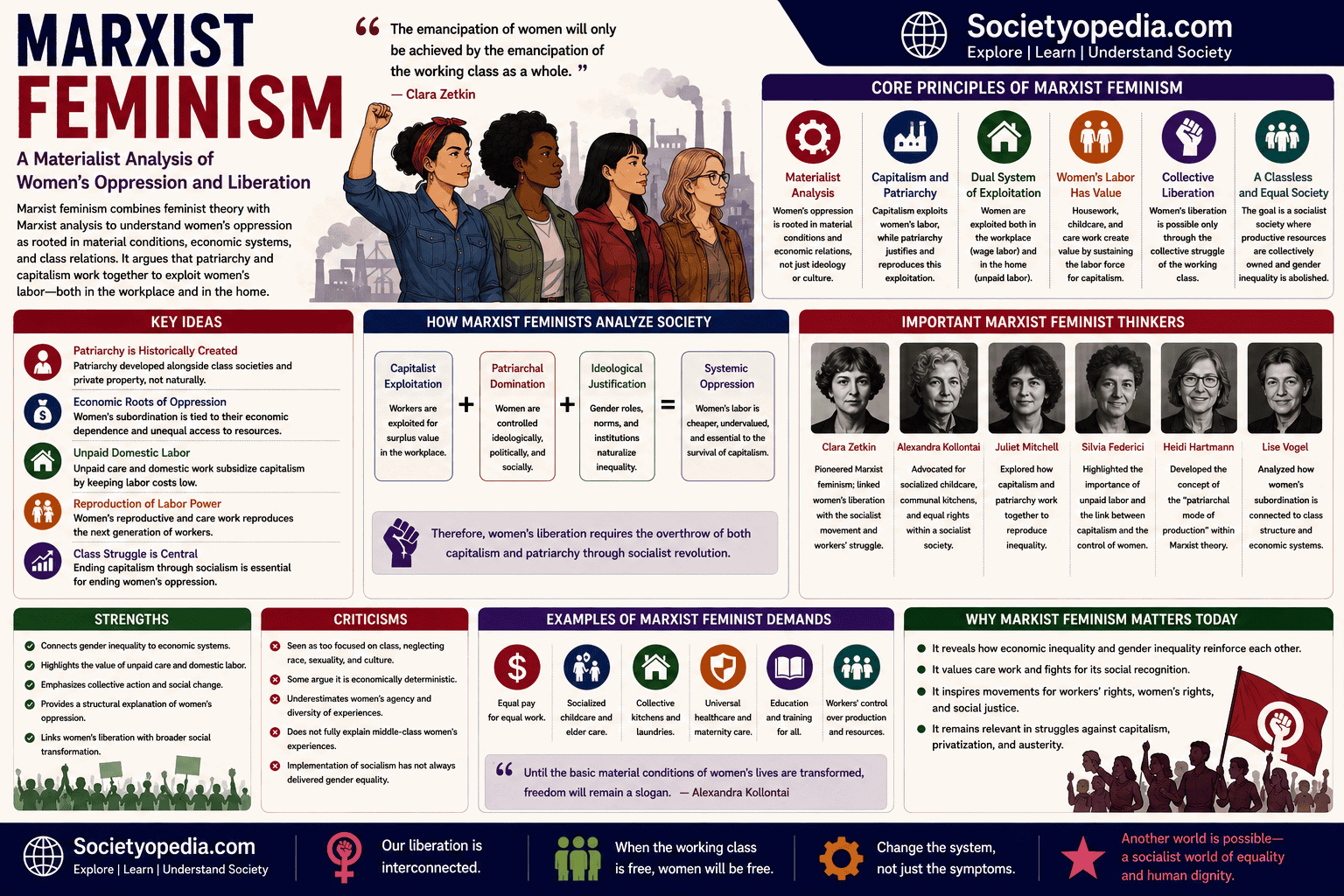
What Is Marxist Feminism?
Marxist feminism is a feminist perspective that explains gender inequality partly through capitalism, class relations, economic dependence, and the organization of paid and unpaid labor.
In simple terms:
Marxist feminism examines how economic systems and class relations contribute to women’s inequality.
It argues that gender inequality cannot always be understood separately from economic inequality.
For example, if women perform large amounts of unpaid household work while also participating in paid employment, Marxist feminist analysis asks how this arrangement is connected to the organization of the wider economy.
The Marxist Foundation
Marxist feminism developed from the broader Marxist analysis of society.
Karl Marx emphasized the importance of:
- economic production;
- class relations;
- labor;
- private property;
- exploitation;
- capitalism.
Marxist feminists extended these ideas to examine gender relations.
They asked an important question:
How does the economic organization of society affect women’s position?
This shifted feminist analysis toward questions about work, property, income, labor, and economic dependence.
Capitalism and Gender Inequality
Capitalism is central to Marxist feminist analysis.
A capitalist economy depends on the production of goods and services through labor.
Workers sell their labor in exchange for wages.
However, people also need to be cared for, fed, educated, and supported so that they can participate in economic production.
Much of this work occurs within households.
Marxist feminists examine how this unpaid reproductive labor supports the wider economic system.
What Is Reproductive Labor?
In Marxist feminist theory, reproductive labor generally refers to the work required to maintain and reproduce human life and the labor force.
It includes activities such as:
- cooking;
- cleaning;
- childcare;
- caring for sick family members;
- caring for elderly relatives;
- household management;
- emotional support.
This work may not produce a direct wage, but it is socially and economically necessary.
For example, workers need food, rest, childcare, and care before they can participate in paid employment.
Paid and Unpaid Labor
One of the central concerns of Marxist feminism is the relationship between paid labor and unpaid labor.
Paid labor occurs in workplaces where people receive wages.
Unpaid labor often occurs within households.
Historically, women have performed a disproportionate share of unpaid domestic work in many societies.
Marxist feminists argue that this division of labor has important economic consequences.
A simplified example is:
Paid worker → earns wages
Household → provides unpaid care and domestic labor
Economy → receives a worker capable of continuing paid employment
This creates a relationship between household labor and the wider economic system.
Economic Dependence
Economic dependence is another important concept.
If one partner earns most of the household income while the other performs unpaid domestic labor, the economically dependent partner may have less control over financial resources.
This can influence:
- decision-making;
- bargaining power;
- independence;
- access to property;
- ability to leave an unhealthy relationship.
Marxist feminist analysis therefore connects household economics with gender relations.
Types of Feminism: Major Feminist Approaches and Their Differences
Women and the Division of Labor
The gender division of labor refers to the way societies distribute different types of work according to gender.
For example, societies may traditionally associate:
Women → childcare, cooking, cleaning, caregiving
Men → paid employment, economic provision, leadership
Marxist feminism examines how this division develops and how it interacts with economic systems.
The important question is not simply whether men and women perform different tasks.
It is:
Why are particular types of work assigned to particular genders, and who benefits from this arrangement?
Domestic Work and Its Economic Value
Household work is often described as “unproductive” because it does not directly generate wages.
Marxist feminists challenge this narrow understanding.
Consider childcare.
A parent may spend several hours:
- feeding a child;
- preparing meals;
- helping with schoolwork;
- cleaning;
- providing emotional support.
Although this work is unpaid, it contributes to the development and maintenance of future workers and household members.
This is why feminist economists and sociologists have paid considerable attention to the economic value of unpaid care work.
Marxist Feminism and the Family
The family is an important institution in Marxist feminist analysis.
The household can provide essential services without requiring employers to directly pay for them.
For example, workers return home after paid employment and receive:
- food;
- cleaning;
- emotional support;
- childcare;
- rest;
- household management.
When much of this work is performed without wages, the household contributes to the reproduction of labor without the same direct cost to employers.
This is one reason Marxist feminists examine the family in relation to capitalism.
Liberal Feminism: Definition, Principles, History, Goals and Importance
Marxist Feminism and Marriage
Marriage can also be examined through economic relationships.
Questions include:
- Who earns the income?
- Who performs unpaid labor?
- Who owns property?
- Who controls household resources?
- How is domestic work divided?
- How does economic dependence affect decision-making?
The Marxist feminist approach therefore views marriage not only as an emotional or cultural relationship but also as a social and economic arrangement.
Marxist Feminism and Women’s Employment
Women’s participation in paid employment has changed significantly in many societies.
However, entering paid employment does not automatically eliminate domestic responsibilities.
Women may experience what is sometimes described as a double burden:
Paid employment + unpaid household labor
For example, a woman may work eight hours outside the home and then spend several additional hours preparing meals, cleaning, and caring for children.
Marxist feminist analysis examines how the combination of paid and unpaid labor can reproduce gender inequality.
The Double Burden
The concept of the double burden is particularly important for understanding working women.
A woman may simultaneously be:
Worker
and
Caregiver
This can influence:
- career advancement;
- working hours;
- income;
- occupational choices;
- stress;
- professional opportunities.
Marxist feminism therefore emphasizes that workplace equality cannot always be separated from household labor.
Marxist Feminism and Capitalist Exploitation
Marxist feminist analysis considers exploitation at multiple levels.
Workers can be economically exploited through their relationship with employers.
Women may also experience gendered exploitation through unpaid household labor.
This creates a complex relationship between:
Class exploitation + Gender inequality
Marxist feminism therefore argues that understanding women’s position requires attention to both economic production and social reproduction.
Social Reproduction
The concept of social reproduction has become increasingly important in Marxist feminist scholarship.
Social reproduction refers broadly to the processes through which people and communities are maintained and reproduced.
It includes:
- childcare;
- education;
- healthcare;
- household labor;
- caring for dependents;
- maintaining daily life.
These activities make participation in economic production possible.
For example:
Childcare → enables parents to work
Cooking → maintains household members
Healthcare → maintains workers’ capacity
Education → prepares future workers
Marxist feminist analysis asks who performs this work and who bears its costs.
Radical Feminism: Definition, Principles, Ideas, History and Importance
Marxist Feminism and Social Class
Class is fundamental to Marxist feminism.
The experiences of women are not identical across social classes.
For example, a wealthy woman may be able to employ domestic workers to perform childcare and cleaning.
A low-income woman may have to perform these tasks herself while also working for wages.
Therefore, gender inequality can interact with economic inequality.
This demonstrates why Marxist feminism considers both gender and class.
Marxist Feminism and Women’s Economic Independence
Economic independence is an important part of gender equality.
Access to:
- employment;
- wages;
- property;
- financial resources;
- education
can increase women’s ability to make independent decisions.
However, Marxist feminists argue that simply entering the labor market does not necessarily eliminate inequality.
The organization of work and household responsibilities also matters.
Marxist Feminism vs Liberal Feminism
The difference between Marxist and liberal feminism is particularly important.
| Liberal Feminism | Marxist Feminism |
|---|---|
| Equal rights and opportunities | Class and economic structures |
| Legal discrimination | Capitalism and labor |
| Individual freedom | Economic relationships |
| Institutional reform | Economic and social transformation |
| Equal employment opportunities | Paid and unpaid labor |
| Legal equality | Class and gender inequality |
Example
Suppose women earn less than men.
A liberal feminist may focus on:
- discriminatory hiring;
- unequal pay;
- promotion practices;
- anti-discrimination laws.
A Marxist feminist may additionally ask:
- How is labor organized?
- Why are women concentrated in lower-paid occupations?
- Who performs unpaid household labor?
- How does capitalism benefit from unpaid care work?
- How does class affect women’s opportunities?
Marxist Feminism vs Radical Feminism
These approaches also have different primary focuses.
Radical feminism → patriarchy and gender power
Marxist feminism → capitalism, class, and economic relations
A radical feminist might emphasize male dominance within family and sexuality.
A Marxist feminist might emphasize the economic organization of family and labor.
Both recognize gender inequality, but they emphasize different underlying structures.
Socialist Feminism and Marxist Feminism
Marxist feminism influenced the development of socialist feminism.
The two approaches overlap considerably, but socialist feminism generally attempts to integrate the analysis of capitalism and patriarchy more explicitly.
Marxist feminism emphasizes class and economic structures.
Socialist feminism argues that both economic and patriarchal structures must be analyzed together.
This distinction is important when studying different feminist theories.
Socialist Feminism: Definition, Principles, Patriarchy, Capitalism and Gender Inequality
Marxist Feminism and Intersectionality
Contemporary analysis recognizes that class and gender are not the only factors affecting women’s experiences.
Gender may intersect with:
- ethnicity;
- race;
- disability;
- age;
- sexuality;
- nationality;
- rural or urban location.
Intersectional approaches therefore extend Marxist feminist analysis by examining how multiple social inequalities interact.
For example, two working-class women may still have different experiences because of ethnicity, disability, geographical location, or other social factors.
Marxist Feminism and Domestic Labor
Domestic labor remains one of the most important subjects for Marxist feminist analysis.
Consider household activities such as:
Cooking
↓
Cleaning
↓
Childcare
↓
Care of dependents
↓
Maintenance of household
Much of this work is unpaid.
Marxist feminist analysis asks why this socially necessary work has historically been undervalued and disproportionately assigned to women.
Marxist Feminism and the Gender Pay Gap
The gender pay gap can also be examined from a Marxist feminist perspective.
Differences in earnings may be influenced by:
- occupational segregation;
- unequal access to leadership;
- career interruptions;
- unpaid caregiving;
- part-time employment;
- discrimination.
Marxist feminism emphasizes how the organization of labor and the distribution of economic resources contribute to these differences.
Marxist Feminism and Globalization
Global economic changes have also influenced feminist analysis.
Women participate extensively in global labor markets, including:
- manufacturing;
- agriculture;
- domestic work;
- service industries;
- healthcare;
- care work.
Marxist feminist approaches may examine how global economic systems depend on relatively low-paid labor, including women’s labor.
This raises questions about:
- wages;
- working conditions;
- migration;
- care work;
- economic inequality.
Marxist Feminism in Sociology
Marxist feminism is particularly useful in sociology because it connects gender with major social institutions.
It can be applied to:
- family;
- economy;
- employment;
- education;
- social class;
- labor markets;
- globalization;
- social reproduction.
It helps sociologists understand that gender inequality is not only cultural but can also be deeply connected to the organization of economic life.
Strengths of Marxist Feminism
It Highlights Economic Structures
Marxist feminism shows how economic systems influence gender relations.
It Recognizes Unpaid Labor
It draws attention to domestic and caregiving work that is often excluded from conventional measures of economic production.
It Connects Family and Economy
It demonstrates that household life and economic production are interconnected.
It Explains Class Differences
It recognizes that women from different economic classes may experience gender inequality differently.
It Highlights Social Reproduction
It demonstrates how unpaid care and household labor contribute to the functioning of society.
Criticisms of Marxist Feminism
It May Overemphasize Capitalism
Critics argue that not all gender inequality can be explained through capitalism.
Patriarchal traditions, culture, sexuality, religion, and other factors can also influence gender relations.
It May Underestimate Gender-Specific Power
Radical feminists argue that male power cannot always be reduced to economic class relations.
It Can Focus Heavily on Economic Structures
Some feminist scholars argue that individual identity, culture, and personal experiences require greater attention.
It May Not Fully Explain Differences Among Women
Class is important, but women’s experiences can also differ according to ethnicity, disability, sexuality, nationality, and other social positions.
These criticisms helped encourage more intersectional and multidimensional approaches.
Examples of Marxist Feminist Analysis
Example 1: Childcare
A Marxist feminist may ask who performs childcare and how unpaid childcare allows other household members to participate in paid employment.
Example 2: Housework
If women perform most household work without wages, Marxist feminism examines the economic significance of this unpaid labor.
Example 3: Low-Paid Occupations
If women are concentrated in low-paid service or care occupations, Marxist feminist analysis examines how gender and economic structures interact.
Example 4: Working Mothers
If women work for wages but remain primarily responsible for domestic labor, Marxist feminism examines the resulting double burden.
Marxist Feminism in Pakistan
Marxist feminist concepts can be applied to several gender and economic issues in Pakistan.
Researchers can examine:
- women’s labor-force participation;
- unpaid domestic work;
- agricultural labor;
- informal employment;
- domestic workers;
- female healthcare workers;
- occupational segregation;
- women’s economic dependence;
- access to property and financial resources.
For example, women’s unpaid household labor can be examined not simply as a family responsibility but as an economically and socially important form of labor.
Similarly, women working in low-paid informal occupations can be studied through the interaction between gender and class.
Why Is Marxist Feminism Important?
Marxist feminism is important because it expands the study of gender inequality beyond attitudes and individual discrimination.
It asks us to consider:
- Who owns resources?
- Who works for wages?
- Who performs unpaid work?
- Who controls economic decisions?
- How are workers reproduced and maintained?
- How does class influence women’s experiences?
These questions demonstrate that economic structures and gender relations are deeply connected.
Conclusion
Marxist feminism is a major feminist perspective that examines gender inequality through capitalism, class, labor, economic dependence, and social reproduction.
One of its most important contributions is its recognition that unpaid domestic and care work has social and economic value. Cooking, cleaning, childcare, and other household activities help maintain families and support participation in paid employment.
Marxist feminism also explains how women’s experiences can differ according to social class and economic position.
However, critics argue that capitalism alone cannot explain all forms of gender inequality. Patriarchy, culture, sexuality, race, ethnicity, disability, and other social factors can also shape women’s experiences.
For sociology and gender studies, Marxist feminism remains valuable because it connects gender, class, work, family, and economic structures and demonstrates that gender inequality is closely related to the organization of social and economic life.