Gender inequality has consequences that extend far beyond differences between women and men. When people have unequal access to education, employment, income, healthcare, political participation, social resources, or decision-making because of gender, the effects can influence individuals, families, communities, institutions, and entire societies.
The effects of gender inequality are therefore an important area of study in sociology and gender studies. Gender inequality can limit individual opportunities while also reducing the social and economic resources available to communities. For example, unequal access to education can affect employment opportunities later in life, while unequal responsibility for unpaid care can reduce women’s participation in paid employment and public life. UN Women identifies discrimination, limited access to resources, and unequal unpaid care responsibilities as important factors connecting gender inequality with poverty and economic exclusion.
Gender inequality is also interconnected. Inequality in one area can produce disadvantages in another. Limited education can restrict employment opportunities; restricted employment can reduce income; lower income can reduce access to resources; and economic dependence can affect decision-making within families.
Understanding these effects helps explain why gender equality is not simply an issue concerning individual fairness but an important component of social development.
What Are the Effects of Gender Inequality?
The effects of gender inequality are the social, economic, educational, political, health-related, and personal consequences that result when people do not have equal opportunities, rights, resources, responsibilities, or power because of gender.
These effects can be direct or indirect.
For example, refusing someone employment because of gender is a direct form of unequal treatment. However, a society may also produce indirect inequality when cultural expectations place most unpaid childcare responsibilities on women, reducing their time for paid employment and career advancement.
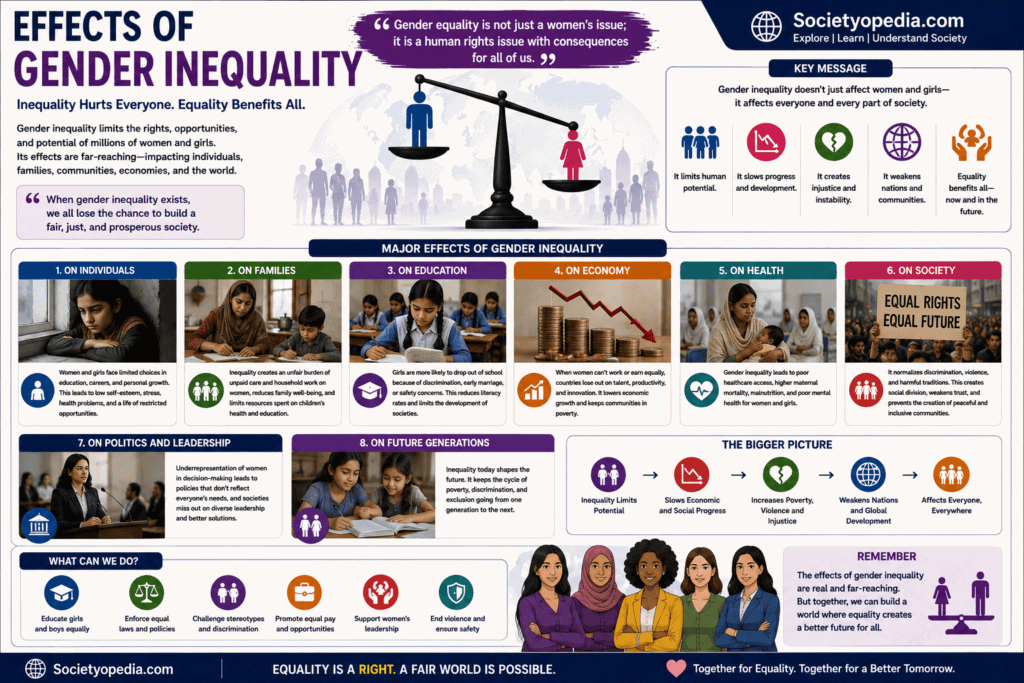
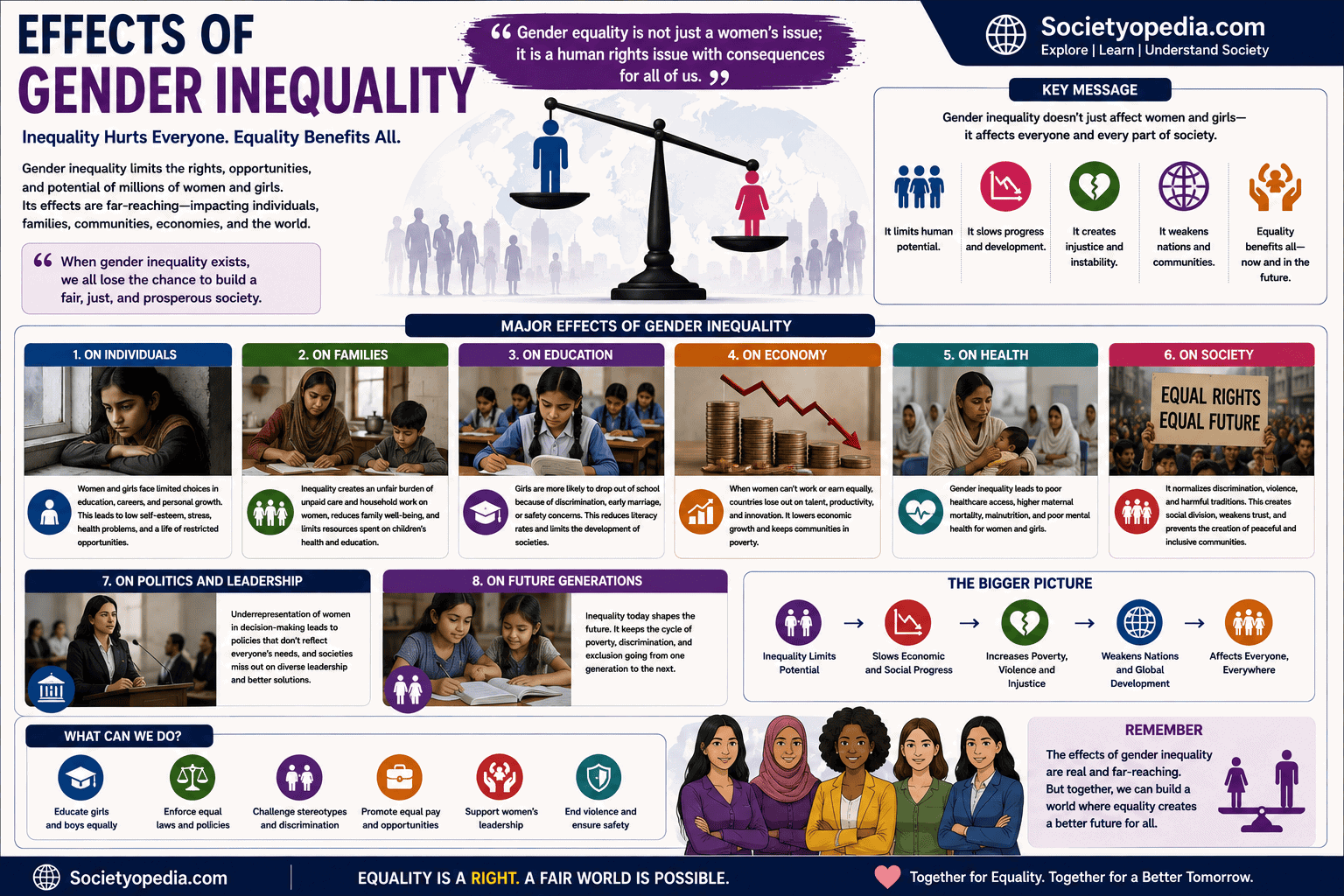
Major effects of gender inequality include:
- limited educational opportunities;
- reduced employment opportunities;
- income inequality;
- increased poverty;
- unequal distribution of unpaid work;
- reduced political participation;
- restricted decision-making power;
- health inequalities;
- psychological and social pressures;
- occupational segregation;
- reinforcement of gender stereotypes;
- reduced economic development;
- intergenerational inequality.
These effects often overlap rather than occurring separately.
Effects of Gender Inequality on Education
Education is one of the most important areas affected by gender inequality.
When girls have limited access to education, they may have fewer opportunities to acquire knowledge, skills, qualifications, and professional credentials.
Educational inequality can affect the entire life course. A person who cannot complete secondary or higher education may have fewer employment opportunities and may remain dependent on family members or informal economic activities.
Education also influences political participation, social mobility, health knowledge, and decision-making.
Gender inequality in education can therefore reproduce inequality across generations.
At the same time, unequal educational opportunities can affect families and communities. When girls and women have greater access to quality education, they can contribute more extensively to household income, professional life, community participation, and social development.
Gender Inequality Examples: Real-Life Examples in Society, Education, Work and Family
Effects on Employment Opportunities
Gender inequality can restrict access to employment and career advancement.
Women may be concentrated in certain occupations or sectors while being underrepresented in senior leadership and decision-making positions. Occupational segregation can limit career choices and contribute to differences in income and professional status.
Workplace discrimination can also affect recruitment, promotion, training opportunities, and job security.
These disadvantages can accumulate throughout a person’s career.
For example, a woman who is denied a promotion early in her career may subsequently lose higher earnings, professional experience, and access to senior positions. Over time, repeated disadvantages can produce substantial differences in career outcomes.
Current global evidence continues to show a substantial employment gap between women and men. UN Women reports that in 2024, 46.4 percent of working-age women were employed compared with 69.5 percent of men, illustrating the continuing economic consequences of gendered barriers.
Effects on Income and the Gender Pay Gap
Gender inequality can contribute to differences in income.
Women may earn less overall because of occupational segregation, unequal access to leadership positions, career interruptions, differences in working hours, unpaid care responsibilities, and discriminatory practices.
Income inequality has consequences beyond the workplace.
Income determines access to housing, education, healthcare, savings, transportation, technology, and other resources.
Therefore, persistent income differences can contribute to broader economic inequality between women and men.
Gender inequality in income can also affect economic security later in life because lower lifetime earnings may result in lower savings and retirement benefits.
Gender and Social Change: Meaning, Relationship, Examples and Importance
Effects on Poverty
One of the major economic consequences of gender inequality is increased vulnerability to poverty.
When women have limited access to education, decent employment, property, financial resources, credit, or social protection, their ability to respond to economic difficulties can be reduced.
UN Women identifies discrimination in employment, limited access to financial assets and resources, unequal unpaid care responsibilities, and stereotypes as factors contributing to women’s poverty.
The relationship between gender inequality and poverty can become a cycle.
Limited education may reduce employment opportunities. Limited employment can produce lower income. Lower income can restrict access to resources, which may then make it more difficult to pursue education or economic opportunities.
This is why reducing gender inequality is also important for reducing poverty.
Effects of Unequal Unpaid Care Work
Household and caregiving responsibilities are essential forms of work, even when they are unpaid.
Cooking, cleaning, childcare, elder care, and household management require substantial amounts of time and effort.
When these responsibilities are distributed disproportionately to women, they can create time poverty.
Time poverty occurs when individuals have insufficient discretionary time because of extensive work and care responsibilities.
Recent UN Women research describes gendered time allocation as an important dimension of social and economic inequality and identifies time poverty as a measurable aspect of gender inequality.
Unequal unpaid care can reduce women’s opportunities to:
- participate in paid employment;
- pursue education;
- develop careers;
- participate in politics;
- engage in community activities;
- rest and enjoy leisure;
- develop professional networks.
The problem is therefore not caregiving itself. The inequality arises when caregiving responsibilities are distributed unfairly and are not adequately supported by families, workplaces, communities, or public policies.
Effects on Family Life
Gender inequality can influence family relationships and household decision-making.
Traditional gender roles may assign men greater authority over financial decisions while women are expected to manage domestic responsibilities.
Such arrangements can create unequal power within households.
When one person has greater control over income, property, mobility, or important decisions, other family members may have less bargaining power.
Gender inequality can also affect relationships between parents and children. Children learn gender expectations by observing how responsibilities and authority are distributed within their families.
Consequently, unequal family arrangements can contribute to the reproduction of gender norms across generations.
Causes of Gender Inequality: Major Social, Cultural, Economic and Institutional Factors
Effects on Women’s Economic Independence
Economic independence is closely connected with access to income, employment, property, financial services, and economic decision-making.
When gender inequality restricts these resources, women may become more financially dependent on family members.
Economic dependence can limit people’s ability to make independent decisions concerning education, employment, residence, marriage, healthcare, and other aspects of life.
This does not mean that every woman without paid employment lacks autonomy. Many unpaid caregivers make important decisions and contribute significantly to household wellbeing.
However, unequal access to independent economic resources can increase vulnerability and reduce bargaining power.
Effects on Political Participation
Gender inequality can also affect political participation.
Political participation includes voting, political campaigning, membership in political organizations, holding public office, and influencing policy decisions.
When women are underrepresented in political institutions, fewer women may participate directly in decisions concerning laws, budgets, public services, education, employment, healthcare, and social protection.
Political representation does not automatically guarantee gender equality, but inclusive political participation can help ensure that diverse experiences and concerns are considered in policymaking.
Gender inequality in political power can therefore reinforce inequality in other areas of society.
Effects on Decision-Making Power
Gender inequality can affect decision-making at multiple levels.
At the household level, unequal power can influence decisions about children’s education, family finances, employment, healthcare, and major purchases.
At the workplace level, unequal representation can influence who makes organizational decisions.
At the political level, unequal representation can affect public policy.
Decision-making power is important because control over decisions often determines access to resources and opportunities.
When one gender has systematically less influence, inequality can become embedded in everyday social relationships.
Effects on Health
Gender inequality can have important consequences for health.
Unequal access to income, education, healthcare, nutrition, transportation, safe living conditions, and decision-making can influence health outcomes.
For example, economic dependence may make it more difficult for someone to independently access healthcare. Restrictions on mobility may also create barriers to obtaining medical services.
Gender expectations can affect men as well. Cultural ideas that men should be strong, avoid expressing vulnerability, or tolerate health problems may discourage some men from seeking appropriate support.
Health consequences therefore need to be examined in relation to broader gender norms and social structures.
UN Women continues to identify gender inequalities across health and well-being alongside disparities in education, employment, poverty, and political participation.
Effects on Psychological Well-Being
Gender inequality can also affect psychological and emotional well-being.
People may experience stress when social expectations restrict their choices or create unequal responsibilities.
Women who combine paid employment with disproportionate unpaid domestic work may experience considerable time pressure and work-family conflict.
Men may also experience pressure from expectations that they must be financially successful, emotionally strong, or primary providers.
These pressures demonstrate that gender inequality involves not only material resources but also social expectations concerning how people should behave.
However, psychological experiences vary considerably between individuals and social contexts, so they should not be reduced to gender alone.
Effects on Social Mobility
Social mobility refers to movement between different social positions, particularly in terms of education, occupation, income, and social status.
Gender inequality can restrict social mobility when people have unequal access to education, employment, property, professional networks, or economic resources.
For example, a girl who is prevented from completing higher education may have fewer opportunities to enter a professional occupation.
Similarly, a woman who leaves employment for unpaid caregiving may experience difficulty returning to the labor market at the same career level.
Gender inequality can therefore affect people’s ability to improve their socioeconomic position.
Effects on Occupational Choices
Gender stereotypes can influence career aspirations and occupational choices.
Children may receive messages about which professions are considered suitable for women or men.
Girls may be encouraged toward caring or traditionally feminine occupations, while boys may be encouraged toward technical, scientific, or leadership-oriented fields.
These expectations can influence subject selection and career planning long before individuals enter the labor market.
Occupational segregation can then reinforce economic inequality because different occupations may have different levels of pay, status, job security, and opportunities for advancement.
Effects on Leadership and Representation
Gender inequality can reduce women’s representation in leadership positions.
Leadership opportunities exist in government, business, education, science, media, civil society, and other organizations.
When leadership is culturally associated with masculinity, women may encounter stereotypes questioning their competence, authority, or suitability for senior roles.
Limited representation can also create a feedback effect. If young women rarely see women in certain leadership positions, they may receive fewer visible examples of such career possibilities.
Increasing diverse representation can therefore challenge traditional stereotypes and expand perceptions of who can become a leader.
Gender Inequality Definition: Meaning, Causes, Types and Examples
Effects on Social Development
Gender inequality affects not only individuals but also societies.
When a significant part of the population faces barriers to education, employment, economic participation, or decision-making, societies cannot fully utilize their available human resources.
Gender equality can contribute to broader economic and social development by expanding access to education, employment, entrepreneurship, leadership, and innovation.
UN Women describes gender equality as an important catalyst for reducing poverty and supporting sustainable development because equal access to opportunities and decision-making can produce broader economic and social benefits.
Gender equality is therefore not simply a matter of individual rights. It also has implications for economic productivity and social development.
Effects on Economic Growth
Gender inequality can create economic costs when people are prevented from fully participating in the labor market or from using their skills and education.
If qualified women cannot access employment or leadership positions, organizations may lose valuable skills and experience.
Similarly, when unpaid care responsibilities prevent women from participating in paid employment, the economy loses potential labor and productivity.
Greater gender equality can therefore expand the effective pool of talent available to organizations and economies.
Economic growth should not be viewed as the only reason for promoting gender equality, but the economic consequences demonstrate that gender inequality can affect society as a whole.
Effects on Children and Future Generations
Gender inequality can be transmitted across generations.
Children learn social expectations by observing parents, relatives, teachers, media, and other social influences.
If children grow up in environments where women have less authority or are expected to perform most unpaid domestic work, they may internalize these patterns.
Economic inequality can also have intergenerational consequences. Parents with limited income may have fewer resources to invest in children’s education, nutrition, and development.
Thus, gender inequality can reproduce both social attitudes and material disadvantages from one generation to another.
Effects on Men and Boys
A balanced understanding of gender inequality should also recognize that restrictive gender expectations can affect men and boys.
Cultural expectations may tell boys that they should be strong, competitive, emotionally controlled, financially successful, or willing to take risks.
These expectations can discourage emotional expression, caregiving, or help-seeking.
Men may also experience pressure to become primary providers even when economic circumstances make this difficult.
This does not mean that gender inequality affects all genders in identical ways. Different groups experience different advantages and disadvantages depending on the social context.
The broader point is that rigid gender systems can restrict people’s choices.
Effects on Social Relationships
Gender inequality can influence relationships between individuals.
When people internalize stereotypes about what women and men should be like, communication and expectations can become constrained.
For example, women may be expected to perform emotional and caregiving labor, while men may be expected to provide financial support and avoid vulnerability.
Such expectations can create misunderstandings and unequal responsibilities in families, friendships, workplaces, and other relationships.
More flexible gender norms can allow individuals to negotiate responsibilities according to their abilities, preferences, and circumstances rather than predetermined expectations.
Effects on Social Attitudes and Stereotypes
Gender inequality can reinforce the very stereotypes that helped produce it.
For example, if women are excluded from leadership positions, people may incorrectly interpret the absence of women as evidence that women are less capable of leadership.
Similarly, if men perform less unpaid care work because of cultural expectations, people may conclude that men are naturally less interested in caregiving.
This creates a self-reinforcing cycle.
Social expectations influence behavior, behavior produces unequal patterns, and those patterns can then be used to justify the original stereotypes.
Breaking this cycle requires changes in both attitudes and institutional practices.
Gender Inequality and Intersectionality
The effects of gender inequality are not experienced equally by everyone.
Gender intersects with social class, age, disability, ethnicity, geographical location, education, occupation, and other social factors.
For example, a highly educated woman living in an urban area may experience different barriers from a low-income woman living in a rural area.
Similarly, women with disabilities may encounter both gender-based and disability-related barriers.
The concept of intersectionality helps sociologists understand these overlapping experiences.
It reminds us that gender inequality should not be treated as a single identical experience for every woman or every man.
The Cycle of Gender Inequality
The different effects of gender inequality can form a cycle.
Limited education can reduce employment opportunities.
Limited employment can produce lower income.
Lower income can increase economic dependence.
Economic dependence can reduce decision-making power.
Reduced decision-making power can make it harder to challenge unequal family or social arrangements.
These arrangements can then influence children’s socialization, reproducing traditional gender expectations.
In this way, gender inequality can persist across generations unless social, economic, cultural, and institutional conditions change.
How Can the Effects of Gender Inequality Be Reduced?
Reducing the effects of gender inequality requires action across several areas.
Equal access to quality education can expand opportunities. Fair employment practices can improve career prospects. Equal pay policies can address income disparities. Affordable childcare and supportive family policies can reduce the unequal burden of unpaid care.
Political participation can increase representation, while legal protections can address discrimination and violence.
Changing social attitudes is equally important. Families, schools, media organizations, workplaces, and communities can challenge stereotypes and encourage people to pursue opportunities regardless of gender.
UN Women emphasizes investment in social protection, public services, education, healthcare, and care systems as part of addressing structural gender inequalities and poverty.
Conclusion
The effects of gender inequality extend across almost every major area of social life. Gender inequality can restrict education, employment, income, political participation, decision-making, health, social mobility, and economic independence.
It can also increase vulnerability to poverty and place unequal burdens of unpaid care on women. At the same time, restrictive gender norms can affect men and boys by creating expectations concerning masculinity, financial responsibility, emotional expression, and behavior.
Perhaps most importantly, the effects of gender inequality are interconnected. Disadvantages in education can influence employment; employment influences income; income influences economic independence; and economic independence can affect decision-making power.
Gender inequality can therefore become a cycle that reproduces itself across individuals, institutions, and generations.
However, these effects are not inevitable. Expanding educational opportunities, improving access to decent employment, reducing discrimination, supporting caregiving, strengthening social protection, encouraging political participation, and challenging restrictive gender norms can help reduce inequality.
Understanding the effects of gender inequality is therefore essential for understanding why gender equality matters not only for individuals but also for families, communities, economies, and society as a whole.