Gender and Society is a vary important concept. Gender is an important part of social life. It influences how people understand themselves, how they interact with others, and how societies organize relationships, responsibilities, opportunities, and expectations. From childhood, individuals learn ideas about what is considered appropriate behavior for women, men, and people with different gender identities. These ideas are shaped by family, culture, education, media, workplaces, peer groups, and other social institutions.
The relationship between gender and society is therefore central to sociology and gender studies. Society influences how gender is understood and expressed, while individuals can also reinforce, modify, or challenge existing gender expectations.
Understanding gender and society helps explain why certain behaviors are considered masculine or feminine, why gender roles differ across cultures, and why gender inequalities continue to exist in many societies.
What Is Gender?
Gender refers to the socially and culturally constructed meanings, roles, behaviors, expectations, and identities associated with being a woman, man, or another gender.
Gender is often distinguished from biological sex. Sex generally refers to biological and physiological characteristics, while gender concerns the social meanings attached to those characteristics.
For example, the belief that women should primarily take care of children while men should be responsible for earning income is a gender role. Such expectations are learned through social interaction rather than being automatically determined by biology.
Gender can influence people’s responsibilities, relationships, appearance, occupations, behavior, and access to social opportunities.
What Is Society?
Society is a structured group of people who share social relationships, institutions, cultural practices, values, norms, and systems of organization.
Families, schools, religious institutions, governments, workplaces, communities, and media are important parts of society.
Society provides individuals with rules and expectations that guide behavior. People learn what is considered acceptable or unacceptable through socialization and interaction with others.
Because gender is expressed within social relationships, it cannot be fully understood without examining society.
How Are Gender and Society Connected?
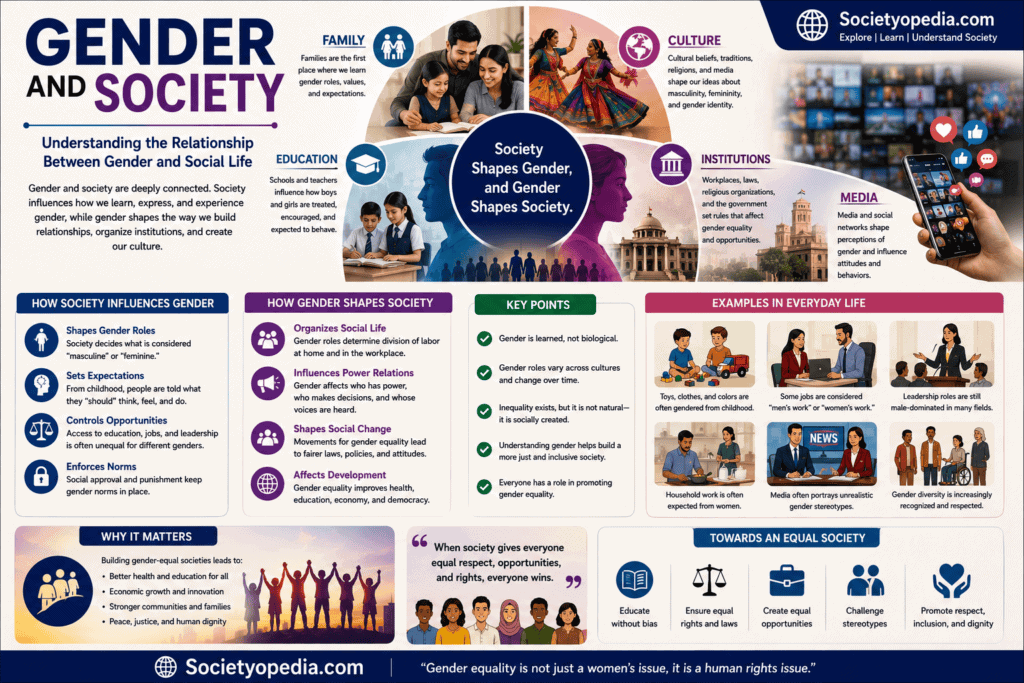
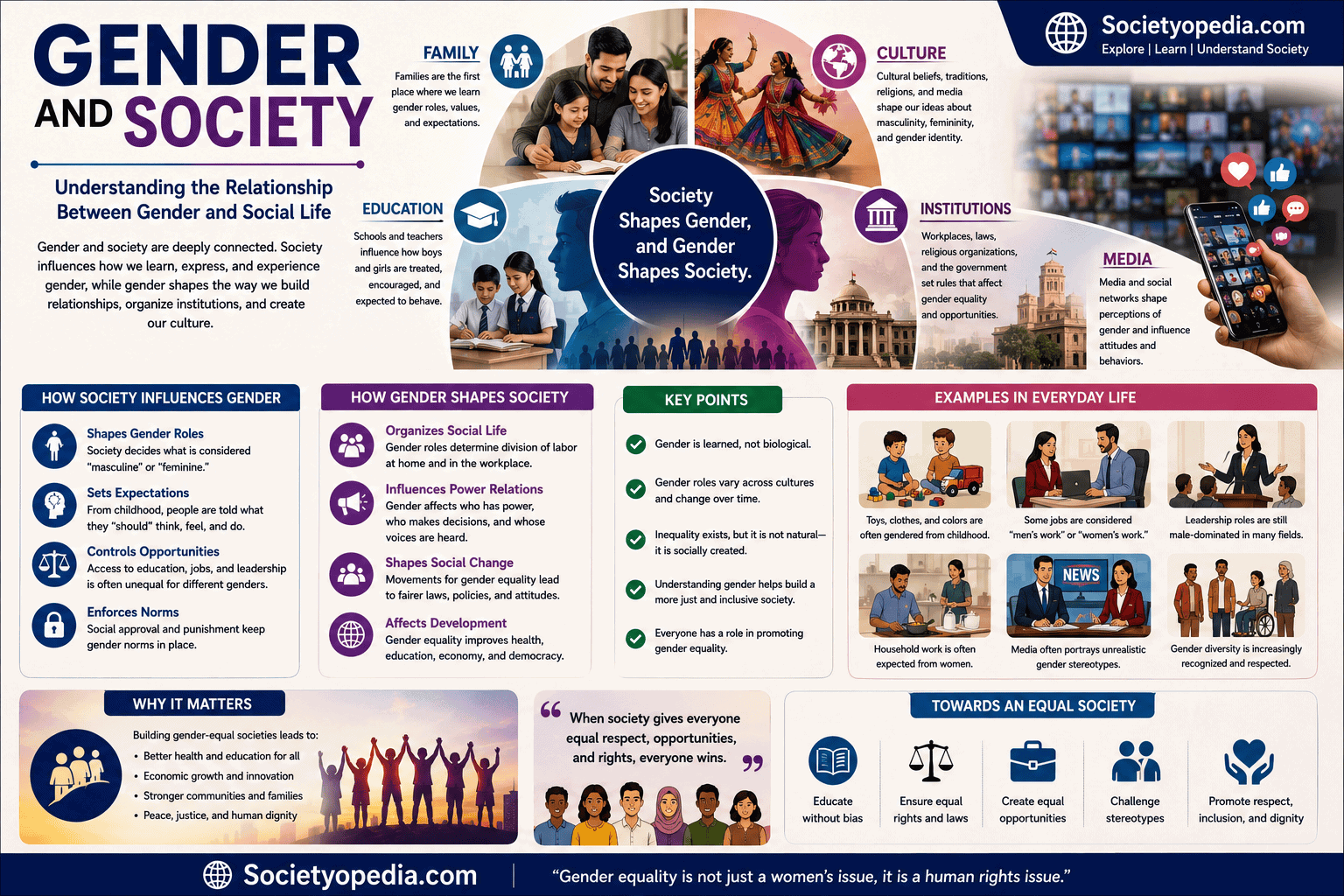
Gender and society have a reciprocal relationship. Society shapes gender expectations, but people can also influence society by accepting, modifying, challenging, or rejecting those expectations.
A child, for example, may learn that certain toys, colors, clothing, or activities are appropriate for boys or girls. These expectations can come from parents, teachers, relatives, friends, advertisements, television programs, and social media.
As individuals grow older, these expectations may influence educational choices, career decisions, family responsibilities, and interpersonal relationships.
At the same time, social change can transform gender expectations. Greater participation of women in higher education and professional employment, for example, has challenged the idea that women should be restricted to domestic responsibilities.
Gender is therefore both shaped by society and involved in the transformation of society.
Gender as a Social Institution
Gender operates across many social institutions. Social institutions are organized patterns of relationships and practices that meet important social needs.
The family, education system, economy, politics, religion, and media can all influence gender expectations.
These institutions do not always communicate identical messages. A family may encourage traditional gender roles while an educational institution promotes equal participation. Similarly, media representations may reproduce stereotypes while social movements challenge them.
The interaction of these institutions contributes to the way gender is understood within a society.
Gender and Family
The family is one of the first institutions through which individuals learn gender expectations.
Children observe how adults divide household responsibilities, make decisions, communicate with one another, and perform different forms of work. These observations can influence children’s understanding of appropriate gender behavior.
For example, if children consistently observe women performing cooking, cleaning, and childcare while men are expected to provide income, they may develop the idea that domestic work is naturally a woman’s responsibility.
However, family patterns vary considerably. In many families, men and women share domestic responsibilities, both parents participate in childcare, and household decisions are made jointly.
Changes in family structures and economic conditions have also contributed to changing gender roles. The increasing participation of women in paid employment, for instance, has encouraged greater discussion about the division of unpaid domestic labor.
Gender and Education
Education is another important institution in the relationship between gender and society.
Schools and universities can either reinforce traditional gender expectations or challenge them. Teachers may unintentionally treat students differently according to gender, while textbooks and classroom examples may reproduce traditional representations of women and men.
For example, presenting men primarily as scientists, political leaders, and professionals while presenting women mainly as mothers or caregivers can communicate implicit messages about appropriate gender roles.
At the same time, education can be a powerful mechanism for reducing gender inequality. Equal access to education can expand employment opportunities, increase economic independence, develop leadership skills, and challenge traditional stereotypes.
The educational experiences of girls and boys are therefore important for understanding broader patterns of gender inequality.
Gender and the Workplace
Gender also influences employment and working life.
Historically, many societies associated men with paid employment and women with unpaid domestic labor. Although these patterns have changed significantly, gender continues to influence occupational choices, workplace opportunities, leadership positions, and expectations about family responsibilities.
Women may face barriers related to discrimination, unequal opportunities, workplace harassment, limited career advancement, and difficulties balancing paid employment with unpaid care responsibilities.
Men can also experience gender expectations. For example, cultural expectations that men should be primary financial providers can create pressure to prioritize employment and income over caregiving.
Thus, gender affects the experiences of people across the labor market, although the specific effects differ between social groups and societies.
Gender and Culture
Culture plays a major role in shaping gender.
Culture includes values, beliefs, norms, traditions, language, symbols, customs, and practices shared by members of a society. These cultural elements communicate ideas about how people are expected to behave based on gender.
Ideas about appropriate clothing, family responsibilities, marriage, parenting, occupations, emotional expression, and social interaction can vary between cultures and historical periods.
For example, an occupation considered inappropriate for women in one society may be commonly accepted for women in another. Similarly, expectations about men’s involvement in childcare differ across societies.
This cultural variation demonstrates that many gender expectations are socially constructed rather than universal.
Gender and Media
Mass media and digital media are powerful sources of gender representation.
Television, films, advertisements, newspapers, websites, and social media can influence people’s perceptions of women, men, masculinity, femininity, beauty, relationships, careers, and family life.
When media repeatedly portrays women primarily as caregivers or objects of beauty and men primarily as strong leaders or providers, such representations can reinforce gender stereotypes.
However, media can also contribute to social change. Representations of women as scientists, political leaders, entrepreneurs, athletes, and professionals can challenge traditional assumptions.
Social media has further expanded opportunities for individuals and groups to discuss gender inequality, challenge stereotypes, share experiences, and organize social movements.
Therefore, media can both reproduce existing gender norms and provide a platform for challenging them.
Gender and Religion
Religion can also influence gender expectations, although the relationship between religion and gender varies greatly across societies, religious traditions, communities, and interpretations.
Religious beliefs and institutions may influence ideas about marriage, family responsibilities, modesty, parenting, leadership, and relationships between women and men.
It is important, however, not to assume that all members of a religious community interpret gender roles in the same way. Religious traditions can contain diverse interpretations, and individuals may negotiate religious teachings alongside changing social conditions.
From a sociological perspective, the important question is how religious beliefs, institutions, and interpretations interact with broader social structures.
Gender and Politics
Gender is closely connected with political power.
Political institutions determine laws, policies, rights, and access to decision-making. The representation of women and other gender groups in political institutions can therefore influence whose experiences and interests receive attention.
Historically, women in many societies had limited access to political participation. Expanding women’s political rights and representation has been an important aspect of broader struggles for gender equality.
Gender also affects political issues such as education, employment, healthcare, family policy, violence, and social protection.
The study of gender and politics therefore examines not only women’s participation in politics but also how political systems themselves can reproduce or challenge gender inequality.
Gender Socialization and Society
One of the strongest connections between gender and society can be seen through gender socialization.
Gender socialization is the process through which individuals learn the gender norms, expectations, behaviors, and values of their society.
Socialization begins early in life. Parents may give children different toys or encourage different activities. Teachers may communicate expectations about academic subjects and behavior. Peer groups can reward conformity to gender norms, while media can reinforce particular images of masculinity and femininity.
These processes help individuals understand the gender expectations surrounding them.
However, socialization does not mean that individuals simply accept everything they are taught. People interpret social expectations differently and may challenge or transform them.
Gender Norms and Social Expectations
Gender norms are shared expectations about how people should behave according to gender.
For example, a society may expect women to be nurturing, emotionally expressive, and responsible for household work, while expecting men to be strong, independent, competitive, and financially responsible.
These expectations can influence everyday behavior even when they are not formally written into laws.
People who conform to gender norms may receive social approval, while those who violate them may experience criticism, exclusion, or discrimination.
This shows how social control can operate through ordinary interactions.
Gender Stereotypes in Society
Gender stereotypes are generalized beliefs about the characteristics, abilities, and behaviors of women, men, and other gender groups.
Examples include the belief that women are naturally better caregivers, men are naturally better leaders, women are emotional, or men should not express vulnerability.
Stereotypes become problematic when they limit people’s choices or contribute to unequal treatment.
For instance, assuming that women are less suitable for leadership can affect hiring and promotion decisions. Similarly, assuming that men should not participate heavily in childcare can discourage fathers from taking caregiving responsibilities.
Gender stereotypes therefore have consequences beyond individual attitudes. They can become embedded within institutions and social practices.
Gender and Social Inequality
Gender is an important dimension of social inequality.
Gender inequality occurs when people experience unequal access to resources, opportunities, rights, status, or power because of gender.
Inequality can appear in education, employment, income, political participation, healthcare, property ownership, family decision-making, and other areas of social life.
Gender inequality is not always caused by a single factor. It can emerge through the interaction of cultural norms, institutional practices, economic structures, family arrangements, and individual attitudes.
For this reason, sociologists examine gender inequality at multiple levels, from everyday interactions to large-scale social institutions.
Gender and Social Change
The relationship between gender and society is not static.
Gender roles and expectations have changed throughout history. Women’s participation in education and employment has expanded in many societies, while ideas about fatherhood, masculinity, marriage, family life, and leadership have also changed.
Social movements have played an important role in these transformations. Feminist movements, women’s rights organizations, civil society groups, educators, researchers, and activists have challenged discriminatory laws, social practices, and stereotypes.
Technological and economic changes can also transform gender relations. Increased access to education, digital communication, remote work, and new forms of employment can create opportunities while also generating new challenges.
Social change therefore demonstrates that gender arrangements are capable of transformation.
Why Is Gender and Society Important?
Studying gender and society is important because gender influences many dimensions of everyday life.
It helps us understand why people may receive different expectations from childhood, why certain occupations become gendered, why domestic responsibilities may be unequally distributed, and why gender stereotypes continue to influence social interaction.
The study of gender also helps researchers and policymakers identify institutional barriers and develop strategies for greater equality.
For students of sociology and gender studies, gender and society provides a foundation for understanding more specialized topics such as gender inequality, feminism, masculinity, gender and family, gender and education, gender and work, and gender and media.
Conclusion
Gender and society are deeply interconnected. Gender is not experienced separately from social life; it is shaped through family relationships, education, culture, religion, media, workplaces, politics, and everyday interaction.
Society teaches people gender norms and expectations through the process of socialization. These expectations can influence individual behavior and contribute to broader patterns of inequality. At the same time, individuals and social movements can challenge existing norms and contribute to social change.
Understanding this relationship allows us to move beyond the idea that gender is simply an individual characteristic. Gender is also a social process and an important organizing principle of society.
For this reason, the study of gender and society is essential for understanding social relationships, institutions, inequality, identity, and social change.