
The idea “gender as a social construct“ is one of the most important concepts in sociology and gender studies. It means that many ideas about what it means to be a woman, man, or another gender are shaped by society, culture, history, and social interaction rather than being determined entirely by biology.
People are born with biological characteristics, but societies attach meanings, expectations, roles, behaviors, and identities to those characteristics. These social meanings can influence how people are expected to dress, behave, communicate, work, form relationships, raise children, and participate in society.
The concept of gender as a social construct does not mean that gender is imaginary or unimportant. Instead, it means that gender has significant social meanings that are created, learned, maintained, and sometimes changed within society.
Understanding this concept helps explain why gender roles differ across cultures and historical periods and why ideas about masculinity and femininity can change over time.
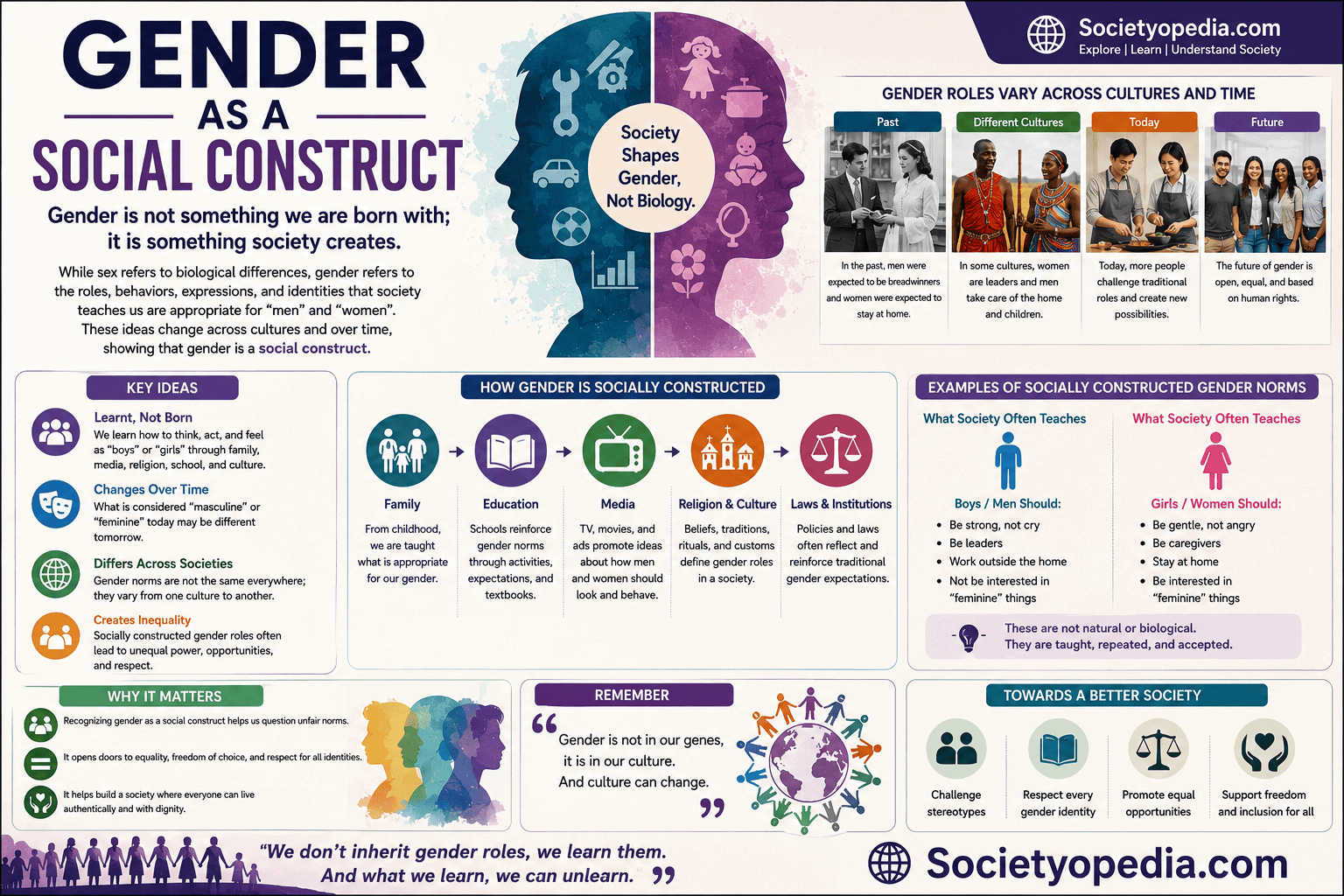
What Does Gender as a Social Construct Mean?
A social construct is an idea, category, norm, or meaning that is developed and maintained through social interaction and collective understanding.
When sociologists describe gender as a social construct, they are referring to the way societies create meanings and expectations around gender.
For example, the belief that women should be primarily responsible for childcare and men should be responsible for earning money is a social expectation. It is not a universal rule that applies identically to every society or historical period.
Similarly, ideas about what clothing, occupations, personality traits, or behaviors are considered masculine or feminine can vary considerably between cultures.
Therefore, gender is not simply an individual characteristic. It is also a social system through which societies organize expectations and relationships.
Gender and Biological Sex
Understanding gender as a social construct requires distinguishing between sex and gender.
Sex generally refers to biological characteristics such as reproductive anatomy, chromosomes, and hormones. Gender refers to the social meanings, roles, expectations, and identities associated with gender.
The distinction does not mean that biology is irrelevant. Biological characteristics can influence people’s experiences, particularly in areas related to reproduction and health.
However, biology alone does not determine how societies interpret gender.
For example, biology does not automatically determine that women should cook, men should become leaders, girls should wear particular colors, or boys should avoid emotional expression. These are social and cultural expectations.
This distinction is one of the foundations of sociological approaches to gender.
How Is Gender Socially Constructed?
Gender is socially constructed through everyday social processes.
From early childhood, people receive messages about gender from their families, schools, peers, religious communities, media, and wider society.
Children may be encouraged to participate in different activities based on gender. They may also receive different forms of praise, discipline, clothing, toys, or expectations.
As individuals grow older, social institutions continue to communicate gender expectations.
For example, young people may receive messages about which subjects or careers are considered suitable for women or men. Adults may encounter expectations about marriage, parenting, employment, appearance, and family responsibilities.
Through repeated social interaction, these expectations can become familiar and appear natural.
Gender Socialization
Gender socialization is one of the main mechanisms through which gender is constructed.
Gender socialization refers to the process through which individuals learn the norms, values, expectations, and behaviors associated with gender in their society.
Parents are often among the first agents of gender socialization. Teachers, peers, media, religious institutions, and workplaces also play important roles.
For example, children may learn that boys are expected to be confident and physically strong while girls are expected to be caring and well-behaved.
These expectations are not necessarily accepted by every individual. People can resist, reinterpret, or challenge them.
Nevertheless, continuous exposure to gender norms can strongly influence behavior and identity.
Gender Roles as Social Constructions
Gender roles are socially expected behaviors associated with gender.
Traditional gender roles often divide responsibilities between women and men.
Women may be expected to manage domestic work, childcare, and emotional care, while men may be expected to provide income, make major household decisions, and perform physically demanding tasks.
However, these arrangements differ across societies and historical periods.
As women’s participation in education and employment has increased in many societies, traditional divisions of labor have been challenged. Men may also increasingly participate in childcare and domestic work.
These changes demonstrate that gender roles are not fixed.
Examples of Gender as a Social Construct
Everyday life contains many examples of socially constructed gender expectations.
Clothing
Societies often classify certain colors, styles, hairstyles, and clothing as masculine or feminine.
These classifications vary across time and culture. A clothing style considered appropriate for men in one historical period may be considered feminine in another.
This demonstrates that gendered meanings attached to clothing are socially produced.
Toys and Childhood Activities
Children may receive different toys according to gender.
Girls may traditionally be given dolls and play kitchens, while boys may be given cars, construction toys, or action figures.
These choices can communicate expectations about future roles. Dolls may encourage caregiving and domestic play, while construction toys may encourage technical or spatial activities.
The toys themselves do not possess an inherent gender. Their meanings are socially assigned.
Occupations
Some occupations become culturally associated with women or men.
Teaching, nursing, childcare, engineering, construction, military service, and other occupations may have different gender associations in different societies.
When an occupation becomes strongly gendered, young people may feel pressure to choose careers that conform to social expectations.
Emotional Expression
Many societies encourage women to express emotions openly while expecting men to remain emotionally controlled.
Boys may hear messages such as “men should be strong” or “boys should not cry.”
Such expectations can shape emotional behavior and interpersonal relationships.
Again, these expectations are cultural norms rather than universal biological rules.
Domestic Responsibilities
Household work provides another example.
Cooking, cleaning, laundry, and childcare have often been culturally associated with women, while financial provision and certain household decisions have been associated with men.
However, these responsibilities can be distributed differently between households and societies.
Changes in women’s employment and changing ideas about fatherhood have contributed to transformations in domestic roles.
Gender and Culture
Culture is one of the strongest influences on gender construction.
Different societies have different expectations about masculinity, femininity, marriage, family responsibilities, appearance, work, and social behavior.
For example, the expected role of a father can differ between societies. In one culture, fathers may be expected primarily to provide financial support, while another may place greater emphasis on fathers’ involvement in childcare.
Similarly, women’s employment may be encouraged in one society but discouraged in another.
Cultural variation therefore demonstrates that gender meanings are not identical everywhere.
Gender and Historical Change
Gender is also historically constructed.
Gender expectations have changed significantly throughout history.
The educational opportunities available to women, women’s participation in paid employment, political participation, marriage practices, family structures, and expectations concerning fatherhood have all changed over time.
An occupation or behavior that was considered inappropriate for women in the past may become socially accepted later.
Likewise, forms of masculinity can change. Modern expectations of fatherhood, emotional expression, and domestic participation may differ from those common in earlier generations.
Historical variation shows that gender is dynamic rather than fixed.
Gender and Social Institutions
Gender is constructed and reinforced through social institutions.
Family
Families teach children gender expectations through everyday behavior, responsibilities, discipline, communication, and role modeling.
Education
Schools and universities can reinforce gender stereotypes through textbooks, classroom practices, subject choices, and expectations. They can also challenge stereotypes by providing equal opportunities.
Workplace
Organizations can reproduce gender expectations through hiring practices, occupational segregation, promotion systems, workplace culture, and assumptions about caregiving.
Media
Television, films, advertising, news, and social media can influence how women and men are represented.
Religion
Religious institutions and interpretations can influence cultural ideas about family roles, marriage, modesty, leadership, and responsibilities.
Politics and Law
Laws and political institutions can either reinforce gender inequalities or provide mechanisms for greater equality.
Because these institutions interact with one another, gender construction occurs at multiple levels of society.
Gender Norms and Social Control
Gender norms are expectations about appropriate behavior.
People who follow gender norms may receive social approval. Those who challenge them may face criticism, ridicule, exclusion, or discrimination.
This creates a form of social control.
For example, a man who chooses a profession traditionally associated with women may face stereotypes about his masculinity. A woman who rejects traditional expectations about marriage or employment may experience social pressure.
Such reactions encourage individuals to conform to dominant gender expectations.
However, social norms can change when enough people challenge them or when institutions adopt new practices.
Gender Performance
Sociologists and gender theorists have also examined how gender is expressed through everyday behavior.
People communicate gender through clothing, speech, body language, social roles, relationships, and other forms of interaction.
This perspective suggests that gender is not simply something a person possesses. It is also something that is continually expressed and interpreted within social situations.
Everyday interactions therefore play an important role in maintaining gender expectations.
Gender as a Social Structure
Gender can also be understood as a social structure.
A social structure consists of patterned relationships, institutions, norms, and systems that organize social life.
Gender structures can influence access to resources, power, authority, education, employment, and social status.
For example, if a society consistently assigns women greater responsibility for unpaid care work, women may have less time available for paid employment or political participation.
Similarly, if leadership is culturally associated with masculinity, women may face additional barriers when seeking positions of authority.
Thus, gender construction can have material consequences.
Is Gender Completely Determined by Society?
Saying that gender is socially constructed does not mean that biology, individual experience, or personal identity have no importance.
A sociological perspective recognizes that human beings have biological bodies and individual experiences. The concept of social construction focuses on how societies attach meanings, expectations, and social consequences to gender.
Gender therefore emerges through the interaction of individuals, social institutions, culture, history, and broader social structures.
It is also important to distinguish between the social construction of gender and the claim that individuals can simply choose every aspect of their gender without social constraints. People’s experiences are shaped by the social environments in which they live.
Why Does the Social Construction of Gender Matter?
Understanding gender as a social construct has several important implications.
First, it helps explain gender variation. If gender expectations were determined entirely by biology, we would expect them to be largely identical across societies. In reality, gender roles vary considerably.
Second, it helps explain social change. Gender expectations can change because they are socially produced and maintained.
Third, it helps identify gender inequality. If social institutions assign different opportunities or responsibilities to different genders, these arrangements can contribute to unequal outcomes.
Fourth, it helps individuals critically examine assumptions that may otherwise appear natural or inevitable.
Finally, the concept provides an important theoretical foundation for studying feminism, gender inequality, masculinity, gender identity, gender socialization, and other topics within gender studies.
Gender Construction and Social Change
Because gender is socially constructed, it can also be reconstructed.
Social change can occur when individuals and groups challenge existing norms and institutions.
Education, feminist movements, legal reforms, economic transformation, technological change, political participation, and changing family patterns can all influence gender relations.
For example, increasing women’s participation in higher education and professional employment can challenge the belief that women should be limited to domestic roles.
Similarly, greater acceptance of men’s participation in childcare can challenge traditional assumptions about masculinity.
Change does not happen automatically. Social institutions, cultural values, and power relationships can resist changes in gender expectations.
Nevertheless, the history of gender relations demonstrates that social arrangements can change.
Gender as a Social Construct: A Sociological Perspective
From a sociological perspective, gender should be examined at several levels.
At the micro level, researchers study everyday interactions, communication, identity, and behavior.
At the meso level, they examine organizations and institutions such as schools, workplaces, families, and communities.
At the macro level, sociologists investigate broader systems of inequality, economic structures, political institutions, cultural norms, and social change.
These levels are interconnected.
For example, an individual’s career decision may be influenced by family expectations. Family expectations may reflect wider cultural norms. Those cultural norms may influence workplace practices and educational opportunities.
Therefore, understanding gender requires examining both individual experiences and broader social structures.
Conclusion
The concept of gender as a social construct explains how societies create, maintain, and transform meanings associated with gender.
Gender expectations are learned through socialization and reinforced through family, education, media, religion, workplaces, politics, and everyday interactions. Ideas about masculinity, femininity, appropriate occupations, clothing, emotional behavior, and family responsibilities vary across cultures and historical periods.
This variation demonstrates that gender is not simply a biological fact. It is also a social and cultural system that influences identities, relationships, opportunities, responsibilities, and power.
At the same time, social construction does not mean that gender is unreal or insignificant. Gender has real consequences because social institutions and individuals treat gender categories as meaningful.
Studying gender as a social construct therefore allows sociologists to understand both the persistence of gender norms and the possibility of social change.
Ultimately, the concept encourages us to ask an important sociological question: How do societies create the gender expectations that people often experience as natural?
Answering this question provides a foundation for understanding gender inequality, feminism, gender identity, socialization, and the wider relationship between gender and society.
Related Articles
Continue exploring the Gender Studies concepts:
- What Is Gender?
- Sex and Gender Difference
- Gender Roles
- Gender Norms
- Gender Stereotypes
- Gender Socialization
- Gender and Society
- Gender and Culture
- Gender Identity Meaning
- Gender Inequality Definition
These articles collectively provide a foundation for understanding gender concepts, social construction, cultural expectations, and gender relations.

