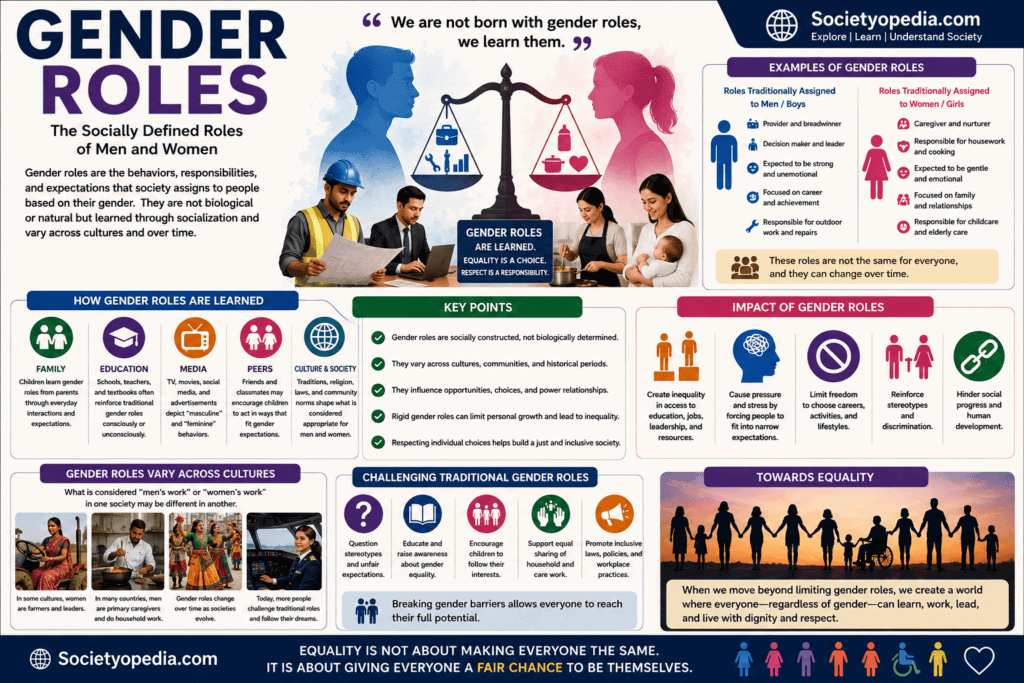
Gender roles are an important concept in sociology and Gender Studies. They refer to the expectations, behaviors, responsibilities, and activities that society associates with people based on their perceived gender. These expectations influence everyday life, including family responsibilities, education, employment, relationships, appearance, and social behavior.
Gender roles are not the same in every society. They vary across cultures, social classes, generations, and historical periods. They can also change as societies experience economic, political, technological, and cultural transformations.
Understanding gender roles helps explain how societies organize social relationships and how individuals learn expectations about masculinity and femininity.
What Are Gender Roles?
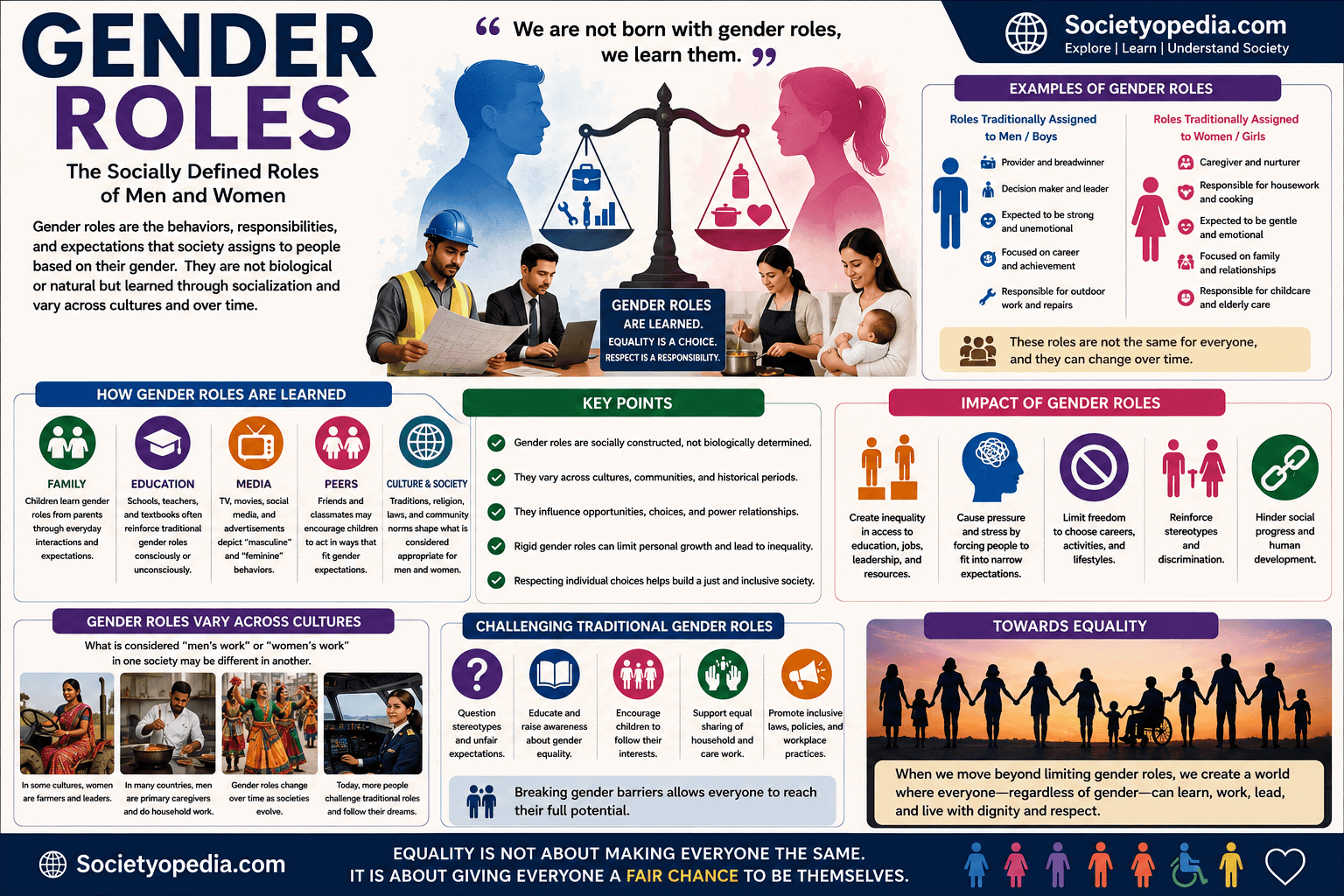
Gender roles are socially created expectations about how people are expected to behave based on their gender.
For example, a society may expect men to be financially responsible for their families and women to take primary responsibility for childcare and household work. These expectations represent traditional gender roles.
Gender roles can influence many areas of life, including:
- Family responsibilities
- Education
- Employment
- Parenting
- Leadership
- Clothing and appearance
- Emotional expression
- Social relationships
Importantly, gender roles are not necessarily the result of biological differences. They are influenced by culture, socialization, institutions, traditions, and social expectations.
Gender Roles in Sociology
Sociologists study gender roles as part of the broader social structure. Gender roles help researchers understand how societies organize relationships between individuals and groups.
From childhood, people are often exposed to expectations concerning appropriate behavior for boys and girls. These expectations can influence educational choices, career aspirations, household responsibilities, and personal relationships.
For example, if children are repeatedly told that engineering is more appropriate for boys while caregiving occupations are more suitable for girls, they may develop different expectations about their future careers.
Sociology therefore examines how these expectations are created and maintained rather than assuming that they are naturally determined.
Examples of Traditional Gender Roles
Traditional gender roles differ across societies, but some common examples include:
Men as Providers
Men may traditionally be expected to earn income and provide financial support for the family.
Women as Caregivers
Women may be expected to take primary responsibility for childcare, cooking, cleaning, and other domestic activities.
Men as Leaders
Leadership and decision-making may traditionally be associated with men in some societies.
Women as Caregivers and Supporters
Women may be expected to provide emotional support and prioritize family needs.
These expectations can influence how people behave and how others judge their behavior.
Gender Roles in the Family
The family is one of the most important institutions through which gender roles are learned and practiced.
Children observe how adults divide household responsibilities and may learn ideas about what men and women are expected to do.
For example, if household chores are consistently assigned according to gender, children may come to view this division as normal.
However, family roles are changing in many societies. Women increasingly participate in paid employment, while men in many families are becoming more involved in childcare and domestic work.
These changes demonstrate that gender roles can adapt to changing social and economic conditions.
Gender Roles in Education
Education can both reinforce and challenge traditional gender roles.
Schools may influence gender expectations through:
- Textbooks
- Teachers’ expectations
- Subject selection
- Classroom interactions
- Career guidance
- School activities
For example, students may receive subtle messages that certain academic subjects are more appropriate for one gender than another.
However, education can also challenge stereotypes by encouraging equal participation and providing opportunities for students regardless of gender.
Gender Roles in the Workplace
Gender roles have historically influenced occupational choices and workplace participation.
Some occupations have traditionally been associated with men, such as construction, engineering, and certain leadership positions. Other occupations, including nursing, teaching, and caregiving, have often been associated with women.
These patterns can contribute to occupational gender segregation, where men and women become concentrated in different types of work.
Changes in education, economic opportunities, workplace policies, and social attitudes have contributed to greater gender diversity in many professions.
Gender Roles and Emotional Expression
Gender roles can also influence how people are expected to express emotions.
In some cultures, boys and men may be encouraged to appear strong, independent, and emotionally controlled. Girls and women may be encouraged to express emotions and seek social support.
Such expectations can influence how individuals communicate and respond to emotional situations.
These patterns are not universal, but they demonstrate how cultural expectations can shape behavior.
How Are Gender Roles Learned?
Gender roles are learned through a process called gender socialization.
Major agents of gender socialization include:
Family
Parents and relatives may teach children gender expectations through language, activities, clothing, responsibilities, and behavior.
Education
Schools influence gender expectations through curriculum, classroom interaction, and institutional practices.
Peer Groups
Children and young people may learn gender expectations through friends and peer pressure.
Media
Television, films, advertising, video games, and social media can portray particular ideas about masculinity and femininity.
Religion and Culture
Religious and cultural traditions may influence ideas about family responsibilities, relationships, dress, and social behavior.
Through these processes, individuals learn what their society considers appropriate or inappropriate gender behavior.
Gender Roles and Gender Norms
Gender roles and gender norms are closely related but not exactly the same.
Gender roles refer to expected behaviors and responsibilities associated with gender.
Gender norms are broader social expectations about what is considered acceptable or appropriate behavior.
For example, the expectation that mothers should be primarily responsible for childcare is a gender role. The broader belief that women should always prioritize family responsibilities represents a gender norm.
Both concepts help sociologists understand how gender expectations operate in society.
Traditional and Changing Gender Roles
Gender roles have changed considerably in many societies.
Factors contributing to these changes include:
- Increased access to education
- Women’s participation in employment
- Urbanization
- Technological development
- Social movements
- Legal reforms
- Economic changes
- Changing family structures
For example, women have increasingly entered occupations and educational fields that were previously dominated by men. At the same time, expectations concerning men’s participation in childcare and household responsibilities have also changed.
However, traditional gender roles continue to influence social behavior in many communities.
Why Are Gender Roles Important?
Gender roles are important because they influence people’s opportunities, responsibilities, and everyday experiences.
They can provide individuals with social expectations that help organize behavior. However, rigid gender roles can also restrict individuals by limiting their choices.
For example, someone may avoid a particular career because society considers it unsuitable for their gender. Similarly, unequal household expectations can affect education, employment, and personal opportunities.
Studying gender roles therefore helps sociologists understand both social organization and gender inequality.
Conclusion
Gender roles are socially created expectations about how people should behave, work, communicate, and participate in family and community life based on their perceived gender. They are learned through family, education, peer groups, media, religion, and other social institutions.
Gender roles vary across cultures and historical periods and can change as societies change. While they can provide social expectations and organization, rigid gender roles may also limit individual choices and contribute to inequality.
Understanding gender roles provides an important foundation for studying gender norms, gender stereotypes, gender socialization, gender inequality, feminism, and the relationship between gender and society.