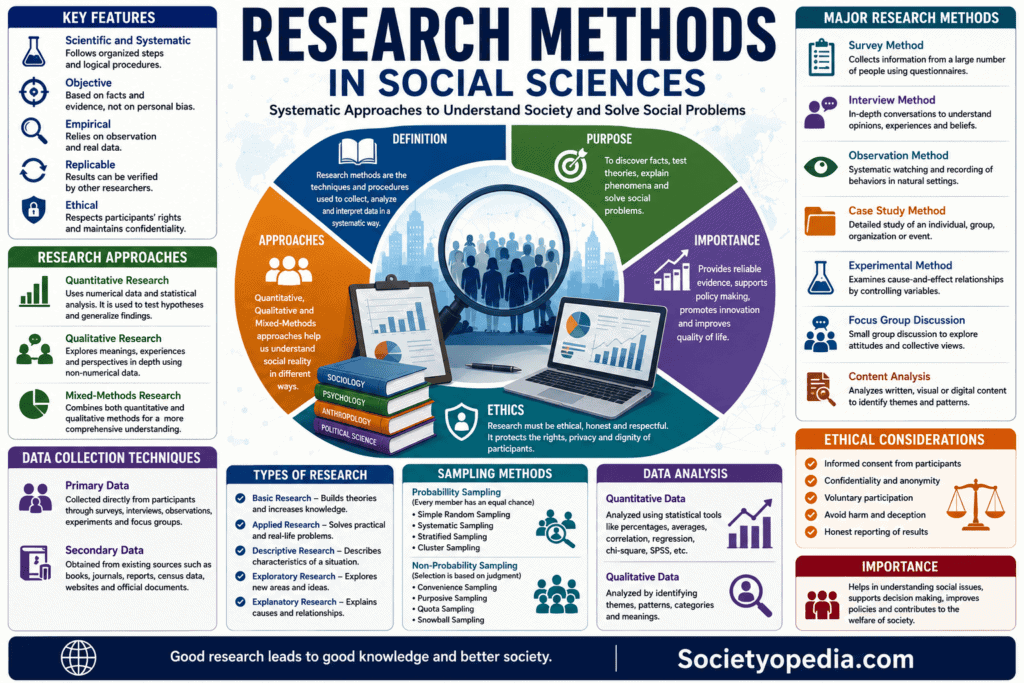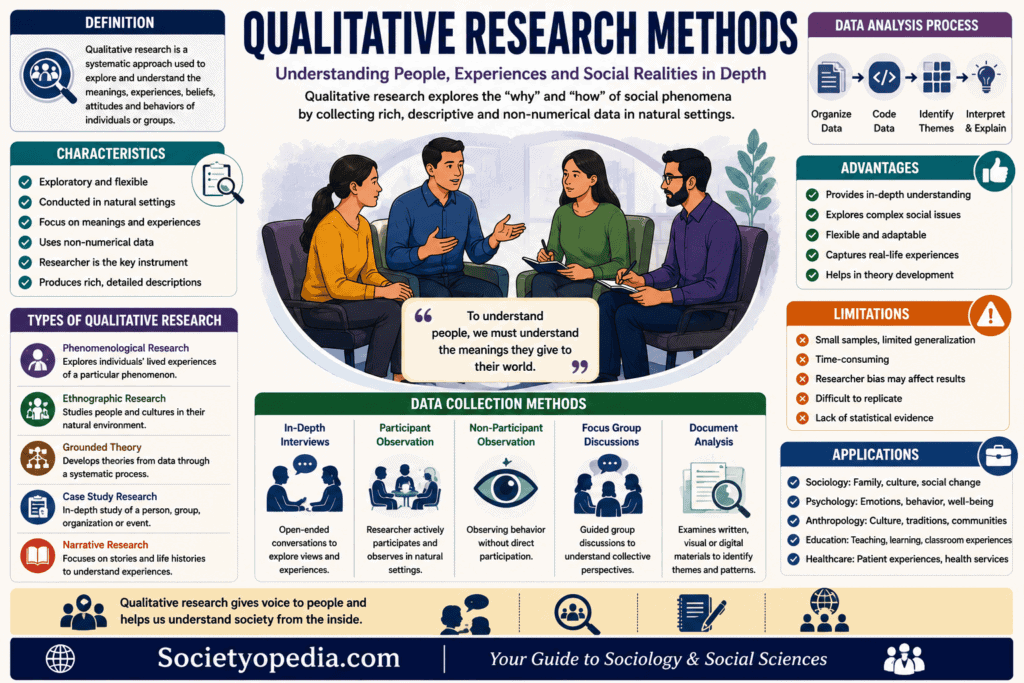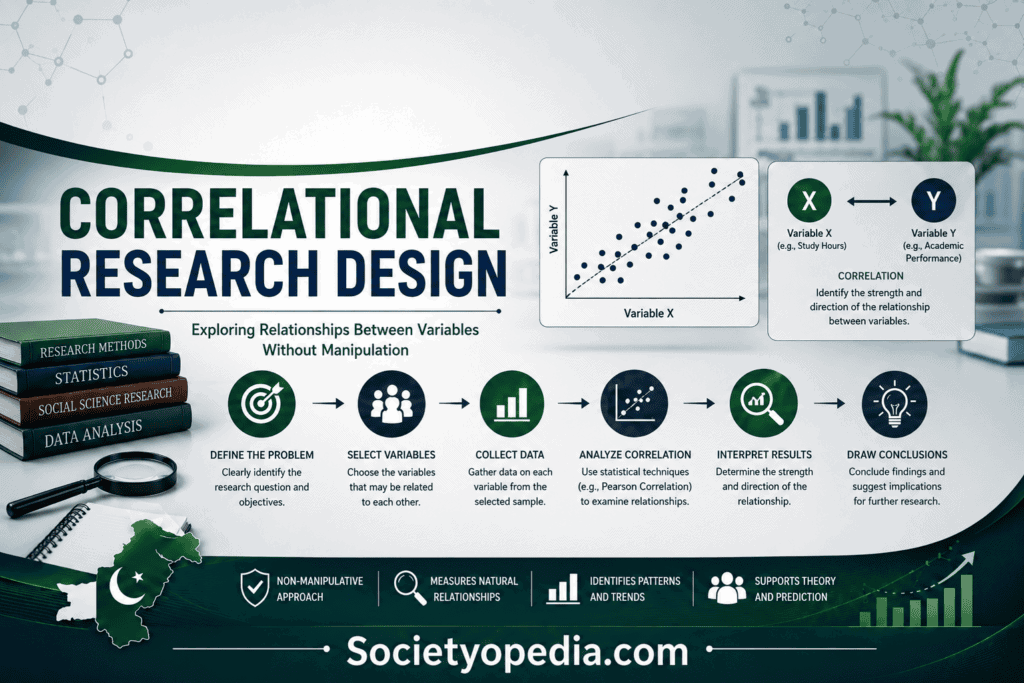
Correlational research design is one of the most widely used non-experimental research approaches in social sciences, psychology, education, health sciences, and business studies. It is designed to examine the relationship between two or more variables without manipulating them. The main purpose of correlational research is to determine whether changes in one variable are associated with changes in another variable and to measure the strength and direction of these relationships.
Human behavior and social phenomena are influenced by multiple interconnected factors. For example, educational achievement may be related to socioeconomic status, workplace satisfaction may be associated with employee productivity, and social media use may be linked with psychological well-being. Researchers often need to understand these relationships before conducting more complex experimental or longitudinal studies. Correlational research provides an effective method for identifying patterns and associations among variables.
Unlike experimental research, where researchers manipulate an independent variable to observe its effect on a dependent variable, correlational research simply observes naturally occurring variations. It does not attempt to control or change participants’ conditions. Instead, it analyzes whether variables move together systematically.
In sociology, correlational research is particularly valuable because social realities involve complex relationships that cannot always be studied through experiments. Issues such as poverty, education, gender inequality, social mobility, political participation, and cultural attitudes often require examining relationships among multiple social factors.
This article explains the concept, definitions, characteristics, types, process, advantages, limitations, applications, and importance of correlational research design.
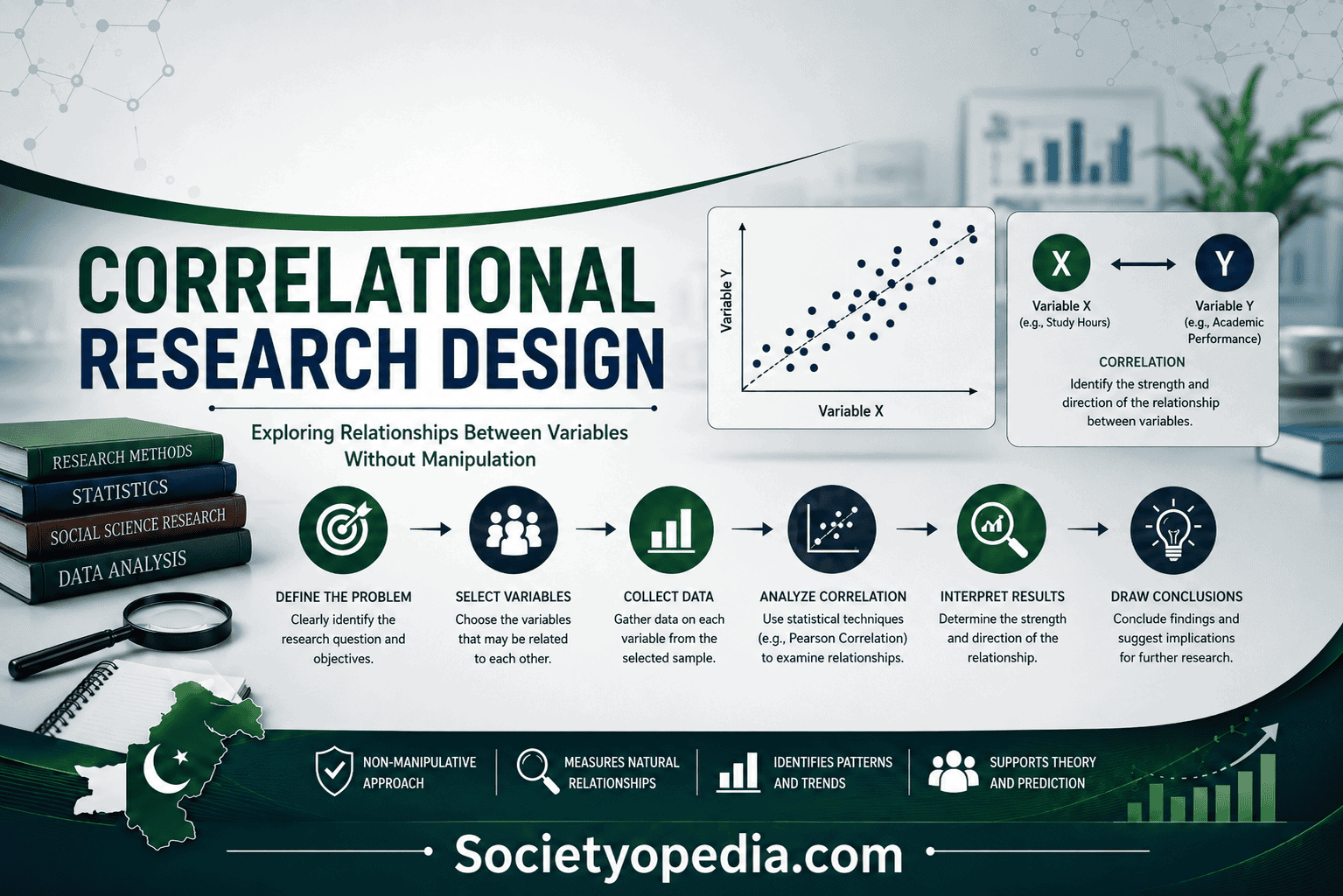
What Is Correlational Research Design?
Correlational research design is a research method used to investigate the relationship between two or more variables. It determines whether variables are related, the direction of the relationship, and the strength of association between them.
In simple terms, correlational research answers questions such as:
- Is education level related to income?
- Is social media use associated with loneliness?
- Is job satisfaction connected with employee performance?
- Is family support related to women’s workforce participation?
The researcher measures existing variables and uses statistical techniques to determine whether relationships exist.
For example, a sociologist may study whether higher levels of education are associated with greater political participation. The researcher does not provide education or manipulate political behavior but observes existing differences and analyzes the relationship between the two variables.
The central idea of correlational research is that variables may change together. However, correlation does not automatically mean that one variable causes another.
Definitions of Correlational Research Design
Several research scholars have defined correlational research from different perspectives.
John W. Creswell defines correlational research as a quantitative approach in which researchers use statistical procedures to measure the degree of association between two or more variables.
Earl Babbie explains that correlational studies examine whether variations in one variable correspond with variations in another variable.
William Lawrence Neuman describes correlational research as a method used to identify patterns of relationships among variables without experimental manipulation.
Kerlinger and Lee define correlational research as a study that investigates relationships between variables as they naturally occur.
These definitions highlight three essential elements of correlational research:
- Measurement of multiple variables
- Analysis of relationships among variables
- Absence of experimental manipulation
Purpose of Correlational Research Design
The primary purpose of correlational research is to determine whether relationships exist between variables. However, researchers use this design for several additional purposes.
Identifying Relationships
Correlational research helps researchers identify whether variables are associated with each other.
For example, researchers may examine the relationship between unemployment and psychological stress.
Predicting Outcomes
One important purpose of correlational studies is prediction. If two variables are strongly related, researchers may use one variable to predict another.
For example, academic performance may be predicted based on attendance, study habits, and family support.
Developing Theories
Correlational findings often contribute to theoretical development by showing how different social or behavioral factors interact.
Guiding Future Research
Correlational studies frequently provide the foundation for experimental or longitudinal research by identifying important variables for further investigation.
Characteristics of Correlational Research Design
Correlational research has several unique characteristics.
Non-Experimental Nature
The researcher does not manipulate variables. Variables are studied as they naturally exist.
For example, a researcher studying the relationship between income and health does not assign participants different income levels but observes existing differences.
Measurement of Multiple Variables
Correlational studies usually involve two or more variables that can be measured statistically.
Statistical Analysis
Correlation coefficients and regression analysis are commonly used to determine relationships between variables.
Prediction-Oriented
Many correlational studies aim to predict outcomes based on relationships among variables.
Natural Settings
Correlational research is usually conducted in real-life environments rather than controlled laboratory settings.
Quantitative Approach
Although qualitative approaches can explore relationships, correlational research is mainly associated with quantitative methods.
Types of Correlational Research Design
Correlational research can be classified into several types depending on the research purpose and analytical approach.
Positive Correlation
A positive correlation occurs when two variables increase or decrease together.
When one variable increases, the other also tends to increase.
Example
A study may find that students who spend more time studying generally achieve higher academic scores.
Similarly, employees with higher job satisfaction may demonstrate greater workplace commitment.
Negative Correlation
A negative correlation occurs when one variable increases while another decreases.
Example
A researcher may find that increased stress levels are associated with lower job satisfaction.
As stress increases, satisfaction tends to decrease.
Zero Correlation
Zero correlation occurs when no significant relationship exists between variables.
Example
A study may find no relationship between a person’s favorite color and academic performance.
Simple Correlation
Simple correlation examines the relationship between two variables.
Example
The relationship between education level and income.
Multiple Correlation
Multiple correlation examines the relationship between one dependent variable and several independent variables.
Example
A researcher may examine how education, income, family background, and social networks influence political participation.
Partial Correlation
Partial correlation examines the relationship between two variables while controlling the influence of another variable.
Example
A researcher may examine the relationship between education and income while controlling for age.
Correlational Research Process
A systematic process is required to conduct effective correlational research.
Step 1: Identify the Research Problem
The researcher identifies the issue and determines which variables need investigation.
Example:
“Does workplace support influence female healthcare professionals’ career continuation?”
Step 2: Review Previous Literature
Existing studies are examined to understand theoretical explanations and identify research gaps.
Step 3: Define Variables
Researchers clearly define independent, dependent, and control variables.
For example:
Independent variable: Workplace support
Dependent variable: Career continuation
Step 4: Develop Hypotheses
Researchers formulate testable statements about expected relationships.
Example:
“Workplace support is positively associated with female employee retention.”
Step 5: Select Sample
A representative sample is selected using appropriate sampling techniques.
Step 6: Collect Data
Data are collected through surveys, interviews, observations, or existing databases.
Step 7: Analyze Data
Statistical techniques are applied to examine relationships among variables.
Step 8: Interpret Results
Researchers explain the meaning and implications of findings.
Data Collection Methods in Correlational Research
Correlational studies use several methods for collecting data.
Surveys and Questionnaires
Surveys are the most common method because they allow researchers to measure multiple variables efficiently.
Likert-scale questionnaires are frequently used in sociology and psychology.
Interviews
Structured interviews can provide detailed information about participants’ experiences.
Observation
Researchers may observe naturally occurring behaviors.
Secondary Data
Existing datasets from government organizations, institutions, or previous studies can also be used.
Correlation Coefficient and Data Analysis
The relationship between variables is usually measured through a correlation coefficient.
The correlation coefficient indicates:
- Direction of relationship
- Strength of relationship
The value generally ranges from -1 to +1.
A value close to +1 indicates a strong positive relationship.
A value close to -1 indicates a strong negative relationship.
A value near zero indicates little or no relationship.
Common statistical techniques used in correlational research include:
- Pearson correlation
- Spearman rank correlation
- Regression analysis
- Multiple regression
- Chi-square analysis
Advantages of Correlational Research Design
Correlational research provides several important benefits.
Examines Relationships in Real Settings
Because variables are studied naturally, findings often reflect real-world situations.
Useful When Experiments Are Impossible
Many social variables cannot ethically or practically be manipulated.
For example, researchers cannot experimentally assign people different levels of poverty.
Cost and Time Efficient
Compared with longitudinal and experimental designs, correlational studies require fewer resources.
Helps Make Predictions
Strong relationships among variables can help researchers predict future outcomes.
Studies Complex Social Phenomena
Correlational research is valuable for examining multiple interacting social factors.
Provides Foundation for Further Research
Findings can guide future experimental or longitudinal studies.
Limitations of Correlational Research Design
Despite its usefulness, correlational research has important limitations.
Cannot Establish Cause and Effect
The biggest limitation is that correlation does not prove causation.
For example, if education is related to income, researchers cannot conclude that education alone causes higher income because other factors may influence both.
Possibility of Third Variables
A third variable may explain the relationship between two variables.
For example, education and health may be related because socioeconomic status influences both.
Limited Control Over Variables
Researchers cannot control all factors affecting participants.
Self-Report Bias
Many correlational studies rely on questionnaires, which may be affected by inaccurate responses.
Relationship May Be Misinterpreted
A statistically significant relationship does not always mean the relationship is practically important.
Correlational Research Design vs Experimental Research Design
| Feature | Correlational Research | Experimental Research |
|---|---|---|
| Purpose | Examine relationships | Establish causation |
| Variable Manipulation | No | Yes |
| Control | Limited | High |
| Setting | Usually natural | Often controlled |
| Cause and Effect | Cannot confirm | Can provide stronger evidence |
| Cost | Lower | Higher |
Correlational Research Design vs Longitudinal Research Design
| Feature | Correlational Research | Longitudinal Research |
|---|---|---|
| Time Period | Usually one point in time | Extended period |
| Main Focus | Relationships among variables | Change over time |
| Data Collection | Often once | Multiple times |
| Purpose | Identify associations | Study development and trends |
Applications of Correlational Research
Correlational research is widely applied across disciplines.
Sociology
Sociologists use correlational studies to examine relationships among social factors such as education, poverty, inequality, family structure, and social participation.
Psychology
Psychologists investigate relationships between personality, emotions, stress, intelligence, and behavior.
Education
Educational researchers study relationships between teaching methods, student motivation, academic achievement, and learning outcomes.
Public Health
Health researchers examine relationships between lifestyle factors, diseases, and health outcomes.
Business and Management
Organizations use correlational research to study employee satisfaction, leadership styles, productivity, and organizational performance.
Ethical Considerations in Correlational Research
Ethical principles are essential in correlational studies.
Researchers must obtain informed consent from participants and ensure confidentiality of collected information.
Sensitive information about health, income, family relationships, or personal attitudes must be protected.
Researchers should avoid making exaggerated causal claims from correlational findings and must report results honestly.
Conclusion
Correlational research design is an important methodological approach for understanding relationships among variables in social sciences and other research fields. By examining naturally occurring associations, it helps researchers identify patterns, make predictions, and develop theories about human behavior and social processes.
Although correlational research cannot establish definite cause-and-effect relationships, it remains highly valuable because many social phenomena are complex and cannot be studied through experiments. When combined with careful sampling, reliable measurement tools, and appropriate statistical analysis, correlational research provides meaningful insights into the connections that shape society.
For students, researchers, and social scientists, understanding correlational research design is essential for selecting appropriate research methods and interpreting relationships between social, behavioral, and institutional factors. At Societyopedia, research methodology concepts like correlational research design help learners build strong foundations for conducting scientific investigations and understanding evidence-based knowledge.