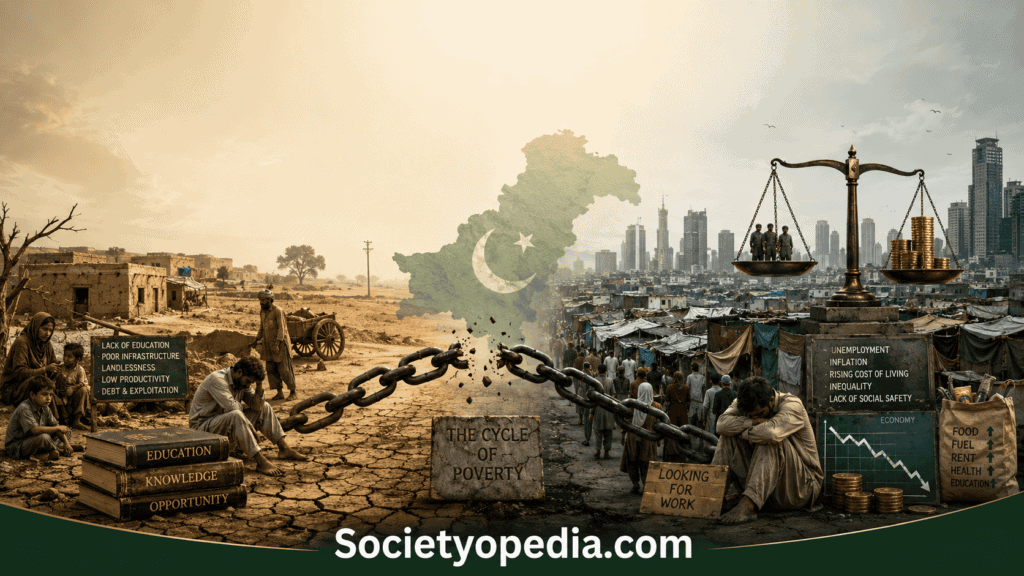
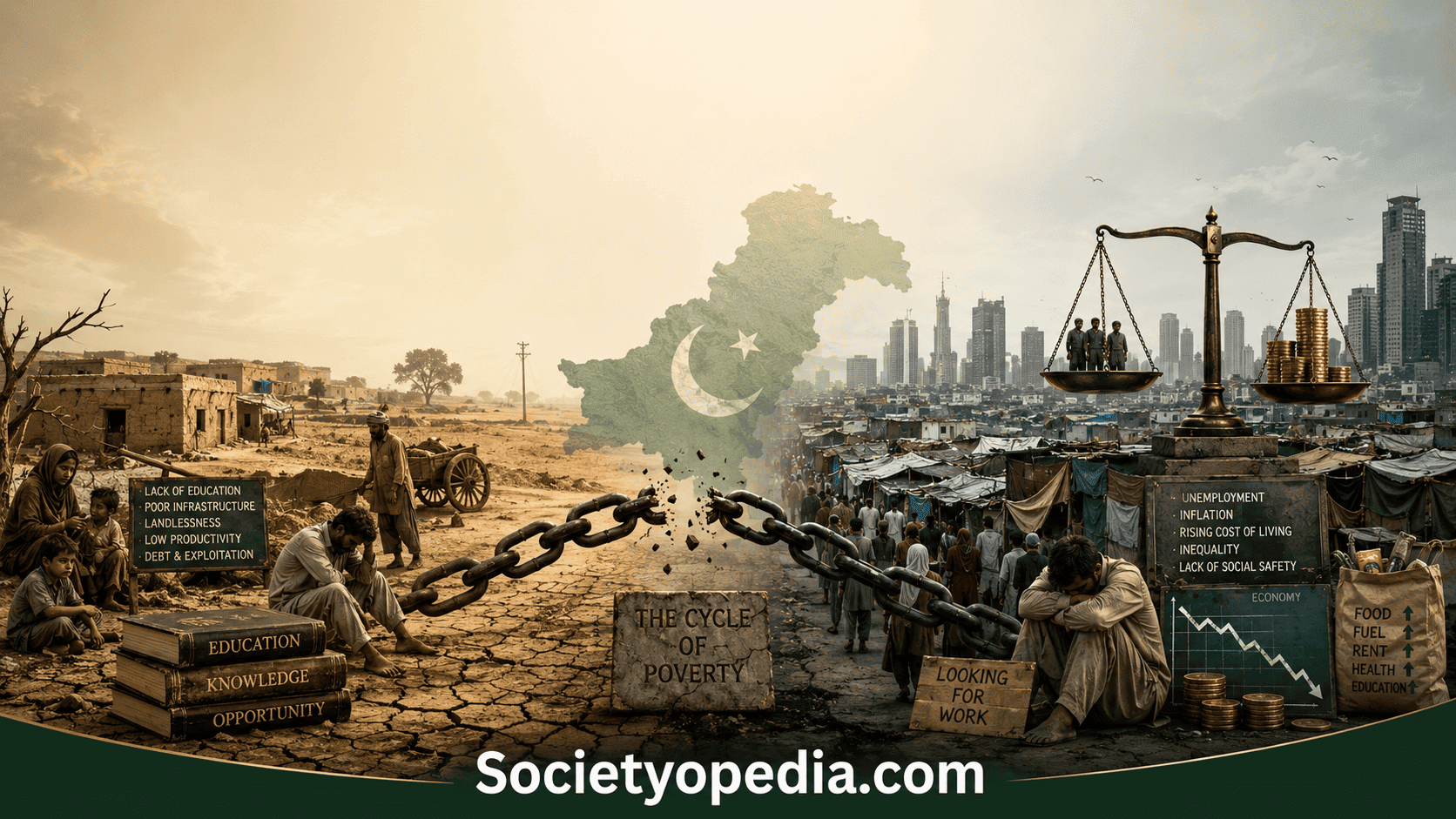
Poverty remains one of Pakistan’s most persistent socio-economic challenges, affecting millions of people across both urban and rural areas. It extends beyond a lack of income and includes limited access to education, healthcare, employment opportunities, housing, clean water, nutrition, and social protection. Poverty influences every aspect of human life by reducing individuals’ ability to achieve a decent standard of living and participate fully in society.
Pakistan has made progress in reducing poverty over different periods through economic growth and social protection programs. However, rapid population growth, inflation, unemployment, climate-related disasters, and structural economic challenges have continued to place many households at risk of poverty. Understanding the root causes of poverty is essential for designing effective policies that promote sustainable development and improve the quality of life for all citizens.
From a sociological perspective, poverty is not merely an individual problem but a structural issue shaped by social, economic, political, cultural, and institutional factors. Therefore, addressing poverty requires comprehensive reforms that tackle its underlying causes rather than only its visible symptoms.
What is Poverty?
Poverty refers to a condition in which individuals or households lack sufficient financial resources and access to basic necessities required for a healthy and dignified life. These necessities include food, clothing, shelter, education, healthcare, sanitation, and employment opportunities.
According to the World Bank, poverty involves pronounced deprivation in well-being, including low income as well as limited access to essential services and opportunities.
The United Nations Development Programme views poverty as multidimensional, encompassing not only income deprivation but also restricted capabilities, social exclusion, and lack of opportunities to live a productive life.
Historical Background of Poverty in Pakistan
At independence in 1947, Pakistan inherited a weak industrial base, limited infrastructure, and widespread rural poverty. Agricultural productivity was low, educational facilities were scarce, and economic resources were unevenly distributed.
Although economic development accelerated during certain periods, rapid population growth, political instability, uneven regional development, and recurring economic crises prevented poverty from being eliminated completely. Natural disasters such as floods, earthquakes, and droughts have further increased the vulnerability of poor communities.
Unequal Distribution of Wealth
One of the most significant causes of poverty in Pakistan is the unequal distribution of wealth and resources. A relatively small segment of society controls a large proportion of land, industries, businesses, and financial assets, while many households possess very limited productive resources.
Income inequality reduces social mobility and limits opportunities for disadvantaged groups. Concentrated wealth also restricts access to quality education, healthcare, and employment for low-income families, perpetuating poverty across generations.
Unemployment and Underemployment
Unemployment remains one of the primary drivers of poverty. Many individuals, particularly young people, are unable to secure stable and productive employment despite completing their education.
Even among those who are employed, a large proportion work in informal sectors where wages are low, job security is limited, and social protection benefits are absent. Underemployment, seasonal employment, and low productivity further reduce household income and increase economic vulnerability.
Rapid Population Growth
Pakistan’s rapidly growing population places immense pressure on available resources, employment opportunities, healthcare services, educational institutions, and housing. As the labor force expands more quickly than the economy can create jobs, unemployment and poverty become more widespread.
Large family sizes also reduce household savings and increase dependency ratios, making it difficult for families to invest in children’s education, nutrition, and healthcare.
Low Quality of Education
Education is one of the most effective tools for reducing poverty. However, unequal access to quality education continues to limit economic opportunities for millions of Pakistanis.
Many children, especially in rural and marginalized communities, face challenges such as inadequate schools, teacher shortages, poor infrastructure, and financial barriers. Low educational attainment restricts access to skilled employment, leading many individuals to remain trapped in low-paying occupations.
The mismatch between educational curricula and labor market requirements also contributes to graduate unemployment.
Limited Technical and Vocational Skills
Economic development increasingly requires skilled workers in manufacturing, information technology, engineering, healthcare, and modern services. However, access to technical and vocational education remains limited in many parts of Pakistan.
Without market-oriented skills, many young people struggle to compete in domestic and international labor markets, contributing to persistent unemployment and poverty.
Inflation and Rising Cost of Living
Persistent inflation significantly affects low-income households by reducing their purchasing power. Rising prices of food, fuel, electricity, transportation, medicines, and housing increase financial pressure on families with fixed or limited incomes.
When wages fail to increase at the same pace as inflation, real household income declines, forcing families to reduce spending on nutrition, education, and healthcare.
Agricultural Challenges
Agriculture remains an important source of employment in Pakistan, yet the sector faces numerous challenges. Small landholdings, outdated farming techniques, water shortages, climate variability, limited mechanization, and inadequate access to agricultural credit reduce productivity and farm income.
Many rural households depend entirely on agriculture, making them highly vulnerable to crop failures, market fluctuations, and natural disasters.
Political Instability
Political instability has frequently disrupted long-term economic planning and development in Pakistan. Frequent changes in government, policy uncertainty, and governance challenges discourage domestic and foreign investment.
Reduced investment slows industrial growth, limits job creation, and weakens public service delivery, all of which contribute to poverty.
Weak Governance and Corruption
Good governance is essential for sustainable economic development. Corruption, administrative inefficiency, lack of transparency, and weak institutional capacity reduce the effectiveness of public spending and development programs.
Resources intended for education, healthcare, infrastructure, and poverty alleviation may not always reach the communities that need them most. Weak governance also discourages business investment and limits economic opportunities.
Social Inequality
Social inequality based on class, gender, ethnicity, and geographic location contributes significantly to poverty. Women, rural populations, persons with disabilities, and marginalized communities often face barriers in accessing education, employment, property ownership, financial services, and political participation.
These inequalities reduce economic opportunities and reinforce cycles of intergenerational poverty.
Gender Inequality
Although women’s participation in education and the workforce has improved over recent decades, gender disparities remain significant in many areas.
Limited labor force participation, unequal wages, restricted access to property rights, cultural barriers, and unequal educational opportunities reduce women’s economic independence. Since women contribute substantially to household welfare, gender inequality also affects overall family income and community development.
Poor Healthcare System
Limited access to quality healthcare increases poverty by reducing productivity and increasing household medical expenses. Many low-income families face difficulties obtaining affordable medical treatment, medicines, maternal healthcare, and preventive services.
Illness often reduces earning capacity while increasing healthcare expenditures, creating a cycle in which poor health and poverty reinforce each other.
Climate Change and Natural Disasters
Pakistan is highly vulnerable to floods, droughts, heatwaves, glacier melting, and other climate-related disasters. These events damage crops, livestock, homes, infrastructure, and livelihoods, particularly in rural communities.
Poor households generally possess fewer resources to recover from disasters, making them more vulnerable to long-term poverty.
Energy Crisis and Industrial Constraints
Reliable energy is essential for industrial production, investment, and employment generation. Energy shortages, high electricity costs, and infrastructure challenges increase production costs and reduce industrial competitiveness.
Lower industrial growth limits employment opportunities and slows overall economic development.
External Debt and Fiscal Challenges
High public debt and fiscal deficits limit the government’s ability to invest in education, healthcare, infrastructure, and social protection programs. Debt servicing consumes a significant portion of public resources that could otherwise support poverty reduction initiatives.
Economic instability associated with fiscal challenges may also reduce investor confidence and employment growth.
Rural-Urban Disparities
Significant disparities exist between urban and rural areas in terms of infrastructure, educational institutions, healthcare facilities, transportation, internet access, and employment opportunities.
Many rural communities experience lower productivity and fewer economic opportunities, encouraging migration to cities where competition for jobs and housing further increases urban poverty.
Weak Industrialization
Industrial development creates employment, increases productivity, and promotes economic diversification. Pakistan’s industrial sector has faced challenges including energy shortages, policy uncertainty, limited technological innovation, and global competition.
Slow industrial growth reduces employment opportunities for both skilled and unskilled workers.
Consequences of Poverty
Poverty has wide-ranging consequences for individuals and society. It contributes to malnutrition, poor health, low educational attainment, child labor, social exclusion, homelessness, crime, and reduced economic productivity.
Persistent poverty also weakens social cohesion and slows national economic development by limiting human capital formation and reducing domestic demand.
Strategies to Reduce Poverty in Pakistan
Reducing poverty requires comprehensive and coordinated policies that promote inclusive economic growth. Investment in quality education and vocational training can improve employability and productivity. Expanding employment opportunities through industrial development, entrepreneurship, and small business support can increase household incomes.
Improving agricultural productivity through modern technology, irrigation, and access to credit can strengthen rural livelihoods. Strengthening governance, reducing corruption, and enhancing transparency improve the effectiveness of public spending.
Social protection programs, targeted cash transfers, affordable healthcare, and nutrition initiatives help protect vulnerable populations. Promoting gender equality, financial inclusion, and regional development further supports sustainable poverty reduction.
Long-term economic stability, investment in infrastructure, climate resilience, and human capital development remain essential for achieving lasting improvements.
Sociological Perspectives on Poverty
Different sociological theories provide various explanations for poverty. Functionalist theorists argue that poverty reflects broader functions and inequalities within social systems, although many contemporary sociologists criticize the persistence of excessive inequality.
Conflict theorists emphasize that poverty results from unequal distribution of wealth, power, and resources, benefiting dominant groups while disadvantaging marginalized populations.
Symbolic interactionists examine how social labels, stereotypes, and everyday interactions influence the experiences of people living in poverty and may contribute to social exclusion.
Together, these perspectives highlight that poverty is influenced by structural, institutional, and interpersonal factors rather than individual effort alone.
Conclusion
Poverty in Pakistan is a complex and multidimensional issue rooted in economic, social, political, institutional, and environmental factors. Unemployment, unequal wealth distribution, inadequate education, rapid population growth, weak governance, inflation, agricultural challenges, gender inequality, and climate-related disasters collectively contribute to persistent poverty.
Addressing these root causes requires long-term commitment, effective governance, inclusive economic policies, quality education, employment generation, social protection, and sustainable development. By tackling the structural drivers of poverty rather than focusing solely on its symptoms, Pakistan can promote greater social justice, economic prosperity, and improved quality of life for future generations.