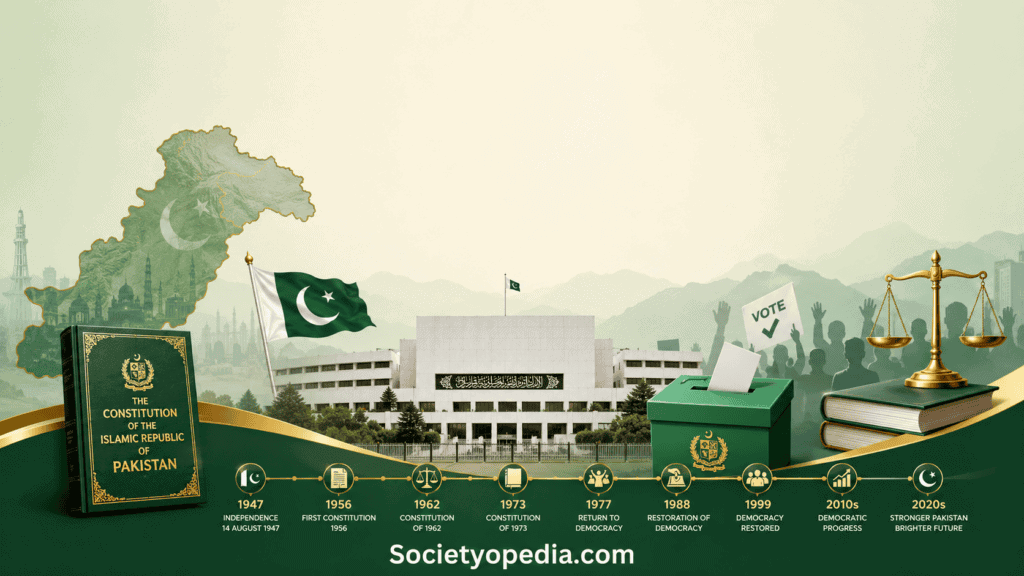
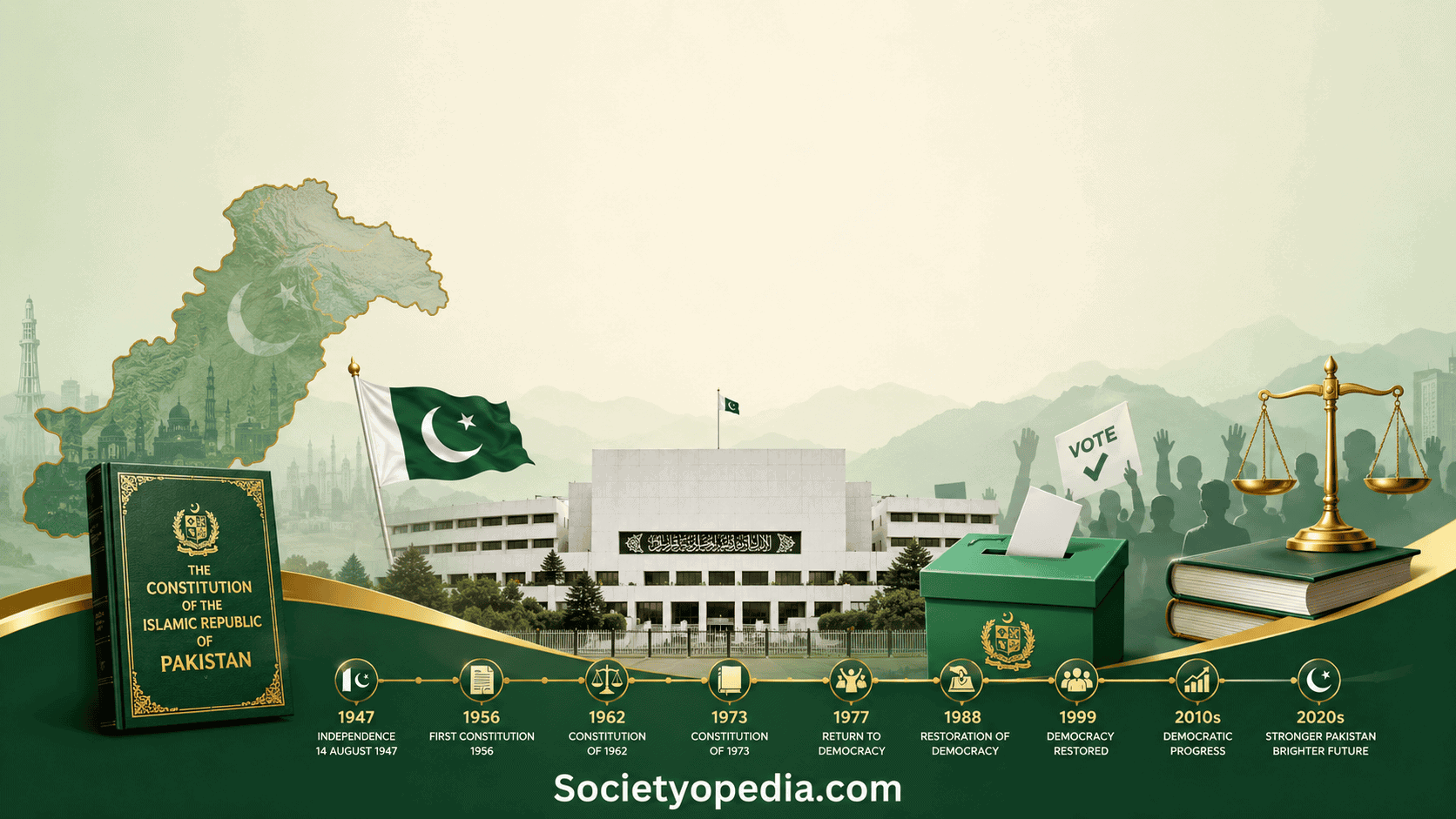
Since its independence on 14 August 1947, Pakistan has experienced numerous political developments that have shaped its constitutional structure, democratic institutions, civil-military relations, and governance. The country’s political history includes constitutional changes, military interventions, democratic transitions, judicial activism, electoral reforms, and significant political movements. These developments continue to influence Pakistan’s political system and its socio-economic progress.
Independence of Pakistan (1947)
Pakistan emerged as an independent state on 14 August 1947 following the partition of British India. Muhammad Ali Jinnah became the first Governor-General, while Liaquat Ali Khan became the country’s first Prime Minister. The newly established state faced enormous challenges, including refugee rehabilitation, administrative restructuring, financial shortages, and disputes with India over Kashmir.
Objectives Resolution (1949)
One of Pakistan’s earliest constitutional milestones was the passage of the Objectives Resolution on 12 March 1949. Introduced by Prime Minister Liaquat Ali Khan, it declared that sovereignty belongs to Almighty Allah while authority would be exercised by the people through their elected representatives. The resolution became the guiding constitutional framework for future constitutions and remains part of Pakistan’s constitutional foundation.
Assassination of Liaquat Ali Khan (1951)
On 16 October 1951, Prime Minister Liaquat Ali Khan was assassinated during a public meeting in Rawalpindi. His death created political instability and marked the beginning of frequent leadership changes during Pakistan’s early years.
First Constitution of Pakistan (1956)
After years of constitutional debates, Pakistan adopted its first Constitution on 23 March 1956. The constitution declared Pakistan an Islamic Republic and established a parliamentary system of government with a President as Head of State and a Prime Minister as Head of Government. However, the constitution remained in force for only about two years before being suspended.
First Martial Law (1958)
Political instability led President Iskander Mirza to impose martial law on 7 October 1958. Shortly afterward, Army Chief Muhammad Ayub Khan removed Iskander Mirza and assumed power, marking Pakistan’s first military government. This event significantly increased the military’s role in national politics.
Constitution of 1962
General Ayub Khan introduced a new Constitution in 1962, replacing the parliamentary system with a presidential form of government. The constitution introduced the “Basic Democracies” system and centralized executive authority in the presidency. Although it aimed to provide political stability, critics argued that it limited democratic participation.
General Elections of 1970
Pakistan held its first general elections based on universal adult franchise in 1970. The Awami League won a majority of seats, primarily in East Pakistan, while the Pakistan Peoples Party secured the largest number of seats in West Pakistan. Political disagreements over the transfer of power intensified the constitutional crisis.
Separation of East Pakistan and Creation of Bangladesh (1971)
Political conflict, civil war, and military intervention by India resulted in the separation of East Pakistan in December 1971, leading to the creation of Bangladesh. The event represented one of the most significant political and constitutional crises in Pakistan’s history and led to major institutional reforms.
Constitution of 1973
The Constitution of 1973 remains Pakistan’s current constitution. It established a federal parliamentary democratic system, guaranteed fundamental rights, recognized provincial autonomy, and defined the powers of the executive, legislature, and judiciary. Despite numerous amendments, it continues to serve as the country’s supreme law.
Military Coup of 1977
Following allegations of electoral irregularities in the 1977 general elections, widespread protests occurred across the country. On 5 July 1977, General Muhammad Zia-ul-Haq overthrew Prime Minister Zulfikar Ali Bhutto and imposed martial law. This period witnessed significant constitutional amendments and Islamization policies.
Restoration of Democracy (1988)
After General Zia-ul-Haq’s death in a plane crash in 1988, Pakistan returned to civilian rule through general elections. Benazir Bhutto became the first woman Prime Minister of Pakistan and the first woman to lead a Muslim-majority country through democratic elections.
Nuclear Tests (1998)
In May 1998, Pakistan conducted nuclear tests at Chagai in response to India’s nuclear tests. Although primarily a strategic and security development, the decision also had profound political consequences by strengthening Pakistan’s defense policy and international standing while triggering economic sanctions.
Military Coup of 1999
On 12 October 1999, General Pervez Musharraf removed Prime Minister Nawaz Sharif from office through a military coup. Musharraf later assumed the presidency and introduced several constitutional and administrative reforms before elections gradually restored civilian institutions.
Lawyers’ Movement (2007)
The Lawyers’ Movement began after the suspension of Chief Justice Iftikhar Muhammad Chaudhry in 2007. Lawyers, political parties, civil society organizations, and media outlets demanded judicial independence and constitutional rule. The movement significantly strengthened Pakistan’s judiciary and democratic institutions.
Democratic Transition (2008)
General elections held in 2008 marked the end of military-led government and the restoration of civilian democratic rule. The peaceful transfer of power represented an important milestone in Pakistan’s democratic development.
Eighteenth Constitutional Amendment (2010)
The 18th Constitutional Amendment is widely regarded as one of Pakistan’s most significant constitutional reforms. It restored parliamentary democracy, reduced presidential powers, strengthened provincial autonomy through greater devolution, enhanced judicial independence, and reinforced democratic institutions.
Peaceful Transfer of Democratic Power (2013)
The 2013 General Elections resulted in Pakistan’s first democratic transition in which one elected civilian government completed its constitutional term and peacefully transferred power to another elected civilian government. This event strengthened democratic continuity in Pakistan.
Rise of New Political Forces (2018)
The 2018 General Elections resulted in the formation of a government led by Imran Khan and the Pakistan Tehreek-e-Insaf. The elections highlighted the growing influence of younger voters, digital political campaigns, and social media in Pakistan’s political landscape.
Vote of No Confidence and Political Realignment (2022)
In April 2022, Prime Minister Imran Khan was removed through a parliamentary vote of no confidence—the first successful use of this constitutional mechanism against a Pakistani prime minister. A coalition government subsequently took office, reflecting the continuing evolution of parliamentary politics in Pakistan.
Continuing Democratic Evolution
Pakistan’s political system continues to evolve through elections, constitutional reforms, judicial decisions, provincial governance, electoral reforms, and debates over civil-military relations. Political competition among major parties, greater public participation, expanding media, and digital communication continue to shape the country’s democratic process.
Conclusion
Pakistan’s political history has been marked by constitutional development, periods of military rule, democratic transitions, judicial activism, and institutional reforms. From independence in 1947 to contemporary democratic politics, each major political development has shaped the country’s governance structure and constitutional framework. Understanding these developments is essential for students of political science, sociology, Pakistan Studies, and public administration, as they offer valuable insights into the evolution of democracy, state institutions, and political processes in Pakistan.