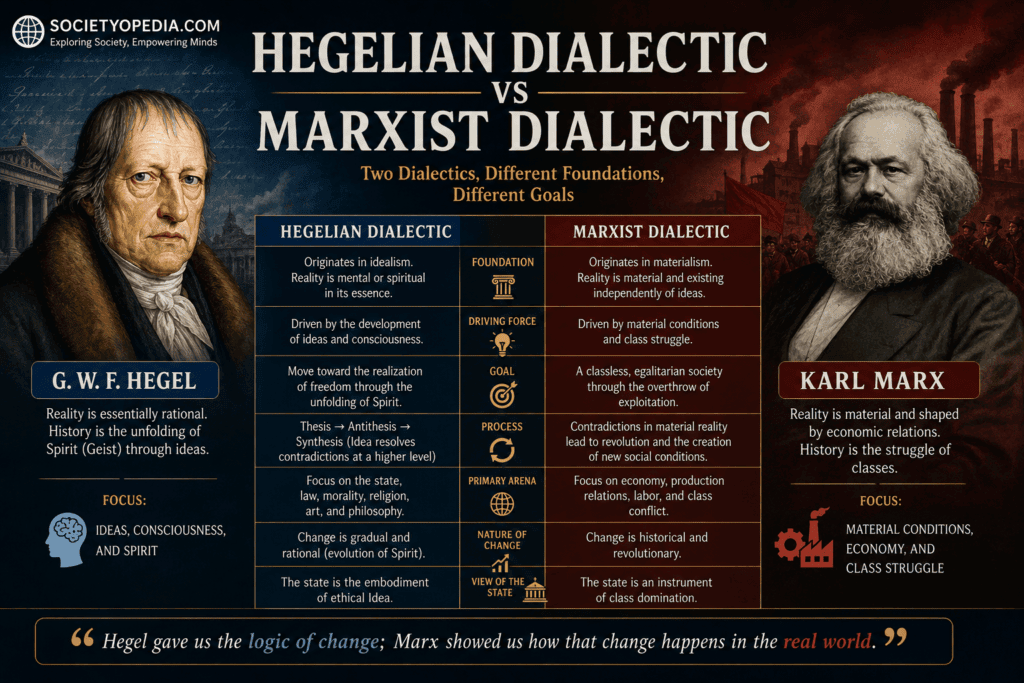
Hegelian Dialectic vs Marxist Dialectic is one of the most important comparisons in philosophy and social theory. Georg Wilhelm Friedrich Hegel and Karl Marx are closely associated because Marx was deeply influenced by Hegel’s dialectical approach. However, Marx did not simply adopt Hegel’s philosophy. He fundamentally transformed it.
The central difference is often explained as idealism versus materialism. Hegel’s dialectical philosophy developed within German Idealism and focused on the development of concepts, consciousness, Spirit, and freedom. Marx retained the importance of development, contradiction, and historical transformation but placed these processes within a materialist analysis of production, economic relations, class structures, and social life.
This difference has had major consequences for philosophy, sociology, political theory, historical sociology, conflict theory, and critical theory.
Understanding the relationship between Hegel and Marx is therefore essential for students studying social change. Both thinkers rejected static understandings of reality. Both examined development and contradiction. However, they disagreed fundamentally about the relationship between consciousness, material conditions, history, and social transformation.
This article explains the major differences and similarities between Hegelian dialectic and Marxist dialectic while distinguishing Hegel’s original philosophy from later Marxist concepts such as dialectical materialism.

Who Were Hegel and Marx?
Georg Wilhelm Friedrich Hegel was a German philosopher and one of the most important figures in German Idealism. His philosophy addressed logic, consciousness, self-consciousness, recognition, freedom, history, social institutions, religion, art, and philosophy.
Karl Marx was a nineteenth-century philosopher, political economist, and social theorist whose work examined capitalism, class relations, labor, exploitation, historical development, and social transformation.
Marx studied Hegel’s philosophy closely and was initially associated with the Young Hegelians, a group of thinkers who interpreted Hegel’s ideas critically in relation to religion, politics, and society.
However, Marx increasingly rejected Hegel’s idealist philosophical foundation.
Marx retained dialectical development but argued that social life should be understood through material and social relations, particularly economic production and class relations.
Hegel’s Philosophy of History: Meaning, Freedom, Spirit & Development
What Is Hegelian Dialectic?
Hegelian dialectic is a philosophical approach to understanding development through relationships, contradiction, negation, and transformation.
Hegel did not present his philosophy as a simple universal formula of:
Thesis → Antithesis → Synthesis
This popular model may help beginners understand dialectical development, but it should not be treated as Hegel’s exact terminology.
Hegel’s actual dialectical philosophy involves concepts such as:
- Contradiction
- Negation
- Determinate negation
- Mediation
- Development
- Aufhebung
- Consciousness
- Recognition
- Spirit
- Freedom
A central Hegelian insight is that concepts and forms of consciousness can reveal limitations within themselves.
These limitations contribute to further development.
The process is not simply an external conflict between two separate ideas.
The contradiction can emerge from within a particular determination.
What Is Marxist Dialectic?
Marxist dialectic refers to Marx’s transformation of dialectical thinking into an analysis of material and social life.
Marx did not simply reject Hegel’s dialectical approach.
Instead, Marx argued that Hegel’s idealism needed to be fundamentally transformed.
Marx placed greater emphasis on:
- Material production
- Economic structures
- Labor
- Property relations
- Class conflict
- Social institutions
- Historical change
For Marx, ideas and consciousness cannot be understood entirely independently of material and social conditions.
Human beings must produce the means necessary for life.
Production creates relationships among people.
These relationships become part of broader social structures.
Therefore, historical development involves changes in the material organization of society.
The Central Difference: Idealism vs Materialism
The most important distinction between Hegel and Marx concerns idealism and materialism.
Hegel’s Idealism
Hegel’s philosophy is generally understood within the tradition of German Idealism.
This does not mean that Hegel believed the physical world was imaginary.
Rather, his philosophical system gives central importance to concepts, reason, Spirit, consciousness, and the intelligibility of reality.
Hegel examines how forms of consciousness and conceptual understanding develop.
History is connected with the development of Spirit and freedom.
Marx’s Materialism
Marx rejected the idea that history could primarily be explained through the development of Spirit or consciousness.
For Marx, human beings are material beings who must produce food, shelter, clothing, and other necessities.
The organization of production creates economic and social relationships.
These relationships influence broader institutions and forms of consciousness.
Marx therefore examined historical development through changing modes of production and social relations.
Hegel’s Famous Influence on Marx
Marx famously acknowledged his intellectual relationship with Hegel.
In the afterword to the second German edition of Capital, Marx described his dialectical method as standing in opposition to Hegel’s idealist approach while also recognizing Hegel as an important predecessor.
Marx argued that Hegel’s dialectic needed to be placed on a material foundation.
This relationship is often simplified through the phrase that Marx “turned Hegel upside down” or “right side up.”
The phrase captures a general difference but should not replace careful study.
Marx did not simply reverse every Hegelian idea.
He selectively transformed dialectical thinking for the analysis of material society.
Hegel and Marx on History
Both Hegel and Marx considered history a process of development.
However, they explained historical development differently.
| Hegel | Marx |
|---|---|
| History connected with Spirit | History connected with material social relations |
| Development of consciousness and freedom | Development of modes of production |
| Social institutions connected with ethical life | Social institutions connected with class and economic relations |
| Contradiction contributes to development | Material and class contradictions drive historical change |
| Philosophical Idealism | Historical Materialism |
Hegel emphasized the historical development of freedom.
Marx emphasized the historical transformation of economic and social systems.
Both rejected the idea that history consists of completely disconnected events.
However, their explanations of historical causation differ substantially.
Contradiction in Hegel and Marx
Contradiction is important to both thinkers.
Contradiction in Hegel
In Hegelian philosophy, contradiction is connected with the internal limitations of concepts and forms of consciousness.
A determination may reveal that it cannot remain complete or self-sufficient.
The contradiction contributes to further development.
Contradiction in Marx
Marx examined contradictions within material and social structures.
For example, capitalism involves relationships between capital and labor.
Marx analyzed tensions connected with ownership, production, accumulation, wages, and class interests.
The contradiction is therefore not primarily a contradiction between abstract ideas.
It is connected with social relationships and material organization.
This difference is crucial for understanding Hegelian dialectic vs Marxist dialectic.
Consciousness and Material Conditions
Hegel gave central importance to consciousness.
His Phenomenology of Spirit examines the development of consciousness through different forms of experience and self-understanding.
Marx did not deny the importance of consciousness.
However, Marx argued that consciousness must be understood in relation to social and material life.
Human beings develop ideas within particular historical and social conditions.
Economic organization, class relations, institutions, and material production influence social consciousness.
This does not mean that Marx believed ideas are unimportant.
Political movements, ideology, philosophy, and culture all matter.
The difference is that Marx places ideas within broader material and social relationships.
The Role of Labor
Labor is important in both Hegel and Marx.
In Hegel’s Master–Slave dialectic, labor contributes to the development of self-consciousness.
The bondsman transforms the external world through work and encounters the results of purposeful activity.
Marx developed a much broader analysis of labor.
For Marx, labor is central to human production and social organization.
However, under capitalism, labor can also become alienated.
Workers may not control:
- The products they create
- The conditions of production
- Their productive activity
- The economic organization of their work
Marx therefore transformed philosophical discussions of labor into a systematic analysis of economic and class relations.
The Master–Slave Dialectic and Class Conflict
Hegel’s Master–Slave dialectic and Marx’s theory of class conflict are sometimes treated as identical.
They are not.
Hegel’s discussion is a philosophical examination of self-consciousness, recognition, domination, and labor.
Marx’s class analysis concerns historically specific relationships involving economic production, property, exploitation, and class interests.
Nevertheless, Hegel’s analysis influenced Marxist thinking because it demonstrated how relationships of domination can contain dependence and internal tensions.
| Master–Slave Dialectic | Marxist Class Conflict |
| Philosophical analysis of self-consciousness | Social and economic analysis |
| Focus on recognition | Focus on class relations |
| Labor develops consciousness | Labor produces material wealth |
| Relationship of domination and dependence | Relationship of exploitation and class power |
| Part of Hegel’s idealist system | Part of Marxist materialist analysis |
The two approaches can be compared, but they should not be treated as identical.
Social Change in Hegel and Marx
Both Hegel and Marx were concerned with transformation.
Hegel understood development through changing forms of consciousness, institutions, and freedom.
Marx focused on transformations in modes of production and class relationships.
For example, Marx examined the historical development of societies through changing economic systems.
Class conflict plays an important role in this process.
Marx famously argued that the history of existing societies is connected with struggles between classes, although the specific forms of class relations differ historically.
Hegel did not develop a comparable general theory in which class struggle serves as the universal motor of history.
This is another important difference.
The State and Society
Hegel developed a detailed political philosophy examining the relationship between the individual, civil society, and the state.
For Hegel, freedom requires institutional forms.
The family, civil society, law, and political institutions all play roles within ethical life.
Marx took a more critical approach to the state.
Marx examined political institutions in relation to class structures and material interests.
Marxist theory later developed extensive analyses of how states can be connected with economic power and class relations.
Therefore, while Hegel viewed rational institutions as potentially important expressions of freedom, Marx focused more strongly on structural inequalities and class power.
Hegelian Dialectic and Historical Materialism
Historical materialism is associated primarily with Marx and Friedrich Engels.
It examines historical development through material conditions and changing modes of production.
A simplified framework includes:
- Productive forces
- Relations of production
- Economic structures
- Social classes
- Political institutions
- Historical transformation
Historical materialism does not mean that culture, politics, or ideas are irrelevant.
Rather, Marxist analysis examines how these dimensions interact with material and economic structures.
Hegel’s philosophy does not contain historical materialism.
The distinction should therefore remain clear.
What Is Dialectical Materialism?
The term dialectical materialism became particularly important in later Marxist traditions, especially through Friedrich Engels and subsequent Marxist thinkers.
It is often used to describe a philosophical approach that combines dialectical development with materialism.
However, students should distinguish between:
- Hegel’s original dialectical philosophy
- Marx’s own writings
- Engels’s philosophical formulations
- Later Marxist interpretations
These traditions are historically connected but should not automatically be treated as identical.
The history of Marxism includes substantial debates about what dialectics means and how it should be applied.
Similarities Between Hegelian and Marxist Dialectics
Despite major differences, there are important similarities.
Both Reject Static Thinking
Neither Hegel nor Marx understood reality as completely fixed.
Both examined processes of development and transformation.
Both Emphasize Contradiction
Contradiction plays an important role in explaining change.
However, the nature of contradiction differs between their systems.
Both Take History Seriously
Both thinkers understood historical development as essential for understanding present social conditions.
Both Examine Relationships
Hegel examined relationships between consciousness, recognition, and institutions.
Marx examined relationships between classes, production, and economic structures.
Both Influenced Social Theory
Their ideas contributed significantly to philosophy, sociology, political theory, historical sociology, conflict theory, and critical theory.
Key Differences at a Glance
| Area | Hegelian Dialectic | Marxist Dialectic |
| Philosophical foundation | German Idealism | Materialism |
| Primary focus | Spirit, consciousness, concepts | Material conditions and social relations |
| History | Development of freedom | Development of modes of production |
| Contradiction | Internal conceptual and social tensions | Material and class contradictions |
| Labor | Development of consciousness | Production and economic life |
| Social conflict | Important but not universal class theory | Central role of class conflict |
| State | Potential institutional realization of freedom | Analyzed critically in relation to class society |
| Major goal | Development and realization of freedom | Analysis and transformation of class society |
Importance for Sociology
The comparison between Hegel and Marx is highly important for sociology.
Hegel contributed philosophical ideas about:
- Historical development
- Recognition
- Social institutions
- Freedom
- Civil society
- Contradiction
Marx contributed major theories of:
- Class
- Capitalism
- Labor
- Exploitation
- Inequality
- Historical materialism
- Social conflict
Together, their intellectual traditions helped establish important foundations for the sociological study of social change.
However, sociology should not treat either thinker as providing a single universal explanation of society.
Contemporary social research often combines historical, economic, cultural, institutional, and political explanations.
Strengths of the Hegelian Approach
Hegelian dialectic provides a powerful way of examining:
- Development
- Consciousness
- Recognition
- Freedom
- Historical change
- Relationships among institutions
Its major strength is its emphasis on the dynamic nature of reality.
Hegel encourages students to ask how concepts and institutions develop rather than treating them as permanently fixed.
Strengths of the Marxist Approach
Marxist dialectic provides powerful tools for examining:
- Economic inequality
- Class relations
- Labor
- Capitalism
- Material conditions
- Social conflict
Its major strength is the connection between philosophical analysis and concrete social structures.
Marxist approaches ask how ownership, production, and economic power influence society.
Criticisms and Limitations
Both approaches have been criticized.
Criticisms of Hegel
Hegel’s philosophy is highly abstract and difficult.
His philosophy of history has also been criticized for Eurocentrism and teleological assumptions.
Criticisms of Marx
Marxist theory has been criticized for economic reductionism when interpreted in overly narrow ways.
Some critics argue that class and economic structures cannot fully explain culture, identity, gender, nationalism, religion, and other social processes.
Other Marxist thinkers have themselves developed more complex approaches to address these issues.
The limitations of both traditions demonstrate the importance of critical interpretation.
Contemporary Relevance
The comparison between Hegelian and Marxist dialectics remains relevant because modern societies continue to experience rapid transformation.
Economic inequality remains a major issue.
Technology is changing work and production.
Political movements challenge existing institutions.
Questions of identity and recognition remain important.
A Hegelian approach may emphasize recognition, consciousness, freedom, and institutional development.
A Marxist approach may emphasize economic structures, labor, class, and material inequality.
Both perspectives can therefore contribute different questions to the study of contemporary society.
Frequently Asked Questions
What is the main difference between Hegelian and Marxist dialectic?
The main difference is that Hegel’s dialectic developed within German Idealism and emphasized Spirit, consciousness, and conceptual development, while Marx transformed dialectical thinking into a materialist analysis of production, class relations, and social structures.
Did Marx reject Hegel completely?
No. Marx was strongly influenced by Hegel’s dialectical approach but rejected Hegel’s idealist philosophical foundation and transformed dialectics within a materialist framework.
Is thesis, antithesis, and synthesis used by both Hegel and Marx?
The formula is a popular simplification and should not be treated as the exact universal method of either thinker. Both Hegelian and Marxist dialectics are more complex.
What is idealism in Hegel’s philosophy?
Hegelian idealism gives central importance to concepts, reason, consciousness, and Spirit in understanding reality and historical development.
What is materialism in Marx’s philosophy?
Marxist materialism emphasizes material life, production, economic relationships, and social structures in understanding historical development.
What is the role of contradiction in Marxism?
Marxist analysis examines contradictions within material and social relationships, particularly tensions connected with production, class interests, property, and economic organization.
How did Hegel influence sociology?
Hegel influenced social theory through his ideas about history, freedom, recognition, institutions, civil society, and contradiction.
How did Marx influence sociology?
Marx contributed major theories of class, capitalism, labor, inequality, exploitation, conflict, and historical materialism.
Conclusion
Hegelian Dialectic vs Marxist Dialectic represents one of the most significant intellectual transformations in modern philosophy and social theory.
Hegel developed a dialectical philosophy within German Idealism that examined consciousness, contradiction, recognition, Spirit, freedom, and historical development. Marx adopted important elements of dialectical thinking but transformed them into a materialist analysis of society, emphasizing production, labor, class relations, and economic structures.
Their major difference can therefore be summarized as the contrast between Hegel’s idealist philosophical framework and Marx’s materialist approach to historical and social development.
Despite this difference, both thinkers shared an important insight: reality is dynamic rather than static. Social and historical forms change, and contradictions can contribute to transformation.