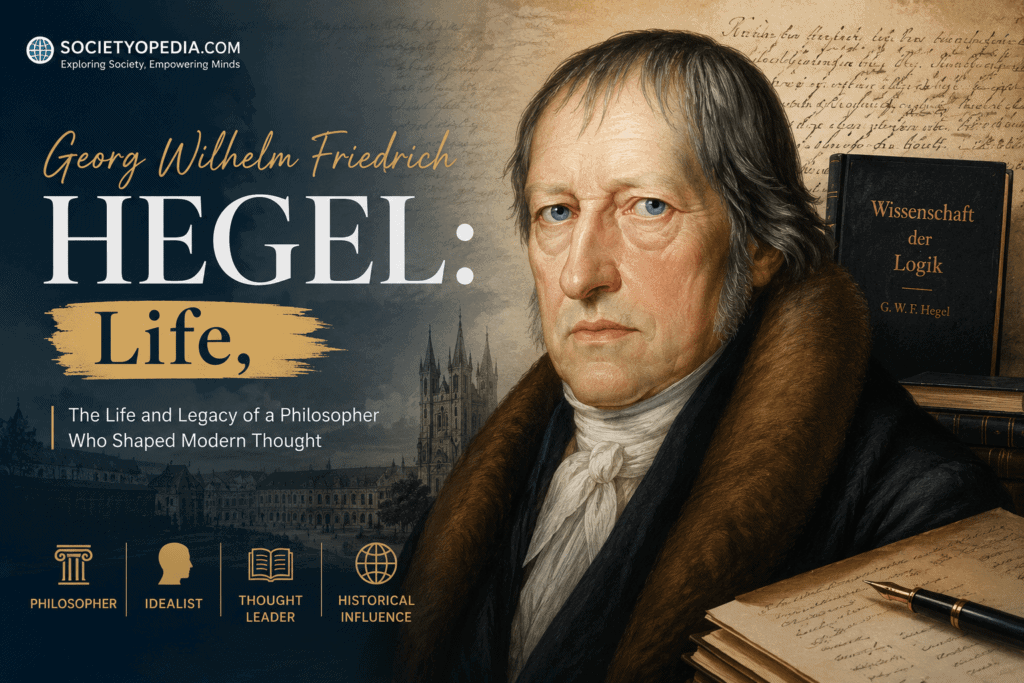
Georg Wilhelm Friedrich Hegel was one of the most influential philosophers of the nineteenth century and a central figure in German Idealism. Born in Stuttgart in 1770 and dying in Berlin in 1831, Hegel developed a highly systematic philosophy concerned with reason, consciousness, freedom, history, society, and the development of Spirit. His ideas influenced philosophy as well as sociology, political theory, Marxism, historical sociology, critical theory, and later theories of recognition.
Hegel is particularly famous for his dialectical approach, although the popular description of his method as simply “thesis, antithesis, synthesis” is an oversimplification. His actual philosophical method is more complex and involves concepts such as contradiction, negation, development, mediation, and Aufhebung.
His philosophy can be difficult to understand because Hegel attempted to construct an interconnected philosophical system rather than presenting isolated theories. His discussions of consciousness, self-consciousness, freedom, history, society, politics, religion, art, and logic are therefore closely connected.
For readers beginning this topic, this article complements the main [What Is Hegelian Dialectic?] article by focusing specifically on Hegel’s life, intellectual development, major philosophical ideas, and long-term influence.
Who Was Georg Wilhelm Friedrich Hegel?
Georg Wilhelm Friedrich Hegel was born on August 27, 1770, in Stuttgart, in the Duchy of Württemberg. He studied at the University of Tübingen from 1788 to 1793, where he studied theology and philosophy. During this period, he became close friends with Friedrich Hölderlin and Friedrich Wilhelm Joseph Schelling, both of whom became important figures in German intellectual life.
After completing his studies, Hegel worked as a private tutor in Switzerland and Frankfurt. During these years he developed interests in religion, politics, social life, and the intellectual legacy of Immanuel Kant.
In 1801, Hegel moved to Jena and joined Schelling. His early philosophical publications were strongly connected with the debates surrounding Kant, Fichte, and Schelling. His philosophical independence became increasingly clear with the publication of Phenomenology of Spirit in 1807.
After the disruption of the University of Jena during the Napoleonic occupation, Hegel worked as a newspaper editor in Bamberg and later became headmaster and philosophy teacher at a gymnasium in Nuremberg. During this period, he married and started a family while also developing his mature philosophical system.
In 1816, Hegel became professor of philosophy at the University of Heidelberg. Two years later, he moved to the University of Berlin, where he became one of the most prominent philosophers of his time. He remained in Berlin until his death in 1831.
Hegel’s Major Works
Hegel’s philosophy is spread across several major works. Understanding these works helps explain the development of his ideas.
| Major work | Date | Main focus |
|---|---|---|
| Phenomenology of Spirit | 1807 | Consciousness, self-consciousness, recognition, Spirit |
| Science of Logic | 1812–1816 | Logic, concepts, contradiction, development |
| Encyclopaedia of the Philosophical Sciences | 1817, revised later | Hegel’s systematic philosophy |
| Elements of the Philosophy of Right | 1821 | Freedom, morality, civil society, state |
| Lectures on the Philosophy of History | Published posthumously | History, freedom, Spirit |
| Lectures on Aesthetics | Published posthumously | Art and aesthetic development |
| Lectures on the Philosophy of Religion | Published posthumously | Religion and Spirit |
The distinction between Hegel’s published books and works reconstructed from lectures is important. Several influential texts on history, religion, aesthetics, and the history of philosophy were published after his death from lecture materials and student notes.
Hegel’s Philosophical Background
Hegel belongs to the tradition known as German Idealism, which developed in the aftermath of Immanuel Kant’s critical philosophy.
Kant had argued that human beings do not simply receive reality passively. Human cognition involves structures through which experience becomes intelligible. Later thinkers, including Johann Gottlieb Fichte, Schelling, and Hegel, attempted to develop and transform these ideas.
Hegel sought a comprehensive philosophical system capable of explaining relationships among thought, reality, nature, consciousness, society, history, and freedom.
This is why Hegelian philosophy should not be reduced to the dialectic alone. The dialectical method is part of a much larger philosophical system.
What Is Hegelian Philosophy?
Hegelian philosophy is fundamentally concerned with development.
Hegel rejected the idea that philosophical concepts could always be understood adequately as isolated, fixed entities. Instead, he examined how concepts relate to one another and how their limitations can generate further development.
This approach is particularly important in his Science of Logic, where categories such as Being, Nothing, Becoming, Essence, and Concept are developed through systematic relationships.
A central principle is that something can contain tensions that expose the limitations of its initial form. Through negation, it can develop into something more comprehensive.
This is why contradiction is so important in Hegelian philosophy.
Contradiction is not merely an error in reasoning. Within Hegel’s dialectical framework, contradiction can reveal that a determination is incomplete and therefore requires further development.
Hegel’s Dialectical Method
Hegel’s dialectic is perhaps his most famous philosophical contribution.
A common introductory explanation describes dialectical development as:
Thesis → Antithesis → Synthesis
However, this formula should be used cautiously. Hegel did not present his philosophy as a universal mechanical formula called “thesis, antithesis, synthesis.” His actual discussions involve the movement of determinations through contradiction, negation, and development.
One of the more accurate concepts for understanding Hegel is determinate negation.
When something is negated, the result is not necessarily simple destruction. The negation can produce a specific new determination that retains and transforms aspects of what came before.
This process is related to the German concept Aufhebung, which can convey meanings including overcoming, cancellation, preservation, and elevation.
For a detailed explanation, readers can explore the related article [Hegelian Dialectic: Meaning, Principles, and Development].
Consciousness and Self-Consciousness
One of Hegel’s most important concerns was the development of consciousness.
In Phenomenology of Spirit, Hegel presents a complex progression through different forms or “shapes” of consciousness. The work begins with forms of consciousness that initially appear immediate and develops toward more sophisticated forms of self-consciousness, reason, and Spirit.
Hegel’s argument is not simply that people acquire more information over time. Rather, consciousness discovers limitations within its own ways of understanding the world.
The development of consciousness therefore involves transformation in how a subject understands both itself and reality.
This makes Hegel especially important for later philosophical approaches that examine the relationship between individual consciousness and social relationships.
The Master-Slave Dialectic
The Master-Slave dialectic is one of Hegel’s most famous discussions.
It appears in the section on self-consciousness in Phenomenology of Spirit. Hegel examines the struggle between self-conscious beings seeking recognition from one another.
The relationship develops into a situation in which one becomes the master and the other becomes the slave. At first, the master appears to have achieved superiority.
However, the relationship contains a contradiction. The master’s recognition comes from someone who has been subordinated. Consequently, the recognition is not the equal recognition that genuine self-consciousness requires.
The slave, meanwhile, develops through work, discipline, and engagement with the material world.
The broader significance of this discussion lies in Hegel’s argument that self-consciousness and human freedom are deeply connected with recognition by others.
The Master-Slave dialectic later became highly influential in Marxist thought, existentialism, social philosophy, and theories of recognition.
Recognition and Social Relationships
Recognition is one of the most socially significant ideas associated with Hegel.
Human beings are not simply isolated individuals. Their sense of themselves develops through relationships with other self-conscious beings.
Recognition therefore involves more than receiving praise or approval. It concerns the social acknowledgment of another person as a free and independent subject.
This idea has had a particularly strong influence on later social philosophy.
It also provides an important bridge between Hegelian philosophy and sociology, because it directs attention toward relationships, social status, identity, institutions, and patterns of inclusion and exclusion.
Hegel’s Concept of Freedom
Freedom occupies a central position in Hegel’s social and political philosophy.
For Hegel, freedom cannot be adequately understood as simply doing whatever one wants. Genuine freedom requires conditions in which individuals can recognize themselves as autonomous persons while participating in rational social institutions.
This is one reason Hegel devoted considerable attention to property, morality, family, civil society, law, and the state.
His Elements of the Philosophy of Right, published in 1821, is his major published work of political philosophy. It develops a systematic account of freedom and its institutional realization.
Hegel’s approach therefore connects individual freedom with social institutions.
This remains important for sociology because it raises questions about whether formal rights alone are sufficient for meaningful freedom.
Hegel’s Philosophy of History
Hegel’s philosophy of history is one of his most influential and controversial ideas.
He viewed history as involving the development of human freedom and self-consciousness. Different historical societies represent different forms through which Spirit and freedom become expressed.
Hegel therefore rejected the idea that history is simply a random sequence of unrelated events.
Instead, he attempted to understand historical development philosophically.
His approach has influenced historical sociology because it emphasizes the relationship between historical circumstances, social institutions, ideas, and forms of consciousness.
However, Hegel’s philosophy of history has also been criticized for its Eurocentrism and for presenting historical development in a strongly developmental framework.
Students should therefore distinguish between studying Hegel’s historical theory and accepting all of its historical claims.
Absolute Spirit
Absolute Spirit is one of the most advanced concepts in Hegelian philosophy.
Hegel’s system distinguishes among forms of Spirit, culminating in Absolute Spirit. In the Encyclopaedia, Absolute Spirit is associated particularly with art, religion, and philosophy.
These forms represent increasingly developed ways in which Spirit comes to comprehend itself.
Art presents truth through sensuous form.
Religion presents truth through representation.
Philosophy expresses truth through conceptual thought.
This does not mean that Hegel simply believed philosophy was “better” than art or religion in every ordinary sense. Rather, he assigned them different forms of expression and comprehension within his philosophical system.
What Is Hegelian Dialectic? Meaning, Principles, Stages, and Importance
Hegel and Social Institutions
Hegel’s social philosophy is especially important for understanding his influence on sociology.
He analyzed society through interconnected institutions rather than treating the individual as completely independent of social life.
Three particularly important elements in his political philosophy are:
Family: A sphere of immediate ethical unity and social belonging.
Civil society: A sphere involving economic activity, needs, interests, social differentiation, and institutional relationships.
State: A political institution through which Hegel believed freedom could achieve a more universal and institutional form.
Hegel’s analysis of civil society is particularly significant because it recognizes that modern society involves competing interests and economic relationships that cannot simply be reduced to family relationships or political authority.
Hegel and Marx
Hegel’s influence on Karl Marx was profound.
Marx adopted and transformed aspects of Hegelian dialectical thinking. However, Marx rejected Hegel’s idealist framework and developed a materialist approach to social and historical development.
A simplified comparison is useful:
| Hegel | Marx |
| German Idealism | Historical/materialist approach |
| Emphasis on Spirit, consciousness, and concepts | Emphasis on material and social relations |
| Historical development linked to freedom and Spirit | Historical development analyzed through production and class relations |
| Dialectical development of concepts and social forms | Dialectical analysis of material and social contradictions |
| Major influence on Marx’s method | Transformation and criticism of Hegel |
Marx famously regarded his own dialectical approach as standing Hegel’s dialectic on a different foundation. Consequently, Hegel and Marx should not be treated as presenting identical theories.
Marx’s transformation of Hegel became foundational for later Marxism, theories of class conflict, critical theory, and historical sociology.
Hegel and Sociology
Hegel was not a sociologist in the modern disciplinary sense. Sociology emerged as a distinct discipline later in the nineteenth century.
Nevertheless, Hegel influenced social thought in several important ways.
His emphasis on historical development encouraged later thinkers to investigate society as a process rather than a static structure.
His analysis of recognition drew attention to social relationships.
His account of civil society helped develop philosophical approaches to modern social organization.
His understanding of contradiction influenced later theories of social conflict and transformation.
These themes became especially important through thinkers who developed Hegelian ideas in different directions.
For sociology students, Hegel is therefore particularly useful when studying social change, conflict theory, Marxism, historical sociology, social institutions, and critical theory.
Hegel’s View of Contradiction
Contradiction is central to Hegel’s dialectical philosophy.
Suppose a society claims that all individuals possess equal rights but simultaneously maintains institutions that prevent some individuals from exercising those rights equally.
A dialectical approach would investigate the tension between the universal principle and its concrete social realization.
The contradiction does not automatically produce a particular outcome. Instead, it creates a problem that can generate social, political, or conceptual development.
This is an important distinction.
Hegelian dialectic is not a theory that says every contradiction inevitably produces a predetermined historical result. It is better understood as an approach to examining how tensions within concepts and social forms can reveal their limitations and contribute to transformation.
Hegel’s Major Ideas at a Glance
| Major idea | Basic meaning |
| Dialectic | Development through contradiction, negation, and mediation |
| Determinate negation | Negation that produces a specific new determination |
| Aufhebung | Overcoming that can also preserve and transform |
| Consciousness | A developing relationship between subject and world |
| Self-consciousness | Consciousness that becomes aware of itself |
| Recognition | Mutual acknowledgment among self-conscious beings |
| Freedom | Rational self-determination realized within social conditions |
| Spirit | A central organizing concept involving human and social forms of self-consciousness |
| Absolute Spirit | Hegel’s culminating sphere involving art, religion, and philosophy |
| Historical development | Transformation of forms of social and spiritual life |
Why Is Hegel Important?
Hegel’s importance lies partly in the extraordinary range of problems addressed by his philosophy.
He attempted to connect logic with metaphysics, consciousness with social relationships, individual freedom with institutions, and historical development with philosophical understanding.
His influence extends far beyond nineteenth-century German philosophy.
Karl Marx transformed Hegelian ideas into a materialist theory of history. Later Marxists used Hegelian concepts to analyze capitalism and class conflict. Critical theorists drew on Hegel when studying domination, recognition, reason, and social emancipation.
Philosophers concerned with social recognition have also returned to Hegel’s analysis of self-consciousness and intersubjective relations.
The renewed scholarly interest in Hegel since the late twentieth century has also challenged older interpretations that treated him simply as an outdated metaphysical thinker. Contemporary scholarship contains competing interpretations of whether Hegel should primarily be understood as a metaphysician, a post-Kantian philosopher, or a thinker whose arguments can be reconstructed without accepting traditional metaphysical assumptions.
Criticisms of Hegel’s Philosophy
Hegel’s philosophy has generated substantial criticism.
One criticism concerns the difficulty and obscurity of his writing. His terminology is highly technical, and simplified summaries can easily misrepresent his arguments.
Another criticism concerns his philosophy of history. His historical account has been criticized for Eurocentrism and for treating some historical developments within a hierarchical framework.
Hegel’s political philosophy has also been interpreted in competing ways. Some scholars emphasize its defense of institutional freedom and constitutional government, while others criticize aspects of his account of the state.
His idealism was later challenged by materialist thinkers, particularly Marx.
There is therefore no single uncontested interpretation of Hegel.
Hegel’s Influence on Modern Thought
Hegel’s influence can be seen across several intellectual traditions.
| Field | Hegel’s influence |
| Philosophy | Dialectics, idealism, history, logic, consciousness |
| Sociology | Social relationships, institutions, historical development |
| Marxism | Dialectical analysis and historical development |
| Political theory | Freedom, civil society, state, ethical life |
| Critical theory | Contradiction, reason, domination, emancipation |
| Social philosophy | Recognition, identity, freedom |
| Historical sociology | Development and transformation of social structures |
His influence has not always been direct. Many later thinkers criticized Hegel while simultaneously adopting concepts derived from him.
This makes Hegel unusual in modern intellectual history: one can reject Hegel’s conclusions while still thinking through problems that his philosophy helped formulate.
Contemporary Relevance of Hegel
Hegel remains relevant to contemporary discussions about social recognition, freedom, identity, institutions, historical change, and social conflict.
Modern societies continue to experience tensions between individual freedom and collective responsibility, formal equality and actual inequality, individual identity and social recognition, and established institutions and demands for change.
Hegel’s philosophy does not provide simple answers to these problems. Instead, it provides a framework for asking how social and conceptual tensions develop and how apparently opposing positions may be connected.
For sociology students, this is particularly valuable because social reality is rarely static. Institutions change, identities develop, political ideals encounter practical limitations, and social movements challenge existing arrangements.
A Hegelian perspective encourages us to examine these processes historically and relationally.
Frequently Asked Questions
Who was Georg Wilhelm Friedrich Hegel?
Georg Wilhelm Friedrich Hegel was a German philosopher of the late eighteenth and early nineteenth centuries and one of the major figures of German Idealism. He developed a comprehensive philosophical system addressing logic, consciousness, freedom, history, society, art, religion, and philosophy.
What is Hegel best known for?
Hegel is particularly known for his dialectical philosophy, his analysis of consciousness and recognition, his philosophy of history, his theory of freedom, and his systematic account of Spirit.
What are Hegel’s major works?
His most important published works include Phenomenology of Spirit, Science of Logic, Encyclopaedia of the Philosophical Sciences, and Elements of the Philosophy of Right. Important works on history, religion, aesthetics, and the history of philosophy were published posthumously from lecture materials.
What is Hegel’s dialectic?
Hegel’s dialectic is a method and conception of development involving relationships among determinations, contradiction, negation, and transformation. It should not be reduced to the mechanical formula “thesis, antithesis, synthesis.”
What is Hegel’s theory of freedom?
Hegel understands freedom as more than the absence of external restrictions. Freedom involves self-determination and requires appropriate social and institutional conditions in which individuals can participate as recognized members of ethical and political life.
How did Hegel influence Marx?
Hegel strongly influenced Marx’s understanding of dialectical development and history. Marx nevertheless criticized Hegel’s idealism and transformed dialectical analysis within a materialist framework.
Why is Hegel important to sociology?
Hegel influenced later social theory by emphasizing historical development, social relationships, recognition, institutions, contradiction, and freedom. His ideas became particularly influential through Marxism, critical theory, and historical approaches to society.
What is the Master-Slave dialectic?
The Master-Slave dialectic is Hegel’s analysis of self-consciousness and recognition in a relationship of domination. It shows why one-sided recognition is unstable and why genuine recognition involves reciprocal relations between self-conscious beings.
Conclusion
Georg Wilhelm Friedrich Hegel was one of the most important and challenging philosophers of modern European thought. His philosophy attempted to explain how concepts, consciousness, social institutions, and historical forms develop through relationships, contradictions, and transformations.
His most influential ideas include dialectic, contradiction, determinate negation, recognition, self-consciousness, freedom, Spirit, Absolute Spirit, civil society, and historical development.
Hegel’s importance for sociology lies not in the fact that he was a sociologist—he was not—but in the way his philosophy helped establish intellectual foundations for later theories of social change, historical development, conflict, recognition, and institutions.
His influence on Karl Marx was especially significant, although Marx transformed Hegel’s idealist dialectic into a materialist approach. Later Marxism, critical theory, social philosophy, and theories of recognition continued to develop questions that originated in Hegel’s work.
Understanding Georg Wilhelm Friedrich Hegel is therefore essential for students who want to understand the intellectual background of Hegelian dialectic, Marxism, conflict theory, historical sociology, and critical theory. His philosophy remains difficult, contested, and highly influential precisely because it asks a fundamental question: How do thought, society, and history develop through their own internal tensions and relationships?