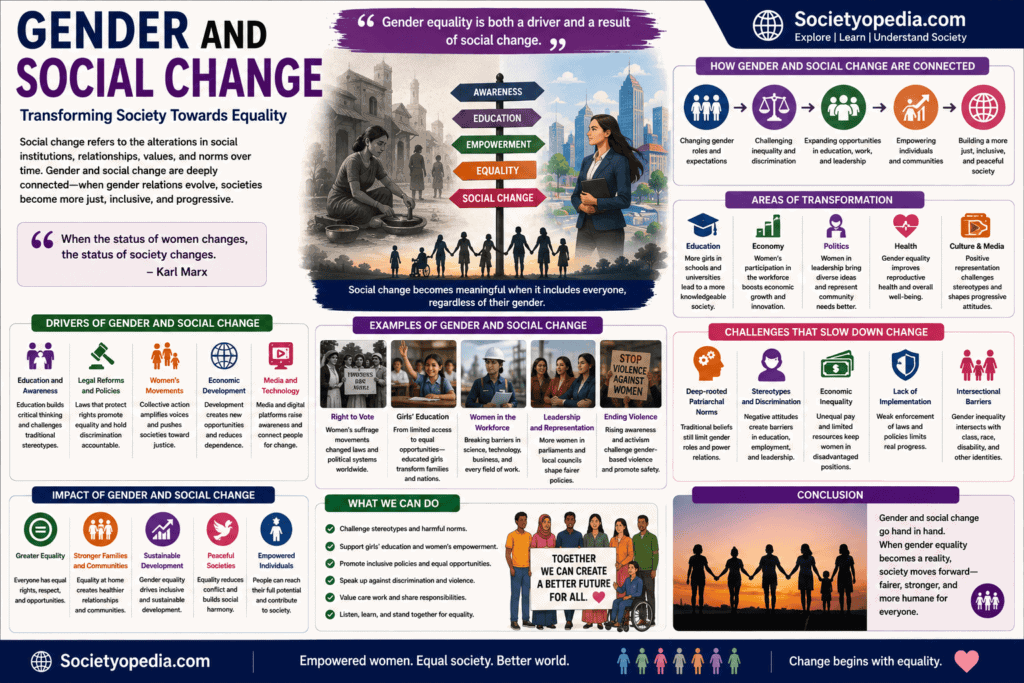
Gender and social change are closely connected. As societies change economically, politically, culturally, and technologically, ideas about gender also change. At the same time, changing gender roles and increasing participation of women and men in different areas of social life can become important forces of broader social transformation.
Gender and social change refers to the relationship between changing gender roles, expectations, inequalities, institutions, and broader transformations in society.
For example, women’s increasing participation in higher education and paid employment has changed family structures, household responsibilities, professional life, and ideas about women’s social roles. Similarly, greater involvement of men in childcare and domestic work can challenge traditional ideas about masculinity.
Gender is therefore not separate from social change. It is both affected by social change and a source of social change.

What Is Social Change?
Social change refers to significant changes in the organization, structure, institutions, relationships, values, norms, and behaviors of a society over time.
Social change can occur because of:
- economic development;
- technological innovation;
- education;
- political movements;
- globalization;
- demographic changes;
- migration;
- social movements;
- changes in laws and policies;
- changes in cultural values.
Social change can happen gradually or rapidly.
The transformation of gender roles is one important dimension of social change.
What Is the Relationship Between Gender and Social Change?
Gender influences social change because gender roles determine how people participate in families, workplaces, politics, education, and other institutions.
When these roles change, social institutions can also change.
For example:
Women’s education → increased employment → greater economic independence → changing family roles → changing gender expectations
Similarly:
Men’s greater participation in childcare → changing ideas about masculinity → more equal division of family responsibilities
This demonstrates that changes in gender relations can influence wider patterns of social organization.
Gender Roles and Social Change
Gender roles are socially constructed expectations concerning how women, men, and people of different genders should behave.
Traditional gender roles often divide responsibilities into categories such as:
- men as economic providers;
- women as caregivers;
- men as leaders;
- women as supporters;
- men as decision-makers;
- women as responsible for household work.
These roles are not identical across all societies or historical periods.
As societies change, gender roles can become more flexible.
Women increasingly participate in professional occupations, politics, entrepreneurship, education, and public life.
Men may increasingly participate in childcare and domestic responsibilities.
Such changes can transform family and workplace relationships.
Women’s Education and Social Change
Education is one of the most important forces connecting gender and social change.
When girls and women gain greater access to education, they can acquire knowledge, professional qualifications, skills, and greater opportunities for economic participation.
Education can influence:
Knowledge → employment → income → independence → decision-making → social change
Women’s education can also influence marriage patterns, fertility decisions, family relationships, political participation, and children’s education.
This does not mean that education automatically eliminates gender inequality.
However, expanded educational opportunities can provide individuals with resources for challenging restrictive gender expectations.
Women’s Employment and Social Change
The growth of women’s participation in paid employment has significantly influenced social relationships.
When women earn their own income, they may gain greater economic independence and bargaining power within households.
Employment can also expand social networks and provide opportunities for professional development and public participation.
Women’s employment can therefore challenge the traditional idea that men should be the primary economic providers.
At the same time, increased employment does not automatically produce equality.
If women continue performing most unpaid household work after entering paid employment, they may experience a double burden.
The Double Burden
The double burden refers to the situation in which a person, particularly women in many societies, is expected to perform both paid employment and a large share of unpaid domestic and caregiving work.
For example, a woman may work eight hours in a professional job and then return home to cook, clean, care for children, and manage household responsibilities.
The double burden demonstrates why women’s participation in employment alone cannot fully explain gender equality.
Social change also requires changes in the distribution of unpaid work.
Men and Changing Family Roles
Gender and social change also involve changes in men’s roles.
Traditional masculinity may emphasize:
- financial provision;
- emotional toughness;
- authority;
- independence;
- competitiveness.
Changing gender relations can encourage men to participate more actively in:
- childcare;
- cooking;
- household management;
- emotional support;
- elder care.
When men participate more equally in family responsibilities, traditional divisions between “male” and “female” roles can become less rigid.
Gender and Family Change
Family structures have changed significantly in many societies.
Changes may include:
- smaller family sizes;
- delayed marriage;
- increased women’s employment;
- greater participation of fathers in childcare;
- increased acceptance of dual-earner households;
- changing expectations about domestic responsibilities.
These changes are influenced by economic development, education, urbanization, technology, and changing cultural values.
Gender relations are both a cause and consequence of these transformations.
Gender and Socialization
Gender socialization refers to the process through which individuals learn cultural expectations about gender.
Children learn gender norms through:
- parents;
- schools;
- peers;
- religion;
- media;
- communities;
- social institutions.
Social change can alter the messages children receive.
For example, a society that once taught girls that their primary role was homemaking may increasingly encourage girls to pursue professional careers.
Similarly, boys may increasingly be encouraged to express emotions and participate in caregiving.
Changing socialization can therefore contribute to long-term changes in gender relations.
Gender and Social Movements
Social movements have played an important role in challenging gender inequality.
Women’s movements have advocated for issues including:
- voting rights;
- educational access;
- employment opportunities;
- equal pay;
- political representation;
- legal equality;
- protection from violence;
- reproductive rights;
- workplace rights.
Feminist movements have particularly influenced public debates about gender, power, discrimination, family, employment, and social institutions.
Social movements demonstrate that gender relations do not simply change automatically. People can actively organize to challenge existing inequalities.
Feminism and Social Change
Feminism is one of the most important intellectual and social movements associated with gender and social change.
Broadly, feminism seeks to understand and challenge gender inequality and promote greater equality.
Different feminist perspectives explain gender inequality differently.
For example, liberal feminism emphasizes equal rights and opportunities.
Marxist and socialist feminist approaches examine the relationship between gender inequality and economic structures.
Radical feminism emphasizes patriarchy and gender-based power relations.
Intersectional feminism examines how gender interacts with other forms of inequality.
Despite differences between feminist approaches, feminist thought has contributed significantly to discussions about gender and social transformation.
Gender and Political Change
Political participation is another important area of gender-related social change.
Women’s participation in voting, political parties, government, local institutions, and leadership has increased in many societies.
Political representation can influence which issues receive attention and how policies are designed.
However, simply increasing the number of women in political institutions does not automatically eliminate gender inequality.
Political systems can continue to contain institutional, cultural, and economic barriers.
Nevertheless, women’s political participation is an important component of broader gender equality.
Gender and Legal Change
Changes in laws can influence gender relations.
Legal reforms may address:
- discrimination;
- equal employment opportunities;
- equal pay;
- inheritance;
- marriage;
- education;
- political participation;
- workplace harassment;
- violence against women.
Legal change can provide formal protections and establish standards for social behavior.
However, laws alone may not immediately change social attitudes.
A society may have formal legal equality while cultural practices continue to produce unequal outcomes.
This is why sociologists distinguish between formal equality and substantive equality.
Formal and Substantive Equality
Formal equality means that people are treated equally under laws or official rules.
Substantive equality focuses on whether people actually have meaningful and comparable opportunities and outcomes.
For example, a law may state that women and men have equal access to employment.
However, if women face severe transportation restrictions, unpaid care responsibilities, workplace harassment, or discrimination, formal equality may not produce equal real-world opportunities.
Social change therefore requires both legal reform and transformation of social conditions.
Gender and Economic Change
Economic development can transform gender relations.
Industrialization, urbanization, the expansion of service-sector employment, and the growth of professional occupations can create new opportunities for women.
At the same time, economic change can produce new forms of inequality.
Women may enter paid employment while continuing to perform most unpaid domestic work.
Economic change therefore has complex effects on gender relations.
Urbanization and Gender Change
Urbanization can influence gender relations by changing social networks, employment opportunities, educational access, and family structures.
Cities may provide greater access to universities, professional employment, transportation, healthcare, and social organizations.
Urbanization can also weaken some traditional community controls.
However, urban life does not automatically eliminate gender inequality.
Gender norms and discrimination can continue in urban institutions and workplaces.
Globalization and Gender
Globalization has increased the movement of people, ideas, technology, information, products, and cultural practices across borders.
This can influence gender norms.
People may encounter different ideas about:
- family roles;
- women’s employment;
- masculinity;
- marriage;
- education;
- political participation.
Globalization can therefore contribute to changing gender expectations.
However, globalization can also produce new inequalities, particularly when women become concentrated in low-paid or insecure employment.
Technology and Gender Social Change
Technology has become an important force in changing gender relations.
The internet and digital communication have expanded access to:
- education;
- employment;
- entrepreneurship;
- political information;
- social networks;
- professional communities.
Technology can allow women to work remotely or operate businesses from home.
Social media can also provide platforms for discussing gender inequality and organizing social movements.
However, technology can reproduce inequality when women have less access to digital devices, internet services, digital skills, or safe online environments.
Thus, technology can be both a tool for gender equality and a source of new inequalities.
Gender Inequality Definition: Meaning, Causes, Types and Examples
Gender and Social Media
Social media has changed how gender issues are discussed publicly.
People can share experiences, challenge stereotypes, organize campaigns, and discuss discrimination.
Online activism has made it easier for individuals to connect with others who have similar experiences.
At the same time, social media can reproduce gender stereotypes and expose users to harassment, abuse, and discriminatory content.
Therefore, digital social change is not automatically progressive.
Its effects depend on how technology is used and who has access to it.
Gender and Cultural Change
Culture includes values, beliefs, norms, traditions, symbols, and patterns of behavior.
Changes in cultural values can transform gender relations.
For example, a society may gradually move from viewing women primarily as homemakers toward recognizing women as professionals, entrepreneurs, political participants, and community leaders.
Similarly, cultural expectations about fatherhood can change when caregiving becomes increasingly accepted as an important responsibility for men.
Cultural change can therefore weaken rigid gender roles.
Gender and Changing Marriage Patterns
Changing gender roles can influence marriage.
In many societies, people increasingly delay marriage because of education, employment, economic considerations, or changing personal expectations.
Women may also increasingly expect marriage to involve greater equality in decision-making and household responsibilities.
Marriage is therefore not only a private relationship. It is also a social institution affected by economic and cultural transformation.
Gender and Fertility Change
Gender relations are also connected with fertility patterns.
Women’s education and employment can influence decisions about the timing and number of children.
Access to education and employment can provide women with greater control over life planning.
At the same time, fertility decisions are influenced by many factors, including economic conditions, cultural expectations, healthcare, family structures, and government policies.
Therefore, gender should be understood as one component of broader demographic change.
Gender and Social Class
Gender does not operate independently of social class.
The experiences of a wealthy professional woman may differ significantly from those of a poor woman working in informal employment.
Similarly, men from different socioeconomic backgrounds can experience different expectations and pressures.
This is why sociologists examine the intersection of gender and class.
Economic resources can influence access to education, employment, healthcare, transportation, technology, and social networks.
Gender and Rural-Urban Differences
Gender relations can also vary between rural and urban environments.
Urban areas may offer greater access to universities, professional jobs, technology, and social organizations.
Rural communities may have different economic structures, cultural traditions, and family arrangements.
However, it is important not to assume that all rural communities are traditional or all urban communities are egalitarian.
Gender relations vary within both rural and urban settings.
Gender and Social Change in Pakistan
Pakistan provides an important context for understanding the relationship between gender and social change.
Over time, women’s access to higher education, professional employment, entrepreneurship, media, politics, and public life has expanded.
Women now participate in diverse professional fields, including medicine, education, law, business, science, technology, media, public administration, and politics.
At the same time, traditional gender norms remain influential in many communities.
Women’s employment and education can be affected by:
- family expectations;
- mobility restrictions;
- transportation;
- workplace safety;
- childcare;
- household responsibilities;
- cultural norms;
- socioeconomic conditions.
These factors demonstrate that social change is not a simple transition from “traditional” to “modern.”
Different aspects of society can change at different speeds.
For example, a woman may obtain a university degree and professional employment while still being expected to perform most household responsibilities.
This is an example of uneven social change.
Uneven Gender Change
Gender relations do not always change equally across society.
One institution may become more egalitarian while another remains relatively traditional.
For example:
Education → rapid change
Employment → moderate change
Household responsibilities → slower change
This creates contradictions in people’s everyday lives.
Women may gain new opportunities outside the home without experiencing equivalent changes in expectations inside the home.
Men may gain greater acceptance of caregiving while still facing pressure to be primary economic providers.
Understanding these contradictions is essential to studying gender and social change.
Gender and Intergenerational Change
Gender attitudes can differ between generations.
Older generations may have grown up with more rigid expectations about men’s and women’s roles.
Younger generations may be more exposed to higher education, social media, global cultural influences, and diverse career possibilities.
Parents and children may therefore disagree about:
- education;
- marriage;
- employment;
- clothing;
- mobility;
- family responsibilities;
- gender roles.
Such differences can become important mechanisms of cultural change.
Gender and Social Change in the Workplace
Workplaces are changing as gender expectations evolve.
Organizations increasingly recognize the importance of:
- equal opportunity;
- maternity protection;
- parental leave;
- childcare;
- flexible working;
- anti-harassment policies;
- women’s leadership;
- equal pay.
These changes can make employment more compatible with family responsibilities.
However, policies are effective only when they are actually implemented.
An organization may have an equality policy on paper while informal workplace practices continue to produce inequality.
Gender and Changing Masculinity
Social change also affects masculinity.
Traditional masculinity often emphasizes strength, emotional control, independence, competition, and financial provision.
Contemporary gender discussions increasingly recognize diverse forms of masculinity.
Men may increasingly be encouraged to:
- express emotions;
- participate in childcare;
- share domestic work;
- seek support;
- pursue careers traditionally associated with women.
These changes can benefit men as well as women by reducing restrictive gender expectations.
Causes of Gender Inequality: Major Social, Cultural, Economic and Institutional Factors
Gender and Changing Femininity
Ideas about femininity also change.
Traditional femininity may emphasize:
- modesty;
- caregiving;
- obedience;
- domesticity;
- emotional sensitivity.
Contemporary women may increasingly be expected to combine multiple identities, such as professional, mother, student, entrepreneur, political participant, and community member.
However, these expanded expectations can sometimes create new pressures.
Women may be expected to succeed professionally while simultaneously meeting traditional expectations concerning appearance, family, and caregiving.
This demonstrates that social change can create both opportunities and new challenges.
Gender Equality as a Goal of Social Change
Gender equality is an important goal of many social movements and policy initiatives.
Gender equality does not mean that all people must have identical lives.
Instead, it means that gender should not unnecessarily determine people’s rights, opportunities, responsibilities, or social value.
A gender-equal society allows people to pursue education, employment, family roles, leadership, and personal development without restrictive gender-based expectations.
How Can Social Change Promote Gender Equality?
Several approaches can support gender equality.
Improve Education
Equal access to quality education can expand opportunities and challenge stereotypes.
Increase Economic Opportunities
Employment and entrepreneurship can increase economic independence.
Promote Equal Family Responsibilities
Men and women should both participate in childcare and household work.
Strengthen Workplace Equality
Fair recruitment, promotion, wages, and working conditions are essential.
Encourage Political Participation
Greater participation of women in decision-making can strengthen representation.
Challenge Gender Stereotypes
Schools, families, media, and communities can challenge restrictive assumptions about gender.
Improve Legal Protection
Effective laws can provide protection against discrimination and harassment.
Expand Digital Access
Equal access to technology can create new educational, economic, and social opportunities.
Conclusion
Gender and social change are deeply interconnected. Changes in education, employment, family structures, technology, politics, economics, culture, and law can transform gender relations. At the same time, changing gender roles and movements for gender equality can contribute to broader social transformation.
Women’s increased participation in education and employment has challenged traditional ideas about gender and contributed to changes in family and professional life. Men’s increasing participation in caregiving can similarly challenge restrictive ideas about masculinity.
However, gender change is often uneven. A society may make significant progress in education and employment while traditional expectations about household responsibilities remain strong.
The relationship between gender and social change is therefore complex. Social change can create new opportunities while also producing new forms of inequality.
From a sociological perspective, the most important point is that gender roles are shaped by social institutions, cultural norms, economic conditions, and historical processes. Because these conditions can change, gender relations can change as well.
Understanding gender and social change helps explain how societies move from established patterns toward new forms of family life, education, employment, political participation, and social relationships.