Gender inequality is one of the most important concepts in sociology and gender studies. It refers to situations in which people experience unequal opportunities, resources, rights, responsibilities, treatment, status, or power because of gender. Gender inequality can affect education, employment, income, political participation, healthcare, family life, and access to decision-making.
Gender inequality is not limited to obvious acts of discrimination. It can also exist within social institutions, cultural traditions, workplace practices, family arrangements, and everyday expectations. Sociologists therefore examine gender inequality at both the individual and structural levels.
Understanding the gender inequality definition is important because it provides a foundation for studying gender discrimination, gender bias, the gender pay gap, inequality in education and employment, and broader questions of gender and social change.
What Is Gender Inequality?
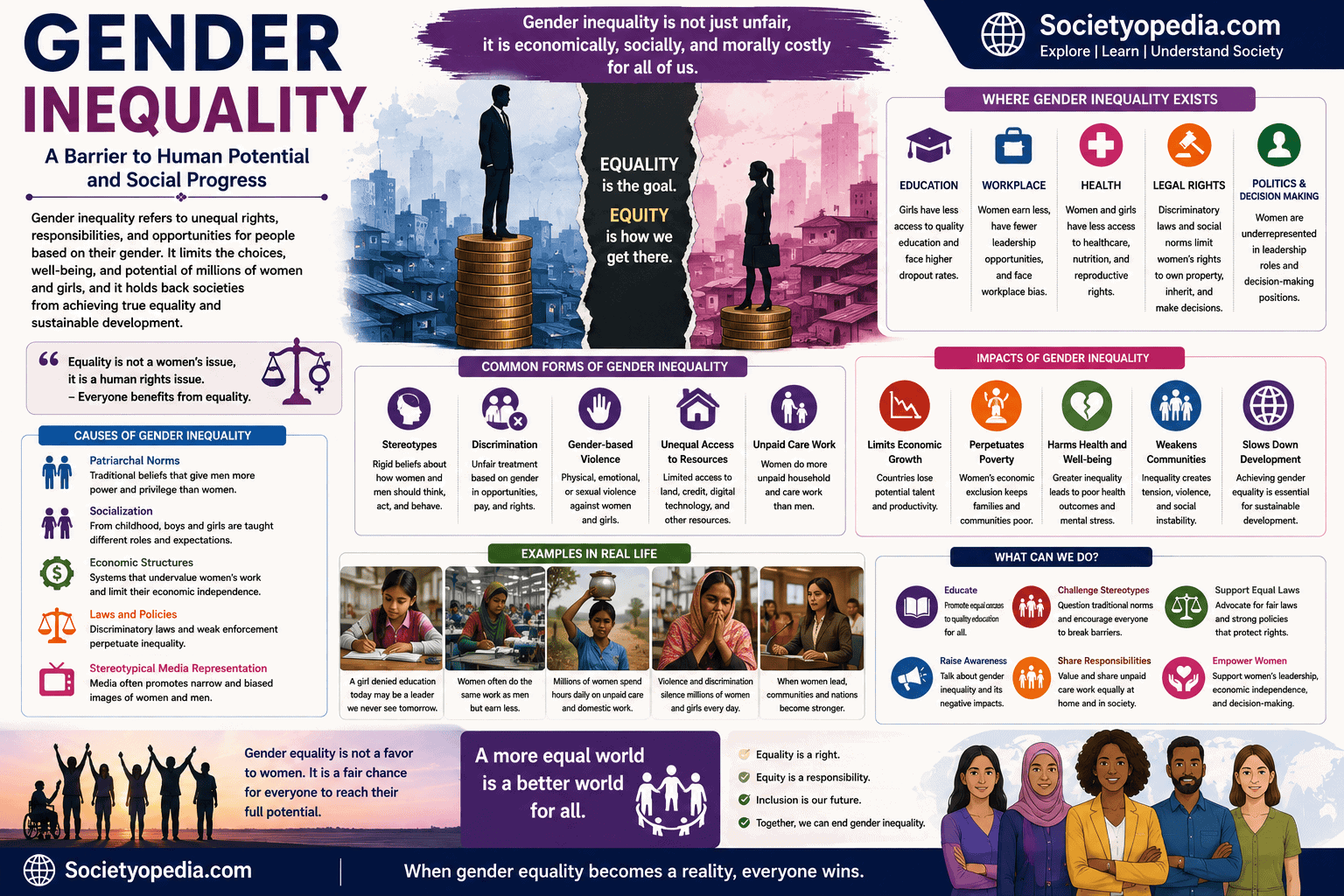
Gender inequality is the unequal distribution of rights, opportunities, resources, responsibilities, status, and power among people because of gender.
In many societies, women and girls have historically experienced disadvantages in areas such as education, employment, political representation, property ownership, and decision-making. However, gender inequality can affect people of different genders in different ways, depending on the social context.
Gender equality does not mean that everyone must have identical lives or characteristics. Rather, gender equality means that rights, responsibilities, and opportunities should not be determined by whether someone is male or female. The United Nations emphasizes equal rights, responsibilities, and opportunities as central to gender equality.
From a sociological perspective, gender inequality is closely connected to social stratification. Social stratification refers to systems through which groups have unequal access to valuable social resources, status, and power. Gender can operate as one of the major dimensions through which such inequalities are organized.
Gender Inequality in Sociology
In sociology, gender inequality is studied as a social phenomenon rather than simply as a collection of individual differences.
Sociologists examine how social institutions and cultural norms influence the opportunities available to different genders.
For example, if a society expects women to perform most unpaid household work while men are expected to concentrate on paid employment, this division can affect women’s economic independence and career opportunities.
Similarly, if leadership is culturally associated with masculinity, women may face additional barriers when attempting to enter positions of authority.
Gender inequality can therefore be produced through patterns of social organization even when individuals do not consciously intend to discriminate.
Gender Inequality and Gender Equality
Gender inequality and gender equality represent opposite conditions.
Gender equality means that people have equal rights, opportunities, responsibilities, and access to social resources regardless of gender.
Gender inequality occurs when gender becomes a basis for unequal opportunities, treatment, power, resources, or social outcomes.
Gender equality does not mean that women and men must become identical. The United Nations explains that equality concerns equal rights, responsibilities, and opportunities rather than making women and men the same.
This distinction is important because people can have different needs and circumstances while still having equal rights and opportunities.
Main Types of Gender Inequality
Gender inequality can take many forms. Some of the most important include inequality in education, employment, income, political participation, family life, healthcare, and access to resources.
Gender Inequality in Education
Educational inequality occurs when people have unequal access to schooling, higher education, educational resources, or academic opportunities because of gender.
Historically, girls and women in many societies were excluded from formal education or had fewer educational opportunities than boys and men.
Although substantial progress has been made in many parts of the world, barriers to education continue in some settings.
Educational inequality can have long-term consequences because education influences employment, income, social mobility, political participation, and personal autonomy.
Gender Inequality in Employment
Employment is another major area of gender inequality.
Women may experience barriers to entering particular occupations, obtaining promotions, reaching leadership positions, or remaining in employment because of family and caregiving responsibilities.
Occupational segregation can also create gender inequality when certain occupations become strongly associated with women or men.
For example, care-related occupations may be heavily feminized in some societies, while technical or leadership positions may remain disproportionately male.
These patterns can influence wages, career advancement, and social status.
Gender Pay Inequality
Gender pay inequality refers to differences in earnings associated with gender.
The gender pay gap can result from multiple factors, including occupational segregation, differences in working hours, career interruptions, unequal access to senior positions, discrimination, and the unequal distribution of unpaid care responsibilities.
The pay gap should therefore not automatically be interpreted as meaning that every woman receives less than every man for performing exactly the same job. Researchers examine several structural and occupational factors when studying gender pay differences.
Political Inequality
Gender inequality can also occur in political institutions.
When women have limited representation in parliaments, governments, local councils, or other decision-making institutions, their perspectives may be less represented in political processes.
Political participation includes more than voting. It also includes holding office, participating in political organizations, influencing policy, and having access to decision-making.
Gender inequality in political power can therefore affect how laws and policies are developed.
Inequality in Family Life
Family relationships are another important area of gender inequality.
Traditional gender expectations may assign women greater responsibility for cooking, cleaning, childcare, and other unpaid household activities.
Men may be expected to serve primarily as financial providers.
When domestic responsibilities are distributed unequally, one partner may have less time and flexibility for education, employment, leisure, or political participation.
Changing family roles and greater participation of women in paid employment have challenged some traditional divisions of household labor.
Inequality in Access to Resources
Gender inequality can involve unequal access to economic and social resources.
These may include income, property, credit, land, technology, education, healthcare, employment, and social networks.
Access to resources is important because resources influence people’s ability to make decisions and pursue opportunities.
When one gender has systematically less access to valuable resources, broader patterns of social inequality can develop.
What Causes Gender Inequality?
Gender inequality usually has multiple causes rather than one single explanation.
Gender Norms
Gender norms are expectations about how people should behave according to gender.
When societies expect women and men to perform different roles, these expectations can limit individual choices.
For example, the belief that women should prioritize family responsibilities may influence educational and career decisions.
Gender Socialization
Gender socialization teaches individuals the norms and expectations associated with gender.
Family, education, peer groups, media, religion, and workplaces can all contribute to gender socialization. OpenStax identifies family, education, peer groups, and mass media as important agents through which gender roles are learned and reinforced.
Cultural Traditions
Cultural traditions can reinforce gender inequality when they assign different rights, responsibilities, or social status to different genders.
Some traditions may prioritize men’s authority in family decision-making or place greater responsibility for unpaid care work on women.
However, culture is not static. Cultural practices can change over time.
Institutional Practices
Gender inequality can become embedded within institutions.
Schools, workplaces, governments, families, and other organizations may have rules or practices that produce unequal outcomes.
Some forms of institutional inequality are deliberate, while others result from longstanding practices that were never designed to address changing social conditions.
Research on gender inequality emphasizes that social institutions can include formal and informal rules, norms, customs, and practices that shape gender roles and the distribution of power.
Economic Structures
Economic systems can also contribute to gender inequality.
Women’s concentration in lower-paid occupations, unequal access to resources, unpaid care work, and limited representation in senior positions can influence economic outcomes.
The relationship between gender and the economy is therefore an important area of sociological research.
Power Relations
Gender inequality is also connected with power.
Power refers to the ability to influence decisions, control resources, shape institutions, or affect the behavior of others.
When one gender consistently has greater authority and access to resources, unequal power relationships can become institutionalized.
Gender Inequality at the Individual and Structural Levels
Gender inequality can operate at different levels.
At the individual level, it may appear through discriminatory attitudes, stereotypes, unequal treatment, or interpersonal behavior.
At the institutional level, it may appear through organizational policies, educational practices, workplace structures, or family arrangements.
At the structural level, gender inequality can become part of broader systems of social organization.
These levels are connected.
For example, a stereotype that women are less suited to leadership may influence an individual employer. If similar assumptions exist across many organizations, they can contribute to broader patterns of occupational inequality.
This is why sociologists distinguish between individual discrimination and structural or institutional inequality.
Gender Inequality and Social Institutions
Social institutions play an important role in producing and maintaining gender inequality.
Family
Families can reproduce traditional gender roles through unequal divisions of household work and decision-making.
Education
Educational institutions can reproduce stereotypes but can also provide opportunities for greater equality.
Economy
The economic system influences employment, wages, occupational opportunities, and access to resources.
Politics
Political institutions influence representation, rights, laws, and access to decision-making.
Religion
Religious institutions and interpretations can influence expectations concerning family, marriage, leadership, and social responsibilities.
Media
Media representations can reinforce stereotypes or challenge them.
Because these institutions interact with one another, gender inequality is best understood as a multidimensional social phenomenon.
Examples of Gender Inequality
Gender inequality can be observed in everyday life as well as in major social institutions.
Examples include a girl being discouraged from studying a particular subject because it is considered unsuitable for women, a qualified woman being overlooked for promotion because of assumptions about leadership, women performing most unpaid household work despite having paid employment, or women having less influence over important household decisions.
Other examples can include unequal access to property, limited political representation, occupational segregation, gender-based harassment, and unequal access to educational or economic opportunities.
These examples demonstrate that gender inequality is not restricted to one area of life.
Is Gender Inequality the Same as Gender Discrimination?
Gender inequality and gender discrimination are related but not identical concepts.
Gender inequality refers broadly to unequal outcomes, opportunities, resources, rights, or power associated with gender.
Gender discrimination refers to unfair or unequal treatment based on gender.
Discrimination can be one mechanism through which inequality is produced.
For example, if an employer refuses to promote qualified women because they are women, this is gender discrimination. If such practices occur across many organizations, they can contribute to broader patterns of gender inequality.
Therefore, discrimination is one important cause or mechanism of inequality, but gender inequality can also emerge through social structures, norms, institutional practices, and unequal divisions of responsibility.
Gender Inequality and Social Class
Gender does not operate independently of other dimensions of social life.
Social class, education, occupation, ethnicity, age, disability, geographical location, and other factors can interact with gender to influence people’s experiences.
For example, the experience of a highly educated professional woman may differ significantly from that of a low-income woman working in informal employment.
This means that gender inequality should not be understood as a single uniform experience.
The concept of intersectionality is particularly useful for understanding how different forms of social inequality can overlap and influence one another.
Gender Inequality and Men
Although discussions of gender inequality often focus on disadvantages experienced by women and girls, gender norms can also create pressures and disadvantages for men and boys.
For example, cultural expectations that men should be financially successful, emotionally strong, physically tough, or primary providers can restrict men’s choices and influence their social experiences.
Men may also experience gender-based disadvantages in areas where social expectations discourage caregiving or emotional expression.
A comprehensive sociological study of gender inequality therefore examines how gender systems distribute advantages, disadvantages, responsibilities, expectations, and power across society.
Why Does Gender Inequality Matter?
Gender inequality matters because unequal opportunities can influence people’s entire life course.
Education affects employment. Employment affects income. Income influences access to housing, healthcare, education, and other resources. Political participation affects representation and decision-making.
When gender influences access to these resources, inequality can become self-reinforcing.
Gender inequality also affects families and communities. When people cannot fully participate in education, employment, political life, or decision-making because of gender, society may lose valuable human and social resources.
Gender equality is therefore not only an issue of individual fairness but also an important aspect of social development.
How Can Gender Inequality Be Reduced?
Reducing gender inequality requires changes at multiple levels.
Education can challenge stereotypes and expand opportunities. Laws and institutional policies can protect equal rights. Workplaces can address discriminatory practices and improve opportunities for career advancement. Families can encourage more equal divisions of household responsibilities.
Greater political participation can also help ensure that gender-related concerns are represented in decision-making.
Social attitudes are equally important. Long-term reductions in inequality require changes in cultural norms and expectations as well as formal policies.
Gender equality therefore involves both institutional reform and social change.
Conclusion
Gender inequality refers to unequal rights, opportunities, resources, responsibilities, status, treatment, or power associated with gender. It is an important form of social inequality and can affect education, employment, income, family life, politics, healthcare, and access to social resources.
Gender inequality is produced through multiple and interconnected factors, including gender norms, socialization, cultural traditions, institutional practices, economic structures, and power relationships.
From a sociological perspective, gender inequality cannot be understood simply as the result of individual attitudes. It can also become embedded within social institutions and broader systems of social organization.
At the same time, gender inequality is not permanent. Changes in education, laws, institutions, economic opportunities, family relationships, cultural attitudes, and social movements can contribute to greater equality.
Understanding the definition and dimensions of gender inequality provides an essential foundation for studying its causes, effects, forms, and possible solutions.