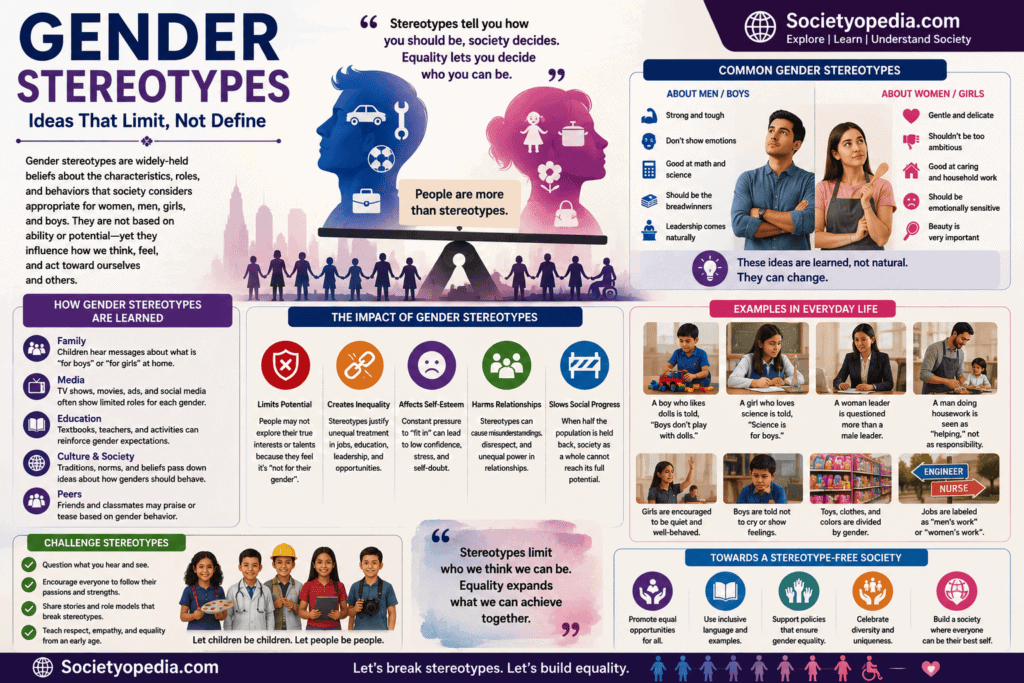
Gender stereotypes are widely held beliefs about the characteristics, abilities, behaviors, and roles that are considered appropriate for people based on their gender. They are an important topic in sociology and Gender Studies because they influence how people understand themselves and others.
Gender stereotypes can appear in everyday conversations, family relationships, schools, workplaces, advertising, entertainment, and social media. Some stereotypes may seem harmless, but repeated expectations can influence people’s choices, opportunities, relationships, and treatment of others.
Understanding gender stereotypes helps explain how societies create expectations about masculinity and femininity and how these expectations can contribute to gender inequality.
What Are Gender Stereotypes?
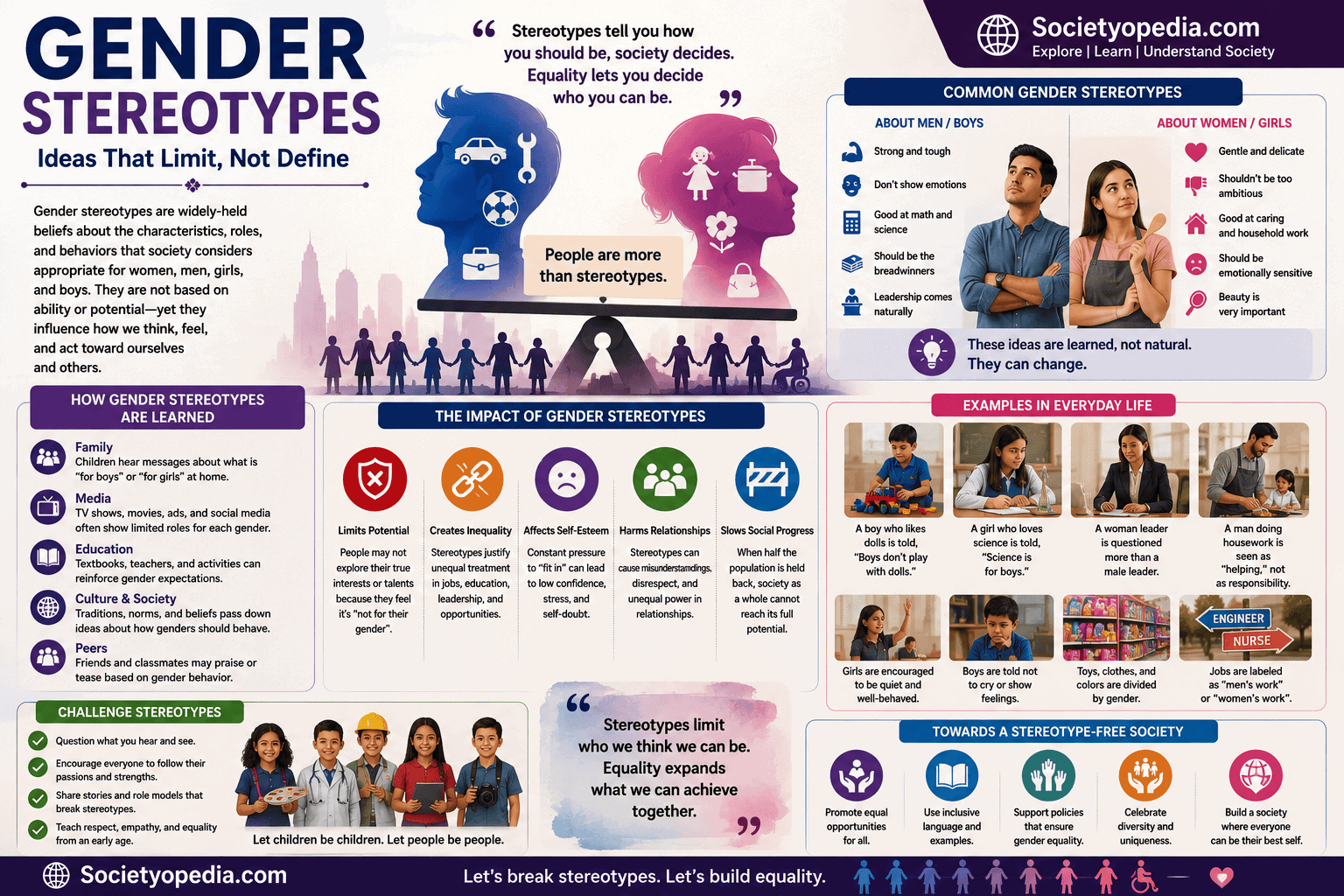
Gender stereotypes are generalized beliefs or assumptions about the characteristics and behavior of people based on their gender.
For example, the belief that men are naturally better leaders while women are naturally better caregivers is a gender stereotype. Similarly, assuming that men should be strong and unemotional or that women should always be caring and sensitive reflects stereotypical ideas about gender.
Stereotypes simplify complex social realities by assigning particular characteristics to entire groups. Individuals, however, differ considerably from one another, and a person’s abilities or personality cannot be accurately determined simply by their gender.
Examples of Gender Stereotypes
Gender stereotypes can take many forms.
Common examples include beliefs that:
- Men are naturally strong and aggressive.
- Women are naturally caring and emotional.
- Men are better suited for leadership.
- Women are better suited for household responsibilities.
- Boys are better at mathematics and science.
- Girls are better at language and communication.
- Men should be financially successful.
- Women should prioritize marriage and family.
- Men should not openly express vulnerability.
- Women should always be polite and nurturing.
These beliefs are not universal facts. They are socially and culturally influenced assumptions.
Gender Stereotypes in the Family
Family is one of the earliest environments where individuals encounter gender stereotypes.
Children may receive different toys, clothing, responsibilities, or encouragement based on gender. For example, boys may be encouraged to engage in activities associated with physical strength, while girls may be encouraged toward caregiving or domestic activities.
Parents may consciously reject stereotypes while still transmitting them through everyday behavior. Children can also observe how adults divide household responsibilities and develop ideas about appropriate gender roles.
Because family is an important agent of socialization, these early experiences can influence attitudes that continue into adulthood.
Gender Stereotypes in Education
Schools can either reinforce or challenge gender stereotypes.
Gender stereotypes may appear in textbooks, classroom interactions, career guidance, and expectations about students’ abilities.
For example, students may receive messages suggesting that boys are naturally better at science or mathematics while girls are better at languages and social subjects.
Such expectations can influence educational choices and confidence. If students repeatedly hear that a particular field is unsuitable for their gender, they may become less likely to pursue it.
At the same time, schools can challenge stereotypes by encouraging students to explore subjects and careers according to their interests and abilities rather than gender expectations.
Gender Stereotypes in the Workplace
Gender stereotypes can also influence employment and professional life.
Some occupations are traditionally viewed as masculine, while others are associated with women. Engineering, construction, and certain leadership positions may be stereotypically associated with men, while teaching, nursing, and caregiving may be associated with women.
These assumptions can contribute to occupational segregation.
Gender stereotypes can also influence perceptions of leadership. For example, a confident male manager may be viewed as decisive, while a woman displaying the same behavior may sometimes be judged differently.
Such patterns demonstrate how stereotypes can affect professional opportunities and evaluations.
Gender Stereotypes in Media
Media plays a significant role in creating and reinforcing gender stereotypes.
Films, television programs, advertisements, magazines, video games, and social media may repeatedly present particular images of masculinity and femininity.
Women may be portrayed primarily in domestic, romantic, or appearance-focused roles, while men may be portrayed as powerful, independent, competitive, or financially successful.
However, media can also challenge stereotypes. Increasingly diverse representations can present people in roles that do not follow traditional gender expectations.
Causes of Gender Stereotypes
Gender stereotypes develop through multiple social and cultural processes.
Socialization
Individuals learn gender expectations from family, schools, peers, and other social institutions.
Culture
Cultural traditions can define particular behaviors as masculine or feminine.
Media
Repeated media representations can make stereotypes appear normal or natural.
Historical Practices
Past social and economic arrangements can influence contemporary gender expectations.
Social Institutions
Family, education, religion, politics, and the workplace can reproduce gender expectations through rules and everyday practices.
Gender stereotypes therefore develop through social processes rather than coming from a single source.
Effects of Gender Stereotypes
Gender stereotypes can have several consequences.
Limiting Individual Choices
People may avoid certain careers, activities, or behaviors because they believe these are inappropriate for their gender.
Reinforcing Gender Inequality
Stereotypes can support unequal expectations regarding employment, education, household responsibilities, and leadership.
Influencing Self-Confidence
Repeated stereotypes can affect how individuals evaluate their own abilities.
Affecting Social Relationships
Stereotypical expectations can influence family roles, friendships, romantic relationships, and workplace interactions.
Creating Social Pressure
Individuals who do not conform to expected gender behavior may experience criticism, exclusion, or pressure to change.
Gender Stereotypes and Gender Roles
Gender stereotypes and gender roles are closely connected.
A gender stereotype is a generalized belief about people based on gender.
A gender role is an expected pattern of behavior or responsibility associated with gender.
For example, the stereotype that women are naturally better caregivers can contribute to the gender role that women should take primary responsibility for childcare.
In this way, stereotypes can help reinforce gender roles within society.
Gender Stereotypes and Gender Norms
Gender stereotypes are also related to gender norms.
A stereotype may claim that men are naturally strong and independent. A corresponding gender norm may expect men to behave confidently and avoid showing vulnerability.
Therefore, stereotypes can contribute to the creation and maintenance of gender norms.
Studying these relationships helps sociologists understand how individual beliefs connect with broader social structures.
Can Gender Stereotypes Change?
Yes. Gender stereotypes can change over time.
Changes in education, employment, technology, family structures, social movements, laws, and cultural attitudes can challenge traditional assumptions.
For example, women have increasingly entered professions that were historically dominated by men, while men have become more involved in childcare and domestic responsibilities in many societies.
However, changes do not occur equally everywhere. Traditional stereotypes may continue to influence attitudes and institutions even when social conditions are changing.
Why Are Gender Stereotypes Important to Study?
Gender stereotypes are important because they can influence people’s expectations, opportunities, and everyday experiences.
Studying them allows researchers to understand why particular behaviors are considered masculine or feminine and how these beliefs become established within society.
It also helps explain broader issues such as gender discrimination, occupational segregation, educational inequality, and unequal household responsibilities.
Conclusion
Gender stereotypes are generalized beliefs about the characteristics, abilities, behaviors, and roles associated with people based on gender. They are learned and reinforced through socialization, culture, family, education, media, and other social institutions.
Although stereotypes may appear to describe ordinary differences between people, they can limit individual choices and contribute to unequal expectations and opportunities.
Understanding gender stereotypes provides an important foundation for studying gender norms, gender roles, gender socialization, gender inequality, gender discrimination, and gender representation in media.