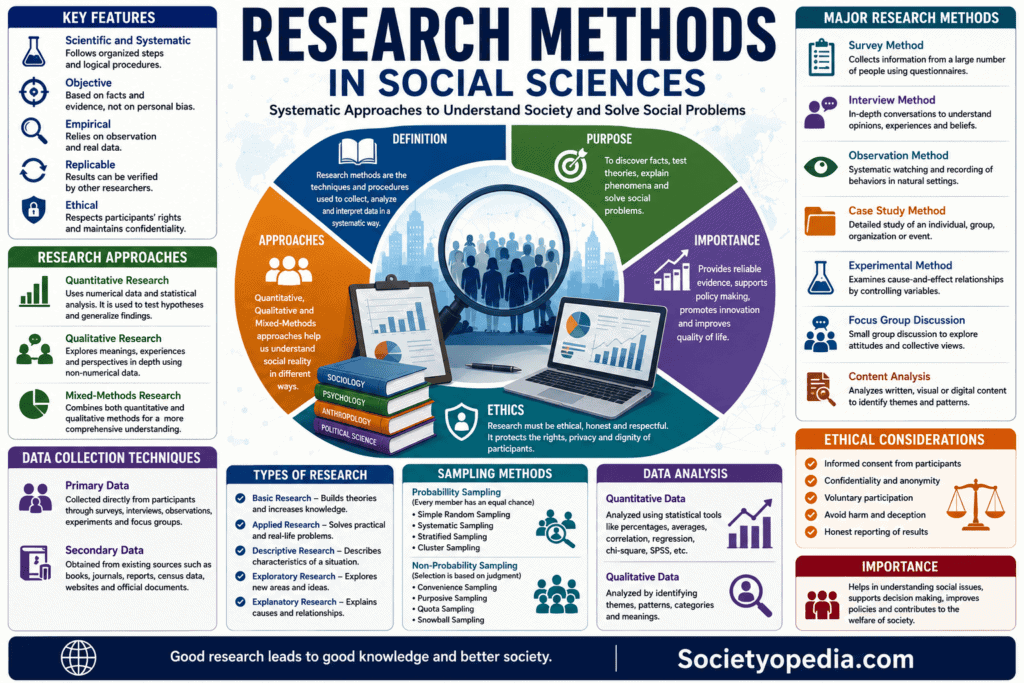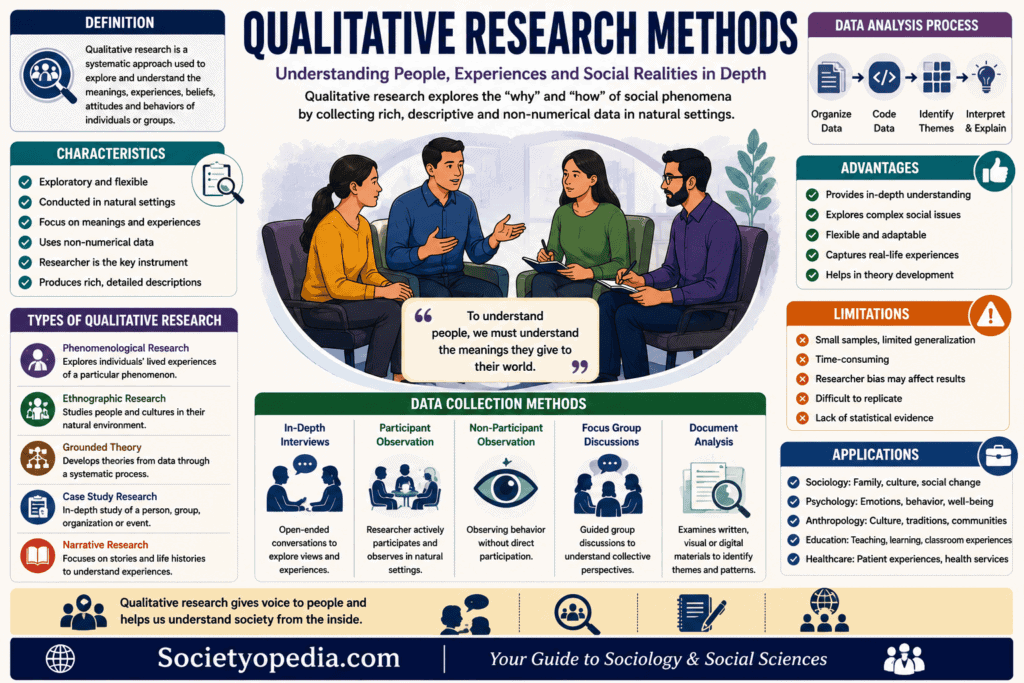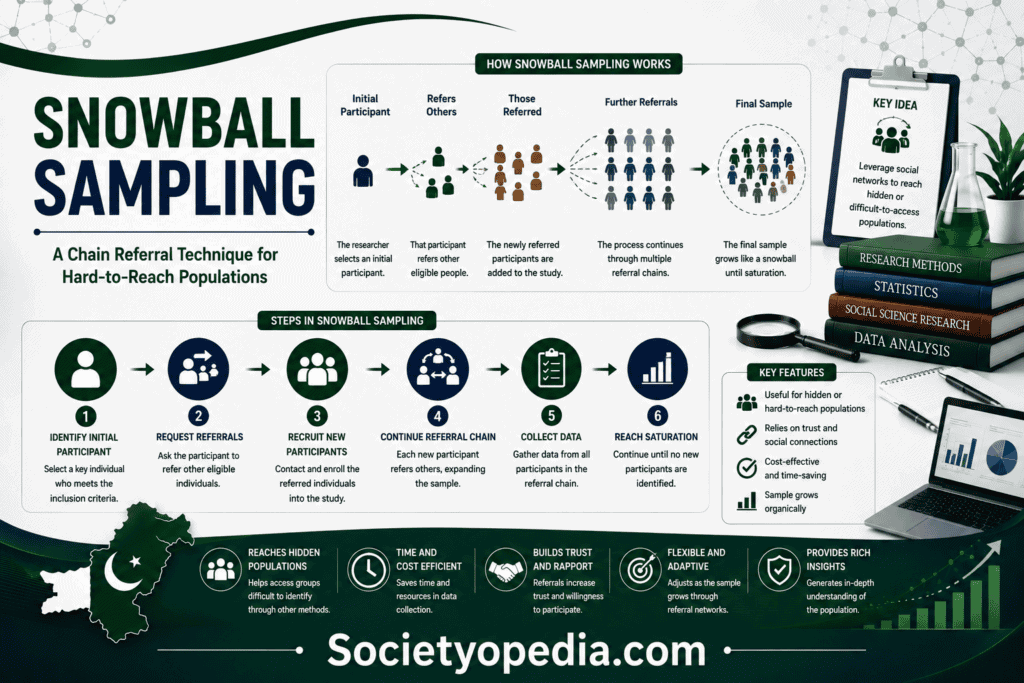
Snowball sampling is one of the most widely used non-probability sampling techniques in qualitative and exploratory research. It is particularly valuable when researchers need to study populations that are difficult to identify, locate, or access through conventional sampling methods. Instead of selecting participants randomly, snowball sampling begins with a small number of eligible participants who then recommend or refer other individuals with similar characteristics. As each participant introduces additional participants, the sample gradually expands, much like a snowball rolling downhill and increasing in size.
This sampling technique is especially useful for researching hidden, vulnerable, or hard-to-reach populations, such as undocumented migrants, refugees, homeless individuals, drug users, survivors of domestic violence, members of secretive organizations, or people living with rare medical conditions. Since these populations are often difficult to identify through official records, researchers rely on participants’ social networks to reach additional respondents.
Snowball sampling is commonly used in sociology, anthropology, psychology, public health, criminology, nursing, and community-based research. It allows researchers to build trust with participants through personal referrals, which often leads to higher participation rates and richer qualitative data.
For example, a sociologist studying the experiences of undocumented migrant workers may begin by interviewing a few known participants. Those participants then introduce the researcher to others within their social network, who in turn refer additional participants until the required sample size is achieved.
Although snowball sampling is highly effective for accessing hidden populations, it has limitations, including sampling bias and limited generalizability. Nevertheless, it remains one of the most practical methods for studying populations that cannot easily be reached through probability sampling.
This article explains the concept, definitions, characteristics, types, process, advantages, disadvantages, applications, and practical examples of snowball sampling.
What Is Snowball Sampling?
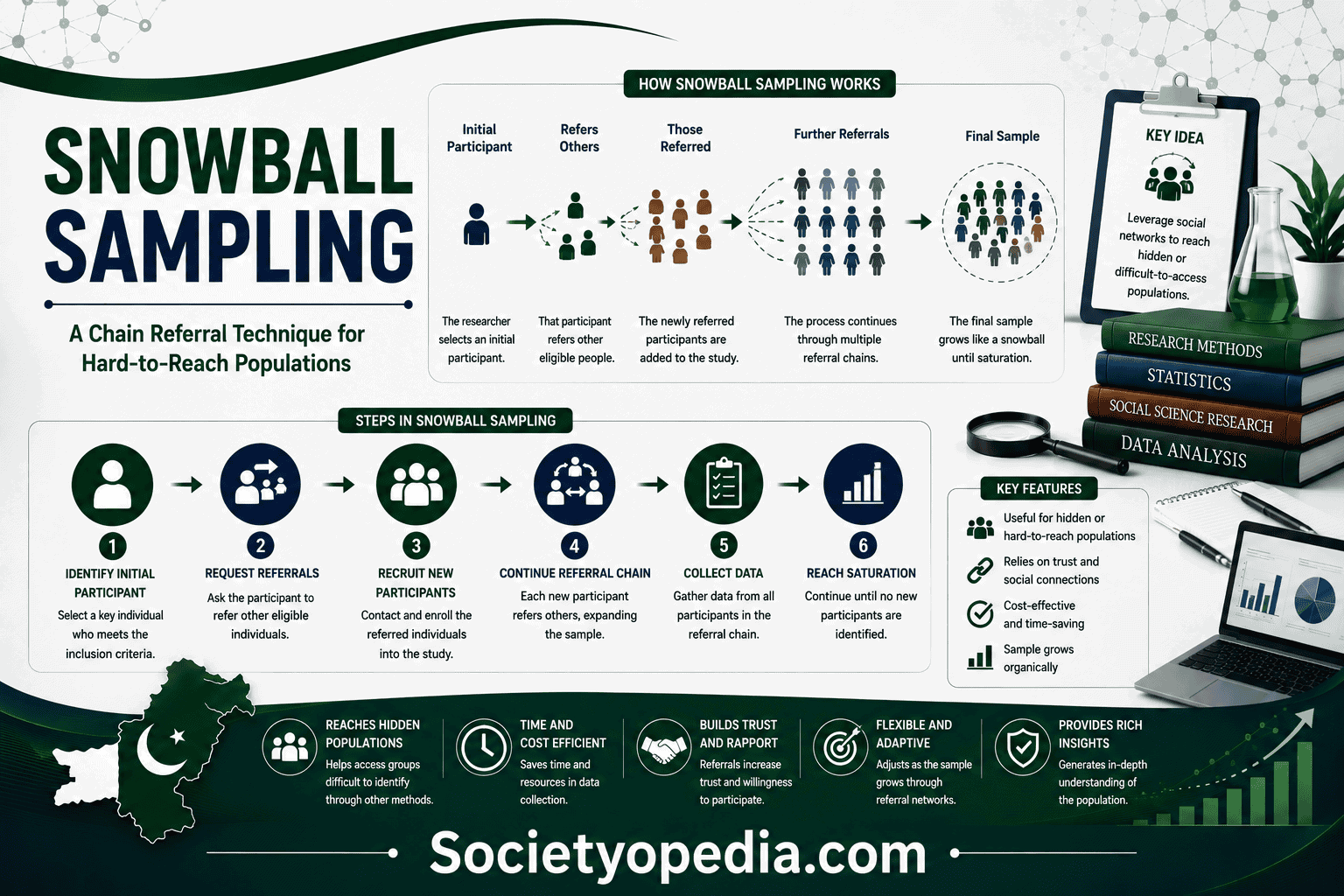
Snowball sampling is a non-probability sampling technique in which existing participants recruit or refer other eligible participants from their personal or professional networks.
The process begins with a small number of initial participants, known as seeds, who meet the study’s selection criteria. After participating in the research, these individuals identify other people who also qualify for the study. The newly recruited participants then refer additional eligible individuals, causing the sample to expand progressively.
Because participant recruitment occurs through social connections, snowball sampling is also known as chain referral sampling or network sampling.
For example, a researcher studying individuals recovering from substance addiction may first interview participants from a rehabilitation center. These participants then recommend others in recovery, enabling the researcher to access a population that would otherwise be difficult to identify.
Definitions of Snowball Sampling
Several research scholars have defined snowball sampling.
Earl Babbie defines snowball sampling as a non-probability sampling technique in which existing participants identify and recruit future participants from among their acquaintances.
William Lawrence Neuman explains that snowball sampling is a chain-referral method used to study populations that are difficult to locate through conventional sampling procedures.
John W. Creswell describes snowball sampling as a technique in which participants recommend other individuals who have experienced the phenomenon under investigation.
Ranjit Kumar defines snowball sampling as a method where participants help researchers identify additional respondents who meet the study’s selection criteria.
These definitions emphasize four key principles:
- Participant recruitment occurs through referrals.
- Selection is non-random.
- The sample grows progressively.
- The technique is useful for hidden or hard-to-reach populations.
Characteristics of Snowball Sampling
Snowball sampling has several distinctive characteristics.
Non-Random Selection
Participants are selected through referrals rather than random procedures.
Chain Referral Process
Existing participants recruit additional participants from their networks.
Suitable for Hidden Populations
The technique is designed for populations that are difficult to identify or access.
Trust-Based Recruitment
Personal referrals often increase participants’ willingness to take part in the research.
Flexible Sampling Process
Researchers can continue recruiting participants until sufficient data have been collected.
Common in Qualitative Research
Snowball sampling is widely used in qualitative, exploratory, and community-based studies.
Objectives of Snowball Sampling
Snowball sampling serves several important research objectives.
The primary objective is to identify and recruit participants from hidden or difficult-to-reach populations.
It also aims to facilitate data collection through trusted social networks, making it easier to access individuals who may be reluctant to participate in research.
Another objective is to gather rich, detailed information from participants with direct experience of the phenomenon being studied.
Types of Snowball Sampling
Researchers use different forms of snowball sampling depending on the nature of the study.
Linear Snowball Sampling
In linear snowball sampling, each participant refers only one additional participant, creating a single chain of referrals.
Example
A researcher interviews one participant, who refers one more eligible participant. The process continues until the desired sample size is reached.
Advantages
- Easy to manage.
- Suitable for small-scale qualitative studies.
Limitations
- Sample grows slowly.
- Limited diversity.
Exponential Non-Discriminative Snowball Sampling
In this approach, each participant refers multiple eligible participants, and all referrals are invited to participate.
Example
A participant refers three colleagues who all qualify for the study, and each of them refers three more participants.
Advantages
- Rapid sample growth.
- Efficient for large hidden populations.
Limitations
- May produce large numbers of similar participants.
Exponential Discriminative Snowball Sampling
Each participant may refer several individuals, but the researcher selects only those who best meet the study’s inclusion criteria.
Example
A participant recommends five healthcare professionals, but the researcher interviews only those with at least five years of experience.
Advantages
- Improves participant quality.
- Maintains focus on research objectives.
Limitations
- Requires careful screening.
- More time-consuming.
Steps in Conducting Snowball Sampling
Snowball sampling follows a systematic process.
Step 1: Define the Research Objectives
Clearly identify the purpose of the study.
Step 2: Identify the Target Population
Determine the hidden or specialized population relevant to the research.
Step 3: Select Initial Participants
Recruit a small number of eligible participants, often called seed participants.
Step 4: Collect Initial Data
Conduct interviews, surveys, or observations with the first participants.
Step 5: Request Referrals
Ask participants to recommend other individuals who meet the study criteria.
Step 6: Recruit New Participants
Contact referred individuals and invite them to participate.
Step 7: Repeat the Referral Process
Continue collecting data and requesting referrals until sufficient participants have been recruited or data saturation is achieved.
Step 8: Analyze the Data
Interpret the findings while acknowledging the limitations of snowball sampling.
Advantages of Snowball Sampling
Snowball sampling offers several important benefits.
Effective for Hidden Populations
It enables researchers to access groups that are difficult to locate through conventional methods.
Builds Trust
Participants are more likely to cooperate when referred by someone they know.
Cost Effective
Researchers spend less time and money identifying eligible participants.
Flexible
The sampling process can expand naturally as new referrals are obtained.
Rich Qualitative Data
Participants often possess direct experience relevant to the research topic.
Useful for Sensitive Topics
Snowball sampling is particularly valuable for studies involving stigmatized or confidential issues.
Disadvantages of Snowball Sampling
Despite its advantages, snowball sampling has several limitations.
Selection Bias
Participants tend to refer individuals with similar backgrounds or viewpoints.
Limited Generalizability
The findings cannot be confidently generalized to the broader population.
Dependence on Social Networks
The success of the study depends heavily on participants’ willingness and ability to provide referrals.
Homogeneous Samples
Participants may come from the same social circles, reducing diversity.
Unknown Sampling Error
Because selection probabilities are unknown, sampling error cannot be calculated.
Snowball Sampling vs Purposive Sampling
| Feature | Snowball Sampling | Purposive Sampling |
|---|---|---|
| Selection Method | Participant referrals | Researcher judgment |
| Participant Recruitment | Through social networks | Direct selection |
| Best For | Hidden populations | Information-rich participants |
| Researcher Control | Moderate | High |
| Common Research Type | Qualitative | Qualitative |
Snowball Sampling vs Convenience Sampling
| Feature | Snowball Sampling | Convenience Sampling |
|---|---|---|
| Recruitment Method | Referrals | Easy accessibility |
| Suitable for Hidden Populations | Yes | No |
| Participant Trust | High | Moderate |
| Sample Growth | Progressive | Fixed |
| Selection Bias | High | High |
Applications of Snowball Sampling
Snowball sampling is widely used across numerous research disciplines.
In sociology, it is commonly used to study undocumented migrants, homeless individuals, marginalized communities, social movements, and informal networks.
In psychology, researchers use snowball sampling to investigate individuals with rare mental health conditions, addiction recovery experiences, or trauma survivors.
In public health, it helps researchers study patients with rare diseases, HIV-positive individuals, caregivers, and vulnerable populations.
In criminology, snowball sampling is frequently used to investigate gangs, organized crime, former offenders, and illegal drug networks.
In education, researchers use the method to identify experienced educators, educational leaders, or members of specialized academic communities.
Businesses and organizational researchers also use snowball sampling to interview entrepreneurs, startup founders, industry experts, and professionals working in niche sectors.
Challenges in Using Snowball Sampling
One of the greatest challenges of snowball sampling is maintaining diversity within the sample. Because participants often recommend people from their own social circles, the sample may become homogeneous and fail to capture a broad range of perspectives. Researchers must also consider ethical issues such as confidentiality and informed consent when participants refer others. Building trust while protecting participants’ privacy is essential throughout the research process.
Best Practices for Using Snowball Sampling
Researchers should begin with diverse seed participants to improve the diversity of referrals. Clear inclusion criteria should be established before recruitment begins, and each referral should be evaluated carefully to ensure eligibility. Researchers should also protect participants’ identities, obtain informed consent, and clearly explain the purpose of the study. Maintaining detailed records of the referral process increases transparency and strengthens the credibility of the research.
Conclusion
Snowball sampling is one of the most effective non-probability sampling techniques for studying hidden, vulnerable, or hard-to-reach populations. By relying on participant referrals, it enables researchers to access individuals who would otherwise be difficult or impossible to identify through traditional sampling methods. Its ability to build trust and generate rich qualitative data makes it particularly valuable in sociology, psychology, public health, criminology, and community-based research.
Although snowball sampling has limitations, including selection bias and limited generalizability, it remains an indispensable tool for qualitative researchers investigating sensitive or specialized populations. When applied carefully with clear ethical guidelines and transparent reporting, snowball sampling can produce meaningful and insightful research findings.
For students and researchers, understanding snowball sampling is essential for conducting high-quality qualitative research involving hidden populations. At forum Societyopedia, mastering this technique helps scholars design ethically sound studies and collect valuable data from participants whose experiences contribute significantly to the understanding of complex social issues.
Frequently Asked Questions (FAQs)
What is snowball sampling?
Snowball sampling is a non-probability sampling technique in which existing participants recruit or refer other eligible participants through their personal or professional networks.
Why is snowball sampling used?
It is used to study hidden, vulnerable, or difficult-to-reach populations that cannot easily be identified through conventional sampling methods.
What are the main types of snowball sampling?
The main types are linear snowball sampling, exponential non-discriminative snowball sampling, and exponential discriminative snowball sampling.
Is snowball sampling a probability sampling method?
No. Snowball sampling is a non-probability sampling technique because participants are recruited through referrals rather than random selection.
What is the biggest limitation of snowball sampling?
The greatest limitation is selection bias, as participants often refer individuals from their own social networks, which may reduce the diversity and representativeness of the sample.