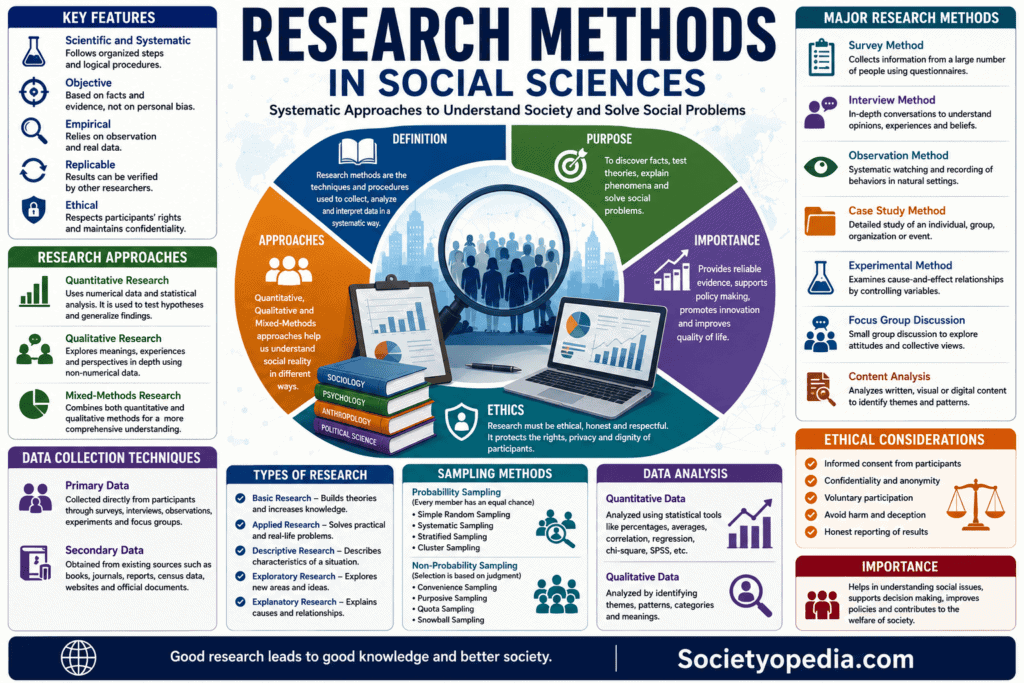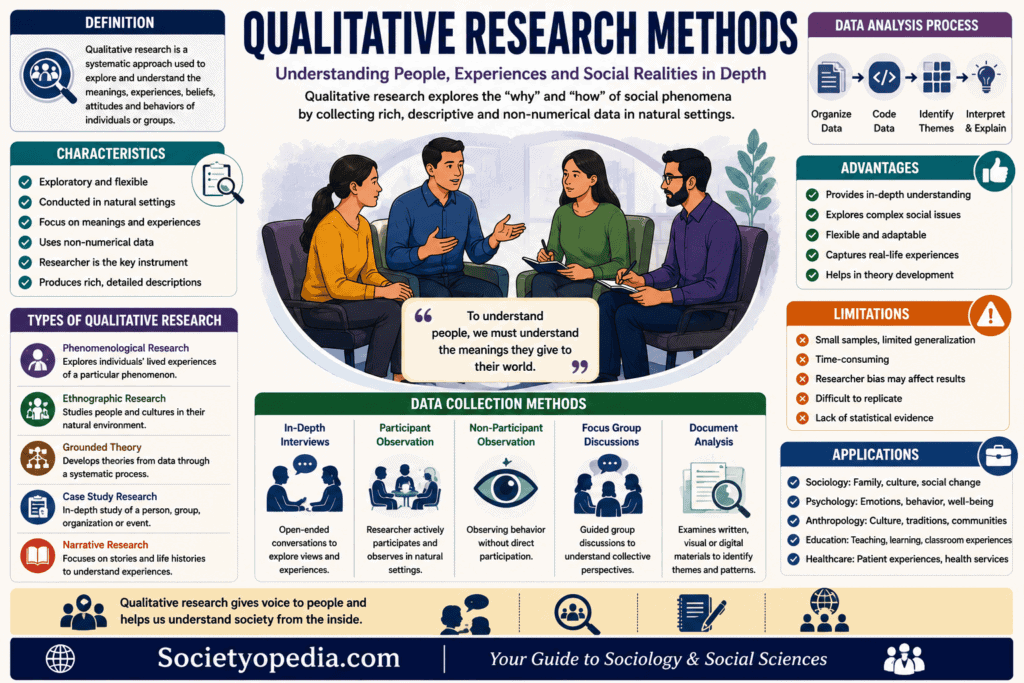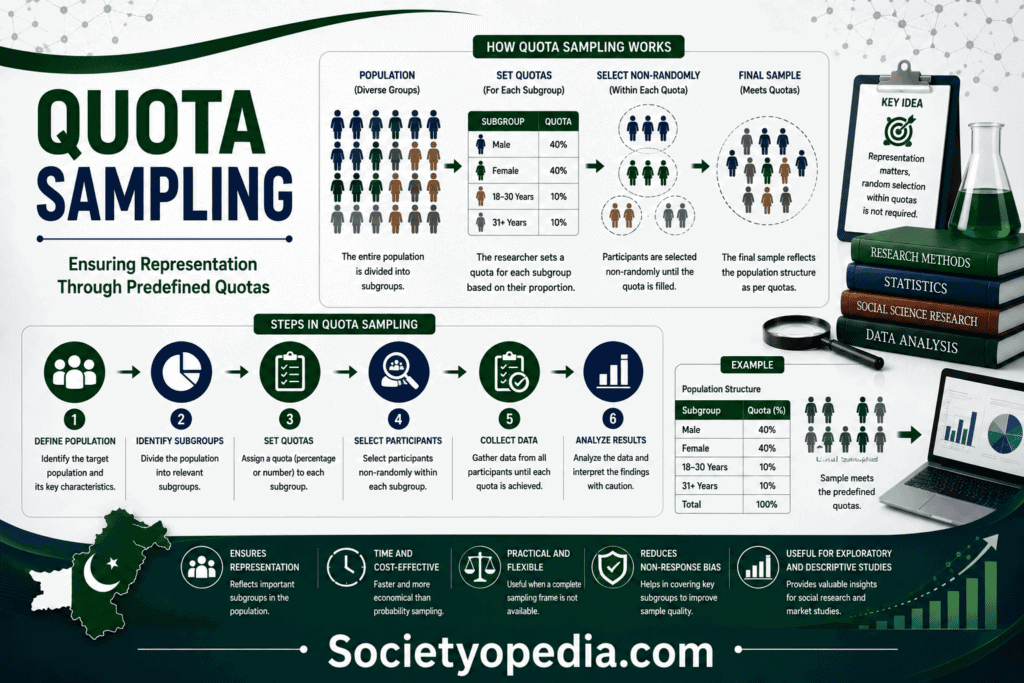
Quota sampling is one of the most commonly used non-probability sampling techniques in research. It involves dividing the target population into different categories or subgroups and selecting participants from each group until a predetermined quota is reached. Unlike probability sampling, quota sampling does not use random selection. Instead, researchers choose participants who are readily available or meet specific criteria until the required number for each category has been fulfilled.
Quota sampling is widely applied in sociology, psychology, education, public health, political science, marketing, and opinion polling. Researchers use this technique when they want to ensure that important population groups are represented in the sample but lack the time, resources, or sampling frame required for probability sampling.
For example, a researcher studying public opinion on healthcare services may require a sample of 400 respondents consisting of 200 males and 200 females. Rather than selecting participants randomly, the researcher continues recruiting individuals until each gender quota has been completed.
One of the major strengths of quota sampling is that it improves the representation of key population groups compared with convenience sampling. However, because participants within each quota are selected using non-random methods, the sample may still be affected by selection bias.
This article explains the concept, definitions, characteristics, types, process, advantages, disadvantages, applications, and practical examples of quota sampling.
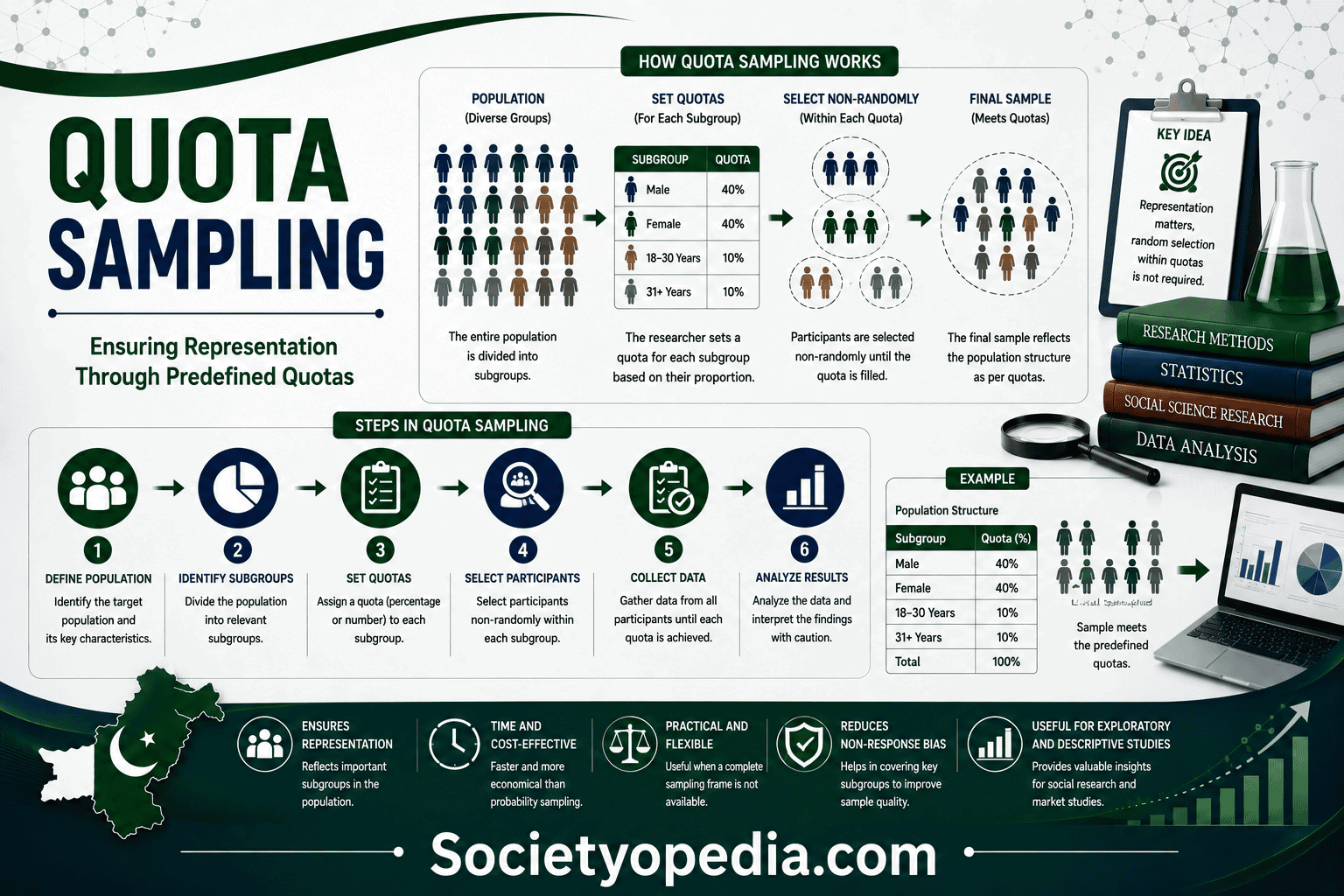
What Is Quota Sampling?
Quota sampling is a non-probability sampling technique in which researchers divide the population into relevant categories and select participants from each category until a predetermined quota has been achieved.
The quotas are usually based on characteristics such as age, gender, education, occupation, income, ethnicity, or geographical location. The objective is to ensure that the sample reflects the distribution of important characteristics within the target population.
Unlike stratified random sampling, where participants are selected randomly within each stratum, quota sampling allows researchers to choose participants through convenience or judgment as long as the required quota is completed.
For example, if a researcher wants to study consumer preferences among different age groups, they may establish quotas of 100 participants aged 18–30, 100 aged 31–50, and 100 aged over 50. Data collection continues until each quota has been filled.
Definitions of Quota Sampling
Several research scholars have defined quota sampling.
Earl Babbie defines quota sampling as a non-probability sampling technique in which researchers identify relevant population categories and select participants until predetermined quotas are achieved.
William Lawrence Neuman explains that quota sampling involves selecting participants according to specified characteristics while using non-random methods within each category.
John W. Creswell describes quota sampling as a method used to ensure that particular groups are represented in the sample without relying on random selection.
Ranjit Kumar defines quota sampling as a sampling technique in which researchers establish quotas for different groups and continue selecting participants until each quota is fulfilled.
These definitions emphasize four essential elements:
- Population is divided into categories.
- Predetermined quotas are established.
- Selection within quotas is non-random.
- The goal is balanced representation of key groups.
Characteristics of Quota Sampling
Quota sampling has several distinctive characteristics.
Non-Random Selection
Participants are selected without randomization.
Predetermined Quotas
Researchers determine in advance how many participants are required from each subgroup.
Representation of Key Groups
The method ensures that important categories within the population are included.
Flexible Data Collection
Researchers can recruit participants until the required quota has been achieved.
Cost Effective
Quota sampling requires fewer resources than probability sampling.
Common in Survey Research
The technique is widely used in opinion polls and market research.
Objectives of Quota Sampling
Quota sampling serves several important research objectives.
The primary objective is to ensure that important population groups are adequately represented in the sample.
It also aims to improve the diversity of participants compared with convenience sampling while reducing the cost and time associated with probability sampling.
Another objective is to collect meaningful information when a complete sampling frame is unavailable or random sampling is impractical.
Types of Quota Sampling
Quota sampling is generally divided into two main types.
Proportional Quota Sampling
In proportional quota sampling, the proportion of participants selected from each subgroup reflects their actual proportion in the population.
Example
Suppose a university has 60% female students and 40% male students. If the researcher requires a sample of 500 students, the quotas will be:
- Female students: 300
- Male students: 200
The final sample reflects the population’s actual gender distribution.
Advantages
- Produces a sample closer to the actual population.
- Improves representativeness.
Limitations
- Requires accurate information about population proportions.
Non-Proportional Quota Sampling
In non-proportional quota sampling, researchers assign equal or predetermined quotas regardless of the actual population distribution.
Example
A researcher studying leadership styles wants to compare male and female managers equally. Even if only 30% of managers are female, the researcher selects 100 male managers and 100 female managers.
Advantages
- Facilitates comparisons between groups.
- Useful when studying minority populations.
Limitations
- The sample may not accurately represent the population distribution.
Steps in Conducting Quota Sampling
Quota sampling follows a systematic process.
Step 1: Define the Research Objectives
Clearly identify the purpose of the study.
Step 2: Identify the Target Population
Determine the population from which participants will be selected.
Step 3: Divide the Population into Categories
Group the population according to relevant characteristics such as age, gender, education, or occupation.
Step 4: Determine the Quotas
Specify the number of participants required from each category.
Step 5: Select Participants
Recruit participants using convenience or purposive methods until each quota is completed.
Step 6: Collect Data
Gather information through surveys, interviews, questionnaires, or observations.
Step 7: Analyze the Data
Interpret the findings while recognizing the strengths and limitations of quota sampling.
Advantages of Quota Sampling
Quota sampling offers several important benefits.
Better Representation Than Convenience Sampling
Important population groups are included in the sample.
Time Efficient
Researchers can complete data collection quickly.
Cost Effective
The method requires fewer financial and logistical resources.
Easy to Implement
Quota sampling does not require complex randomization procedures.
Suitable for Large Populations
It is practical for studies involving large and diverse populations.
Useful Without a Sampling Frame
Researchers can conduct studies even when a complete population list is unavailable.
Disadvantages of Quota Sampling
Despite its advantages, quota sampling has several limitations.
Selection Bias
Participants within each quota are selected non-randomly, increasing the possibility of bias.
Limited Generalizability
The findings cannot usually be generalized to the entire population with statistical confidence.
Researcher Subjectivity
Researchers may unintentionally select participants who are easier to access or more willing to participate.
Unknown Sampling Error
Sampling error cannot be accurately calculated because the selection probabilities are unknown.
Potential Overrepresentation
Some characteristics may be overrepresented if participant selection is not carefully managed.
Quota Sampling vs Stratified Sampling
| Feature | Quota Sampling | Stratified Sampling |
|---|---|---|
| Sampling Type | Non-probability | Probability |
| Selection Within Groups | Non-random | Random |
| Population Division | Categories or quotas | Strata |
| Generalization | Limited | Strong |
| Sampling Error | Cannot be calculated | Can be calculated |
| Cost | Lower | Higher |
Quota Sampling vs Convenience Sampling
| Feature | Quota Sampling | Convenience Sampling |
|---|---|---|
| Representation of Groups | Yes | Usually No |
| Participant Selection | Non-random | Non-random |
| Research Planning | More structured | Less structured |
| Sample Diversity | Higher | Lower |
| Common Use | Surveys and Opinion Polls | Pilot Studies |
Applications of Quota Sampling
Quota sampling is widely used across many disciplines.
In sociology, researchers use quota sampling to investigate social attitudes, family structures, gender roles, migration, and community development while ensuring representation of important demographic groups.
In education, it is used to compare students from different grade levels, schools, academic disciplines, or educational backgrounds.
In public health, quota sampling helps researchers compare healthcare access across age groups, genders, or geographical regions.
In political science, opinion polling organizations frequently use quota sampling to ensure balanced representation of voters based on demographic characteristics.
Businesses and marketing agencies use quota sampling extensively for customer satisfaction surveys, product evaluations, advertising research, and consumer behavior studies.
Challenges in Using Quota Sampling
Researchers using quota sampling may face challenges in accurately determining population quotas and avoiding bias during participant selection. Since participants are not selected randomly, the researcher must take care to recruit individuals from diverse backgrounds within each quota. Another challenge is ensuring that quotas truly reflect the characteristics of the target population when reliable demographic information is unavailable.
Best Practices for Using Quota Sampling
Researchers should establish quotas based on reliable population data and clearly explain how the quotas were determined. Participant selection within each category should follow consistent procedures to reduce bias. Detailed documentation of the sampling process and acknowledgment of the method’s limitations strengthen the transparency and credibility of the research. Whenever possible, quota sampling should be combined with careful recruitment strategies to increase sample diversity.
Conclusion
Quota sampling is an effective non-probability sampling technique that helps researchers ensure the representation of important population groups without the complexity of probability sampling. By establishing predetermined quotas, researchers can obtain balanced samples quickly and economically, making the method particularly useful in opinion polls, market research, educational studies, and social surveys.
Although quota sampling cannot eliminate selection bias or support statistical generalization to the same extent as probability sampling, it offers significant practical advantages in situations where time, resources, or sampling frames are limited. When applied thoughtfully and transparently, quota sampling provides valuable insights into the characteristics and opinions of different population groups.
For students and researchers, understanding quota sampling is essential for selecting appropriate sampling techniques in qualitative and applied research. At Societyopedia ٖForum, learning about quota sampling helps build a strong foundation in research methodology and enables scholars to design studies that are both practical and methodologically sound.
Frequently Asked Questions (FAQs)
What is quota sampling?
Quota sampling is a non-probability sampling technique in which researchers divide the population into categories and select participants until predetermined quotas for each category are completed.
What are the two main types of quota sampling?
The two main types are proportional quota sampling and non-proportional quota sampling.
Why is quota sampling used?
Quota sampling is used to ensure that important population groups are represented in the sample while reducing the time and cost of data collection.
What is the difference between quota sampling and stratified sampling?
Both divide the population into groups, but stratified sampling selects participants randomly within each group, whereas quota sampling uses non-random selection.
What is the biggest limitation of quota sampling?
The main limitation is selection bias because participants within each quota are chosen through non-random methods, limiting the generalizability of the findings.