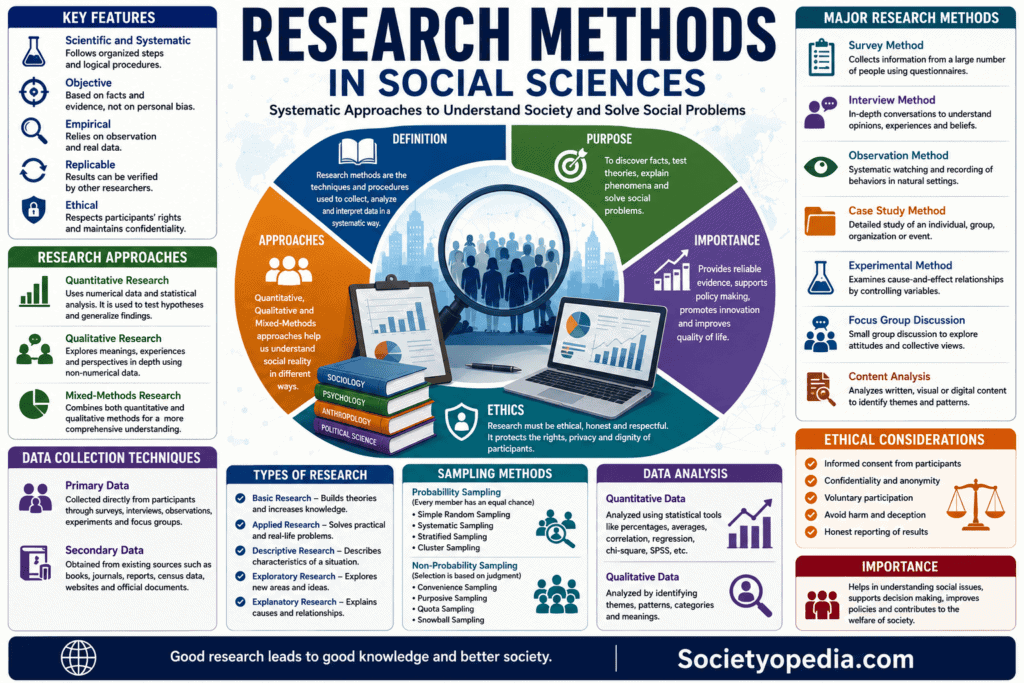
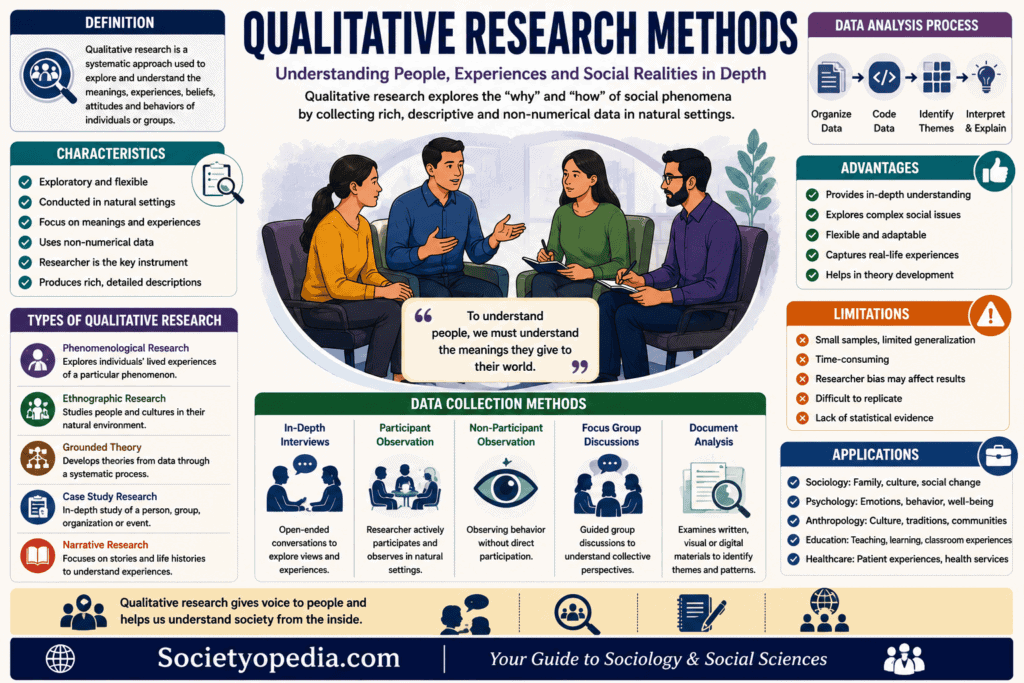
Purposive sampling is one of the most widely used non-probability sampling techniques in qualitative research. Unlike probability sampling, where participants are selected randomly, purposive sampling involves the deliberate selection of individuals who possess specific knowledge, experiences, skills, or characteristics relevant to the research problem. The researcher intentionally chooses participants who are most likely to provide rich, detailed, and meaningful information.
This sampling technique is particularly valuable when researchers aim to gain an in-depth understanding of a phenomenon rather than produce statistically generalizable findings. It is commonly used in sociology, psychology, education, anthropology, public health, nursing, political science, and business research. Studies involving case studies, phenomenology, grounded theory, ethnography, and action research frequently rely on purposive sampling because participants are selected based on their ability to contribute valuable insights.
For example, a researcher studying leadership experiences among female university vice-chancellors would deliberately select women who currently hold or have previously held such positions. Randomly selecting participants from the general population would not provide the specialized knowledge needed for the study.
Purposive sampling is also known as judgmental sampling because the researcher’s judgment plays a central role in selecting participants. While this method is highly effective for obtaining detailed information, researchers must apply clear selection criteria to minimize bias and enhance the credibility of the findings.
This article explains the concept, definitions, characteristics, types, process, advantages, disadvantages, applications, and practical examples of purposive sampling.

What Is Purposive Sampling?
Purposive sampling is a non-probability sampling technique in which researchers intentionally select participants based on predefined characteristics, knowledge, experiences, or expertise that are directly related to the objectives of the study.
Rather than giving every member of the population an equal chance of selection, purposive sampling focuses on individuals who can provide the most relevant and informative data. The researcher uses professional judgment to identify participants capable of answering the research questions effectively.
For example, if a researcher wants to investigate the experiences of nurses working in intensive care units during a pandemic, only ICU nurses with relevant experience would be selected. Interviewing nurses from unrelated departments would not meet the purpose of the study.
Purposive sampling is therefore driven by the research objectives rather than random selection.
Definitions of Purposive Sampling
Several research scholars have defined purposive sampling.
Earl Babbie defines purposive sampling as a non-probability sampling technique in which researchers select participants based on their knowledge and judgment regarding the research objectives.
William Lawrence Neuman explains that purposive sampling involves deliberately choosing participants who possess characteristics relevant to the study.
John W. Creswell describes purposive sampling as selecting individuals or sites that can best help the researcher understand the central phenomenon.
Ranjit Kumar defines purposive sampling as a sampling method in which participants are intentionally selected because they can provide the required information.
These definitions highlight three important principles:
- Participant selection is intentional.
- Selection is based on the purpose of the research.
- Participants possess relevant knowledge or experience.
Characteristics of Purposive Sampling
Purposive sampling has several distinctive characteristics.
Non-Random Selection
Participants are selected intentionally rather than randomly.
Information-Rich Participants
Researchers choose individuals who possess relevant knowledge, expertise, or experience.
Researcher Judgment
The researcher’s knowledge and experience guide participant selection.
Suitable for Qualitative Research
Purposive sampling is primarily used in qualitative and exploratory research.
Flexible Sampling
Researchers can modify participant selection as new information emerges during the study.
Focus on Depth Rather Than Quantity
The emphasis is on obtaining rich, detailed information rather than large sample sizes.
Objectives of Purposive Sampling
Purposive sampling serves several important research objectives.
The primary objective is to select participants who can provide detailed, accurate, and meaningful information about the research topic.
It also aims to explore complex social phenomena, understand participants’ lived experiences, and gather expert opinions on specialized issues.
Another objective is to obtain high-quality qualitative data that contributes to a deeper understanding of the research problem.
Types of Purposive Sampling
Purposive sampling includes several specialized techniques depending on the objectives of the research.
Expert Sampling
Expert sampling involves selecting individuals who possess extensive knowledge or expertise in a particular field.
Example
A researcher studying climate change policies interviews environmental scientists and policy experts.
Advantages
- Provides highly credible information.
- Suitable for specialized research topics.
- Enhances the quality of expert-based studies.
Limitations
- Experts may have differing opinions.
- Identifying suitable experts can be difficult.
Criterion Sampling
Criterion sampling selects participants who meet predetermined criteria established by the researcher.
Example
A researcher investigating the experiences of cancer survivors interviews individuals who have completed treatment within the past two years.
Advantages
- Ensures participants meet research requirements.
- Produces focused and relevant information.
Limitations
- Strict criteria may reduce the number of eligible participants.
Homogeneous Sampling
Homogeneous sampling involves selecting participants who share similar characteristics.
Example
A researcher studying first-year university students interviews only first-year students enrolled in sociology programs.
Advantages
- Facilitates detailed analysis of a specific group.
- Reduces variation among participants.
Limitations
- Findings may not reflect other groups.
Maximum Variation Sampling
Maximum variation sampling selects participants with diverse backgrounds or experiences to capture a broad range of perspectives.
Example
A researcher studying online education includes students from urban and rural areas, different age groups, and various academic disciplines.
Advantages
- Captures diverse viewpoints.
- Enhances understanding of variations within a phenomenon.
Limitations
- Data analysis may become more complex.
Typical Case Sampling
Typical case sampling focuses on participants who represent average or common characteristics of the population.
Example
A researcher studying public school education selects schools that reflect average academic performance rather than exceptionally high- or low-performing schools.
Advantages
- Provides a realistic picture of ordinary situations.
- Useful for policy evaluation.
Limitations
- Rare or unusual cases may be overlooked.
Extreme or Deviant Case Sampling
This method involves selecting unusual or exceptional cases that differ significantly from the norm.
Example
A researcher investigating academic excellence interviews students who consistently achieve top national examination scores.
Advantages
- Reveals unique insights.
- Helps explain exceptional outcomes.
Limitations
- Findings may not apply to typical cases.
Steps in Conducting Purposive Sampling
Step 1: Define the Research Objectives
Clearly identify the purpose of the study.
Step 2: Identify the Target Population
Determine the group capable of providing the required information.
Step 3: Establish Selection Criteria
Develop inclusion and exclusion criteria based on the research objectives.
Step 4: Identify Suitable Participants
Use professional judgment to locate individuals who meet the criteria.
Step 5: Recruit Participants
Invite eligible participants to take part in the study.
Step 6: Collect Data
Gather information through interviews, observations, focus groups, or other qualitative methods.
Step 7: Analyze and Interpret Findings
Interpret the collected data while considering the context and characteristics of the selected participants.
Advantages of Purposive Sampling
Purposive sampling offers numerous advantages.
Rich and Detailed Information
Participants possess relevant knowledge and experience.
Suitable for Specialized Research
It is highly effective for studying specific populations or unique phenomena.
Flexible
Researchers can adapt participant selection during the research process.
Cost Effective
The method requires fewer resources than probability sampling.
Ideal for Qualitative Research
It supports in-depth exploration and detailed understanding.
Efficient
Researchers focus only on participants who can contribute meaningful information.
Disadvantages of Purposive Sampling
Despite its strengths, purposive sampling has several limitations.
Researcher Bias
Participant selection depends heavily on the researcher’s judgment.
Limited Generalizability
Findings cannot usually be generalized to the broader population.
Subjectivity
Different researchers may select different participants based on their own perspectives.
Unknown Sampling Error
Sampling error cannot be calculated because selection probabilities are unknown.
Limited Representativeness
The selected sample may not accurately reflect the diversity of the population.
Purposive Sampling vs Convenience Sampling
| Feature | Purposive Sampling | Convenience Sampling |
|---|---|---|
| Selection Basis | Knowledge and relevance | Ease of access |
| Researcher Judgment | High | Limited |
| Participant Expertise | Required | Not necessary |
| Information Quality | Rich and detailed | General |
| Common Use | Qualitative Research | Pilot and Exploratory Studies |
Purposive Sampling vs Probability Sampling
| Feature | Purposive Sampling | Probability Sampling |
|---|---|---|
| Selection Method | Judgment-based | Random |
| Chance of Selection | Unknown | Known |
| Generalization | Limited | Strong |
| Sampling Bias | Higher | Lower |
| Primary Research Type | Qualitative | Quantitative |
Applications of Purposive Sampling
Purposive sampling is widely used across many research disciplines.
In sociology, researchers use purposive sampling to study social movements, gender inequality, migration, poverty, community leadership, and marginalized populations.
In psychology, it is used to investigate individuals with specific psychological conditions, counseling experiences, or behavioral characteristics.
In education, researchers select experienced teachers, school principals, curriculum experts, or educational policymakers to examine educational practices and reforms.
In public health, purposive sampling helps researchers study healthcare professionals, patients with particular diseases, caregivers, and health administrators.
Businesses use purposive sampling to interview industry experts, senior executives, experienced consumers, and product specialists during market research and product development.
Challenges in Using Purposive Sampling
One of the main challenges of purposive sampling is minimizing researcher bias during participant selection. Researchers must establish clear inclusion criteria and avoid selecting participants solely because they support preconceived ideas. Another challenge is ensuring that participants possess sufficient knowledge or experience to contribute valuable information. Transparent documentation of the sampling process is essential for maintaining the credibility of the research.
Best Practices for Using Purposive Sampling
Researchers should clearly define participant selection criteria before beginning data collection. The reasons for choosing purposive sampling should be explained in the research methodology, and participants should be selected based on their ability to address the research objectives rather than personal convenience. Maintaining detailed records of the selection process and using multiple data sources where appropriate can further strengthen the trustworthiness of the findings.
Conclusion
Purposive sampling is one of the most valuable non-probability sampling techniques for qualitative research. By intentionally selecting participants with relevant knowledge, expertise, or experience, researchers can obtain rich and meaningful data that contributes to a deeper understanding of complex social, educational, psychological, and healthcare issues.
Although purposive sampling does not support statistical generalization and may be influenced by researcher judgment, its ability to generate detailed insights makes it indispensable in qualitative inquiry. When applied with clear selection criteria and methodological transparency, purposive sampling produces credible and valuable research findings.
For students and researchers, understanding purposive sampling is essential for conducting high-quality qualitative research. At Societyopedia.com, mastering purposive sampling equips scholars with the methodological skills needed to investigate real-world issues through informed participant selection and in-depth analysis.
Frequently Asked Questions (FAQs)
What is purposive sampling?
Purposive sampling is a non-probability sampling technique in which participants are intentionally selected because they possess specific knowledge, experience, or characteristics relevant to the research.
Why is purposive sampling used?
It is used to obtain rich, detailed, and meaningful information from participants who can best address the research objectives.
What are the main types of purposive sampling?
Common types include expert sampling, criterion sampling, homogeneous sampling, maximum variation sampling, typical case sampling, and extreme or deviant case sampling.
Is purposive sampling a probability sampling method?
No. Purposive sampling is a non-probability sampling technique because participants are selected intentionally rather than randomly.
What is the biggest limitation of purposive sampling?
The greatest limitation is researcher bias, as participant selection depends largely on the researcher’s judgment, limiting the ability to generalize findings to the wider population.