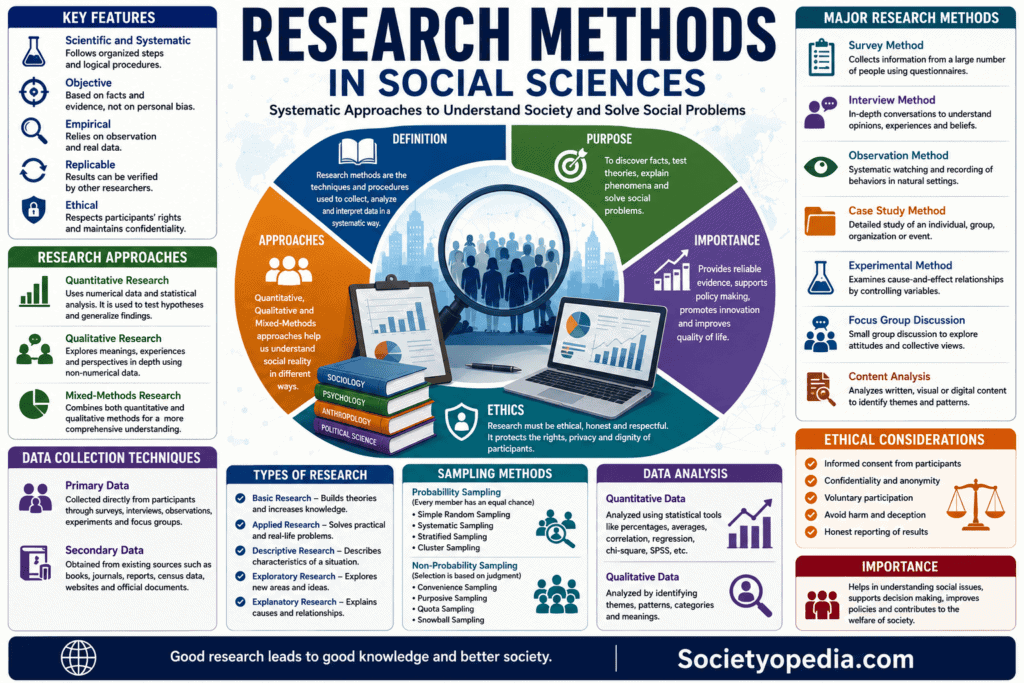
Multistage sampling is an advanced probability sampling technique used when researchers need to study large, geographically dispersed, or complex populations. Unlike simple random sampling, where individuals are selected directly from the entire population, multistage sampling involves selecting samples through multiple stages. In each stage, researchers narrow down the population gradually until reaching the final participants who will provide data.
This sampling technique is widely used in large-scale surveys, national studies, government research, public health investigations, educational assessments, and social science research. It is particularly useful when studying populations spread across large geographical areas where creating a complete list of all individuals would be difficult, expensive, or impossible.
For example, conducting a nationwide survey on educational outcomes among school students may involve selecting provinces first, then districts, then schools, then classrooms, and finally students. Each level represents a different stage of the sampling process.
Multistage sampling combines practicality with scientific sampling principles. It allows researchers to collect data from large populations while reducing costs, travel requirements, and administrative challenges. However, because selection occurs through multiple stages, researchers must carefully design the sampling procedure to reduce sampling error and maintain representativeness.
In social sciences, multistage sampling is particularly important because many populations exist within natural groups such as villages, schools, hospitals, communities, or administrative regions. Instead of selecting individuals directly, researchers can select groups first and then individuals within those groups.
This article explains the concept, definitions, characteristics, types, process, advantages, disadvantages, applications, and practical examples of multistage sampling.

What Is Multistage Sampling?
Multistage sampling is a probability sampling technique in which researchers select samples through two or more successive stages rather than selecting participants directly from the entire population.
In this method, the population is divided into natural groups or clusters, and researchers randomly select samples from each stage until reaching the final sampling units.
The process usually begins with larger units and gradually moves toward smaller units.
For example:
Country → Province → District → Village → Household → Individual
Each step represents a stage of sampling.
Multistage sampling is commonly used when the population is too large or geographically scattered for direct sampling. It provides a practical solution by reducing the complexity of data collection while maintaining the principles of probability sampling.
Definitions of Multistage Sampling
Several research scholars have defined multistage sampling.
Earl Babbie defines multistage sampling as a probability sampling method in which sampling is carried out in successive stages, often involving the selection of clusters followed by individuals.
William Lawrence Neuman explains that multistage sampling involves selecting samples at different levels, moving from larger groups to smaller units.
John W. Creswell describes multistage sampling as a process where researchers select groups or clusters first and then select individuals within those groups.
Ranjit Kumar defines multistage sampling as a sampling technique in which researchers use multiple steps to select the final sample from a large population.
These definitions highlight the main principles of multistage sampling:
- Selection occurs through multiple stages.
- Sampling units become smaller at each stage.
- Random selection is applied at different levels.
- It is suitable for large and complex populations.
Characteristics of Multistage Sampling
Multistage sampling has several important characteristics.
Multiple Levels of Selection
Participants are selected through two or more stages rather than a single selection process.
Probability-Based Method
Random selection is usually applied at each stage.
Suitable for Large Populations
It is highly effective for studying geographically dispersed populations.
Cluster-Based Approach
The population is often organized into natural groups before selection.
Cost Effective
It reduces travel, administrative, and data collection expenses.
Flexible Design
Researchers can design different stages according to the objectives of the study.
Objectives of Multistage Sampling
Multistage sampling is designed to achieve several research objectives.
The primary objective is to make research possible when studying large populations where direct sampling is impractical.
It also aims to reduce the cost and complexity of data collection while maintaining a probability-based selection process.
Another objective is to improve the efficiency of large-scale surveys by organizing populations into manageable groups.
Types of Multistage Sampling
Multistage sampling can be designed in different ways depending on research objectives.
Two-Stage Sampling
Two-stage sampling involves selecting samples through two steps.
In the first stage, researchers select larger groups or clusters. In the second stage, individuals are selected from those clusters.
Example
A researcher studying healthcare access among rural populations may:
Stage 1:
Select villages randomly.
Stage 2:
Select households randomly within those villages.
Advantages
- Simple compared with complex designs.
- Reduces data collection costs.
Limitations
- May have higher sampling error than simple random sampling.
Three-Stage Sampling
Three-stage sampling involves selecting samples through three levels.
Example
A study of school performance may involve:
Stage 1:
Selection of districts.
Stage 2:
Selection of schools.
Stage 3:
Selection of students.
Advantages
- Suitable for very large populations.
- Provides greater organizational flexibility.
Limitations
- More complex planning is required.
Four-Stage or Higher-Level Sampling
Large national and international surveys often use four or more stages.
Example
A national health survey may select:
Country regions → Provinces → Districts → Communities → Households → Individuals
This approach allows researchers to study millions of people efficiently.
Steps in Conducting Multistage Sampling
Multistage sampling involves several systematic steps.
Step 1: Define the Target Population
Identify the complete population that the study intends to examine.
Example: All university students in a country.
Step 2: Identify Sampling Stages
Determine the levels through which selection will occur.
Example:
Universities → Departments → Students
Step 3: Select First-Stage Units
Randomly select larger groups or clusters.
Example:
Select universities from all universities.
Step 4: Select Second-Stage Units
Choose smaller groups within the selected clusters.
Example:
Select departments within selected universities.
Step 5: Select Final Participants
Choose individuals who will participate in the research.
Example:
Select students from selected departments.
Step 6: Collect Data
Gather information using surveys, interviews, or observations.
Step 7: Analyze Data
Use appropriate statistical techniques while considering the multistage structure of the sample.
Advantages of Multistage Sampling
Multistage sampling provides several important benefits.
Practical for Large Populations
It makes research possible when populations are too large for direct sampling.
Reduces Cost
Researchers save resources by focusing data collection on selected clusters.
Saves Time
The method simplifies participant identification and fieldwork.
Flexible Design
Researchers can create sampling stages according to research requirements.
Suitable for Geographical Research
It is highly useful when populations are spread across large areas.
Allows National-Level Studies
Governments and international organizations frequently use multistage sampling for large surveys.
Disadvantages of Multistage Sampling
Despite its advantages, multistage sampling has several limitations.
Higher Sampling Error
Multiple stages of selection may increase the possibility of sampling error.
Complex Planning
Designing and managing multiple sampling stages requires expertise.
Statistical Complexity
Data analysis can be more complicated because of the hierarchical structure of the sample.
Cluster Similarity Problem
Individuals within selected clusters may share similar characteristics, reducing diversity.
Requires Accurate Information
Researchers need reliable information about clusters and population structures.
Multistage Sampling vs Cluster Sampling
| Feature | Multistage Sampling | Cluster Sampling |
|---|---|---|
| Selection Process | Multiple stages | Usually one stage |
| Number of Steps | Two or more | Single selection stage |
| Final Participants | Selected from clusters | Entire clusters may be studied |
| Complexity | Higher | Lower |
| Common Use | Large surveys | Group-based research |
Multistage Sampling vs Stratified Sampling
| Feature | Multistage Sampling | Stratified Sampling |
|---|---|---|
| Population Division | Clusters or stages | Strata based on characteristics |
| Selection | Multiple levels | Random within strata |
| Purpose | Manage large populations | Ensure subgroup representation |
| Complexity | Higher | Moderate |
| Common Use | National surveys | Comparative studies |
Applications of Multistage Sampling
Multistage sampling is widely used in different fields.
In sociology, it is used in national surveys examining poverty, social inequality, migration, family structures, and community development.
In education, large educational assessments use multistage sampling to select schools, classrooms, and students.
In public health, researchers use it for national health surveys, disease prevalence studies, and healthcare access research.
In political science, election surveys and public opinion studies often use multistage sampling to represent diverse populations.
In economics, household income surveys and labor force studies frequently apply multistage sampling.
Government agencies commonly use this method for census-related surveys and national statistical research.
Challenges in Using Multistage Sampling
Researchers using multistage sampling face several methodological challenges. The design requires careful planning because errors at an early stage can influence the entire sample. Selecting appropriate clusters, maintaining randomness at each stage, and applying correct statistical analysis are essential for producing reliable findings. Researchers must also consider the possibility that individuals within selected clusters may have similar characteristics, which can affect the accuracy of results.
Best Practices for Using Multistage Sampling
Researchers should clearly define each sampling stage before beginning data collection. Random selection should be applied whenever possible at every stage to reduce bias. The number of stages should be carefully considered because unnecessary stages may increase complexity and error. Researchers should also use appropriate statistical methods that account for the multistage structure of the sample.
Conclusion
Multistage sampling is a powerful probability sampling technique that enables researchers to study large, complex, and geographically dispersed populations efficiently. By selecting samples through multiple stages, researchers can overcome practical challenges associated with direct sampling while maintaining scientific rigor.
Although multistage sampling requires careful planning and advanced statistical consideration, its advantages make it indispensable for large-scale social surveys, public health studies, educational assessments, and government research programs.
For students and researchers, understanding multistage sampling is essential for designing effective research studies involving large populations. At Societyopedia.com, learning about multistage sampling strengthens research methodology skills and helps scholars select appropriate sampling strategies for complex real-world investigations.
Frequently Asked Questions (FAQs)
What is multistage sampling?
Multistage sampling is a probability sampling technique in which researchers select participants through two or more stages, moving from larger groups to smaller units.
Why is multistage sampling used?
It is used for studying large and geographically dispersed populations where direct sampling of individuals is difficult or expensive.
What are the main types of multistage sampling?
The main types include two-stage sampling, three-stage sampling, and higher-level multistage sampling.
Is multistage sampling a probability sampling method?
Yes. Multistage sampling is a probability sampling technique because random selection is applied during one or more stages of the process.
What is the biggest advantage of multistage sampling?
Its greatest advantage is that it allows researchers to conduct large-scale studies efficiently while reducing time, cost, and logistical challenges.